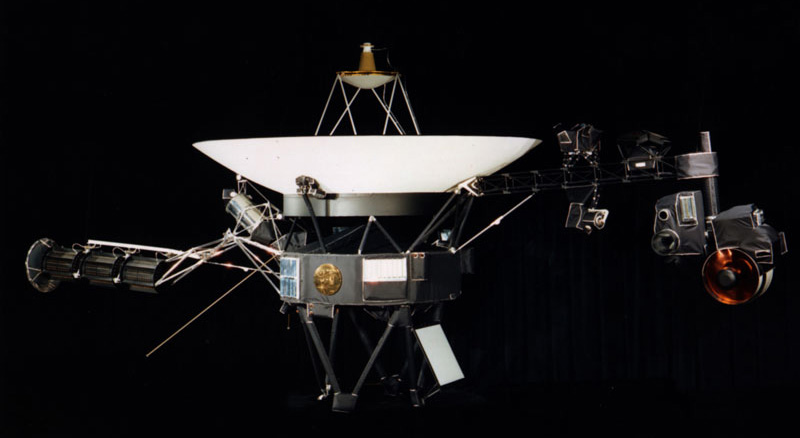
As of today, Voyager 1 becomes the first human-made object to be at least one light-day away from Earth. Launched on September 5, 1977 (16 days after Voyager 2 launched, but Voyager 1 is moving faster and has traveled farther, as was planned from the beginning) from Cape Canaveral, Florida, Voyager 1’s original mission was to visit Jupiter in 1979 and Saturn in 1980. In 1998, Voyager 1 became the most distant spacecraft, traveling faster than and thus exceeding the distance record then owned by Pioneer 10. It has continued transmitting data from its dwindling suite of instruments (shut off one by one as the power available to them drops, due to the age of its three plutonium-238-powered radioisotope thermoelectric generators [at the time of its launch, they were generating about 470 watts of electric power, and though plutonium’s half-life is 87.7 years, they’re expected to continue generating usable power until some time in the 2030s]). But still, it continues to travel out of the solar system and into interstellar space at a speed of 37,844.49 miles per hour.
One light-day, for those who have trouble grasping it, is the distance it takes light to travel in one day. Light, that nearly instantaneous thing (as anyone who ever flipped the light switch and then tried to get into bed before it became dark knows) is actually not instantaneous. It travels (in a vacuum) 299,792,458 meters per second, which is 186,282.4 miles per second. Thus, one light-second is 186,282.4 miles. One light-minute is 11,176,944 miles. One light-hour is 670,616,640 miles. And one light-day is 16,094,799,360 miles. That’s slightly more than sixteen billion miles. (And for those of you looking ahead, one light-year is 5,878,625,446,624.099 miles. Voyager 1 will be traveling another 17,732.4 years before it’s one light-year from Earth.)
The next star Voyager 1 is expected to encounter is Gliese 445, a star in the constellation Camelopardalis, in about 40,000 years. At the time, Voyager 1 will be about 1.6 light-years from Gliese 445, which is currently about 17 light-years from Earth. But the star is moving toward us very quickly, so that when Voyager passes “near” it, it will be only about 3.5 light-years from Earth.
All of these big numbers are occasioned mostly by Voyager 1, but also by my continuing work on my next book, Numbers: They’re Just Too Darn Big! (the companion to the talk I gave in Chicago last month). I’ll let you know when it’s finished and ready.