The Trumpian wing of the Republican Party has been doing an excellent job of forcing me into the arms of the Democratic Party. I fear their hatred, their racism, their dishonesty, their graft, and their deification of Donald Trump. So for the last several elections, I’ve voted straight Democratic tickets.
But now I’m watching the Socialist wing of the Democratic Party doing their best to force me away from the Democrats. It’s on fewer issues, but perhaps that’s only because they are the newer player on the stage, and haven’t had the time to poison as many wells. There’s the outrageous “abolish police” position, and their drives to nationalize certain industries. And there’s more.
I’m not religious—don’t attend temple, don’t keep kosher—but I am socially or culturally Jewish. And every time the Democratic Socialists open their mouths, I feel even more marginalized, even more a target of their outright hatred. A few weeks ago, New York City Mayor Zohran Mamdani threatened to arrest Israeli Prime Minister Benjamin Netanyahu. Netanyahu is not accused of committing any crimes in New York City (though the ICC has an asymmetric view of the events of October 7, 2023, and its aftermath). So why is Mamdani making such threats? Who is the audience he’s playing to? His comments certainly don’t represent this citizen of New York City. And now, he’s decided the Mayor’s Advisory Committee on the Judiciary should have no Jews on it.
And most recently, DSA spokesmodel Hasan Piker is certain that whoever wins the Democratic nomination for president in 2028 will oppose Israel and embrace Hamas and the Palestinians. (CNN on July 31 played a clip of his comment, taken from an interview that is scheduled to air August 2.)
The Democrats seem hell-bent on losing, and I’ve written about it before. In 2018, it was throwing out Senator Al Franken, because he’d been in a questionable photo years before he was elected to the Senate. In 2021, it was the fight with the new progressives demanding everything instantly, and threatening to derail the entire Joe Biden presidency if they didn’t get everything they wanted immediately. In 2022, the Democrats were yelling at Senators Manchin and Sinema to abolish the filibuster rule (they should be venerating them today for not giving in). Today, the Democrats have been handed the future on a platter: Trump’s reputation is at historical lows; the Trump-Iran War is keeping prices and inflation high; the Trump-Epstein Files still have not been released; his chief domestic priority seems to be plastering his name and his tacky taste on everything in Washington; and the list goes on. A Democratic sweep of government offices would require only keeping their heads down and doing their jobs. Instead, they’ve let their Socialist wing come rampaging in, doing nothing to attract new voters, but doing everything to turn off Democratic stalwarts, the centrists.
There have always been racists in this country. But when Trump came to power, the racists felt emboldened. They became comfortable proclaiming their racism publicly. And there have always been anti-semites. But with the rise of the Democratic Socialists, they, too, are no longer ashamed.
Several of my friends have or will soon move out of the country because they fear a Trumpian future. Each of those moves saddens me, because I’ve held the firm opinion that the country can be saved, and is worth fighting for. But now, listening to the Democratic Socialists, I’m wondering if my friends fleeing the country are actually the smart ones.
The Republicans have accepted the Trumpians and their vitriolic hatred for everyone who isn’t them. Now the Democrats are accepting the Socialists and their hatred of Jews. Is there any place left for me and mine?
I’ve been rewatching The West Wing (and dreaming of politicians we can all admire), while also remarking on the pure fantasy of it all. We hear opinion polls all the time: the party in power is supported or opposed, the person in office has favorables and unfavorables, and so forth. But the point of it all—regardless of the polls, regardless of the people—is that the American electorate, by and large, is never happy with the party in the White House.
Specifically, we have buyer’s remorse, and almost always have. For evidence, I point to the number of times we’ve elected a new president who is a member of the same party as the outgoing president. That number is small.
From 1800 to 1828, we had four straight presidents who were members of the Democrat-Republican party, but there really wasn’t much of an opposition party at that time. Indeed, the election of 1820 had only one candidate: sitting president James Monroe was re-elected with more than 78% of the popular vote and 231 of the 232 electoral votes cast (the Federalist party, with no named candidate, got 19% of the popular vote). Thomas Jefferson was elected in 1800 and 1804, James Madison in 1808 and 1812, Monroe in 1816 and 1820, and John Quincy Adams in 1824.
In the election of 1836, Democrat Andrew Jackson was retiring after two terms, and his second vice president, his chosen successor, Martin Van Buren, won the election, holding the White House for the Democrats.
The next time that happened was in 1856, when Democrat Franklin Pierce lost his bid to be nominated for a second term, but the Democrat who won the nomination, James Buchanan, won the presidency as well.
The election of 1876 was very close. As Republican Ulysses Grant was retiring after two terms, Republican Rutherford B. Hayes was in a very close race with Democrat Samuel J. Tilden. Indeed, Tilden won the popular vote, but the Electoral Commission awarded enough of the disputed electoral votes to give Hayes the electoral college, 185 to 184. In 1880, Hayes kept his pledge and did not run for a second term. Instead, Republican James A. Garfield won the election to succeed him (and was assassinated six months into his term of office).
Republican William McKinley was elected in 1896. His first vice president, Garrett Hobart, died in 1899, and in the election of 1900, McKinley was re-elected with vice president Theodore Roosevelt. McKinley was assassinated in late 1901, and Roosevelt succeeded. Roosevelt then won his own term as president in 1904. In 1908, Roosevelt stepped aside, and his chosen successor, Republican William Howard Taft was elected. In 1912, Roosevelt would split from Taft, run against him, and give the election to Democrat Woodrow Wilson.
In 1920, Republican Warren Harding was elected. He died in 1923, elevating Vice President Calvin Coolidge to the presidency. Coolidge won his own term in 1924, and chose not to run for another term in 1928, so Republican Herbert Hoover was elected to succeed him.
In 1988, after two terms of wide support, Ronald Reagan was forced to retire from the presidency under the terms of the 22nd Amendment, and his vice president, George H.W. Bush, was elected to succeed him.
To sum up, we’ve chosen a person of the same political party to succeed a departing president only in 1808, 1816, 1824, 1836, 1876, 1880, 1908, 1928, and 1988. Nine times. That’s it. (That is also ignoring Vice Presidents John Tyler and Chester Arthur [who weren’t elected to their own terms] and Harry Truman and Lyndon Johnson [who were], who first succeeded to the office upon the deaths of their predecessors).
We chose to change parties in the elections of 1800, 1828, 1840, 1844, 1848, 1852, 1860, 1868 (Abraham Lincoln’s second vice president, Andrew Johnson, was not a member of his Republican party), 1884, 1888, 1892, 1896, 1912, 1920, 1932, 1952, 1960, 1968, 1976, 1980, 1992, 2000, 2008, 2016, 2020, and 2024.
I’m not predicting anything for 2028; you can draw your own conclusions.…
After being forced to kill in order to protect their widowed mother, three brothers escape Mafia-controlled Sicily to the New World.
Life for immigrants in America during the second decade of the 1900s is difficult and often harrowing, but that’s the reality into which Peter, John, and Angelu Donatello are thrust when their ship docks in Philadelphia. As Peter tries to make his way in this new land through honest hard work, John’s talents—many learned fighting in the Great War—lead him to the seamier, but potentially more profitable, underworld. And all the while, Angelu, the youngest brother and a true innocent, struggles to just find a place for himself in a world he can never truly understand.
Prohibition may make criminals of honest men, but it also allows poor immigrants to mingle with the upper classes; the Donatellos among them. Yet, despite war and crime, marriage and loneliness, honor and betrayal, the brothers, each in their own way, cling to their creed of Supra tuttu la famigghia: Family is all.
Eventually, everything will lead them back to Sicily, to a confrontation with the forces that have shaped their lives, and to a heart-wrenching reconciliation.
Reminiscent of John Jakes’ Bicentennial series, The New Americans by Tony and Ty Drago is a wonderfully moving saga. The genesis of the story is itself a tale: in his final weeks, Tony Drago tape-recorded what his son Ty thought were simple reminiscences. It was only in the years following Tony’s death, after Ty became an established novelist, that he listened to the tapes and realized his father had left him, not a family history, but rather an emotional novel of immigration, rebirth, and growth. Milherst Publishing is honored to bring this story to the world.
The New Americans, by Tony & Ty Drago, has been released in six monthly installments, as both trade paperbacks and ebooks.
1: Fuggitivi. $10.99, 182 pages, ISBN 978-1-5154-5842-5. February 3, 2026. 2: Strangers in Paradiso. $10.99, 186 pages, ISBN: 978-1-5154-5843-2. March 3, 2026. 3: The Pursuit of Felicita. $10.99, 184 pages, ISBN: 978-1-5154-5844-9. April 7, 2026. 4: The Philly Crew. $12.99, 230 pages, ISBN: 978-1-5154-5845-6. May 5, 2026. 5: A Leaf in the Turning. $12.99, 224 pages, ISBN: 978-1-5154-5846-3. June 2, 2026. 6: The Prodigal Sons. $10.99, 170 pages, ISBN: 978-1-5154-5847-0. July 7, 2025.
Book #6: The Prodigal Sons
Having returned home to Sicily alone, Angelu’s letters to his brothers in Philadelphia mysteriously cease. Only later is John able to ferret out the truth: that their mother fell victim to cruel betrayal, and died of a broken heart.
Traveling back to Sicily to exact vengeance will not be easy, nor will it be happy. But such a vendetta cannot be ignored. So, at long last, the brothers who fled Sicily as frightened young boys return as wronged men, determined to find justice, even if they have to dispense it themselves. But justice, if such a thing exist, carries a heavy cost.
This is the thrilling conclusion to The New Americans saga.
Unwritten rules are fine, so long as everyone complies with them. But then a person or group comes along—such as the Trump Crime Family—that requires us to put actual words to these unwritten rules to turn them into written law.
And after years of Congressional representatives talking about preventing themselves from trading stocks while not actually doing anything, I think it’s time we the people proposed the law we want. Therefore, as my contribution to the discussion, I offer…
A Law Delineating Emoluments Prohibitions that Were Previously Understood but Unwritten
Section I: People Subject to This Law 1. Elected and appointed members of the House of Representatives and the Senate. 2. Members of the Supreme Court. 3. The President and Vice President of the United States. 4. People appointed by the President, whether confirmed by the Senate or not. 5. People hired or appointed by, or who in the normal course of business report directly to, anyone in lines 1, 2, 3, or 4. 6. People hired or appointed by, or who in the normal course of business report directly to, anyone in line 5. 7. Immediate family members of anyone in lines 1, 2, 3, 4, 5, or 6.
Section II: Prohibited and Required Actions of People in Section I. 1. All people covered by this law are prohibited from buying or selling stocks, bonds, or any other form of ownership of any company, whether publicly traded or privately held. 2. All people covered by this law are required to place all assets in a blind trust. 2.a. Assets with a combined value of less than 50% of the mean personal annual income of the United States may be exempted from this requirement. 2.b. A primary residence may be exempted from this requirement. 2.c. Covered people shall have 30 days from notice of election, appointment, or hiring to a position listed in Section I in order to complete this requirement. 3. All people covered by this law are prohibited from communicating what would be considered “insider information” about any government or business activities to any person or people for financial benefit.
Section III: Penalties for Failure to Comply with This Law 1. Stocks, bonds, or other forms of ownership purchased are subject to forfeiture—in their entirety—to the United States Treasury General Account. 2. Proceeds from sales of stocks, bonds, or other forms of ownership are subject to forfeiture—in their entirety—to the United States Treasury General Account. 3. Assets with a combined value greater than 50% of the mean personal annual income of the United States held outside of a blind trust are subject to forfeiture—in their entirety—to the United States Treasury General Account. 4. Instances of communicating insider information (see Section II, 3) shall be fined at a rate equal to the potential gain enjoyed by the recipients of such communication.
Section IV: Duration of These Requirements 1. People listed in Section I shall be subject to this law during the entire time they hold one of the offices listed in Section I, and for 180 days after leaving such office. 2. Those people in office when this law is adopted shall have 30 days to comply with all the provisions herein.
RealClear Polling doesn’t show a Congressional approval rating above 40% in the last 15 years. In the short term, Ballotopedia agrees. Gallup has Congress’s job approval rating in the teens.
In other words, everywhere we look, nobody likes what Congress is doing or how they’re doing their jobs. Every news story using those numbers predicts a massive change in Congress at the midterm election, shifting control to the Democratic party, and watchers hope they’re right.
But what none of those polls and none of those pundits are doing is looking at four hundred and thirty-five individual campaigns for four hundred and thirty-five individual seats in the House of Representatives.
And that’s why I think a lot of people looking forward to that massive change are going to be very disappointed next January 3, when the 120th Congress is seated. It’s very difficult to do legitimate polling on such a granular level, but the way our government is put together, combining the results of such tiny polling samples is the only way to get a legitimate estimation of what is going to happen. Because while the sentiments of 55%, or 60%, or 70% of the voting public in the US may be with the Democrats, that doesn’t matter. What matters is which candidate gets the greater number of votes in the California 41st, and the Texas 32nd, and the Florida 9th, and the New York 15th, and on and on and on. Each district, by itself, in an election of several hundred thousand people, upon which the opinions of 99.8% of the population matters not one whit.
Congressional approval ratings are always low. People never like what Congress—as a whole—is doing, or its direction. If that were the only thing that mattered, we’d see a tidal wave of electoral defeats among Representatives every two years. But we don’t. We don’t see that tidal wave, and we won’t as long as we have a body made up of representatives by geography who have chosen the boundary lines of their own districts in order to guarantee their re-election. And we, the voters, always vote to re-elect our own Congressional representatives.
As Ballotopedia told us, in the election of 2024, fifteen Representatives running for re-election were defeated in primary or general elections. Further, they say, since 2014 (six elections), a total of 125 House incumbents were defeated: an average of 21 per election (remember, out of 435 seats).
That’s the reason we keep getting the same non-functional Congress we all hate not doing what we want: because we only vote for our own representative. It doesn’t matter what I think of the Speaker—who lives in Louisiana. And it doesn’t matter what I think of the minority leader—who lives in the next district over from mine in Brooklyn. Neither does my opinion of any of the 432 other members of the House matter. I only have a say in who will represent New York’s 9th district. And the two major political parties have done such an excellent job of choosing their voters through political gerrymandering that almost none of the 435 districts have any chance of changing the party of the person who represents them.
A year ago—in April of 2025—Fair Vote said that 81% of the House seats were already decided… for the 2026 election! And this is not surprising or new. It’s been going on for decades.
So when everyone around me expresses optimism for change following the election of 2026, I’m the Eeyore. I’m the one who is not looking forward to the results, because I don’t expect very much, if anything, to change. Unite America claimed that only 69 of the seats were competitive elections in 2024. We’ve seen absolutely no reason to think it will be any different this time around. https://www.uniteamerica.org/articles/research-brief-why-are-most-congressional-elections-uncompetitive-2
And this is one of those times that I don’t have a solution to propose. We’re stuck. We’ve let the parties gerrymander the country too damn far, and we can’t find a way out of it. So as much as I hate that Congress has abdicated its responsibilities; as much as I hate that Congress—even if its members wanted to—can’t do anything it should; as much as I hate the political gridlock caused by extreme politicians who only campaign in the primaries because they don’t have to compete in a general election… I fear we’re stuck with it all until we can find a way to tear down walls of power that the Democans and Republicrats have built for themselves.
Should I just give up, or should I continue to cringe when I hear people using the word “fulsome” when they mean “full” or “large”? Because it grates on my ears. And yes, before I looked up this source, I hadn’t realized that the modern usage of just meaning “full” but with more syllables is actually the original meaning from the 1200s.
Dictionary.com offers the following on the word fulsome:
adjective
offensive to good taste, especially as being excessive; overdone or gross. Example: fulsome praise that embarrassed her deeply; fulsome décor.
disgusting; sickening; repulsive. Example: a table heaped with fulsome mounds of greasy foods.
excessively or insincerely lavish. Example: fulsome admiration.
encompassing all aspects; comprehensive. Example: a fulsome survey of the political situation in Central America.
abundant or copious.
adjective
excessive or insincere, esp in an offensive or distasteful way Example: fulsome compliments
[not standard] extremely complimentary
[informal] full, rich or abundant Examples: a fulsome figure a fulsome flavour fulsome detail
[archaic] disgusting; loathsome
Note: In the 13th century when it was first used, fulsome meant simply “abundant or copious.” It later developed additional senses of “offensive, gross” and “disgusting, sickening,” probably by association with foul, and still later a sense of excessiveness: a fulsome disease; a fulsome meal, replete with too much of everything. For some centuries fulsome was used exclusively, or nearly so, with these unfavorable meanings. Today, both fulsome and fulsomely are also used in senses closer to the original one: The sparse language of the new Prayer Book contrasts with the fulsome language of Cranmer’s Book of Common Prayer. Later they discussed the topic more fulsomely. These uses are often criticized on the grounds that fulsome must always retain its connotations of “excessive” or “offensive.” The common phrase fulsome praise is thus sometimes ambiguous in modern use.
Is this all far-fetched, doom-and-gloom, dystopian theorizing? Probably. I hope certainly. Nevertheless, it is a topic of conversation which keeps cropping up, so…
I know how Donald Trump is going to attempt to stay in office beyond the end of his term. It’s Section 3 of the 20th Amendment. Section 3 talks about who shall become President or act as President (two different things) if there is no President elect or if the President elect is not qualified to serve as President. The final clause of that Section reads “the Congress may by law provide for the case wherein neither a President elect nor a Vice President elect shall have qualified, declaring who shall then act as President, or the manner in which one who is to act shall be selected, and such person shall act accordingly until a President or Vice President shall have qualified.” In other words, if the election is somehow prevented from occurring—and despite Article II, Section 1, and Amendment 20, Section 1—I think Donald Trump’s sycophants are relying on this phrase to enable the Congress to “select” him to “act” as President “until a President or Vice President shall have qualified” (by being elected).
This revelation came while I was researching the essay I thought I was going to write, noting that, regardless of what Trump and the Trumpians try to do to the election of 2028, a lack of an incoming President does not enable the current President to remain in office.
I was going to quote Article II, Section 1 of the Constitution, which says the President “shall hold his office during the Term of four Years”—thus limiting the time the President serves to four years, whether a successor has been elected or not.
I was going to go on to the 12th Amendment, which says “…no person constitutionally ineligible to the office of President shall be eligible to that of Vice-President of the United States.” Thus preventing the President from becoming Vice President, only to succeed to the Presidency with the removal of the new President.
Then comes the first Section of the 20th Amendment: “The terms of the President and the Vice President shall end at noon on the 20th day of January, and the terms of Senators and Representatives at noon on the 3d day of January, of the years in which such terms would have ended if this article had not been ratified; and the terms of their successors shall then begin.” Repeating and emphasizing the Article II quote above: the President’s term ends, regardless of whether or not there is a successor waiting.
And, of course, the first Section of the 22nd Amendment: “No person shall be elected to the office of the President more than twice, and no person who has held the office of President, or acted as President, for more than two years of a term to which some other person was elected President shall be elected to the office of the President more than once.”
But then I stumbled upon Section 3 of the 20th Amendment, as I said above. That’s the “well, there may be a way around the Constitution” that the most ardent Trumpians have been hinting at. It’s fairly simple, if we assume they can somehow prevent the next Presidential election. And one doesn’t have to be too creative to figure out ways to do that: declare a state of emergency, ban gatherings “for public safety” during the first week in November, so that an election cannot be held (that’s why they keep pushing to get rid of mail-in ballots and early voting; so that there will be no ballots to count). Or, perhaps easier, would be to look at the fifth paragraph of Article II, Section 1: “The Congress may determine the Time of chusing the Electors, and the Day on which they shall give their Votes; which Day shall be the same throughout the United States.” Such an emergency declaration could simply prevent the Electors from gathering to cast their votes in December. No electoral votes, therefore nothing to count on January 6, and no President elect. Blocking that, rather than the general election, would mean that there would still be a new Congress elected who would then be charged with selecting that person who shall act as President.
Therefore, Congress needs to adopt a new law, by a veto-proof margin, saying “No person who is ineligible to be elected President may act as President.”
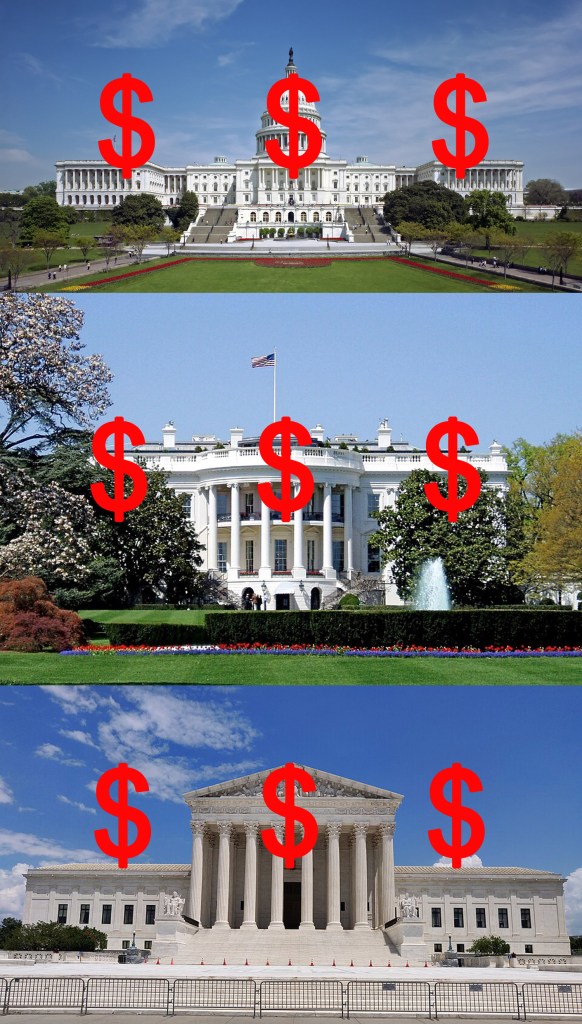
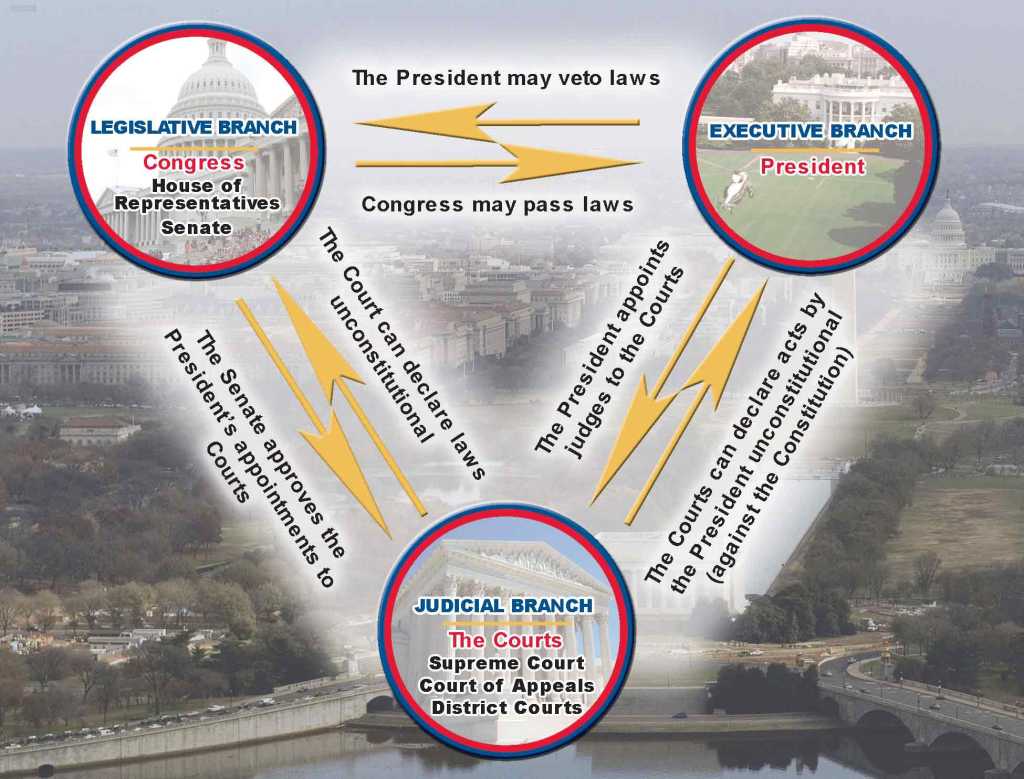
As angry as I am with many of President Trump’s statements and actions—some of which are immoral and unworthy of the presidency, and some of which are demonstrably criminal—my ire today is reserved for Congress and the Supreme Court. Part of the genius of our Constitution is that it organized a government that is not dictated solely by one person or one body, but rather has three co-equal branches, each of which has certain powers over the other two, and other responsibilities to the other two. As we learned in elementary school: the Legislative branch (Congress) makes the laws, the Executive branch (the President and his departments) enforces the laws, and the Judicial branch (the Supreme Court) interprets the laws (tells us what they mean, and if they are in keeping with the Constitution).
The President appoints the members of the Supreme Court, but the Senate has to agree. The President spends the money, but only according to the budget that Congress creates. Congress writes the laws that the President can veto or accept, but the Supreme Court can say “no, that law is not Constitutional.” Congress can remove the President and the members of the Supreme Court for “high crimes and misdemeanors.”
According to Article I of the Constitution, Section 8, the powers of Congress include the power to lay and collect taxes, duties, imposts and excises; to regulate commerce with foreign nations; to declare war; “to provide for calling forth the Militia to execute the Laws of the Union, suppress Insurrections and repel Invasions”; and a slew of others.
Article II, Section 2, lists the powers of the President, including serving as the Commander in Chief of the Army, Navy, and Militia, “when called into the actual Service of the United States”; making treaties, appointing ambassadors, Supreme Court judges, “and all other Officers of the United States,” all “by and with the Advice and Consent of the Senate”; and other things.
Article III vests “the judicial Power of the United States” in the Supreme Court and other inferior courts. Section 3, interestingly reads “Treason against the United States, shall consist only in levying War against them, or in adhering to their Enemies, giving them Aid and Comfort.”
This system of checks and balances among the three co-equal sections of the United States government worked pretty well for a long time. The relative power of the executive and legislative branches waxed and waned over the decades, but all three branches maintained their shared powers through the strength of their leaders over the years. Congressional leaders have worked with and against presidents, the Supreme Court has allowed and denied laws over the years, but always, the holders of those offices upheld the power of their position, the importance of their branch, and kept the tripod standing.
Lately, the tripod has collapsed, because two of those legs have been allowed to weaken before the onslaught of the third. Obviously, this collapse has been going on for longer than just the last decade, but no one looking at Ronald Reagan’s relationship with Tip O’Neill ever thought either one of them was subservient to the other. Since that time, however, we’ve been stuck with a series of ideologues who realized that the way to enforce their partisan will long beyond their service would be to enable a collapse of the system of checks and balances. Thus, Mitch McConnell’s lies and machinations have unbalanced the Supreme Court: in early 2016, he told us the Senate could not appoint a new Supreme Court justice during an election year, and kept Antonin Scalia’s seat vacant for 11 months, until Donald Trump’s election. Four years later, McConnell told us to ignore his four-year-old words, and that the Senate had to fill a vacant Supreme Court seat when Ruth Bader Ginsburg died a month and a half before the election of 2020. That’s the same Mitch McConnell who, on January 6, 2021, called Donald Trump “practically and morally responsible” for the attack on the Capitol, but then voted to acquit Trump of those charges at his second impeachment. McConnell is no longer the leader of the Senate, but his successor, John Thune, has not shown himself to be any more of a leader. His every utterance proclaims his subservience to the office of the President.
Chief Justice John Roberts has used his ideological majority of the Court to grant the president nearly complete immunity for anything he may do during his term of office, since the president in question supports his views. He also can’t imagine any of our recent or potential presidents hailing from the Democratic party ever running so far beyond the pale as Donald Trump has, so he’s not worried about karma coming back.
And now we have the Speaker of the House, Mike Johnson, who has completely subsumed his authority to Donald Trump’s will. He has decided the House shouldn’t actually be conducting any business, because the president is happier to have the government shut down, so he can rampage however he wants.
The Supreme Court, unfortunately, is beyond our power to correct in the near term. The way the Justices are chosen requires waiting for those currently in office to leave in order to replace them. And let’s face it, there doesn’t appear to be anyone even on the horizon with the strength of John Marshall or the moral fiber of David Davis.
The make-up Congress, however, is—at least, theoretically (but see my several previous pieces on Gerrymandering)—something we can affect. I say it is time to elect Senators and Representatives who will stand up, not necessarily for me and my views, but for the strength of the Congress. Congress needs to restore itself to its role as a co-equal branch of the government.
Far too often, among the Republicans and Trumpians in the Congress, we see people who are far more interested in doing what Trump wants so that he won’t attack them. Can they possibly be proud of their service? Or are they merely keeping their seats warm? Liz Cheney stood up for right over party, and was punished for it by losing her seat. But as much as I disagree with many of her views, she earned my respect. The problem was, she was one voice in a vast sea of the voiceless, and thus, easy to target. The other members of Congress need to find their voices, to stand up, not to keep knuckling under.
I may not have agreed with their policies or their actions, but did anyone ever doubt the Congressional allegiance, the strength, the patriotism, of prior Senate Majority Leaders such as Robert Byrd, Mike Mansfield, Everett Dirksen, Lyndon Baines Johnson, or Henry Cabot Lodge? Similarly, will the House of Representatives ever feel the need to remember the service of Mike Johnson as it does Tip O’Neill, Carl Albert, Sam Rayburn, or Nicholas Longworth?
Donald Trump has gone off the rails. He cares nothing for the Constitution, law, or tradition, and is interested only in lining his own pockets and glorifying his own name. But if the rest of the government was functioning as it should, the damage Trump could inflict would be minimized. But with the Supreme Court saying only “Yes, sir,” while Congress’s leaders say “We’ll do whatever Trump wants,” our government, our nation, is in danger.
And yes, I know I’ve not mentioned the Democratic leaders. Chuck Schumer and Hakeem Jeffries, too, are falling down on their jobs. They’re doing what they can in their minorities, but it sure feels like they could be doing, could be saying, more. And their younger colleagues, the flaming liberal branch of the party who don’t recognize that good government is negotiation, compromise, and not getting everything? They, too, are not doing us any favors.
Term limits are not, and never have been, the answer. But whether you vote Republican or Democratic, I urge you—in the strongest terms possible—to vote for someone who wants to serve in Congress, not someone who wants only to kowtow to or attack the president.
To those comparing Donald Trump’s wanton destruction of the East Wing of the White House to the complete rebuild of the entire building during Harry Truman’s administration, you’re using a false equivalency.
In January 1948, the Commissioner of Public Buildings warned of the “imminent collapse” of the second floor of the mansion. In February, the presidents of the American Institute of Architects and of the American Society of Civil Engineers made a structural survey of the safety of the White House, and concluded that the second floor structure was a fire hazard and was in danger of collapse. In September, the White House Architect announced that the White House’s “structural nerves” had been damaged, and the second floor would need to be rebuilt. He estimated the cost of repairs might be $1 million (Congress had previously approved more than $800,000 for repairs). On November 3, 1948 (the day after election day), the Federal Works Agency told the president he needed to vacate the White House so critical repairs could be effected. On November 7, the news was made public, and the Trumans left town for two weeks. They returned to Blair House, which would serve as the president’s home for most of his second term.
During 1949, the architectural and engineering designs were finalized. The plans were to completely replace the interior of the building, expand the third floor, add more basement levels, and more. Congress created the Commission on the Renovation of the Executive Mansion in March, granting the commission the authority to act on behalf of the federal government in the execution of the project, and late in the year, authorized funding of $5.4 million for the project to reconstruct the White House while keeping the exterior walls in place.
In September 1949, the Commission invited bids from general contractors, and by October, had received 15 bids ranging from $100,000 to $950,000 (that’s in addition to the costs of labor and materials). They went with low bidder John McShain, Inc, who reportedly lost about $200,000 on the project.
Work started in December 1949, and after four months, the removal of historic material slated for salvage was complete. By the middle of 1950, the walls enclosed an empty space, and then a brand-new interior was built, from foundations up.
The Truman family returned to the White House on March 27, 1952.
Currently, the White House is managed by the National Park Service (NPS) but operated by the Executive Office of the President (EOP). Proposed changes to the building are supposed to begin through the Office of the Curator and the White House Facilities Management Division. The NPS, operating under the Presidential Residence Act and National Historic Preservation Act (NHPA), must review all alterations for compliance with the NHPA. This requires assessing potential impacts on historic and cultural resources in consultation with the Advisory Council on Historic Preservation (ACHP) and the DC State Historic Preservation Office (SHPO).
The National Capital Planning Commission (NCPC) evaluates all major federal projects in the National Capital Region, including work on the White House grounds, for design, planning, and environmental impacts under the National Environmental Policy Act (NEPA). Public comment and design reviews are part of that process.
The US Commission of Fine Arts reviews and advises on the design and appearance of any exterior modifications to the White House or its grounds.
After approvals from NPS, NCPC, and CFA, the Office of Management and Budget (OMB) and the White House Chief Usher / Facilities Management Office finalize funding, scheduling, and logistics. All of that is required before any major construction or demolition of the White House.
Apparently Trump—in his roles of dictator and general contractor (how much is he skimming from the cost of this project?)—ignored all of that.
The Republican redistricting scheme currently causing so much consternation in and toward Texas gives me hope. Not, perhaps, in the way you might think. But in it, I see the seeds of potentially, maybe, if if if, a solution to the gerrymandering that has plagued this country for two centuries.
Allow me to explain.
I’ve been railing against gerrymandering for years. Gerrymandering is the drawing of boundaries on political districts in order to group blocks of voters together, either to increase the power of one group, or to decrease the power of another. Sometimes it is used to increase the chances that a member of a minority group can win an election. But far more often these days, it is used to cement a political party’s hold on a district, to make it “safe.” (For the problems safe districts cause, see my previous writings.)
In normal times, Congressional district boundaries are redrawn every ten years, after the decennial census data is received, so that the districts accurately represent where the people live and what those people want. These are not normal times.
Governor Abbott of Texas, kowtowing to President Trump’s request, is urging the Texas legislature to redraw the state’s Congressional map right now, half-way through a decennial period, in order to concentrate the Democratic minority voters into fewer districts, and thus give the Republicans, potentially, three to five more seats in the House of Representatives. Democratic members of the Texas legislature have left the state, in order to prevent the legislature from reaching a quorum, which would—at least, in theory— prevent action on the proposal. But they’ve tried such a quorum-break in the past; it has not been successful. I doubt it will be this time, either.
So we have to accept the reality that Texas is about to further marginalize their Democratic population and flip five of their seats in the House to the Republican party.
Governor Newsom of California has been making noises about attempting the same scheme in his state, which would flip several seats from the Republicans to the Democrats. There’ve been whispers elsewhere—such as Governor Hochul in New York—that other states might do something similar if Abbot and Trump get their way in Texas. The problem I foresee is an ongoing character flaw of the Democrats: the party insists that it must be holier than thou, purer than thou, that it will play be the rules even when their opponents have shown absolutely no compunction about violating those rules. While doing so may give them a moral victory, it will inevitably lead to an actual loss. To my mind, in these cases, the Democrats are those crying “life isn’t fair.” No, it isn’t. Everyone should follow the rules. Everyone should be a good, moral, decent human being. Everyone should be more interested in the good of us all than in our individual results.
But not everyone is.
We don’t need Governor Newsom and Governor Hochul warning “don’t do it or we might do something, too.” We need him and his fellow Democratic governors to act! Today! We need them to implement precisely the schemes Abbot and the Texans are planning. We need to gerrymander the country to a fare-thee-well, to legislate out of existence those last 40 competitive seats in the House.
Because then, and only then, will we all see just how egregious the gerrymandering has become. Only then will it be brought to the Supreme Court. And to my mind, regardless of the Court’s political slant, there is no way it can allow such outrageous diminution of the minorities to survive. In such a case, I think, the Supreme Court will only be able to rule that the gerrymandering violates the people’s rights to be fairly represented, and that political maps must be drawn in a fair, impartial manner.
(Yes, I know, I’m an idealist. It may not work out that way. But I don’t see any other way to fix the mess we’re in.)
And if, IF my dream comes true, may I humbly suggest new legislation regarding how districts are drawn? A fairly simple test, actually:
No Congressional district, when drawn on a Mercator projection map, shall be drawn in such a way that a straight line drawn on that map shall be able to cross into the district more than once. That is, except in cases where the state border itself violates this dictum.
I don’t expect any of this to happen. I expect the Democrats will continue to purge their own ranks, as they threw out Al Franken. I expect they’ll yell and whine and do nothing, while Texas rejiggers their Congressional map, and that the election of 2026 will result in a Trumpian increase in the House, and we’ll continue bitching and moaning about their self-serving actions for years to come.
But wouldn’t it be nice if I was wrong, and we could actually make things better?