I heard part of this clip on CNN, and had to find the whole thing. It’s eerily similar to “Wideload,” the story I co-wrote with Allen Steele. The real-world version is a mother and daughter in Kentucky who refused to sell their farmland in order for it to be replaced with a data center. Our story was in Resistance, the anthology I edited earlier this year.
Author: ianrandalstrock
Word Choice
I recently saw a post on Facebook that I thought was a joke, perhaps part of the manosphere, talking about how we’ve perhaps finally learned to call women women, rather than girls, but at the same time, men have become boys. I thought it was just amusing or silly grumbling, and forgot about it as soon as it scrolled.
But I just heard it in the real world. Stephanie Ruhle, the host of Money, Power, Politics on MSNOW, just ended one segment by saying, “I’m only letting these boys leave the group chat now because I have a great woman coming up to talk about the unrest in France.” I’m not sure if she really emphasized the word “woman,” or if that emphasis was only in my mind (and she’d shown no disrespect to the two male guests), but it immediately recalled that post.
I try not to get worked up over specific words — other than those which are simply the wrong words (see my earlier commentaries on “literally,” “fulsome,” and more) — and I really couldn’t care less if you call me a man or a boy or a guy or whatever. I just found it worthy of comment that apparently it is actually happening, and I hadn’t noticed.
Presidential Ships
As it frequently does, research on one thing took me down a deep rabbit hole elsewhere; in this case, into ship naming. For another piece I’m working on, I looked at President Donald Trump directing a new class of battleships (which apparently no one but him wants) to be named for him. It’s like he has no concept of history or tradition: first and foremost, that classes of ships are actually named after the first ship of the class. But to name a ship or a class after himself is… well… classless.
In the early days of the republic, it was actually fairly common to name US Navy vessels after living people.
There were at least fourteen US Navy ships named after the first president, George Washington (1732–99; he was president from 1789 to 1797), at least five of them while he was still alive (several, indeed, simultaneously):
- USS Washington (1775) was a schooner named Endeavor that was acquired by Gen. Washington in October 1775, renamed Washington, and re-rigged as a brigantine.
- USS Washington (1776) was a row galley that operated in Narragansett Bay during the winter and spring of 1776.
- USS Washington (1776) was one of 13 frigates authorized by the Continental Congress. She was launched in August 1776.
- USS Washington (1776), a lateen-rigged two-masted galley, was built in the autumn of 1776.
- USS George Washington (1798), a frigate, was commissioned in 1798.
The practice of naming ships after the living died out in the middle of the 1800s. The USS Harriet Lane was commissioned by the US Revenue Cutter Service in 1857 and transferred to the Navy in 1861. She was named for Harriet Lane (1830–1903), the niece and First Lady of bachelor President James Buchanan.
After that, the next naval ship to be named for a living person was the USS Holland (SS-1), the first submarine commissioned by the US Navy, in 1900. She was named for submarine designer John Philip Holland (1841–1914). But then, no more.
In 1969, a Navy panel made it official, formally decreeing that warships would no longer be named after living persons. That lasted until 1974, when President Richard Nixon announced that the Nimitz-class aircraft carrier USS Carl Vinson (CVN-70) would be named for Carl Vinson (1883–1981), who chaired the House Armed Services Committee from 1949 to 1953 and 1955 to 1965. The ship was commissioned nine months after he died, in March 1982.
Since then, however, it’s become more acceptable to name ships after a few living people. Specifically, former presidents, for whom the Nimitz-class aircraft carriers were named, with a few exceptions.
In 1994, the USS Ronald Reagan (CVN-76) was named for the former president who died in June 2004, eleven months after the ship was commissioned in July 2003. Reagan served in the US Army from 1937 to 1945, serving only in the continental US, mostly in public relations.
In 1998, the Seawolf-class submarine USS Jimmy Carter (SSN-23) was named for the former president and submariner. Carter graduated from Annapolis in 1946, and served as an officer aboard several submarines. He left the Navy in 1953, after the death of his father, to take over the family business. Carter died in December 2024, 19 years after the ship was commissioned.
The USS George H.W. Bush (CVN-77) was named in December 2002 for the former president who served as a naval aviator during World War II. He flew 58 missions and completed 128 carrier landings. Bush died in November 2018, nine years after his ship was commissioned.
The USS Gerald R. Ford (CVN-78)—the first Ford-class carrier—was named in October 2006. ; Ford served as an instructor and a carrier officer during World War II. He died in December 2006, eight years before the ship was commissioned.
On January 13, 2025, President Joe Biden announced that Ford-class carriers CVN-82 and CVN-83 will be named for former presidents William J. Clinton and George W. Bush, respectively. Bush served in the Texas Air National Guard, and is the last president to have served in the military.
Only 18 of the 58 ships named for US presidents were named for those who did not serve in the military, and the honor was only accorded to six presidents who did not so serve:
John Adams—seven ships. Most recently, ballistic missile submarine John Adams (SSBN-620) was named for both Presidents Adams was launched January 12, 1963, decommissioned in 1989, and scrapped in 1996.
Thomas Jefferson—five ships. Most recently, ballistic missile submarine USS Thomas Jefferson (SSBN-618) was commissioned in January 1963, decommissioned in 1985, and recycled between 1996 and 1998.
Martin Van Buren—one ship. A schooner-rigged revenue cutter entered service with Revenue Marine on December 2, 1839. She was transferred to the Navy for the Seminole War (1841–42), and also served against Mexico (1846). She was declared unseaworthy late in 1846, and sold June 1, 1847.
James Knox Polk—three ships. Most recently, ballistic missile submarine USS James K. Polk (SSBN-645) was commissioned in April 1966, decommissioned in July 1999 and recycled.
Woodrow Wilson—one ship. Ballistic missile submarine USS Woodrow Wilson (SSBN-624) was christened in February 1963, decommissioned in 1994, and recycled between 1997 and 1998.
Franklin Delano Roosevelt—one ship. The USS Franklin D. Roosevelt (CVB-42) was a Midway-class aircraft carrier, commissioned on October 27, 1945, decommissioned on October 1, 1977. She was sold for scrapping on April 1, 1978.
Bill Clinton—planned CVN-82.
Presidents with ships named for them who did serve in the military include:
- George Washington: 14 ships, including the in-service aircraft carrier CVN-73.
- James Madison: 4 ships.
- James Monroe: 1 ship.
- Andrew Jackson: 3 ships.
- Abraham Lincoln: 3 ships, including the in-service aircraft carrier CVN-72.
- Ulysses Grant: 3 ships.
- Rutherford Hayes: 1 ship.
- Theodore Roosevelt: 2 ships, including the in-service aircraft carrier CVN-71.
- Harry Truman: 1 ship, the in-service aircraft carrier CVN-75.
- Dwight Eisenhower: 1 ship, the in-service aircraft carrier CVN-69.
- John Kennedy: 2 ships, the retired aircraft carrier CV-67 and CVN-79, which was christened in 2019, and is expected to be delivered to the Navy next year.
- Lyndon Johnson: 1 ship, the in-service destroyer DDG-1002.
- Gerald Ford: 1 ship, the in-service aircraft carrier CVN-78.
- Jimmy Carter: 1 ship, the in-service Seawolf-class submarine SSN-23.
- Ronald Reagan: 1 ship, the in-service aircraft carrier CVN-76.
- George H.W. Bush: 1 ship, the in-service aircraft carrier CVN-77.
- George W. Bush: the planned aircraft-carrier CVN-83.
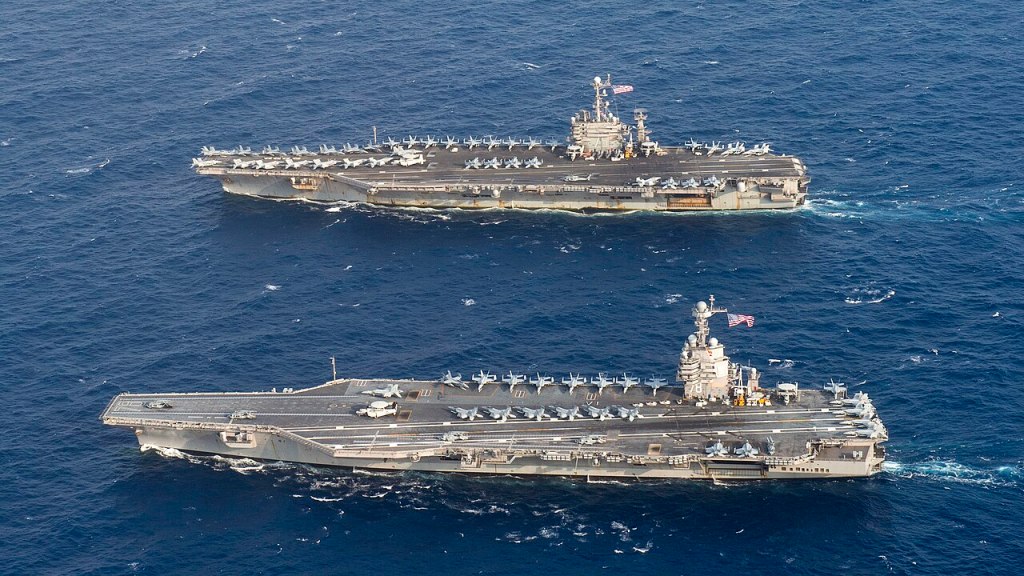
(The picture is the USS Gerald R. Ford sailing alongside the USS Harry S. Truman.)
Where have all the war correspondents gone?
The Trump-Iran War is a strange one, in that we’re not experiencing it directly; we only experience the effects.
Every war since Vietnam has been live and in person, in our living rooms on the evening news (or, with the rise of the 24-hour news channels, all day long). There have always been war correspondents embedded with the troops, and we’ve seen them on the ground in the fields of battle. We’ve heard from them how well or poorly the troops are holding up; they’ve offered us pronouncements and interviews from the commanders in battle; they’ve involved us in the wars. War has been emotional for Americans.
But this one is different. We aren’t experiencing the war directly, visually, viscerally. The only way we know the Trump-Iran War is still happening is because we’re paying more for gas, and high diesel prices have translated into higher costs for food and everything else. But beyond those basic effects on our lives, the only way we know the war is happening is due to the near-constant assertions from the White House that we’ve destroyed the Iranian military, that we control the Gulf of Hormuz, that Iran wants to negotiate.…
I can only surmise it’s a result of Donald Trump and Pete Hegseth’s war on the free press. Hegseth threw the press out of the Pentagon, so there are no Pentagon briefings. And Donald Trump and his lackeys keep trying to throw the free press out of the White House. Well, I will say the press are also colluding in this silence, to a degree. It is far cheaper and easier for the press to report on the never-ending political/election “news” than to actually put reporters in the field. But sending those reporters into a war zone is not a unilateral decision; it has required the assistance of the government and the military, and that assistance is not there this time.
I don’t have an answer, just questions, and a feeling that something is amiss. There is no longer any such thing as a “long-distance phone call.” UFOs have disappeared because everyone now has a cell phone camera. We can communicate with nearly everyone on the planet with only the slightest of difficulties or pauses. And yet the Trump-Iran War is shrouded in mystery; we have only a single source of information about it, and that source—Donald Trump—has proven repeatedly over the last decade that he is not a reliable reporter about anything.
Word Counts
In the current issue of the Mensa Bulletin, Richard Lederer’s article is about Mark Twain, including several quotes from Twain. One of them caught Mom’s attention: “I never write metropolis for seven cents because I can get the same price for city. I never write policeman because I can get the same money for cop.” She lauded that thinking, and to a degree, she’s right: a word is a word, and if one is getting paid per word, shorter indeed may be better. (Although I am a staunch proponent of precisely the right word, because there are nuances of difference in Twain’s examples.)
The stumbling point for me was that when I started working for Analog and Asimov’s, one of my jobs was writing up the contracts for stories the editors were buying. We had a formula for calculating words: count the spaces in an average-long line, multiply by the number of lines on the page, and then by the number of pages in the manuscript, and then divide by six to get the number of words we were paying for and then publishing. This formula thus included spaces and punctuation marks in the rate of pay, but it did not count actual words. It did, however, give an accurate length, which helped when putting together the puzzle pieces that were stories in an issue of a printed magazine. Also, recall that this was the end of the typewriter era, just as writers were starting to use computers. So actually counting the number discrete words in a document was almost always an inaccurate approximation. Thus, in that era, from those magazines, a writer was actually paid more for a longer word than for a shorter one. I had that epiphany after selling my first couple of stories, and tried to use longer character names for just that reason (“Tom” was worth 3 cents when they were paying 6 cents per six-character “word”; “Christopher,” however, was worth almost 12 cents). When I was publishing Artemis Magazine, I kept the approximation for figuring out pay rates.
Writing this now, when everything is computers and electronic submissions, I’m realizing I rely far more on the word processing program’s calculation of a number of “words” in a document, but the number of words only really matters when I’m publishing an anthology, and now the approximation I’m most interested in is “how many pages will this story fill.”
Anyway, it struck me as an interesting change. Ignoring the fact that Twain (who died in 1910) was getting seven cents a word, while writers today are lucky to find a fiction market paying that much, I’m wondering if the varying ways in which we count words has affected writers’ earning ability by any appreciable amount.
Brooklyn Books & Booze Author Book Fair
A new book fair in Brooklyn is coming up soon! I’ll be at the Brooklyn Books & Booze Author Book Fair with my books and some of Fantastic Books’ books and a bunch of other wonderful authors, including Marc Abbott, Liz Alterman, Sarah Branson, Crissa-Jean Chappell, Russ Colchamiro, C.S.E. Cooney, Randee Dawn, Keith R.A. DeCandido, M.M. Devoe/Pen Parentis, Lara Elena Donnelly, John Foster, Lara Frater, Tyler C. Gore, Fran Hawthorne, Carlos Hernandez, Karen Heuler, Kirk Johnson, Eskay Kabba, Kirsten Kashock, Nick Kaufmann, Barbara Krasnoff, Priscilla Oliveras, Aaron Rosenberg, Celia Seupel, Alex Shvartsman, Hildy Silverman, Su J. Sokol, Carren Strock, Ian Randal Strock, Denise Tapscott, Terence Taylor, Steven Van Patten, Michael A. Ventrella, and David Winner. We’ll all have books to sell and sign, from a variety of genres. There were also be discussions and chances to meet with editors and agents.
The event is Saturday, September 19, 2026, from 11:00am to 5:00pm at Barrow’s Intense Tasting Room, 86 34th Street, Brooklyn, NY 11232 (Subway: D train to 36th Avenue, then about a 4-minute walk).
Hope to see many of you there!

Reporters should call out interviewees who lie
I was just watching CNN, the anchor (I think it was Brianna Keilar) interviewing Erin Hawley who is “Of Counsel” for the ironically named “Alliance Defending Freedom.” The discussion was about the case State of Louisiana v US Food and Drug Administration, in which the US Court of Appeals for the Fifth Circuit is currently hearing arguments. (The case is an attempt to restrict access to mifepristone by mail.)
What caught my ear, and kept me watching to the end of the interview, was that during the few minutes I watched, Hawley said—three times—that the drug sends “one in point five women to the emergency room.” She also harped on the drug’s “black box” nature, and compared sending it through the mail to sending cocaine. But that “one in point five women…” bit, that’s what made me yell not at the guest, but at the interviewer. I yearn for the days when reporters paid attention to what interviewees were saying and called them on it. “One in point five”? What does that even mean? Why didn’t Keilar call her on that non-statistic to ask Hawley what the hell she really meant?
Digging through this group’s web site, I think the statistic Hawley was trying to quote was that “roughly one in 25 women who take mifepristone as directed will end up in the emergency room.” And she was probably conflating it with another biased group’s study quoted on the ADF web site that analyzed 866,000 prescriptions and found nearly 11 percent of women suffered serious complications, “which is approximately 22 times higher than the less than 0.5 percent figure the FDA cites.”
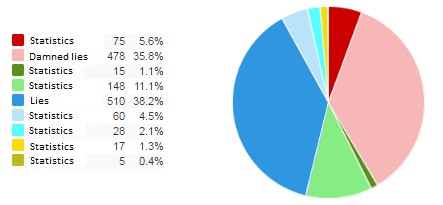
Statistics don’t lie, but the uses one puts them to—especially when misquoting them—mean that we’re not getting the whole story. In this case, the story probably would not have changed had the anchor called out the guest for spouting nonsense, but when people are presenting themselves (or being presented) as experts, they really ought to be able to communicate the truth correctly.
And for a news program to let such miscommunication go by, forcing me to dig through the guest’s web site to figure out what she was saying, makes the news program much less useful to me (which is bad) and the guest far less credible (which in this case, is fine with me. She represents a group which has morals [okay, that’s acceptable] and is trying to force those morals on others [which is completely out of line]).
The Said Book
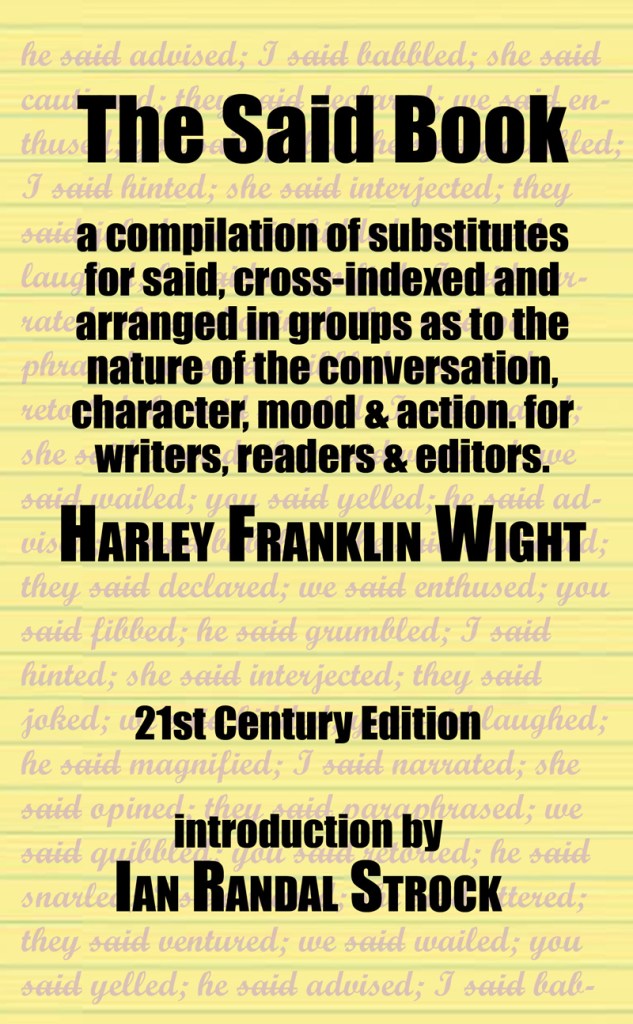
For years, I’ve been talking to beginning writers, both in solo presentations and on convention panels. One of the things all we experienced writers and editors tell them is to not use too many said-bookisms—that is, all those words one might use as a dialogue tag instead of “said.” And for all those years, to me it was just a term, one I never bothered to investigate, to figure out from whence it came.
I recently learned that the term “said-bookism” comes from… wait for it… THE SAID BOOK! Yes, there is an actual book called The Said Book, which is a thesaurus for the word “said.” And it’s got a subtitle big enough to choke a moose: “a compilation of substitutes for said, cross-indexed and arranged in groups as to the nature of the conversation, character, mood & action. For writers, readers & editors.”
At the time it was published—in the 1930s—apparently using the word “said” was a horrible thing that writers needed to avoid at all costs, so Harley Franklin Wight (he is credited as H.F. Wight on the original cover) put together this book to help them not write “said.” Now, the book is mostly a historical artifact, an oddity, and a look at a fashion from the past.
Due to its publication history, the book has been nigh unto impossible to find. Until now. I’ve found the book, corrected several mistakes in the original (including sections that were mis-alphabetized), and brought it back into print, for those of you whose writing is littered with too many saids, and who are looking for guide to all those other words. Or not. But it’s a fun look at the past. With a new introduction I wrote, just to put the book in a slightly wider context.
Memories
I know, the only constant in life is change. But here’s one that basically won’t affect anything that has an emotional impact on me.
When I was little, the first thing Mom taught me to bake was her grandmother’s mondel bread. It’s been a constant in my life, a recipe I haven’t looked at in years because I can do it without even thinking, pure muscle memory.
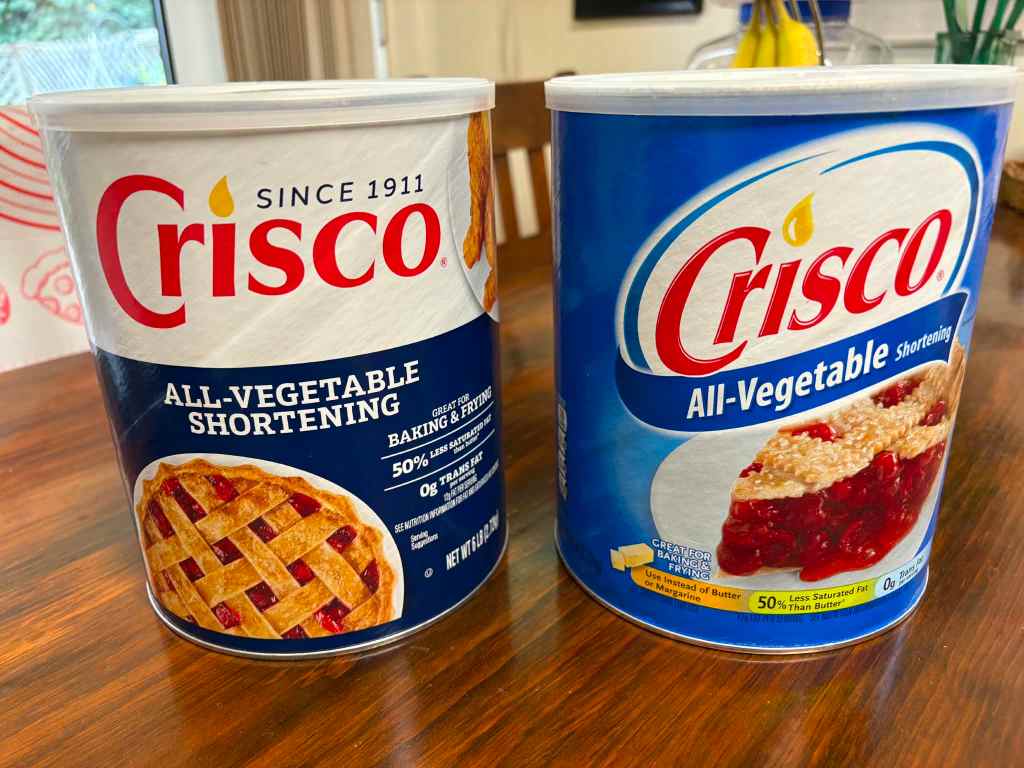
The main ingredients are flour, sugar, eggs, and Crisco. And for all the years I’ve been making it, the can on the right has been the one I bought when I needed more (I buy it at Costco, because I bake often enough that it lasts). The can on the left is the new design, and it was a shock when I first saw it. It was almost painful when I had to buy it, and today, I used up the old one and opened the new: the end of an era. The contents are exactly the same; the only thing that has changed is the look of the can. But that’s an emotional change that makes me remember all that baking over all those years.
#Crisco #baking #memories
Science Fiction PLUS Convention (4th of 2026)
All the cool kids are doing it, so…
Here’s my tentative schedule for DragonCon, September 3–7, in Atlanta, Georgia:
Thursday at 10:00 pm (in Embassy AB Hyatt): “Eye of Argon, Again!” with Keith R.A. DeCandido, Esther Friesner, and Jean Marie Ward.
Friday from 8:30 pm to midnight or so (in the Hyatt’s International Ballroom): Fantasy Gather. This is the massive book signing and sale event. Come meet many authors, buy their books, and get them autographed!
Saturday at 11:30 am (in Embassy EF Hyatt): “Breaking into Traditional Publishing” with Melissa Olthoff, Steve Saffel, Anne Sowards, and Toni Weisskopf.
Monday at 1:00 pm (in Embassy EF Hyatt): “Writing Tiny: Flash and Microfiction” with David Boop, Darin M. Bush, Wayland Smith, and Sean Hylton Taylor.
That leaves me lots of free time, if anyone is looking for a chance to meet up somewhere in the throngs. I imagine I’ll be in the Westin bar (where the writers tend to hang out) Thursday late, Saturday and Sunday evenings. And I’ll have copies of my books available, especially at the Fantasy Gather, but also at my panels.
I know I’ll see many, many people there. I hope you’re one of them!

