How am I doing?

Last night, I was at Readercon for about 25 minutes. I went to the hotel just to drop off the boxes of books which I’ll be setting up today. Then I returned the luggage cart, and in the forty feet I had to walk from leaving the luggage cart to exiting the hotel door to get back to the car, I stopped and talked with five people I know. (In other words, a standard convention: can’t walk down a hall without stopping to talk.)

Each of them asked how I was doing, and to each, I gave the same flippant answer I’ve been using for years: “I’m properly insane.” With those three words, I usually intend to convey the fact that I’m busy, doing many things, but they’re the things I should be doing.

But last night, getting ready for bed, I had something of an epiphany. Sure, I’m busy, but actually the answer to “how am I doing?” is “pretty damn good!”

RESISTANCE (the anthology I edited to help support the ACLU and Pro Publica) is doing well, and people are appreciating it.

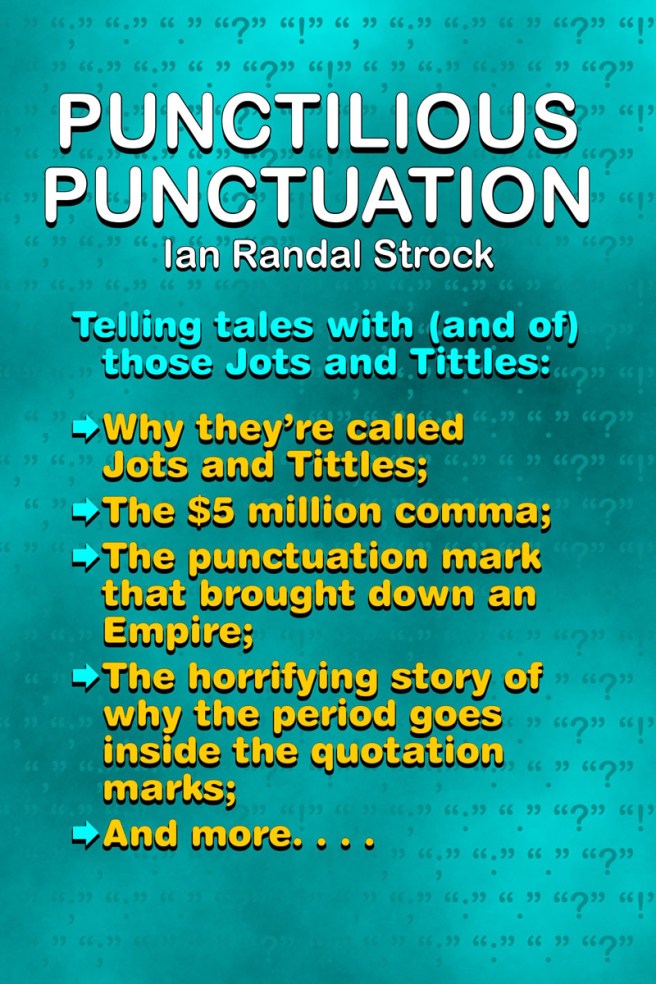
Last week, I got a fan letter about PUNCTILIOUS PUNCTUATION.

I’m excited to be publishing Allen Steele’s newest novel, LEMURIA 7, on Tuesday.

I’m just about finished editing a really great book about film that I’ve been enjoying.

I’m excited to be working with a brand-new author on a two-book science fiction tale that I think a lot of people are going to like as much as I do.

I’ve got several more authors waiting for my close attention, most of them waiting patiently.

And in the few brief moments I give myself to do my own writing, it feels like I’m improving. And when I finish the stories I’m working on, I have some confidence I’ll be able to find an editor who agrees that they’re good, and wants to publish them.

I’m doing a job I want to be doing. My friends seem to value and like me, and I’m very glad to have them in my life.

And now I have to leave to go set up those books at the convention, because selling books and talking on panels to appreciative audiences is my day job.

Sure, I’m busy, trying to think in several different directions at once. But you know what? I’m doing pretty damn good!

Where are reviewers hiding?

When I worked for Analog and Asimov’s, we had a perennial question: Analog routinely outsold Asimov’s by five or ten percent, but when it came to awards time, stories from Asimov’s always got lots of nominations and awards, while Analog garnered almost none. We knew Analog readers actually read the stories, because they wrote letters and kept renewing their subscriptions; they simply weren’t people who were interested in nominating or voting for awards. And I felt badly for the writers who didn’t see that external recognition, but there was nothing we could do to convince those readers to get into the award-nominating and -voting mindset.

Now I’m experiencing something similar, but not talking about awards. I know Fantastic Books books are selling and being read. For instance, the anthology Resistance was the #1 new release in American Literature Anthologies on Amazon, it is selling copies, and several readers have commented to me on individual stories in the book. But like most of the books my company publishes, it was yet to see a single reader review on either Amazon or GoodReads, or LibraryThing, or anywhere else I can find.

In the modern bookselling world, reader reviews are important. They make books more findable, increase their visibility on the bookselling platforms, and apparently translate to better sales numbers. But I have simply not been able to figure out why my readers are among those who don’t post reader reviews. In the old days, at Analog and Asimov’s, those readers who wanted to comment on stories had to write physical letters, in envelopes with stamps sent through the mail, and they did: we received dozens of letters every week. But today, those reader reviews are as simple as “click here, click a number of stars, type a couple of words.” Literally, just four or five words is sufficient: “I liked the book.” or “The story with the AI was cool.” And yet, nothing.

So I’m asking y’all: how do you urge readers to write those reviews? Or for those of you who do: what urges you to write a review?

Research help needed

Looking for some research help. Specifically, I’m looking for any other religions with a concept similar to Judaism’s Shabbos goy.

For those who don’t know, a Shabbos goy is a non-Jew who is employed by Jews to perform certain types of work that Jewish religious law prohibits a Jew from doing on the Sabbath.

I’m not asking about the religious validity of the concept—whether it is allowed or not—just looking for other religions that might have a similar concept: someone not of the faith who is necessary to do things for the brethern that they are not themselves permitted to do.

Literary Abbrevs

Do you find it as jarring as I do, when reading fiction, if the narrator uses abbreviations rather than spelling out the words? Or, for that matter, uses Arabic numerals rather than spelling out the numbers (other than, you know, for ridiculously large numbers—there’s never any sense in spelling out two hundred ninety-nine million, seven hundred ninety-two thousand, four hundred and fifty-eight meters per second)?

What prompted this thought was a story I was reading, and the narrator’s voice says something about the intersection of Maple Blvd. and Elm Ave. In non-fiction or reporting, that’s fine. Indeed, it’s expected. But somehow, when I’m reading fiction, I find the abbreviations serve only to remind me that I’m reading words on a page, distancing me from the story I’m reading.

I find it even more of a literary turn-off when it occurs in dialogue, because nobody actually says “blivid,” so the writer really ought to spell out “boulevard.”

Is it just me…?

Electronic Punctilious Punctuation

I’m thrilled to announce that there is—finally—an ebook version of my latest book, Punctilious Punctuation. The book is so full of graphics, footnotes, special characters, and more, that I didn’t trust myself to turn it into an ebook, and had to get an expert to do it. Well, it’s done and it’s available!

You can get it directly from me/the publishing company on the linked page, or follow the links on that page to some of the major ebook retailers.

This is the book that Samuel R. Delany “really enjoyed,” and Joe Haldeman said contained “the best joke I’ve encountered today… well, the best grammar joke, anyway.”

The word “fulsome” is, to my ear, fulsome.

Should I just give up, or should I continue to cringe when I hear people using the word “fulsome” when they mean “full” or “large”? Because it grates on my ears. And yes, before I looked up this source, I hadn’t realized that the modern usage of just meaning “full” but with more syllables is actually the original meaning from the 1200s.

Dictionary.com offers the following on the word fulsome:

adjective

  1. offensive to good taste, especially as being excessive; overdone or gross.
    Example: fulsome praise that embarrassed her deeply; fulsome décor.
  2. disgusting; sickening; repulsive.
    Example: a table heaped with fulsome mounds of greasy foods.
  3. excessively or insincerely lavish.
    Example: fulsome admiration.
  4. encompassing all aspects; comprehensive.
    Example: a fulsome survey of the political situation in Central America.
  5. abundant or copious.

adjective

  1. excessive or insincere, esp in an offensive or distasteful way
    Example: fulsome compliments
  2. [not standard] extremely complimentary
  3. [informal] full, rich or abundant
    Examples: a fulsome figure
    a fulsome flavour
    fulsome detail
  4. [archaic] disgusting; loathsome

Note: In the 13th century when it was first used, fulsome meant simply “abundant or copious.” It later developed additional senses of “offensive, gross” and “disgusting, sickening,” probably by association with foul, and still later a sense of excessiveness: a fulsome disease; a fulsome meal, replete with too much of everything. For some centuries fulsome was used exclusively, or nearly so, with these unfavorable meanings. Today, both fulsome and fulsomely are also used in senses closer to the original one: The sparse language of the new Prayer Book contrasts with the fulsome language of Cranmer’s Book of Common Prayer. Later they discussed the topic more fulsomely. These uses are often criticized on the grounds that fulsome must always retain its connotations of “excessive” or “offensive.” The common phrase fulsome praise is thus sometimes ambiguous in modern use.

A predicted date is rolling around

When talking about writing science fiction, I usually warn authors not to put near-future dates into their stories, because they run the risk of being overtaken by reality. Matthew B. Tepper just reminded me that early in my career, I did put a date in a story, one that is arriving all too soon. In “How I Won the Lottery, Broke the Time Barrier (or is that ‘Broke the Time Barrier, Won the Lottery’), and Still Wound Up Broke” (which was published in the June 2000 issue of Analog), the narrator gets a message from the future, from March 16, 2026.

There are several predictions in the story that did not come true… at least, not in this universe. Nevertheless, I’m wondering if I should do something to commemorate the day, to kick myself for getting it wrong (although I guess it was successful in at least one way: I sold the story, which was the real goal).

I’ll be traveling to Massachusetts later that week, but March 16 is a Monday, on which I currently have nothing scheduled. Anyone want to celebrate the day by helping me try to open a 27-year-long wormhole, to transmit a little information back in time? Or do something a little more pedestrian, people-getting-together type of thing? Or perhaps the day before, which is a Sunday?

A problem with names

Most of my fiction is short, sometimes very short. And I write a lot of my stories in the first person, because I find it lends intimacy and immediacy to the story.

But one of the stories I am currently writing seems to be more suited to being told in third person. Fine, good. It gives some room for a narrator (which I also enjoy doing). But a skill that seems to have atrophied because of all of my first-person writing is that I’m having trouble naming and describing the characters.

With a first-person point of view, the main character will rarely or never mention his own name. And think about how often you use other people’s names: if you’re talking with someone you know, you can go a very long time without either one of you mentioning your own or the other’s name.

Similarly, unless there’s been some great change—a new hair style or an interesting outfit—you’ll rarely describe or “characterize” yourself or the other. Heck, I look in the mirror every morning, but I almost never remark on my own appearance (well, other than this week, when I’ve been watching this subconjunctival hemorrhage turning my left eye a remarkably horrifying red, but the doctor said it should resolve itself in a few days [and yes, there’s a bit of characterization that doesn’t really move the story forward, but does lend color, if you will, to the tale]).

Back to my original point: I know sometimes names are very important, and can be a large part of characterization, but far more often, character names are just indicators so the author can differentiate one from another. So how do you pick a good name—and perhaps interesting characteristics—when those aren’t the foci of the story you’re telling?

P.S.—I thought about including a picture of my eye, but decided it would gross out more people than it would attract readers.

2025: The Year in Reading and Writing

A bunch of my friends do this, and I’ve done it in the past, but let it slide the last few years. My list is not so impressive as many others’, but for… reasons.
 
The books I read in 2025:
 
The Complete Sherlock Holmes by Arthur Conan Doyle. So many of my friends and acquaintances so often talk about Holmes, and I’ve come to understand the mythos somewhat, so I finally decided it was time to read some Sherlock Holmes. Well, I decided to just read ALL of Sherlock Holmes. So now I’m caught up.
 
The Prince by Niccolo Machiavelli. Another one of those classics to which reference is often made, but which I hadn’t actually read. When I did finally finish it, I remember thinking the last few chapters seem to play (or at least pre-echo) a great deal of President Trump’s politics.
 
Godel Escher Bach by Douglas R. Hofstadter. I’d been reading this one, off and on (mostly off) for quite a long time. I finally finished it. Seems a little predictive and a little dated.
 
Tales of Galactic Pest Control edited by David Gerrold and Tom Easton. Some very good stories in this anthology, including one of mine.
 
Unidentified Funny Objects 7 edited by Alex Shvartsman. I didn’t laugh at all of them, but a good enough percentage.
 
The books I edited and published:
Ginger Snaps by A.R. Alan
Mystralhaven by Ron Kaiser
A Talent to Amuse by Daniel M. Kimmel
The Lies We Tell Others edited by Sahar Abdulaziz and Michael A. Ventrella
 
I also read and edited and worked on another seven books that will be published in 2026. I’ll talk about them in the near future.
 
By some measures, that’s not a lot. Only eighteen titles. Still, the Complete Sherlock Holmes is several books’ worth of reading. And in the cases of the books I edited, that was reading each of them two or three times (or even a few more, through various iterations). So I’m not embarrassed, but not bragging, either.
 
Finally, I am also a writer. And while too much time editing means very little time writing, I did manage to finishing writing and publish my book Punctilious Punctuation. And two of my stories saw print: “…a Crack of Lightning, or, The Zen Solipsist Muses Upon His Own Genesis” appeared from Amazing Stories on June 16, 2025; and “Infestation: White House” appeared in the anthology Tales of Galactic Pest Control, edited by David Gerrold and Tom Easton (July 2025).
 
Writing is a very emotionally rewarding occupation, but it isn’t exactly financially rewarding, so I’ve also joined the crowed, and set up a ko-fi page as a tip jar. If you’re so inclined, anything and everything will be gratefully appreciated, at https://ko-fi.com/ianrandalstrock . Thank you, and happy 2026. Let’s read!

Don’t Tell Me

I’ve been trying to be a better writer recently. I’ve actually been writing every day, and I’m making more of an effort to find markets for my writing (haven’t had much luck finding paying markets for my essays recently; my fiction—as does everyone’s—sometimes takes quite a while to find the right home).

Something I noticed several years ago—but which is making more of an impression as I’m making more of an effort to find places to sell my stories—is those markets requiring anonymized submissions. It’s not a terribly onerous burden—saving another copy of the story without my name on it—but I’ve been wondering who it really serves?

As a professional, I know that the most important people in the publishing ecosystem are the advertisers and the readers: those who pay for the magazine to exist. Everyone else is of secondary import. And I’m wondering if any of them care, or even notice, if the magazine or anthology in question requires anonymized submissions.

I did a quick search of publications who don’t want to know who wrote the story they’re considering, and found these examples from their guidelines:

Remember to take all author information out of your story! Tell us who you are in the space provided in the web form cover letter you get when you click on the “submit” button, NOT in your story! No headers, no bylines… just the story.

Please anonymize your work. No names or other identifying information should appear on the manuscript.

Anonymous Submissions. No identifying information should appear on your manuscript. We use anonymized submissions for our associate editors (first readers). Only upper-level editors will read your submission form information and cover letter, including any diversity statement. Failure to anonymize the manuscript will not cause us to automatically reject your story, but failure to read and follow our guidelines may affect our decisions.

Anonymity: Please do not put your name on your manuscript. All stories are assessed anonymously. [Ironically, this one requires contributors to identify as part of a specific community.]

[Magazine name] only accepts anonymous submissions. Please do not include your name, address, phone number, or other similar identifiers in the manuscript itself. All original fiction and poetry submissions will be read anonymously on first read: moving on to further consideration will depend on the merit of the work alone.

As I said, it’s not a terrible burden on the would-be writers (other than making sure the manuscript file I send is the anonymized one, not the regular one). But does anyone notice? Has any reader ever picked up a magazine and said “This is a great issue. I’m glad the submissions were anonymous.”? or “This issue would have been a lot better if the editor reading the submissions didn’t know the names of the authors before buying the stories.”?

For you readers out there: did you even know this was a thing?