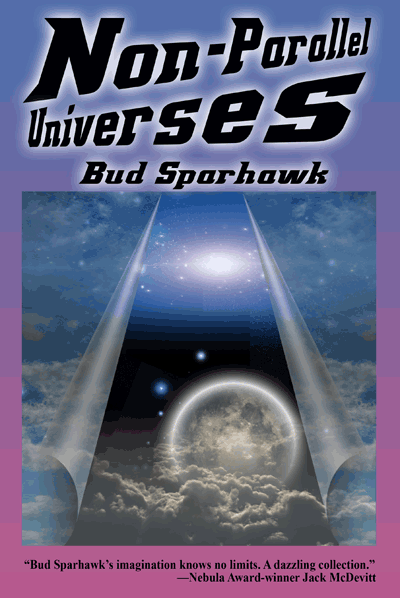
 This weekend at Balticon, Fantastic Books is debuting two brand new books you’re sure to want. One of them is Bud Sparhawk’s new collection, Non-Parallel Universes.
In this enthralling collection of 19 stories, we meet space pirates and bounty hunters, baseball pitchers and intelligent toilets. From a pair of buddies brewing beer on Jupiter, to a couple of old friends reconnecting at an environmental rally, the people living these incredible lives in unbelievable situations are relatable and human. But whether it’s an insterstellar pilot skipping through the centuries as he travels the universe, or a boy trying not alienate his loving father, we recognize ourselves in each of them.
If you’ll be at Balticon, be sure to join us at our shared launch party, where we’ll be celebrating Bud, as well as Brian Koscienski and Chris Pisano’s new novel The Biggest Bounty, and Fortress Publishing’s TV Gods—Summer Programming. The party is scheduled for Sunday, from 1 to 3pm, in the 12th Floor Club Lounge. If you’re at Balticon, but can’t make it to the party, we’ll have the books in the dealers’ room the rest of the weekend. And if you’re not going to join us this weekend, Non-Parallel Universes is already listed on all the major online retailers’ sites: be sure to get your copy on publication day, next Tuesday.
Non-Parallel Universes is already garnering wonderful praise, including:
“If the term ‘Analog writer’ means anything anymore, long after John W. Campbell’s death, the description has to encompass and be enshrined in the person of Bud Sparhawk. Like Christopher Anvil and Eric Frank Russell, like James Schmitz and Tom Purdom, Sparhawk offers us unflashy, solid tales which nonetheless often extend SF’s remit. He never neglects either real technological novums nor humanistic story-telling values. He does not privilege message over entertainment, nor vice versa, but rather tries to keep both in balance. And in the end, he’s all about the art and the history and traditions of the genre, not self-aggrandizing grandstanding. I call that a valuable gift to the community of readers and a proud and honorable legacy.” —Paul Di Filippo, Locus Online
“Bud Sparhawk is a writer of clarity, wit, and insight. His stories provoke wonder, will sometimes give you a good laugh, and always make you think. I enjoy his work, and believe you will, too.” —Allen Steele, three-time Hugo Award-winner
“Bud Sparhawk’s imagination knows no limits. A dazzling collection.” —Jack McDevitt, Nebula Award-winner
“In today’s science fiction field, if I hear these three descriptors—’one of the living masters of the short form,’ ‘humor and pathos in equal measure,’ and ‘universally accessible,’—I know whose work is being discussed: Bud Sparhawk’s. And you hold the very finest of that work in your hands.” —Charles E. Gannon, author of the Tales of the Terran Republic series
“A collection of Bud Sparhawk’s work is as diverse and mind-blowing as an anthology of a dozen other writers. His stories can span the breadth of the Universe, or the distance between a man and his son. He can even unlock the heart of a crusty curmudgeon (like you, perhaps) and find a world of hope and wonder.” —Robert R. Chase, author of The Game of Fox and Lion
“Stories that shift reality and widen perspective, an amazing journey!” —Gail Z. Martin, author of Shadow and Flame
For more information, see http://www.fantasticbooks.biz/fantasticbooks/sf/151541020X.html
 !
!
 Ian Randal Strock