Billionaire inventor Edison Smith pays for the Lemuria 7 moon mission as a tourist trip, sending media into an uproar. Is it a case of conspicuous consumption? Fodder for the tabloids? Actual, privately funded scientific research? Or something else? It turns out to be all of those things at once, and more.…
When Smith, his wife Mary Alice, their daughter Amelia, Amelia’s fiancé Todd, and the crew of Lemuria 7 disappear, the only conclusion to be drawn is sudden equipment failure leading to catastrophic disaster. But there are hints that such might not be the case.
Believing it was something more—and hoping against hope that the inevitable outcome might not have been so inevitable—Merlin Feng sends robots, and then people (including himself) to the Moon to find out what happened to the Smiths, who were like family to him. That mission, too, encounters… problems.When three-time Hugo Award winner Allen Steele is telling the tale, you can be assured there is more happening than meets the eye. Deeper mysteries and hidden motives mean that Lemuria 7 will live forever, even if the Smiths don’t.
When I worked for Analog and Asimov’s, we had a perennial question: Analog routinely outsold Asimov’s by five or ten percent, but when it came to awards time, stories from Asimov’s always got lots of nominations and awards, while Analog garnered almost none. We knew Analog readers actually read the stories, because they wrote letters and kept renewing their subscriptions; they simply weren’t people who were interested in nominating or voting for awards. And I felt badly for the writers who didn’t see that external recognition, but there was nothing we could do to convince those readers to get into the award-nominating and -voting mindset.
Now I’m experiencing something similar, but not talking about awards. I know Fantastic Books books are selling and being read. For instance, the anthology Resistance was the #1 new release in American Literature Anthologies on Amazon, it is selling copies, and several readers have commented to me on individual stories in the book. But like most of the books my company publishes, it was yet to see a single reader review on either Amazon or GoodReads, or LibraryThing, or anywhere else I can find.
In the modern bookselling world, reader reviews are important. They make books more findable, increase their visibility on the bookselling platforms, and apparently translate to better sales numbers. But I have simply not been able to figure out why my readers are among those who don’t post reader reviews. In the old days, at Analog and Asimov’s, those readers who wanted to comment on stories had to write physical letters, in envelopes with stamps sent through the mail, and they did: we received dozens of letters every week. But today, those reader reviews are as simple as “click here, click a number of stars, type a couple of words.” Literally, just four or five words is sufficient: “I liked the book.” or “The story with the AI was cool.” And yet, nothing.
So I’m asking y’all: how do you urge readers to write those reviews? Or for those of you who do: what urges you to write a review?
During the awards ceremony at this weekend’s annual Boskone science fiction convention, the members of the New England Science Fiction Association (NESFA) awarded their annual Edward E. Smith Memorial “Skylark” Award to Ian Randal Strock.
The Skylark is presented annually by NESFA “to some person, who, in the opinion of the membership, has contributed significantly to science fiction, both through work in the field and by exemplifying the personal qualities which made the late ‘Doc’ Smith well-loved by those who knew him.” (For the full definition, see below.)
The award citation reads:
This year’s Skylark winner is the editor and publisher of Fantastic Books, but he’s much more than that. He’s worked at Asimov’s and Analog and (the now defunct) Artemis magazines. At Fantastic Books, he’s not only published original works (such as the Hugo finalist Jar Jar Binks Must Die), but also kept in print works by authors as diverse as Shariann Lewitt, Walter Hunt, and Allen Steele. He is one of the nicest people in SF (and Mensa, too). We are pleased to present this year’s Skylark Award to Ian Randal Strock.
Also known as a public speaker, Strock gives talks on presidential history, publishing and writing, punctuation, and more. But in the moment, standing on that stage receiving the award, he had no coherent thoughts. “It was my worst performance on the stage ever,” he said. “I think I said ‘thank you,’ but I’m quite certain I could not come up with anything more insightful or erudite.” A few days later, he was finally able to gather his thoughts, commenting “To say the award was unexpected would be to say that I believed I might one day be nominated for it. I never even imagined I would be considered for the Skylark. I am humbled by this award, and by the awe-inspiring list of prior recipients. I will try to live up to their illustrious examples. Thank you, NESFA.”
The Skylark is defined in NESFA’s bylaws: The Edward E. Smith Memorial Award for Imaginative Fiction, or “Skylark,” shall be presented from time to time by NESFA to some person who, in the opinion of the Membership, has contributed significantly to science fiction, both through work in the field and by exemplifying the personal qualities which made the late “Doc” Smith well-loved by those who knew him. Doc was so well thought of that he was invited to be Guest of Honor at the Second World Science Fiction Convention in Chicago, 1940 (Chicon I). Only two years before his death, Doc was given the First Fandom Hall of Fame Award at the Twenty-First World Science Fiction Convention in Washington, 1963 (Discon I). Doc Smith attended many conventions and participated in them as a pro and as a fan. He was one of the earliest enthusiasts in what are now called hall costumes and often dressed as characters from his stories—the good guys, of course. Smith was one of the old breed of SF writers who did not distinguish between pro and fan. He talked on panels; he talked informally; he never thought himself too important. He was, in a word, a mensch. It is fitting that this convention’s name was, is, and always will be Boskone and that the Skylark Award was, is, and always will be given out to someone who exemplifies Doc’s qualities both as a professional contributor to the field and as a human being.
Late last night, I learned that Barry N. Malzberg had died. Born July 24, 1939, he was a writer and editor. His daughter, Erika, wrote: “My dad passed away this evening, around 4:30pm. My sister had been with him for a few hours and I was just getting back after having visited with my mother. He took his last breath almost the moment I arrived. It was very, very peaceful and we are so grateful.”
His fiction was ground-breaking and seemingly everywhere moments after he started publishing (his first science fiction story, “We’re Coming Through the Window,” was published in the August 1967 issue of Galaxy), but I’ll probably remember him more for his non-fiction: his essays on science fiction, literature, and the people in the field, which was his stock-in-trade for the last couple of decades.
I remember Barry as a fixture at the science fiction conventions I attended when I first got into the field, but I never really got to know him: there were too many bright and shiny new things and people clamoring for my attention for me to seek out the austere, somewhat foreboding looking fellow he was. Now, reading the reminiscences of so many of my friends, I’m realizing just how much I missed out by not getting to know him better. Rather than trying to recapitulate them, I commend to you posts on Facebook by John Kessel (https://www.facebook.com/john.kessel3), Adam-Troy Castro (https://www.facebook.com/adamtroycastro), and Kristine Kathryn Rusch (https://www.facebook.com/kristinekathrynrusch). I’m sure there will be more in the coming days.
He was nominated for a dozen Hugo and Nebula Awards, and his novel Beyond Apollo won the inaugural John W. Campbell Memorial Award in 1973. His nonfiction works won two Locus Awards: The Engines of the Night (1983), and Breakfast in the Ruins: Science Fiction in the Last Millennium (2008), and I was pleased and honored to publish his third volume, The Bend at the End of the Road (2018).
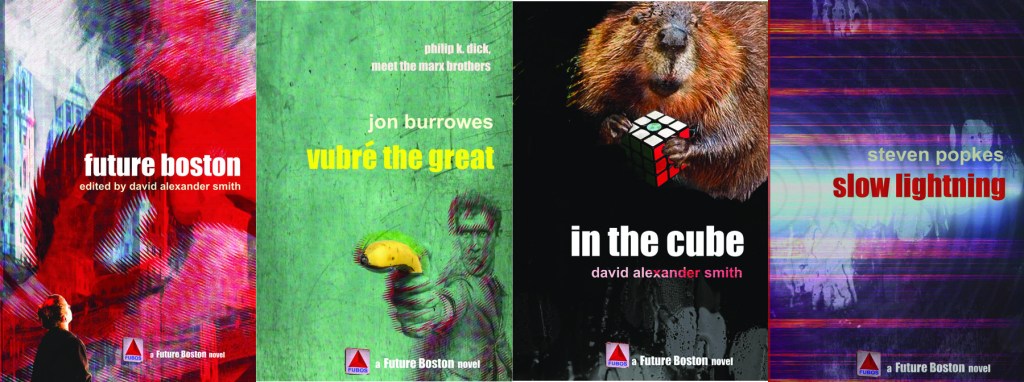
Fantastic Books is pleased to bring the Future Boston series back into print.
First appearing in 1994, this four-book cycle tells the history of New England’s most populous city from 1990 to 2100. In those years, Boston is slowly sinking into the sea. The citizens of Boston plan a revolution against the governments of Earth. Alien races occupy the city and must decide if the human race deserves full galactic citizenship—or total destruction.
The mosaic novel Future Boston is the sweeping saga of a handful of dreamers—artists and scientists, scufflers and survivors, revolutionaries and thieves—who dream of a new society as their ancestors did before them. From slums to Brahmin boardrooms, Future Boston is a rich mosaic of history and human drama, as real as the great metropolis that inspired it. It features the work of Jon Burrowes, Alexander Jablokov, Geoffrey Landis, Resa Nelson, Steven Popkes, David Alexander Smith, and Sarah Smith.
Publishers Weekly called it “Adventure-filled… a wealth of evocative detail.… The real star is a painstakingly constructed future Boston,” while Locus said “Future Boston is more than the sum of its parts—and its parts are very good.”
Following Future Boston is Jon Burrowes’ novel Vubré the Great, in which a space ship breaks down, and the aliens check into little old Motel-o Earth-o to see if they can find a new conduction bolt for their night-drive. And the next thing you know, alien technology and ideas are erasing the cultures of Earth forever.
In David Alexander Smith’s In the Cube, private detective Beverly O’Meara is paired with Akktry, a small, sharp-clawed animal that has an inhuman affinity with the past and an ability to recreate the history of any place or person from the remains of the present. They’re on the trail of Diana Sherwood, the missing daughter of the most powerful—and hated—woman in sinking Boston. Unfortunately, that trail leads straight into the Basement, the oldest, lowest, most dangerous part of Boston. The part below sea level. The part you can down in…
Hugo, Nebula, and Locus award-winning author James Patrick Kelly said “In the Cube is David Alexander Smith’s best book.… Not only do his humans live and breathe, but he has drawn some of the strangest and most convincing aliens you’ll ever meet.”
Rounding out the series is Steven Popkes’ Slow Lightning, in which Ira and Gray find an egg on an abandoned ferryboat. It’s wrinkled, with smears of red and yellow, and bigger than a basketball. They’re not sure why it’s there, only that it must have been left there on purpose.
Science fiction Grand Master Poul Anderson said “Slow Lightning does a remarkable job of conveying the sheer strangeness of the universe and the future.”
Future Boston Edited by David Alexander Smith ISBN: 978-1-5154-5823-4 $17.99, 328 pages, trade paperback; $7.99 ebook
Vubré the Great by Jon Burrowes ISBN: 978-1-5154-5824-1 $16.99, 256 pages, trade paperback; $7.99 ebook
In the Cube by David Alexander Smith ISBN: 978-1-5154-5825-8 $16.99, 242 pages, trade paperback; $7.99 ebook
Slow Lightning by Steven Popkes ISBN: 978-1-5154-8526-1 $12.99, 124 pages, trade paperback; $6.99 ebook
The Future Boston series—and all Fantastic Books books—are distributed via Ingram. Review copies are available upon request.
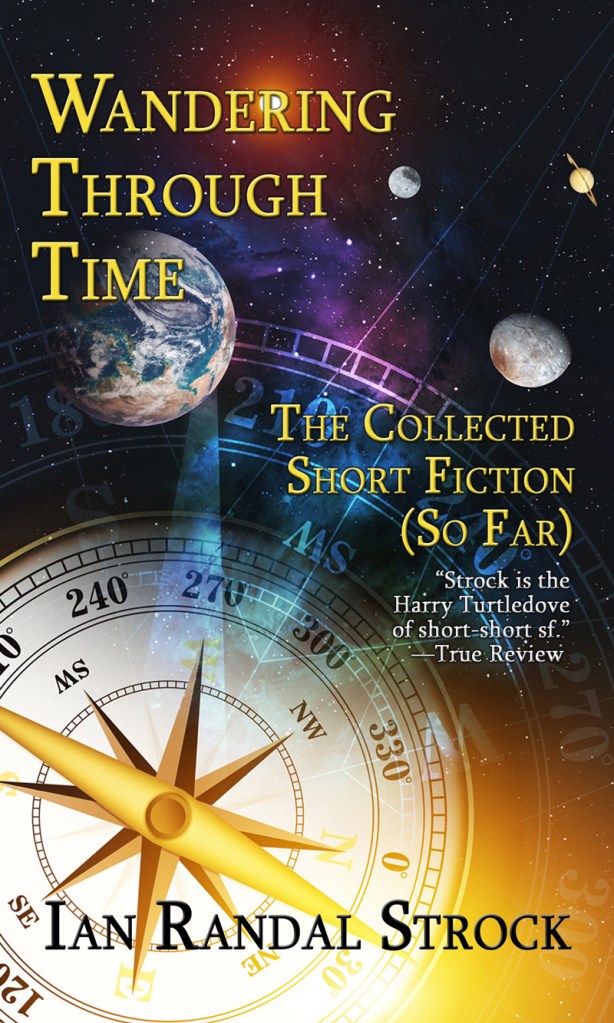
I’ve been writing short fiction and being professionally published for a long time, but now, finally, I’ve collected those stories which appear in magazines and anthologies into a collection all my own. I’ve also written introductions for each story, to tell the reader a little about my writing process, and show from whence come the ideas behind them.
Today, I’m hoping all my friends, fans, and followers will do me the huge favor of sharing this post, to help me spread the word. Thank you!
I asked my friend and mentor Stanley Schmidt, who was the editor of Analog from 1978 to 2012, to give me a blurb for the collection. He read it, and then wrote “The short-short story is one of the hardest kinds of fiction to pull off, and few since Fredric Brown have done it as often or as well as Ian Randal Strock. But that’s not all he does. Wandering Through Time displays a delightful diversity of his thought-provoking ideas and engaging storytelling.”
His successor at Analog, Trevor Quachri, who also buys my stories for publication, wrote “This is the kind of classic, clever idea-oriented SF you’d find in the Golden Age, but built for today. Recommended for your witty friends, history buffs, time-travel fans, and anyone curious for a peek behind the curtain at magazine publishing.”
Hugo Award-winner Robert J. Sawyer offered these kind words: “Ian Randal Strock is a literal genius—a card-carrying member of Mensa—and his intellect shines through on every page of this fabulous collection. From the man who helped steer Analog for many years comes this wonderful sampler of just the sort of stories I love to read.”
And Andrew Andrews at True Review reviewed the book and wrote: “Ian Randal Strock is the Harry Turtledove of short-short SF. His alternate-history stories have punch. The take on a geographically divided America in the time of the Civil War rings strongly in ‘Shall Not Perish from the Earth.’ I think it’s Strock’s best tale. In ‘The Necessary Enemy,’ it’s always wars, it seems, that drive humankind’s progress and destiny. ‘Rockefeller on the Rocks’ proves that unique tales, true or not, of U.S. vice presidents could perhaps work, with sufficiently advanced technology. Why can’t we replace veeps with robots? Who would know?”
Again, thank you for all your support over the years, and for helping me spread the word to feel even more like a real writer today!
Next Friday I’ll be at Philcon, which is my last scheduled convention of the year. Last! (For those of you counting along at home, I’ve already been to eleven sf conventions and seven Mensa conventions, and that’s not counting meetings, speeches, and more personal out-of-town trips.)
If you’re looking for me at Philcon (in Cherry Hill, New Jersey), I will, as always, be spending a lot of time at the Fantastic Books table in the dealers’ room. But I’m also on programming. You’ll be able to see me at:
Friday at 7:00pm in Grand Ballroom: “Whose Line, SFF Style!” with Melody Cryptid, Randee Dawn, Odele Pax, Michael A. Ventrella, and Abigail Welsher.
Friday at 9:00pm in Crystal 3: “A Funny Thing Happened on the Way to the Con” with Tony Finan, Brian T. Price, Roberta Rogow, and Michael A. Ventrella.
Saturday at 12:00n in Plaza 5: “Remembering Tom Purdom” with Barbara Purdom, Mark Roth-Whitworth, and Michael Swanwick.
Saturday at 6:00pm in Plaza 5: “How to Write a Cover Letter for Your Novel” with Ken Altabef, Isabel J. Kim, and David Walton.
Hoping to see many of you there, because I don’t have another convention scheduled for more than two months.
I just received an awesome blurb from Stanley Schmidt, who was the editor of Analog Science Fiction and Fact from 1978 to 2012, and who is a 35-time Hugo Award nominee. Stan writes of my upcoming collection:
“The short-short story is one of the hardest kinds of fiction to pull off, and few since Fredric Brown have done it as often or as well as Ian Randal Strock. But that’s not all he does. Wandering Through Time displays a delightful diversity of his thought-provoking ideas and engaging storytelling.”
On several pages, I’m seeing that today is National Science Fiction Day, so chosen because it coincides with Isaac Asimov’s birthday. Well, I’m a science fiction writer and publisher, so that’s as good a reason as any to encourage you to go read some science fiction.
It also reminds me that, next Saturday, I’ll be the monthly speaker for Eastern Oklahoma Mensa, talking about “A Century of Asimov” and my time with him. I won’t actually be in Oklahoma (which is one of the 15 states I have not yet visited), but I’ll be using the formerly science fictional method of Zoom to join them electronically.
Virtual convention weekend: Philcon has moved most of the con online, and I’m doing four panels for them (the most I’ve had at any virtual convention this year). One of them was already this evening, but the two tomorrow and one Sunday I thought I had are actually three on Saturday (November 21):
10am: “Heinlein’s Third Rule of Writing” with Barbara Barnett, Lawrence M. Schoen, Michael Swanwick, and Elektra Hammond.
2:30pm: “Kickstarting Your Next Project” with Keith DeCandido, Danielle Ackley-Mcphail, Neil Clarke, and Alex Shvartsman.
8:30pm: “What Else Might Have Changed?” with Simone Zelitch, Miriam Scheiber Seidel, and Tom Doyle.
The panels are on Zoom, with after-panel discussions on Discord. Details on the Philcon web site.