Future Boston

A press release from Fantastic Books:

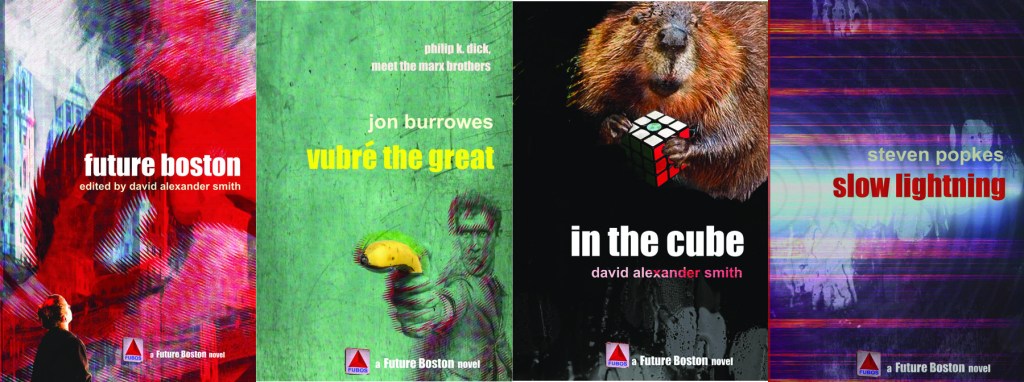
Fantastic Books is pleased to bring the Future Boston series back into print.

First appearing in 1994, this four-book cycle tells the history of New England’s most populous city from 1990 to 2100. In those years, Boston is slowly sinking into the sea. The citizens of Boston plan a revolution against the governments of Earth. Alien races occupy the city and must decide if the human race deserves full galactic citizenship—or total destruction.

The mosaic novel Future Boston is the sweeping saga of a handful of dreamers—artists and scientists, scufflers and survivors, revolutionaries and thieves—who dream of a new society as their ancestors did before them. From slums to Brahmin boardrooms, Future Boston is a rich mosaic of history and human drama, as real as the great metropolis that inspired it. It features the work of Jon Burrowes, Alexander Jablokov, Geoffrey Landis, Resa Nelson, Steven Popkes, David Alexander Smith, and Sarah Smith.

Publishers Weekly called it “Adventure-filled… a wealth of evocative detail.… The real star is a painstakingly constructed future Boston,” while Locus said “Future Boston is more than the sum of its parts—and its parts are very good.”

Following Future Boston is Jon Burrowes’ novel Vubré the Great, in which a space ship breaks down, and the aliens check into little old Motel-o Earth-o to see if they can find a new conduction bolt for their night-drive. And the next thing you know, alien technology and ideas are erasing the cultures of Earth forever.

In David Alexander Smith’s In the Cube, private detective Beverly O’Meara is paired with Akktry, a small, sharp-clawed animal that has an inhuman affinity with the past and an ability to recreate the history of any place or person from the remains of the present. They’re on the trail of Diana Sherwood, the missing daughter of the most powerful—and hated—woman in sinking Boston. Unfortunately, that trail leads straight into the Basement, the oldest, lowest, most dangerous part of Boston. The part below sea level. The part you can down in…

Hugo, Nebula, and Locus award-winning author James Patrick Kelly said “In the Cube is David Alexander Smith’s best book.… Not only do his humans live and breathe, but he has drawn some of the strangest and most convincing aliens you’ll ever meet.”

Rounding out the series is Steven Popkes’ Slow Lightning, in which Ira and Gray find an egg on an abandoned ferryboat. It’s wrinkled, with smears of red and yellow, and bigger than a basketball. They’re not sure why it’s there, only that it must have been left there on purpose.

Science fiction Grand Master Poul Anderson said “Slow Lightning does a remarkable job of conveying the sheer strangeness of the universe and the future.”

Future Boston
Edited by David Alexander Smith
ISBN: 978-1-5154-5823-4
$17.99, 328 pages, trade paperback; $7.99 ebook

Vubré the Great
by Jon Burrowes
ISBN: 978-1-5154-5824-1
$16.99, 256 pages, trade paperback; $7.99 ebook

In the Cube
by David Alexander Smith
ISBN: 978-1-5154-5825-8
$16.99, 242 pages, trade paperback; $7.99 ebook

Slow Lightning
by Steven Popkes
ISBN: 978-1-5154-8526-1
$12.99, 124 pages, trade paperback; $6.99 ebook

The Future Boston series—and all Fantastic Books books—are distributed via Ingram. Review copies are available upon request.
Book Birthday!

I’m so excited!

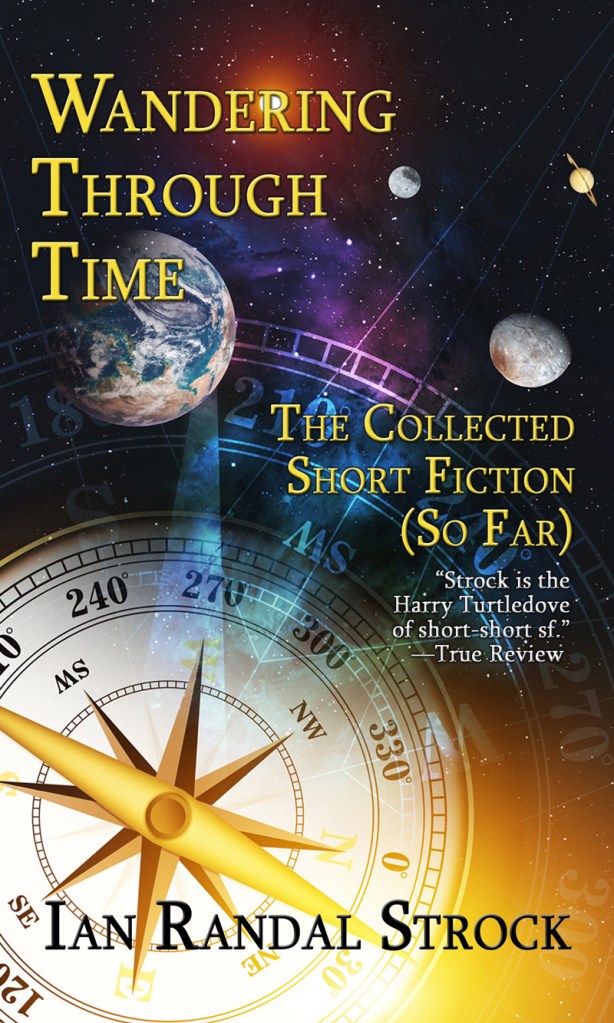
Today is publication day for my first fiction collection, Wandering Through Time!

I’ve been writing short fiction and being professionally published for a long time, but now, finally, I’ve collected those stories which appear in magazines and anthologies into a collection all my own. I’ve also written introductions for each story, to tell the reader a little about my writing process, and show from whence come the ideas behind them.

Today, I’m hoping all my friends, fans, and followers will do me the huge favor of sharing this post, to help me spread the word. Thank you!

I asked my friend and mentor Stanley Schmidt, who was the editor of Analog from 1978 to 2012, to give me a blurb for the collection. He read it, and then wrote “The short-short story is one of the hardest kinds of fiction to pull off, and few since Fredric Brown have done it as often or as well as Ian Randal Strock. But that’s not all he does. Wandering Through Time displays a delightful diversity of his thought-provoking ideas and engaging storytelling.”

His successor at Analog, Trevor Quachri, who also buys my stories for publication, wrote “This is the kind of classic, clever idea-oriented SF you’d find in the Golden Age, but built for today. Recommended for your witty friends, history buffs, time-travel fans, and anyone curious for a peek behind the curtain at magazine publishing.”

Hugo Award-winner Robert J. Sawyer offered these kind words: “Ian Randal Strock is a literal genius—a card-carrying member of Mensa—and his intellect shines through on every page of this fabulous collection. From the man who helped steer Analog for many years comes this wonderful sampler of just the sort of stories I love to read.”

And Andrew Andrews at True Review reviewed the book and wrote: “Ian Randal Strock is the Harry Turtledove of short-short SF. His alternate-history stories have punch. The take on a geographically divided America in the time of the Civil War rings strongly in ‘Shall Not Perish from the Earth.’ I think it’s Strock’s best tale. In ‘The Necessary Enemy,’ it’s always wars, it seems, that drive humankind’s progress and destiny. ‘Rockefeller on the Rocks’ proves that unique tales, true or not, of U.S. vice presidents could perhaps work, with sufficiently advanced technology. Why can’t we replace veeps with robots? Who would know?”

Again, thank you for all your support over the years, and for helping me spread the word to feel even more like a real writer today!

Reviews!

The new issue of True Review has just been posted. In this one, they’ve reviewed two Fantastic Books titles: one six years old, the other still two months from being published.

Of Susan Casper’s The Red Carnival, reviewer Andrew Andrews writes “I love Casper’s style. It is truly gritty, edgy, compelling, dark and emotional. In this case, there is a stark and sinister force at this carny in the town of Somerset that makes all the festival lights turn red. There is a ride that appears out of nowhere, not attested to by the carny operators, called ‘Golgotha, Place of Skulls,’ and there comes a frenzy of violence by the carnygo’ers and carny staff. There is an impulsivity to this narrative that is disturbing, yet almost amusing.”

That’s a good review of a very good book, and I don’t want to take anything away from it.

But of far more personal import is his review of my forthcoming collection, Wandering Through Time. He writes: “Ian Randal Strock is the Harry Turtledove of short-short SF. His alternate-history stories have punch. The take on a geographically divided America in the time of the Civil War rings strongly in ‘Shall Not Perish from the Earth.’ I think it’s Strock’s best tale. In ‘The Necessary Enemy,’ it’s always wars, it seems, that drive humankind’s progress and destiny. ‘Rockefeller on the Rocks’ proves that unique tales, true or not, of U.S. vice presidents could perhaps work, with sufficiently advanced technology. Why can’t we replace veeps with robots? Who would know?”

I’m thrilled, honored, and a humbled to be compared to Harry Turtledove. My book is being released on December 3.