The Said Book

For years, I’ve been talking to beginning writers, both in solo presentations and on convention panels. One of the things all we experienced writers and editors tell them is to not use too many said-bookisms—that is, all those words one might use as a dialogue tag instead of “said.” And for all those years, to me it was just a term, one I never bothered to investigate, to figure out from whence it came.

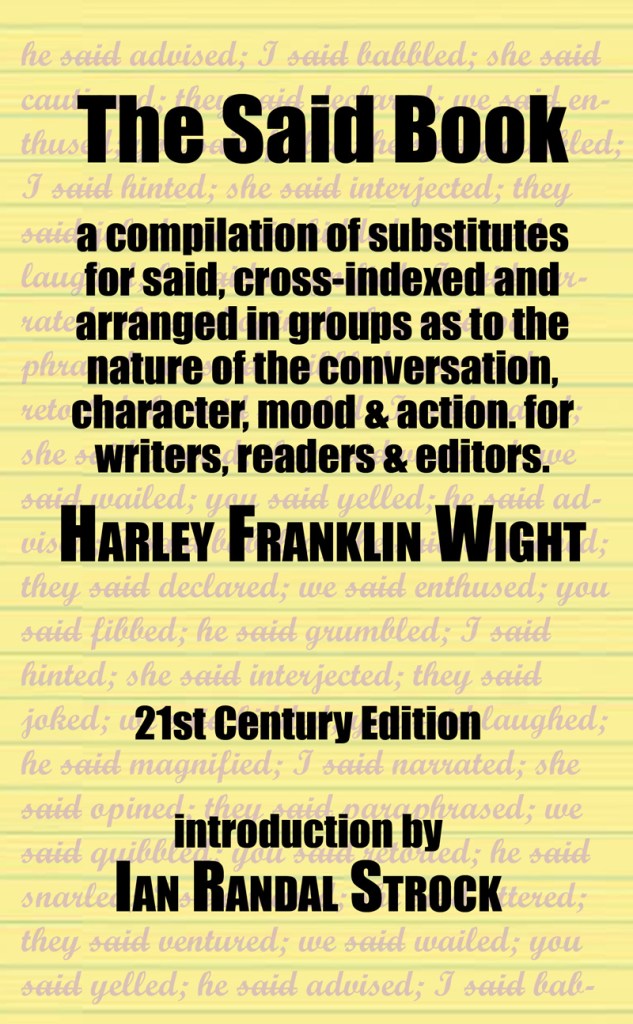
I recently learned that the term “said-bookism” comes from… wait for it… THE SAID BOOK! Yes, there is an actual book called The Said Book, which is a thesaurus for the word “said.” And it’s got a subtitle big enough to choke a moose: “a compilation of substitutes for said, cross-indexed and arranged in groups as to the nature of the conversation, character, mood & action. For writers, readers & editors.”

At the time it was published—in the 1930s—apparently using the word “said” was a horrible thing that writers needed to avoid at all costs, so Harley Franklin Wight (he is credited as H.F. Wight on the original cover) put together this book to help them not write “said.” Now, the book is mostly a historical artifact, an oddity, and a look at a fashion from the past.

Due to its publication history, the book has been nigh unto impossible to find. Until now. I’ve found the book, corrected several mistakes in the original (including sections that were mis-alphabetized), and brought it back into print, for those of you whose writing is littered with too many saids, and who are looking for guide to all those other words. Or not. But it’s a fun look at the past. With a new introduction I wrote, just to put the book in a slightly wider context.

How am I doing?

Last night, I was at Readercon for about 25 minutes. I went to the hotel just to drop off the boxes of books which I’ll be setting up today. Then I returned the luggage cart, and in the forty feet I had to walk from leaving the luggage cart to exiting the hotel door to get back to the car, I stopped and talked with five people I know. (In other words, a standard convention: can’t walk down a hall without stopping to talk.)

Each of them asked how I was doing, and to each, I gave the same flippant answer I’ve been using for years: “I’m properly insane.” With those three words, I usually intend to convey the fact that I’m busy, doing many things, but they’re the things I should be doing.

But last night, getting ready for bed, I had something of an epiphany. Sure, I’m busy, but actually the answer to “how am I doing?” is “pretty damn good!”

RESISTANCE (the anthology I edited to help support the ACLU and Pro Publica) is doing well, and people are appreciating it.

Last week, I got a fan letter about PUNCTILIOUS PUNCTUATION.

I’m excited to be publishing Allen Steele’s newest novel, LEMURIA 7, on Tuesday.

I’m just about finished editing a really great book about film that I’ve been enjoying.

I’m excited to be working with a brand-new author on a two-book science fiction tale that I think a lot of people are going to like as much as I do.

I’ve got several more authors waiting for my close attention, most of them waiting patiently.

And in the few brief moments I give myself to do my own writing, it feels like I’m improving. And when I finish the stories I’m working on, I have some confidence I’ll be able to find an editor who agrees that they’re good, and wants to publish them.

I’m doing a job I want to be doing. My friends seem to value and like me, and I’m very glad to have them in my life.

And now I have to leave to go set up those books at the convention, because selling books and talking on panels to appreciative audiences is my day job.

Sure, I’m busy, trying to think in several different directions at once. But you know what? I’m doing pretty damn good!

Where are reviewers hiding?

When I worked for Analog and Asimov’s, we had a perennial question: Analog routinely outsold Asimov’s by five or ten percent, but when it came to awards time, stories from Asimov’s always got lots of nominations and awards, while Analog garnered almost none. We knew Analog readers actually read the stories, because they wrote letters and kept renewing their subscriptions; they simply weren’t people who were interested in nominating or voting for awards. And I felt badly for the writers who didn’t see that external recognition, but there was nothing we could do to convince those readers to get into the award-nominating and -voting mindset.

Now I’m experiencing something similar, but not talking about awards. I know Fantastic Books books are selling and being read. For instance, the anthology Resistance was the #1 new release in American Literature Anthologies on Amazon, it is selling copies, and several readers have commented to me on individual stories in the book. But like most of the books my company publishes, it was yet to see a single reader review on either Amazon or GoodReads, or LibraryThing, or anywhere else I can find.

In the modern bookselling world, reader reviews are important. They make books more findable, increase their visibility on the bookselling platforms, and apparently translate to better sales numbers. But I have simply not been able to figure out why my readers are among those who don’t post reader reviews. In the old days, at Analog and Asimov’s, those readers who wanted to comment on stories had to write physical letters, in envelopes with stamps sent through the mail, and they did: we received dozens of letters every week. But today, those reader reviews are as simple as “click here, click a number of stars, type a couple of words.” Literally, just four or five words is sufficient: “I liked the book.” or “The story with the AI was cool.” And yet, nothing.

So I’m asking y’all: how do you urge readers to write those reviews? Or for those of you who do: what urges you to write a review?

A problem with names

Most of my fiction is short, sometimes very short. And I write a lot of my stories in the first person, because I find it lends intimacy and immediacy to the story.

But one of the stories I am currently writing seems to be more suited to being told in third person. Fine, good. It gives some room for a narrator (which I also enjoy doing). But a skill that seems to have atrophied because of all of my first-person writing is that I’m having trouble naming and describing the characters.

With a first-person point of view, the main character will rarely or never mention his own name. And think about how often you use other people’s names: if you’re talking with someone you know, you can go a very long time without either one of you mentioning your own or the other’s name.

Similarly, unless there’s been some great change—a new hair style or an interesting outfit—you’ll rarely describe or “characterize” yourself or the other. Heck, I look in the mirror every morning, but I almost never remark on my own appearance (well, other than this week, when I’ve been watching this subconjunctival hemorrhage turning my left eye a remarkably horrifying red, but the doctor said it should resolve itself in a few days [and yes, there’s a bit of characterization that doesn’t really move the story forward, but does lend color, if you will, to the tale]).

Back to my original point: I know sometimes names are very important, and can be a large part of characterization, but far more often, character names are just indicators so the author can differentiate one from another. So how do you pick a good name—and perhaps interesting characteristics—when those aren’t the foci of the story you’re telling?

P.S.—I thought about including a picture of my eye, but decided it would gross out more people than it would attract readers.

2025: The Year in Reading and Writing

A bunch of my friends do this, and I’ve done it in the past, but let it slide the last few years. My list is not so impressive as many others’, but for… reasons.
 
The books I read in 2025:
 
The Complete Sherlock Holmes by Arthur Conan Doyle. So many of my friends and acquaintances so often talk about Holmes, and I’ve come to understand the mythos somewhat, so I finally decided it was time to read some Sherlock Holmes. Well, I decided to just read ALL of Sherlock Holmes. So now I’m caught up.
 
The Prince by Niccolo Machiavelli. Another one of those classics to which reference is often made, but which I hadn’t actually read. When I did finally finish it, I remember thinking the last few chapters seem to play (or at least pre-echo) a great deal of President Trump’s politics.
 
Godel Escher Bach by Douglas R. Hofstadter. I’d been reading this one, off and on (mostly off) for quite a long time. I finally finished it. Seems a little predictive and a little dated.
 
Tales of Galactic Pest Control edited by David Gerrold and Tom Easton. Some very good stories in this anthology, including one of mine.
 
Unidentified Funny Objects 7 edited by Alex Shvartsman. I didn’t laugh at all of them, but a good enough percentage.
 
The books I edited and published:
Ginger Snaps by A.R. Alan
Mystralhaven by Ron Kaiser
A Talent to Amuse by Daniel M. Kimmel
The Lies We Tell Others edited by Sahar Abdulaziz and Michael A. Ventrella
 
I also read and edited and worked on another seven books that will be published in 2026. I’ll talk about them in the near future.
 
By some measures, that’s not a lot. Only eighteen titles. Still, the Complete Sherlock Holmes is several books’ worth of reading. And in the cases of the books I edited, that was reading each of them two or three times (or even a few more, through various iterations). So I’m not embarrassed, but not bragging, either.
 
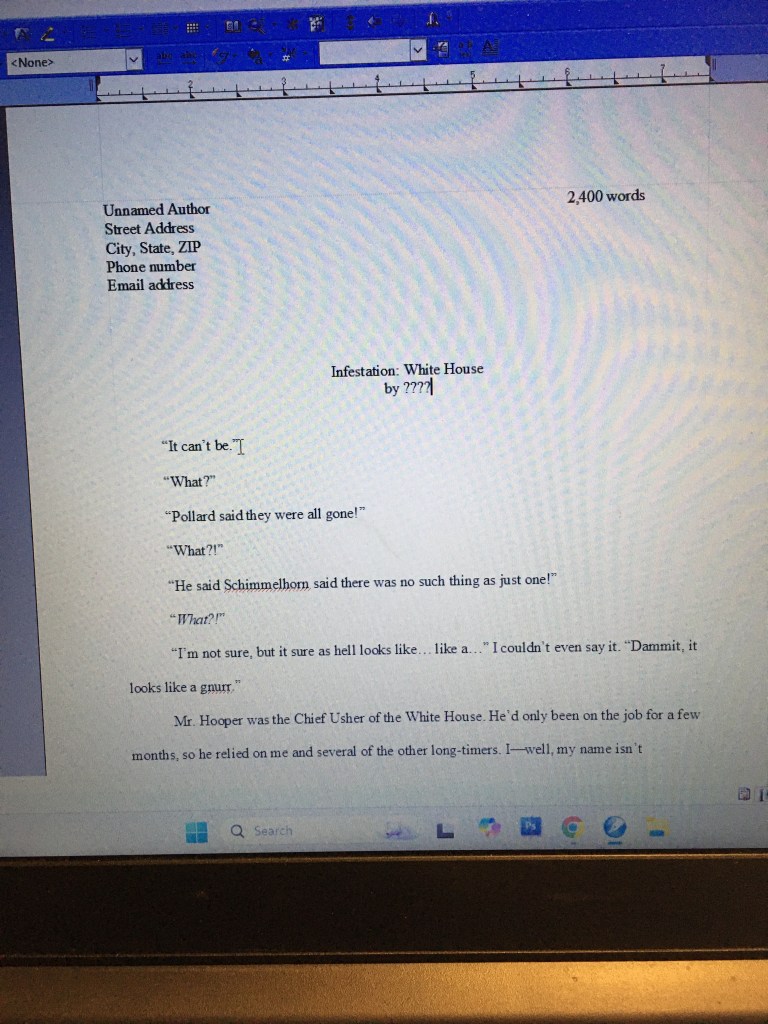
Finally, I am also a writer. And while too much time editing means very little time writing, I did manage to finishing writing and publish my book Punctilious Punctuation. And two of my stories saw print: “…a Crack of Lightning, or, The Zen Solipsist Muses Upon His Own Genesis” appeared from Amazing Stories on June 16, 2025; and “Infestation: White House” appeared in the anthology Tales of Galactic Pest Control, edited by David Gerrold and Tom Easton (July 2025).
 
Writing is a very emotionally rewarding occupation, but it isn’t exactly financially rewarding, so I’ve also joined the crowed, and set up a ko-fi page as a tip jar. If you’re so inclined, anything and everything will be gratefully appreciated, at https://ko-fi.com/ianrandalstrock . Thank you, and happy 2026. Let’s read!

Don’t Tell Me

I’ve been trying to be a better writer recently. I’ve actually been writing every day, and I’m making more of an effort to find markets for my writing (haven’t had much luck finding paying markets for my essays recently; my fiction—as does everyone’s—sometimes takes quite a while to find the right home).

Something I noticed several years ago—but which is making more of an impression as I’m making more of an effort to find places to sell my stories—is those markets requiring anonymized submissions. It’s not a terribly onerous burden—saving another copy of the story without my name on it—but I’ve been wondering who it really serves?

As a professional, I know that the most important people in the publishing ecosystem are the advertisers and the readers: those who pay for the magazine to exist. Everyone else is of secondary import. And I’m wondering if any of them care, or even notice, if the magazine or anthology in question requires anonymized submissions.

I did a quick search of publications who don’t want to know who wrote the story they’re considering, and found these examples from their guidelines:

Remember to take all author information out of your story! Tell us who you are in the space provided in the web form cover letter you get when you click on the “submit” button, NOT in your story! No headers, no bylines… just the story.

Please anonymize your work. No names or other identifying information should appear on the manuscript.

Anonymous Submissions. No identifying information should appear on your manuscript. We use anonymized submissions for our associate editors (first readers). Only upper-level editors will read your submission form information and cover letter, including any diversity statement. Failure to anonymize the manuscript will not cause us to automatically reject your story, but failure to read and follow our guidelines may affect our decisions.

Anonymity: Please do not put your name on your manuscript. All stories are assessed anonymously. [Ironically, this one requires contributors to identify as part of a specific community.]

[Magazine name] only accepts anonymous submissions. Please do not include your name, address, phone number, or other similar identifiers in the manuscript itself. All original fiction and poetry submissions will be read anonymously on first read: moving on to further consideration will depend on the merit of the work alone.

As I said, it’s not a terrible burden on the would-be writers (other than making sure the manuscript file I send is the anonymized one, not the regular one). But does anyone notice? Has any reader ever picked up a magazine and said “This is a great issue. I’m glad the submissions were anonymous.”? or “This issue would have been a lot better if the editor reading the submissions didn’t know the names of the authors before buying the stories.”?

For you readers out there: did you even know this was a thing?


Publication Day: Mystralhaven

It’s publication day!

Fantastic Books is thrilled to be publishing a major new fantasy novel by first-time novelist Ron Kaiser, who Paul Witcover calls “a bold new voice in epic fantasy.” Mystralhaven is the tale of Baz, the Mossbringer, who may be able to save humanity, if only she can figure out her own powers before she is enslaved or killed.

Sebsastien de Castell (author of the Greatcoats and Spellsinger series) says the book blends “classic epic fantasy adventure with modern themes,” and that it “is a fast-paced, emotionally charged tale of magic, duty and the complex nature of heroism. Ron Kaiser’s fearless protagonist discovers not only the burden of destiny but the difficult balance between fighting exploitation and believing in redemption.”

Can she figure out what she is in time to save humanity?

The coming of Baz, the Mossbringer, has been foretold: she has powers far beyond those of even the most gifted around her. And had her mother lived, she certainly would have been able to guide Baz through her dawning awareness of her abilities.

But even if Baz learns how to control and use those powers, it may not be enough to save the monks who want to use her, the Borderforges who want to enslave her, or the people who fear her. Can she trust Rendwyll—who is more sand than person—to guide her into her new awareness? With the fate of the world hanging in the balance, can she afford not to?

“This thrilling hero’s quest is a pulse-pounding journey. Ron Kaiser’s epic novel had me thoroughly gripped, from start to finish.” —David Yoo, author of The Choke Artist and The Detention Club

“Artful prose, strong characterization and a freewheeling imagination lights up this fascinating tale. This one is in the top echelon of modern fantasy.” —Bram Stoker Award-winner John Shirley, author of A Sorcerer of Atlantis

With an eye-catching cover by new artist Helen Cotrupi, Mystralhaven: The Mossbringer is available today in trade paperback, case laminate hardcover, and ebook formats. For more details and links, see https://www.fantasticbooks.biz/product-page/mystralhaven-by-ron-kaiser.

Fiction Today, Tomorrow, and Hopefully Soon

Three quick announcements from Ian the fiction writer.

One. My latest story, “…a Crack of Lightning, or, The Zen Solipsist Muses Upon His Own Genesis,” is available starting today from Amazing Stories at this link: https://amazingstories.com/2025/06/a-crack-of-lightning-by-ian-randal-strock-free-story/ . Check it out!

Two. Tomorrow, I’m one of the readers at the monthly Brooklyn Books & Booze reading event at Barrow’s Intense Tasting Room, 86 34th Street, in Brooklyn, New York. Admission is free, but it is a bar, and they’re hoping you’ll be thirsty for beverages as well as for great fiction. Hosted by Randee Dawn, the June 17 event will feature me, Clay McLeod Chapman, Meg Ripley, and L. Marie Wood. Festivities start at 7:00 pm, so be there! More details at https://randeedawn.com/bonus/brooklyn-books-booze/

Three. I’ve got a new story, “Infestation: White House,” scheduled to appear in the forthcoming anthology Tales of Galactic Pest Control (edited by David Gerrold and Tom Easton). But in order for it to appear, the winding-up-soon Kickstarter campaign needs a little more push to get to the funding line. If you’re interested in reading the story, reading the book, consider pre-purchasing a copy. And if you can’t lay out the money now, at least please tell your friends about it. I, the editors, and the other authors (it’s an awesome line-up; at least check out the link here to see who else is involved) thank you. The link is https://www.kickstarter.com/projects/galactic-pests/tales-of-galactic-pest-controla-sci-fi-and-fantasy-anthology?ref=discovery&term=galactic%20pest%20control&total_hits=1&category_id=324

Barry N. Malzberg (1939-2024)

Late last night, I learned that Barry N. Malzberg had died. Born July 24, 1939, he was a writer and editor. His daughter, Erika, wrote: “My dad passed away this evening, around 4:30pm. My sister had been with him for a few hours and I was just getting back after having visited with my mother. He took his last breath almost the moment I arrived. It was very, very peaceful and we are so grateful.”

His fiction was ground-breaking and seemingly everywhere moments after he started publishing (his first science fiction story, “We’re Coming Through the Window,” was published in the August 1967 issue of Galaxy), but I’ll probably remember him more for his non-fiction: his essays on science fiction, literature, and the people in the field, which was his stock-in-trade for the last couple of decades.

I remember Barry as a fixture at the science fiction conventions I attended when I first got into the field, but I never really got to know him: there were too many bright and shiny new things and people clamoring for my attention for me to seek out the austere, somewhat foreboding looking fellow he was. Now, reading the reminiscences of so many of my friends, I’m realizing just how much I missed out by not getting to know him better. Rather than trying to recapitulate them, I commend to you posts on Facebook by John Kessel (https://www.facebook.com/john.kessel3), Adam-Troy Castro (https://www.facebook.com/adamtroycastro), and Kristine Kathryn Rusch (https://www.facebook.com/kristinekathrynrusch). I’m sure there will be more in the coming days.

He was nominated for a dozen Hugo and Nebula Awards, and his novel Beyond Apollo won the inaugural John W. Campbell Memorial Award in 1973. His nonfiction works won two Locus Awards: The Engines of the Night (1983), and Breakfast in the Ruins: Science Fiction in the Last Millennium (2008), and I was pleased and honored to publish his third volume, The Bend at the End of the Road (2018).

T. Jackson King (1948-2024)

I’ve just learned of the death of Thomas King, Jr., who wrote as several dozen books as T. Jackson King, on December 3, at the age of 76. In his last post on Facebook, dated November 24, he wrote:

Sorry for the delay on AI SURVIVAL [his planned next novel]. 2024 has been traumatic for me. Wife divorced me. Coping with Diabetes and Asthma. Now diagnosed with Congestive Heart Failure! Still hanging in there. Planning to write on the novel come Jan. 1, 2025. Thanks for being loyal readers! Tom. FYI, Readers can contact me via email. Or visit my Facebook page for T. Jackson King. Tom.

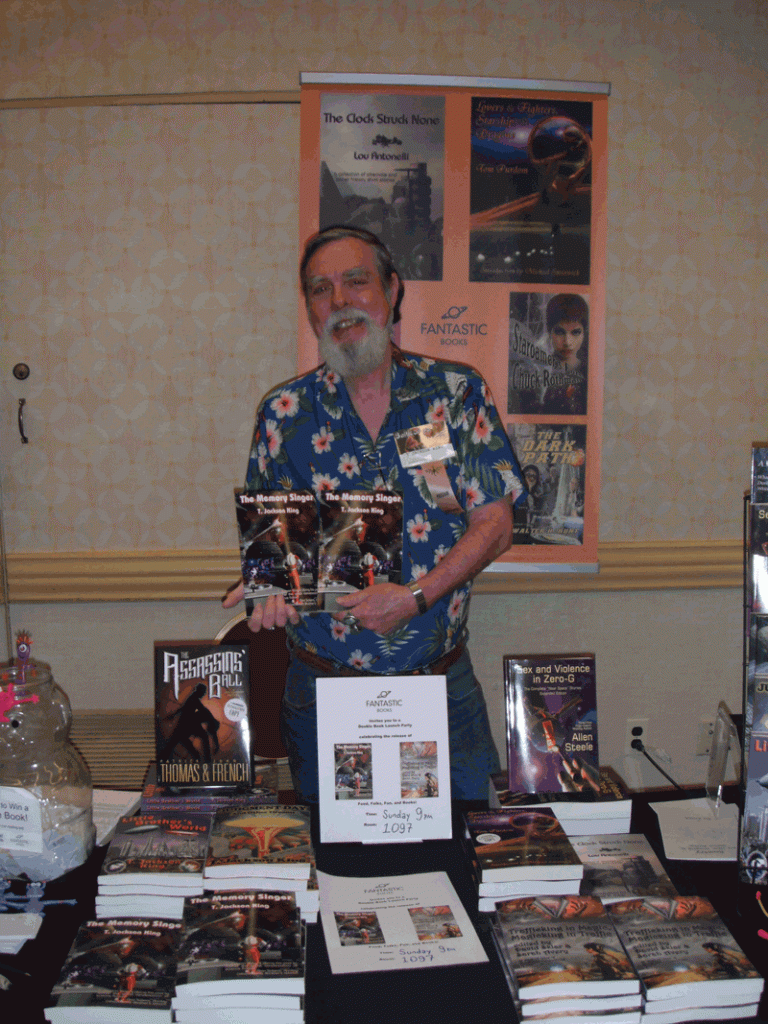
His YA novel, Little Brother’s World, was one of the first original books I accepted for Fantastic Books. In 2014, we launched his novel The Memory Singer at Balticon, which is when I met him in real life (whence the attached picture; apparently I didn’t get a picture of the two of us together). I think that convention was the only time we were physically in the same space together, but he seemed to relish life, taking great joy from whatever he was doing. And his tales of his life beyond the walls of the convention hotel seemed to reflect that, too.

He was much more than just a science fiction writer, but it’s probably easiest to let him tell that story (this is his biography from his web site, https://www.tjacksonking.com/):

T. Jackson King (Tom) is a professional archaeologist and journalist. He writes hard science fiction, anthropological sci-fi, dark fantasy/horror and contemporary fantasy/magic realism—but that didn’t happen until he was 38.

Before then, college years spent in Paris and in Tokyo led Tom into antiwar activism, hanging out with some Japanese hippies and learning how often governments lie to their citizens. The latter lesson led him and a college buddy to publish the Shinjuku Sutra English language underground tabloid in Japan in 1967. That was followed by helping shut down the University of Tennessee at Knoxville campus in 1968 and a bus trip to Washington, D.C., for the Second March on Washington where thousands demanded an end to the Vietnam War.

Temporary sanity returned when Tom worked in a radiocarbon lab at UC Riverside and earned an MA degree in Archaeology from UCLA. His interests in ancient history, ancient cultures and journalism got him several government agency jobs that paid the bills, led him to roam the raw landscape of the Western United States, and helped him and his wife Leslee raise three kids.

A funny thing happened on the way to normality. By the time he was 38 and doing federal arky work in Colorado, Tom’s first novel Star Traders was a stage play in his head that wouldn’t go away. So he wrote it down. It got rejected. His next novel was published as Retread Shop (Warner Books, 1988). It was off to the writing races and Tom’s many voyages of imaginative discovery have led to 24 published novels, a book of poetry, and a conviction that when Humans reach the stars, we will find them crowded with space-going Aliens. We will be the New Kids On The Block! This theme appears in much of Tom’s short fiction and novel writing.

Tom lives in Santa Fe, New Mexico, USA and hangs with a group of smart and tolerant Westerners. Divorce has taught him to smile a lot and to work at being a Nice Guy. Still, he is pretty weird. Has been since fourth grade when he began reading sci-fi. Since then, he and Authority have rarely been in agreement.