 President George H.W. Bush (1989-93) died November 30, 2018—after living with Parkinson’s Disease for some time (he used a wheelchair for at least the last six years of his life)—at the age of 94 years, 171 days. Born June 12, 1924, in Milton, Massachusetts, he was the fourth President born in that state (after John and John Quincy Adams, and John Kennedy).
He served in the US Navy during World War II (the last veteran of the war to be elected President, following Dwight Eisenhower, John Kennedy, Lyndon Johnson, Richard Nixon, and Gerald Ford).
During the war, Bush married Barbara Pierce on January 6, 1945. They remained married until her death earlier this year: their 73-year marriage was the longest in Presidential history (Jimmy and Rosalynn Carter married 18 months after the Bushes; Gerald and Betty Ford were married just over 58 years.)
After the war, Bush worked in the oil industry and moved to Texas. In 1964, he lost a campaign for the Senate. In 1966, he was elected to the House of Representatives (serving two terms), and then President Nixon appointed him US Ambassador to the United Nations (he was the first—and to date, only—Ambassador to the UN to later be elected President). In 1974, President Ford appointed him de facto Ambassador to China (the post wasn’t titled until the resumption of full diplomatic relations in 1979). Again, he is the only former Ambassador to China to become President. After a year and a half in China, Ford appointed Bush the 11th Director of the Central Intelligence Agency (he served for the final year of Ford’s term, and is the only former CIA chief to become President). In 1980, he sought the Republican nomination for President, but lost it to Ronald Reagan, who chose Bush as his Vice Presidential running mate. After eight years in that post, Bush became the first sitting Vice President to be elected President since Martin Van Buren in 1836. In 1992, he became the 12th President to be defeated in his bid for re-election (inaugurating only the second era in US history that saw three successive Presidents elected to two consecutive terms).
Following his retirement from the Presidency, Bush became only the second former President to see his son elected President, when George W. Bush won the election of 2000 (and was re-elected in 2004). Unlike John Adams and John Quincy Adams, however, George H.W. Bush lived long enough to see his son retire from the Presidency. Indeed, George and Barbara Bush were only the second couple to outlive their son’s Presidency (following Joseph and Rose Kennedy, whose son was assassinated in 1963).
Just over a year ago, Bush became the longest-lived President, when he exceeded Gerald Ford’s record (of 93 years, 165 days). Jimmy Carter, who left the Presidency when Bush was elected Vice President, was born 111 days after Bush.
President Bush’s funeral this week will be the first presidential funeral since Ford’s (who died December 26, 2006). That nearly-twelve-year span is the fifth longest time the nation has gone without a President’s death.
Bush is first President to outlive his wife since Richard Nixon (whose wife, Pat, died in June 1993, ten months before he did).
Bush’s death means Carter is first President to outlive two of his successors since Harry Truman (who died after Dwight Eisenhower and John Kennedy, and one month before Lyndon Johnson).
The Presidency is usually considered an older person’s job. George Bush has been retired from the Presidency for almost 26 years, but he only ranks fourth on the list of longest-retired Presidents. Jimmy Carter leads that list, having left the Presidency nearly 39 years ago. Herbert Hoover’s 31 years, which took the title from John Adams, is now #2 (Ford was retired for just shy of 30 years). Carter has been senior living President since Gerald Ford’s death twelve years ago. Now he is also the oldest living President, the oldest person to assume that title.
There are now more living Presidents from the Democratic party than from the Republican party (Democrats Jimmy Carter, Bill Clinton, and Barack Obama, and Republicans George W. Bush and Donald Trump) for the first time since Harry Truman’s death in December 1972 (from the time of Dwight Eisenhower’s death in 1969, the living Presidents were Democrats Truman and Lyndon Johnson, and Republican Richard Nixon).
President George Herbert Walker Bush’s funeral is scheduled for Wednesday, with his burial at his Presidential library in Texas on Thursday.
 Have I mentioned that I’ve got another convention coming up next weekend? Actually,
 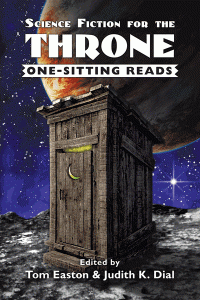 Peter Heck, writing in his “On Books” column in the November/December 2018 issue of
  Because I haven’t had one in three weeks, this coming weekend is another convention weekend! (Well, I did take a wonderful road trip to Vermont this past weekend, but there was no convention at the other end.) This time, it’s Boston Mensa’s
  Andy Andrews’ online review publication
  Tonight was the third of the five episodes of
 Ian Randal Strock