 Napoleon, Aristotle, and Dolley Madison go to Burning Man. How will they react? Is that a story you can write? Check out Three Time Travelers Walk Into… on Kickstarter. https://www.kickstarter.com/projects/667435382/three-time-travelers-walk-into
Historical Trio 6?
 Shaka Zulu, Montezuma, and Marie Antoinette walk into the Dew Drop Inn… sounds like a joke? Perhaps a fracture in the ripples of time. Think you can write it? Check out Three Time Travelers Walk Into… on Kickstarter. https://www.kickstarter.com/projects/667435382/three-time-travelers-walk-into
I forgot dessert
 I just realized there was a reward level missing from the current Kickstarter campaign: dessert! So now it’s there, The Sweet Time Machine, limited to only the first ten backers at that level!
Also, a comment elsewhere reminded me that the time traveling trios I’ve been posting are simply ideas for stories that might appear in the book… if you choose to write them. But the stories haven’t yet been written, and I have no idea which writers are going to write about which characters (though there is one pledge level where you can tell Peter David which characters to use).
Check out Three Time Travelers Walk Into… on Kickstarter. https://www.kickstarter.com/projects/667435382/three-time-travelers-walk-into
Historical Trio 5?
 Groucho Marx, Karl Marx, and Richard Marx at the signing of the Declaration of Independence… or writing it. Will the world today even be recognizable? Check out Three Time Travelers Walk Into… on Kickstarter. https://www.kickstarter.com/projects/667435382/three-time-travelers-walk-into
Get a jump on the time travelers
 Today’s the final day! If you want to get a jump on the time travelers, if you want to sign up for the ebook at the cheapest it will ever be, you have to get your pledge recorded by the end of today! If you back the Kickstarter campaign for Three Time Travelers Walk Into… in the next 11 hours, you can get an electronic copy of the anthology (when it’s published) for a scant $5. And if you’re interested in some of the other rewards, we’ve still got some great Tuckerizations available, and the truly awesome opportunity—for one person only—to tell Peter David what story to write for the book! Check it all out at https://www.kickstarter.com/projects/667435382/three-time-travelers-walk-into . And then remember to tell your friends.
Historical Trio 4?
 Amelia Earhart, Queen Victoria, and Marie Curie hanging out at Coachella: what a day! Check out Three Time Travelers Walk Into… on Kickstarter. https://www.kickstarter.com/projects/667435382/three-time-travelers-walk-into
Historical Trio 3?
 Jesus, Mary Shelley, and Josef Stalin painting the ceiling of the Sistine Chapel: what will it look like and how will it affect us? Check out Three Time Travelers Walk Into… on Kickstarter. https://www.kickstarter.com/projects/667435382/three-time-travelers-walk-into
Historical Trio 2?
 Groucho Marx, Karl Marx, and Richard Marx at the signing of the Declaration of Independence: what do you think would happen? Check out Three Time Travelers Walk Into… on Kickstarter. https://www.kickstarter.com/projects/667435382/three-time-travelers-walk-into
Historical Trio?
Theodore Roosevelt, Mae West, and P.T. Barnum on Marco Polo’s voyage to China: would you write that story? Check out Three Time Travelers Walk Into… on Kickstarter. https://www.kickstarter.com/projects/667435382/three-time-travelers-walk-into
Time Machines Through History
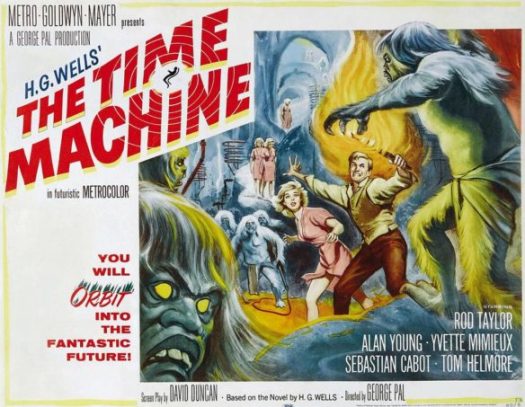 An interesting bit of synchronicity that I completed missed: on August 17, 1960, George Pal’s classic film The Time Machine (based on the iconic novel by H.G. Wells) debuted in New York City. On August 17, 2021, Fantastic Books’ Kickstarter campaign for Three Time Travelers Walk Into… debuted. And in one scant day, we’ve got 19% of the campaign’s goal already pledged. Thanks, everyone!
 Ian Randal Strock