Fantastic Books is honored to be publishing the updated-for-the-21st-century edition of the classic (Analog called it “fascinating”) Project Solar Sail.
Arthur C. Clarke’s “Sunjammer” updated an ancient dream, taking millions of readers on a sailing regatta in space. His stirring tale sparked a tech revolution that’s coming true today—interplanetary vehicles, navigating across the Solar System on inexhaustible torrents of sunlight!
Many others have since explored the coming, renewed age of sail. This intriguing anthology—updated for a new century—features both up-to-the-minute facts and future visions of solar sailing in a fascinating mix of stories, essays, and illustrations. Contributors range from JPL scientists to Isaac Asimov, Poul Anderson, Kevin Anderson, and Ray Bradbury. From classics by Arthur C. Clarke, David Brin, Joe Clifford Faust, and Larry Niven, to the latest missions by NASA and the Planetary Society. Even interstellar possibilities—explored by Robert L. Forward & Joel Davis—are now carried even farther in reports by space pioneers like Les Johnson, Robert Staehle & Louis Friedman. This 21st Century Edition, specially crafted by David Brin and Stephen W. Potts, also includes a lost gem by Jack Vance.
Of the original edition, Locus said “[T]his is not a book of dry prospects. The diversity of our strengths and the zest of the ideas unleashed is revealed by the range of fiction.… There is a ton of sense of wonder packed into this book, all about gossamer ships.”
Project Solar Sail edited by Arthur C. Clarke, David Brin, and Stephen W. Potts 224 pages, 21 illustrations Hardcover: $25.99, ISBN 978-1-5154-5819-7 Trade Paperback: $15.99, ISBN: 978-1-5154-5818-0
Project Solar Sail—and all Fantastic Books books—are distributed via Ingram. Review copies are available upon request.
Contents: Preface to the 21st Century edition by David Brin Foreword to the 20th Century edition: The Winds of Space by Arthur C. Clarke Introduction to the 20th Century edition: Sailing the Void by Isaac Asimov To Sail Beyond the Sun by Ray Bradbury and Jonathan V. Post Tripping the Light Fantastic: Lightsails in Science Fiction by Stephen W. Potts Sail 25 by Jack Vance The Wind from the Sun by Arthur C. Clarke Sailing on Light: Today and the Near Future by Les Johnson Sunjammer by Poul Anderson Lightsail by Scott E. Green The LightSail Program Propels Solar Sailing Forward by Bruce Betts The Fourth Profession by Larry Niven Sails in an Interplanetary Economy by Robert L. Staehle and Louis Friedman Rescue at L-5 by Kevin J. Anderson and Doug Beason Lightsails to the Stars by Robert L. Forward and Joel Davis Grand Tour by Charles Sheffield Riding on a Beam of Light by Steve Nadis Explorers by David Brin Goodnight, Children by Joe Clifford Faust About the Authors
Next weekend is my next science fiction convention. This time, I’ll be in the Inner Harbor area of Baltimore, Maryland, for Balticon. If you’re looking for me, as always, first check the Fantastic Books table in the dealers’ room, which will be open 2–7pm on Friday, 10am–7pm on Saturday and Sunday, and 10am–2pm on Monday.
I’ll also be on programming. Look for me on the following panels:
Friday at 4:00pm in Guilford: “What Good is an Agent?” with John Appel, Joshua Bilmes, and Shahid Mahmud
Saturday at 2:30pm in Guilford: “Punctuation and Other Things” with Sarah Avery, Carrie Gessner, and Elaine Stiles
Saturday at 8:30pm in Federal Hill: “Late Night Tales From the Slush Pile” with Neil Clarke, David Keener, Jennifer R. Povey, and Sheila Williams
Sunday at 11:30am in Gibson: “OH NO A Paradox!” with John Ashmead, Jack Campbell, Aaron M. Roth, and Martin Wilsey
Sunday at 4:00pm in Guilford: “Running a Small Press” with Neil Clarke, Shahid Mahmud, and Martin Wilsey
Sunday at 8:30pm in Mount Washington: “First Pages Party” with Joshua Bilmes, Morgan Hazelwood, and Sheila Williams
Only the third? It’ll be May. That seems to be far fewer than in usual years. Hmm…. Anyway…
I’m still on the road, and the current plans are for me to return to New York late Tuesday. Nevertheless, the wheel of conventions continues to roll on, and next weekend, I’ll be at Heliosphere in Piscataway, New Jersey.
If you’re looking to join me at the convention, I will be (as always) at the Fantastic Books table in the dealers’ room, open Friday 4–7pm, Saturday 10am–5pm, and Sunday 11am–3pm.
I’ll also be on programming, if you’re looking to join me for these fascinating discussions:
Saturday at 11:30am in Salon E: “This is How You Lose the Space Race”
Saturday at 2:30 pm in Salon E: “So You Want to Make an Anthology”
Sunday at 11:30am in Salon C: “Fact and Fiction: Hear from writers who write both”
I went to bed very early last Wednesday night, woke up about midnight, and was on the road before 1:30 am on Thursday. A weird time of day to leave, but in terms of traffic, it was wonderful. I got through the northeast metroplex, and was south of Washington, DC, before 6:00 am, before the traffic started to flow. I took a couple of longer-than-average rest breaks, and still rolled into the hotel’s parking lot in Charlotte, North Carolina, a few minutes before noon.
Mensa Mind Games—to bring you all up to speed—is an annual weekend gathering of Mensans. But unlike our Regional Gatherings or the Annual Gathering, Mind Games has a specific purpose, and no other programming. Games manufacturers submit their newest and best board games to Mensa for our review and judging. Attendees (the Mensan judges) promise to read the instructions, set up and play the game, and then rank it in five categories and offer commentary. (Those five categories are Aesthetics, Instructions [clarity, completeness, brevity], Originality, Play Appeal, and Play Value [can you play the game multiple times? Do you want to?].) At the end of the weekend, the player-judges vote for their seven favorites, and the top five are awarded the Mensa Select seal.
I had never attended Mind Games before, so I decided this was the year. There are a lot of members for whom Mind Games is the only event they attend each year, but it is a must-do for them; they love it. And I can see the appeal. On the other hand, the weekend was also incredibly tiring and intense, because giving due diligence to all the games can take a considerable amount of effort and time (for instance, a game that should take 60–90 minutes to play may also require an hour or more of reading the instructions, and then another half hour setting up the game, and that time estimate is usually for someone who has played the game before… so the actual time spent on any one game may be twice that estimate or more).
This year, there were 47 games submitted, though I gather that in most years, that number is closer to 60. When checking in, we each got lists of 30 games we were expected to play, as well as another list of the other 17 games, in case we had time/wanted to play them as well, to comment (votes are only taken from member-judges on the 30 assigned games; we all get different lists, so all the games get ample consideration). The game-playing is scheduled to start at 4:00 pm on Thursday, but we were able to get in and get gaming earlier, about 1:00. Before the gaming, a crew of volunteers had “fluffed” the games: unwrapped them, separated out any pieces that needed to be separated, sorted those pieces (usually into little plastic bags), and stacked the games in alphabetical order on the long table in the center of the room.
Once game-playing begins, judges find a game to play, people to play with, and get to it. I connected with three people I already knew—and knew to be good game players (no speed bumps in this crowd)—with whom I shared about half my list. It was their recommendation to start with the longest games requiring the most players, because it would be easier to find just one or two others for the smaller, quicker games later in the weekend. The first we attempted was a game for 4–6 players and 60–90 minutes. A fifth player joined us. After an hour of reading the instructions and setting up the initial game configuration, we jumped in. It was a long slog, just to get through the first round of turns, whereupon our fifth decided she understood the game, and chose to drop out and find another. But the game took a sharp turn on the third turn, and we played it out. It did not appeal to any of us. Indeed, the first four I played were less than thrilling. But eventually, I did come across several that were very good, that really caught my interest.
I played until 2:00 am Friday, got a few hours of sleep, took a quick swim and breakfast, and then it was back to the gaming. Friday I played until 3:00 am, and then Saturday was nearly the same. The last game on my list, late Saturday evening, was a one-player game designed for 8–to–12 year-olds (there were several that were for children, but we had to evaluate them as games themselves, as in “would you buy this for a child of that age?”). It, too, was a long slog, and ultimately unsatisfying (to me), though I did hear a child in the target age-range say it was her favorite. Oh, yes: member-judges ranged from probably 6 years old to well into their 80s.
After each game, I completed the comment card (with both the rankings and my comments). One comment I could have made (but didn’t) on nearly half the games I judged was “hire an editor!” The instructions, in many cases, were terrible. Misspelled words, grammar trouble, and poor punctuation were the least of it. Missing words and fuzzy instructions were far worse. And then—a trend in modern game design, apparently—the tediously long back-story to justify the design of the game, but which has no effect whatsoever on the game play. It’s bad enough if it’s the first half of the instructions one has to slog through to get to the instructions on how to play, but some of them decided to interleave the story with the instructions throughout the booklet. Oh, and another pet peeve: the instructions that walk us through setting up the game and playing the game, and only at the end talk about the object, how to win. A brief note up front on how to win—in other words, why one is playing the game—would greatly help many of them.
And one of the games I played said it was for 2–4 players. But the two-player version requires a non-player character, which is laid out in the instructions. Unfortunately, I chose to play that game in the two-player version, and the NPC was not fully fleshed out, not properly designed, so the game was not very enjoyable (actually, it didn’t seem to work, which was disappointing, because I liked the design and concept, and really wanted to like the game). But late Saturday, I had the opportunity to play it again with two others, and the game was much better, much easier to understand.
Saturday night/Sunday morning, the ballots are counted and the games are repackaged. At 10:00 Sunday, the winners are announced, and then the game give-away takes place. The names of the attendees have by this point been randomized, and they are read out, one at a time. The named person calls out the game he wants, and the next name is read (while runners deliver the games). I didn’t get one of the five winners, but I did get a game from the top of my list. I picked up a copy of Philosophy, a two-player strategy game (with a too-long back-story) with interesting game play. Players take turns placing tiles in the center nine squares of a board. Each tile can affect a tile next to it in a specific way (pushing the other tile this way or that, and so forth, which may push the next tile). The object is to get three in a row (the board is larger than three-by-three, but players can only place tiles in that three-by-three section). A seemingly key feature is that moving an opponent’s tile may also force one of the player’s tiles to move, which would enable it to take effect again, but I’ve now played the game six times, and that chain-reaction only occurred once or twice.
The winners of this year’s Mensa Select seal are (in alphabetical order): Abducktion, First in Flight, In the Footsteps of Darwin, The Vale of Eternity, and Wandering Towers.
Abducktion is a cute, easy strategy game in which each player has a small board with twelve spaces in sequence, each of which holds one of four different colors of duck. Using a hand of three cards that direct how to move one’s ducks (swap two, rotate a square of four, remove three and replace them, swap with one on another player’s board, etc.), each player in turn tries to form a pattern of ducks that matches one of three revealed pattern cards (worth varying amounts of points). At the end of one’s turn, the ducks on the card flow down to fill empty spaces, and then more ducks are added at the top of the card, the player’s hand is replenished to three movement cards, and the patterns are replenished to three. The game ends when all the pattern cards have been claimed.
First in Flight is the game I mentioned, which played poorly with two players, but well with three. It’s a deck-building game, themed on the early days of heavier-than-air powered flight. Pretty pieces, nice design, just make sure to play it in groups of three or four.
In the Footsteps of Darwin is one of those where the back story seems a bit longer than it needs to be. Each player, each turn, claims an animal card or an explorer card, which are worth either points or other features that can be multiplied into points. Certain combinations earn one multipliers or bonus points for certain sets of claimed cards.
The Vale of Eternity, too, is a deck-building game, of sorts. Each turn, players buy cards which can be played to earn points or money to buy others. Some cards can be removed after playing, but many remain in the played position on the board (which has a limited, though increasing turn-by-turn, number of spots in which to play cards). This game comes with a stand-up creature to be placed in the middle of the scoring board. The instructions note that the creature “makes for a more interesting picture when you take a picture of the game,” but otherwise is not part of the game.
Wandering Towers is the one of the five that was not on my list, so I didn’t play it. I probably could have found time to play it late Saturday night, but at that point, there were 17 games I hadn’t played, and I had no idea which would win… and I was played out!
It was a fascinating experience.
Sunday afternoon (as well as intermittently during the weekend), there was Mensa business discussion (because such always crop up when I’m with other officers of the organization), so I didn’t leave the hotel until after 4:30 Sunday afternoon. And then, because I was already half-way here, I continued south, and drove to Florida to visit my parents in their winter abode. Remember, I’d had about three hours of sleep each of the previous three nights. So I was kind of wrung out. I stopped a couple of times to walk around, and closed my eyes for a few minutes at a rest area in South Carolina. But just over the border into Florida, at the first rest area, I felt the need to close my eyes again. Those few minutes turned into seven hours of sleep in the car. Then I continued the drive in the morning light on down to Delray Beach, where I am now safe and sound and enjoying this quasi-vacation (while trying to do some work as well). I’ll head back north in a few days, and if any of you have read this far, I’ll be on the road up the east coast probably Monday and Tuesday, looking for reasons to pause and rest. Florida, Georgia, South Carolina, North Carolina, Virginia, Maryland, Delaware, New Jersey, and home. At least, that’s my current plan, though traffic conditions could conceivably push me farther west.
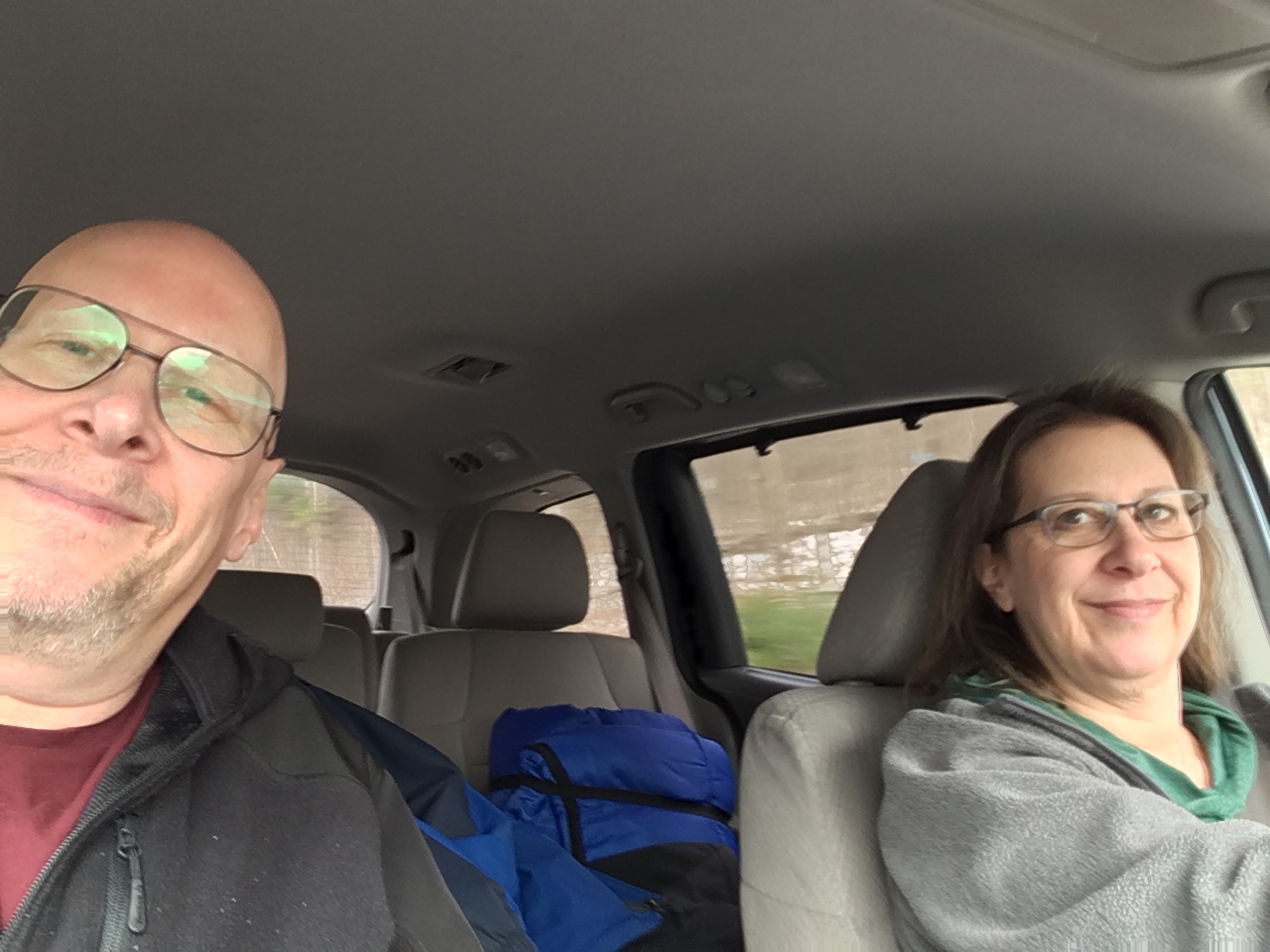
On the road from Massachusetts to eclipse adventures.
It’s been a long—but wonderful—week of traveling. Last Tuesday, I left New York for my sister’s house, to help out with some maintenance, and to spend a couple of days working there.
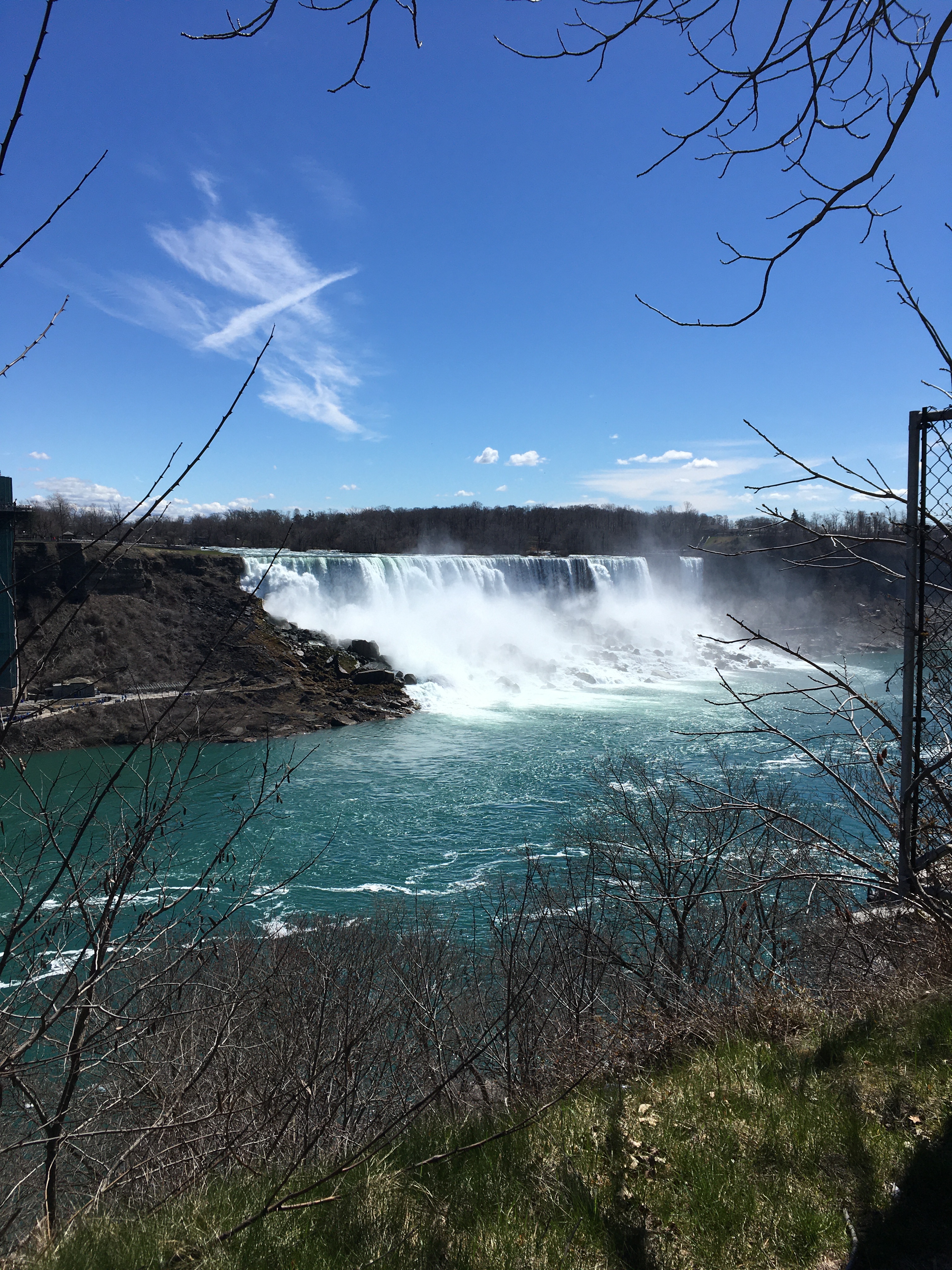
Niagara Falls (the American Falls).
Friday, after she got home from work. we hit the road for Ian and Laurie’s Great Eclipse 2024 Road Trip. We stopped for the night in Rome, New York, and made a brief visit to the Turning Stone Casino there. I played no-limit hold ’em in a cash game for the first time (I’ve played tournaments before), and while I noticed (and hopefully, corrected) a few leaks in my game, I managed to end the session winning $11. So, woo hoo!
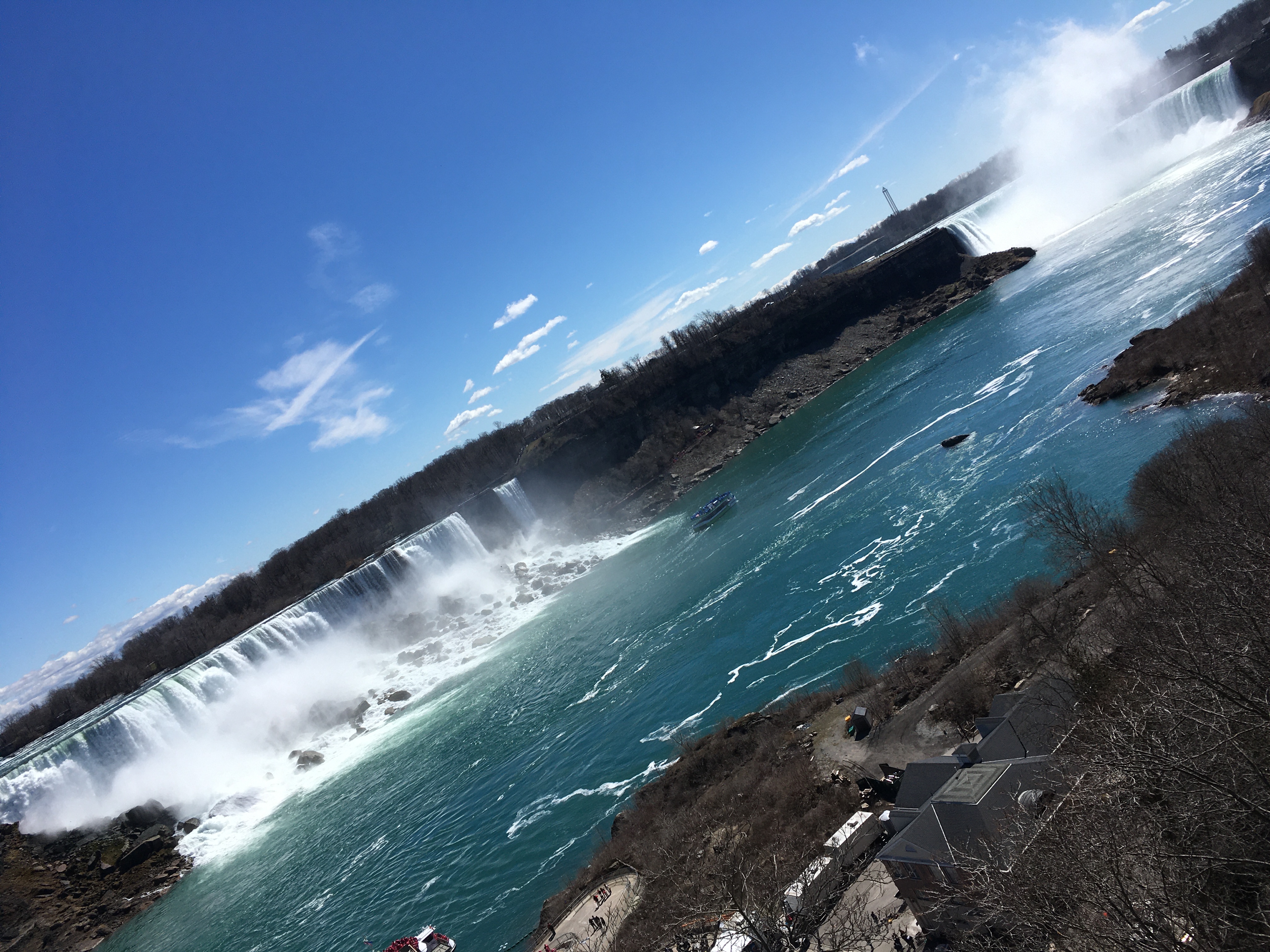
Niagara Falls: American Falls on the left, Canadian or Horseshoe Falls on the right, Goat Island in between. The little waterfall to the right of the American Falls is Bridal Veil Falls.
Saturday morning, we drove west. And all along the New York State Thruway were signs warning “Eclipse Monday; Arrive Early, Stay Late” and “Prepare for Delays” and “Expect Traffic.” And in the days before we left, I’d seen the reports that local authorities around the Falls had declared states of emergency, expecting massive influxes of tourists. We drove all the way to Buffalo (looks like a lot of new high-rise buildings in downtown Buffalo; it’s been many years since I was there), and then straight over the Peace Bridge into Canada. It was my first time driving into Canada in several decades, the first time I needed a passport to do so, but it was an easy crossing. We drove up to Niagara Falls, Ontario, and had a wonderful time walking around under a brilliant blue sky, seeing the Falls from the proper side. For all the warnings of a tourist avalanche, it wasn’t terribly crowded; no jostling as we walked around, easy driving to a parking lot. Ho-hum in terms of the planned emergency. As to the Falls themselves, I was a tour guide at Niagara Falls for two summers during my college years, so I remembered all the facts and figures, but none of that truly describes the experience of actually seeing them. The thousands of gallons of water flowing every second, from the bright indigo blue of the upper river to the green-blue of the lower river, the constant roar, the ever-present column of mist (which, on this windless day, stood straight up, obscuring as little of the view as possible). We also saw the no-longer-quite-so-new-but-still-new-to-us zip line down from the rim of the gorge on the Canadian side, and the new Maid of the Mist boats (they’re using fairly wide catamaran hulls now; we remembered the monohulls). It was a lovely visit. Then we took a quick look into Casino Niagara, and mourned the Maple Leaf Village shopping mall it replaced. It’s a casino, nothing much. We didn’t play.
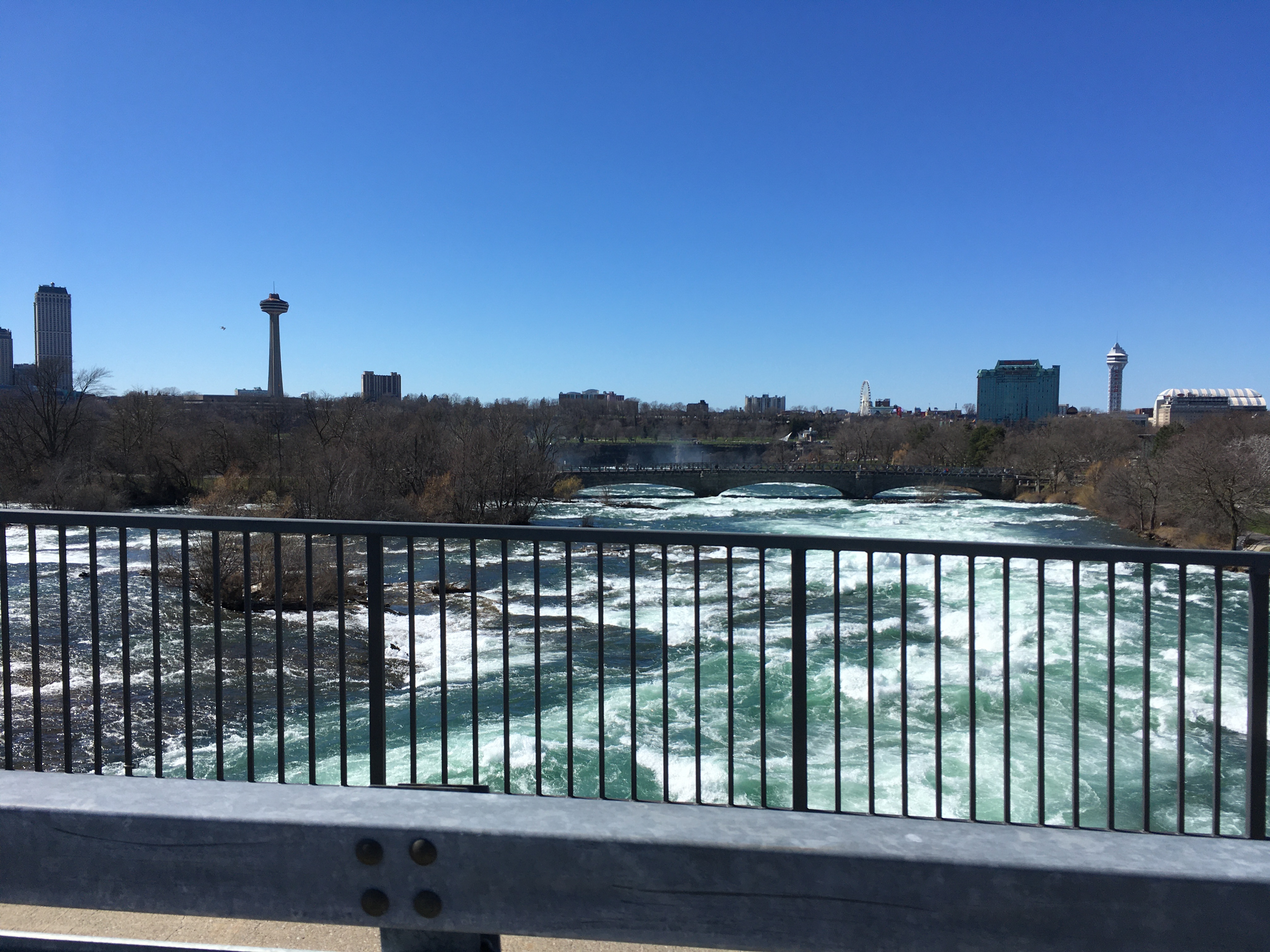
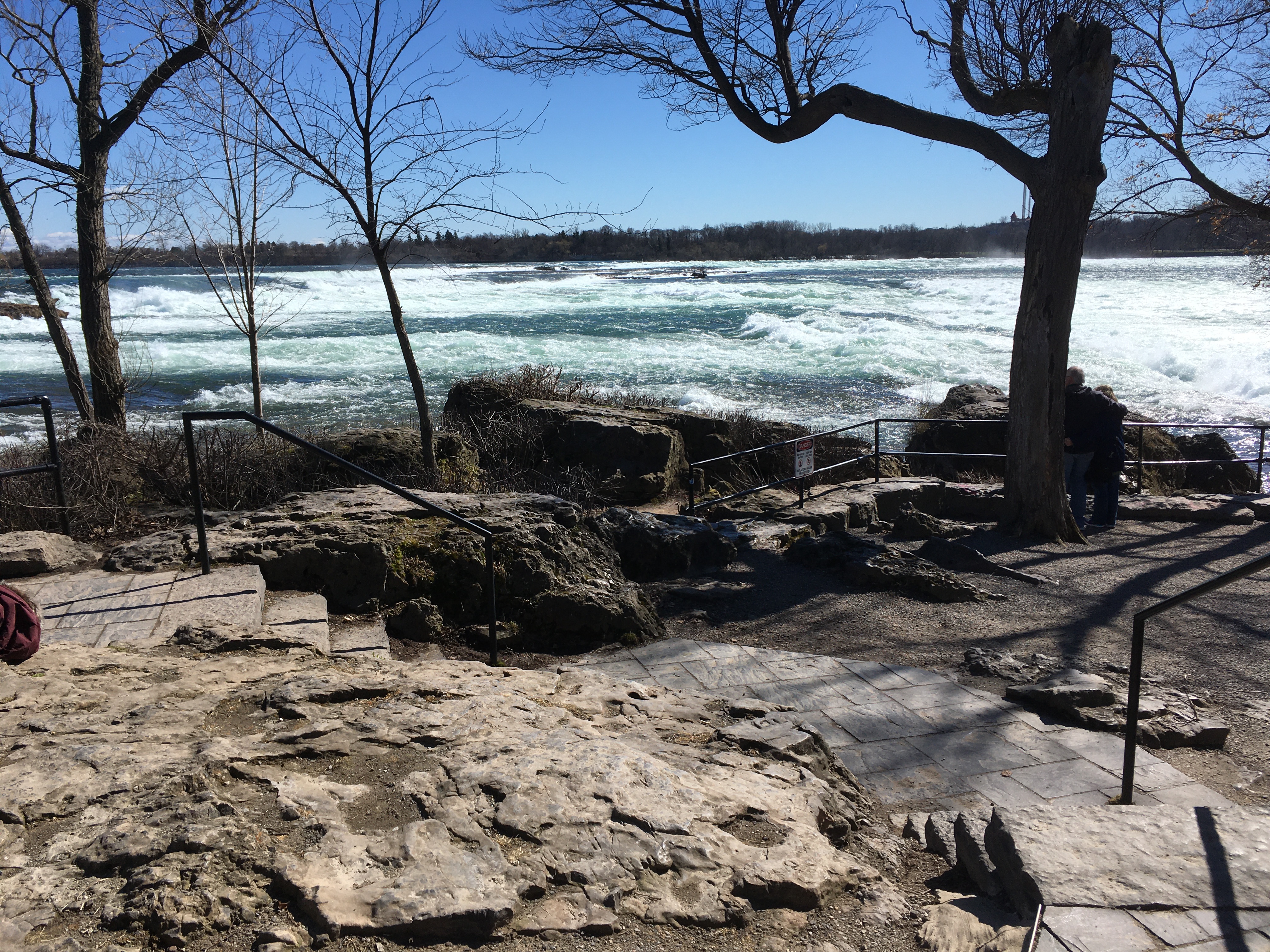
View from the bridge driving to Goat Island. The rapids just above the American Falls. The towers beyond are in Canada.
Then we crossed back into the States via the Rainbow Bridge. Again, a fairly rapid crossing, despite the more modern security procedures. And we headed to Goat Island (the big island that separates the American Falls from the Horseshoe, or Canadian, Falls). If I’m recalling correctly, they’ve changed the flow of car traffic around the island from clockwise to mostly counter-clockwise. We didn’t need to look over the edge into the gorge, but did want to visit Three Sisters Islands, on the south side of Goat Island, sticking out into the river. They are still wonderfully small, mostly undeveloped, close to the water, and far from the bulk of tourists. But we noticed a disappointing development, emblematic of certain changes in the world: when we lived there, the little islands had a mostly unpaved path (with paved bridges between them) and nothing blocking the feel that this was completely natural, including the ability to walk to the water’s edge and put one’s hand in the upper Niagara River. Now, however, those paths are completely paved or tiled, and fences have been built all along them, to prevent people from reaching the river. Is it our hyper-litigious society? Or our obsessive need to protect others from themselves? Whatever it is, we both found it very disappointing. Nevertheless, the environment—so close to the roar of the cataracts just above the falls, the water, and the water fowl enjoying themselves—was a truly restful oasis so close to the hyper-commercialized tourist mecca.
The rapids above the Horseshoe Falls, from the Three Sisters Islands.
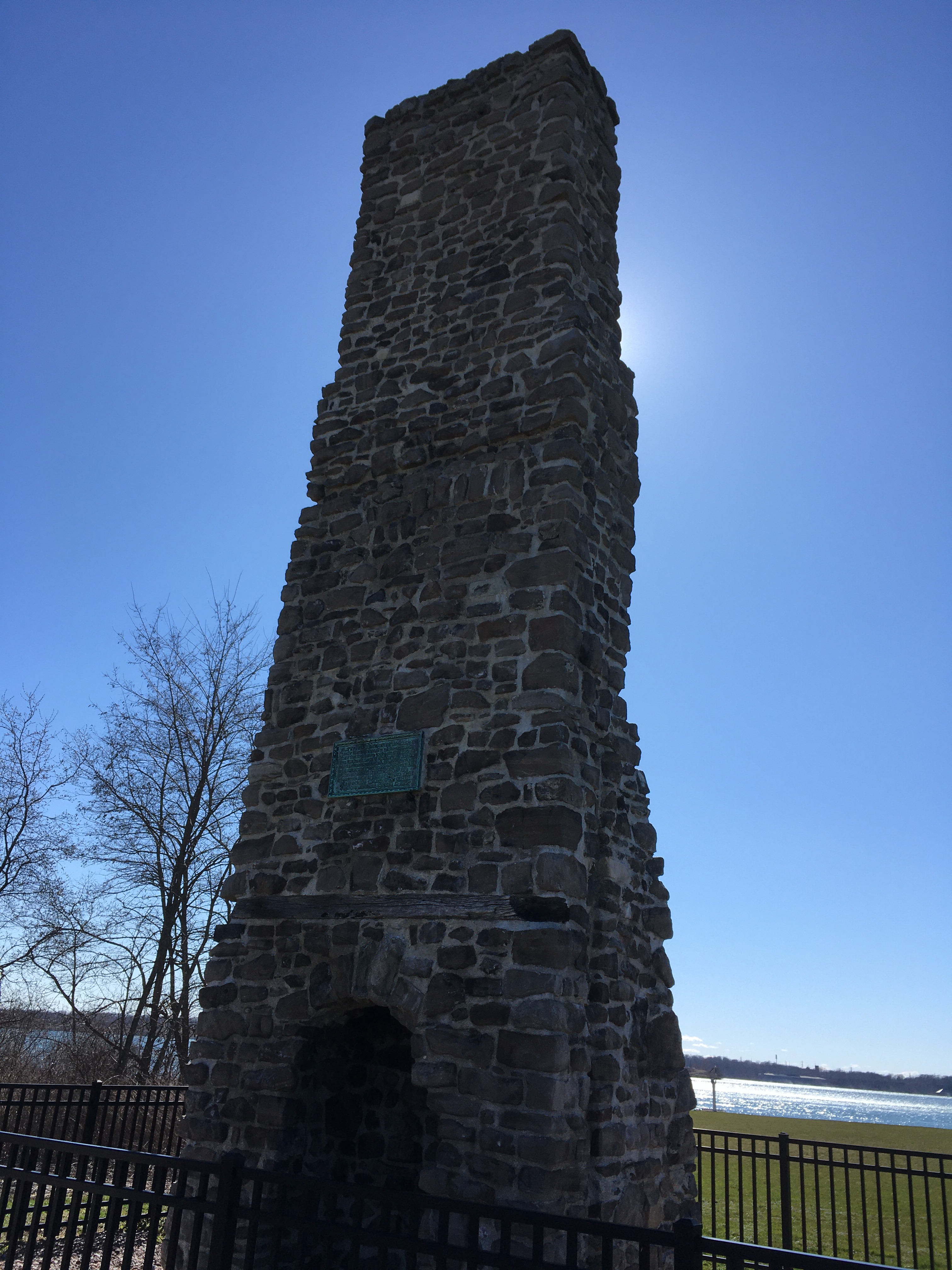
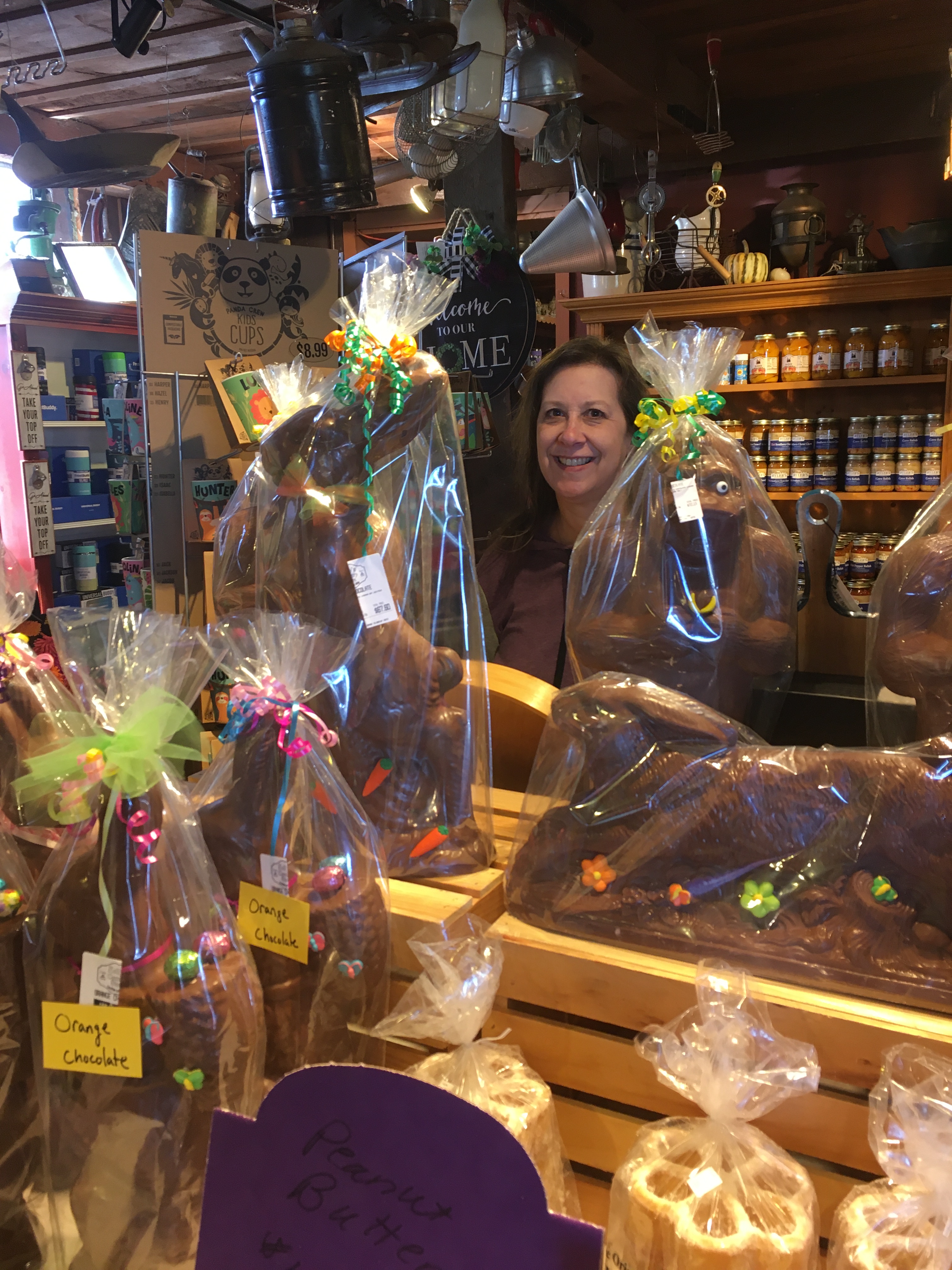
Leaving Niagara Falls, Laurie surprised me by stopping at a historical marker along the road (that’s something I would do, but not the old Laurie; she’s stepping out of her shell and trying new things this year). The Old Stone Chimney stands by the Niagara Scenic Parkway, and though the chimney dates to the 1700s, I didn’t recall ever having seen it. Well, it turns out it’s been moved… three times, since it was built. It moved to its current location in 2015, well after the last time I was in the neighborhood. We stopped at Kelly’s Country Store on Grand Island, a memory from when we lived in the neighborhood. So many of the decorations are the same as they were way back then. And of course, we had to buy some sponge candy.
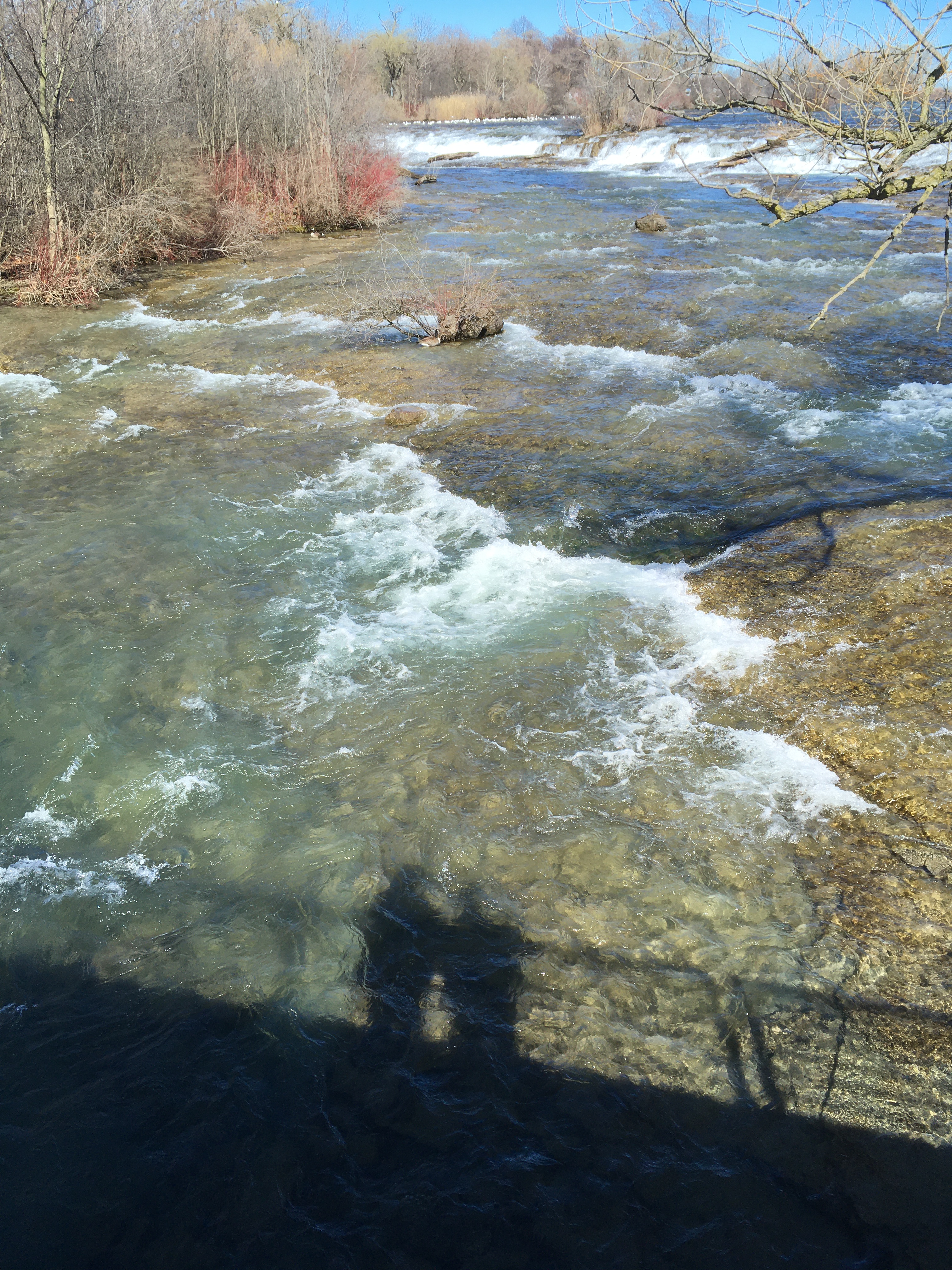
Shadow Laurie and me, viewed from a bridge in the Three Sisters Islands.
Then it was on to Beth and Tammy’s house, our hosts for the next two nights. Beth is one of my friends from my high school years, from our temple youth group. It’s wonderful to have people (not relatives) who we’ve known so long, and who knew us back then. It was comfortable while being new.
The Old Stone Chimney.
Sunday morning, we had breakfast with one of Laurie’s friends from the neighborhood, who I’d not met before; very nice. One flaw: the waitress asked if I wanted two or three pancakes. I said three. But she had neglected to tell just how big the pancakes were. I ate a few bites of the third just because leaving it untouched felt wrong. But two were actually a bit more than enough. Then we drove around, just drove, looking at the house we lived in, the high school we attended, the neighborhood we lived in, houses friends had lived in, and so on. Constant comments of “so-and-so lived there,” and “that wasn’t there before.” A wonderful several hours of nostalgia.
Laurie with unsold Easter chocolate at Kelly’s Country Store. We didn’t know that, in addition to the Easter Bunny, there was an Easter Kong.
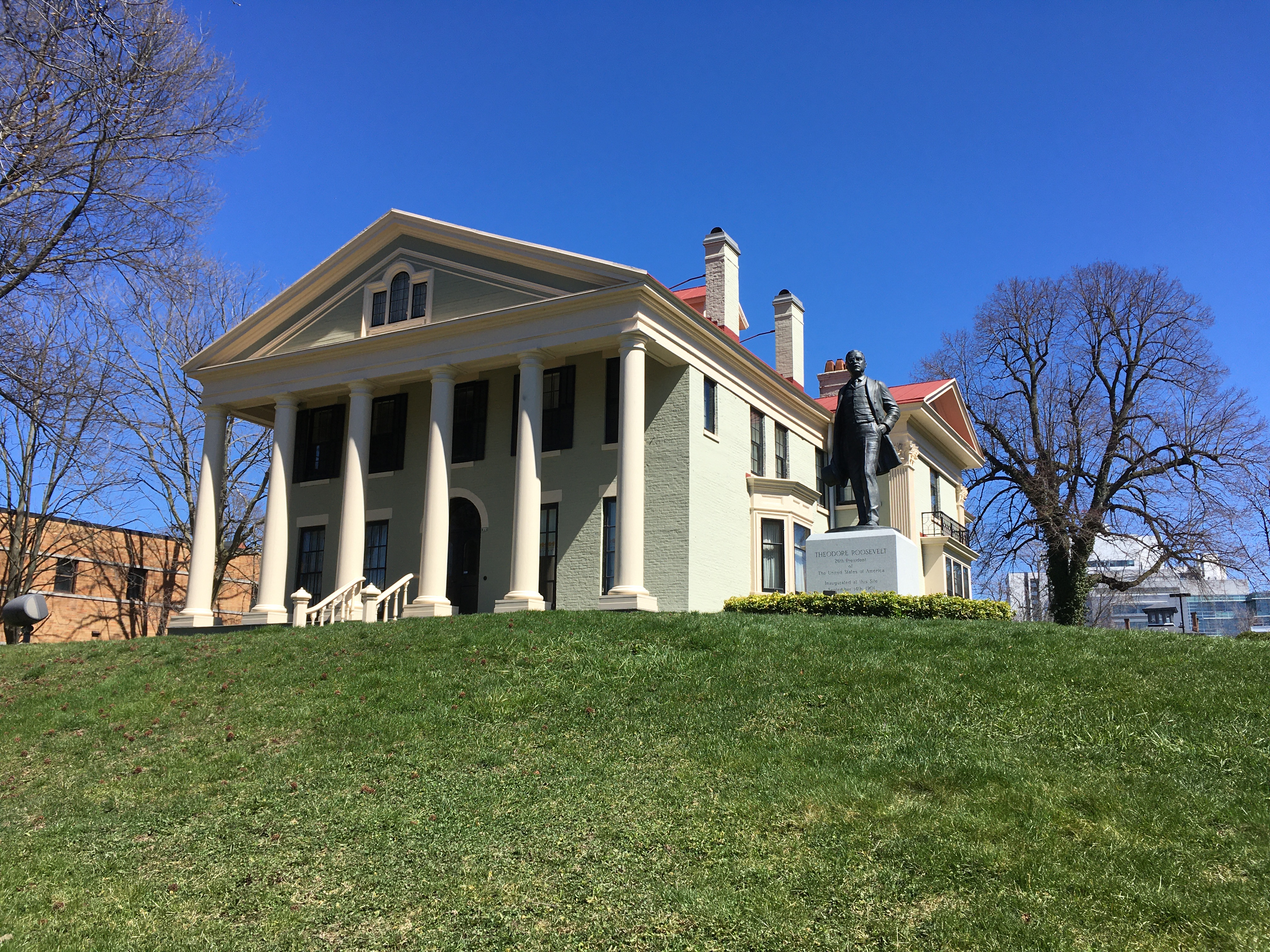
And then, because we had some time—and because I hadn’t been there since long before my books were published—we went to the Theodore Roosevelt Inaugural National Historic Site. For those who don’t know the story: President William McKinley was shot in Buffalo while visiting the Pan-American Exposition in 1901. Vice President Roosevelt rushed to his side, but was told McKinley was going to recover, so he returned to his family—vacationing in eastern New York—to calm public fears. A week later, McKinley took a turn for the worst, and died while Roosevelt was rushing back to Buffalo. So Roosevelt was sworn in as the 25th president in the Ainsley Wilcox mansion in Buffalo, one of the few inaugurations to take place outside the national capitol. The historic site is the building where Roosevelt took the oath of office, and where he stayed for a couple of days. But he never owned it, never lived in it. So it’s a museum of the era, with an overview of the Pan-American Exposition and the inauguration. A good museum (except that my books were not in evidence in the gift shop).
Theodore Roosevelt Inaugural Site, the Ainsley Wilcox mansion, in Buffalo, New York.
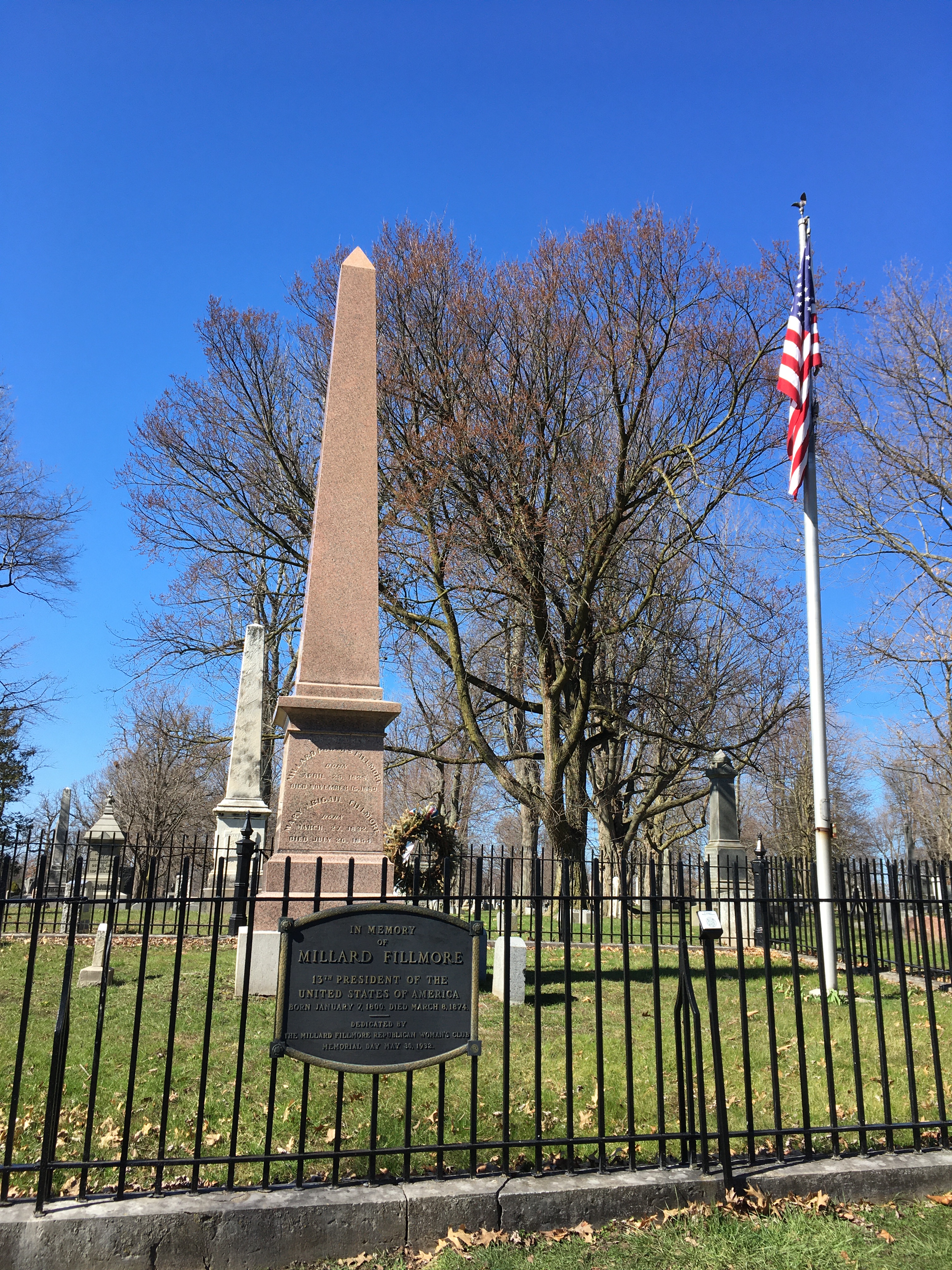
After the museum, we drove about a mile up Delaware Avenue to visit President Millard Fillmore’s grave site. Also within the fence are the graves of his two children and his two wives (his first wife, Abigail, died a month after they moved out of the White House; five years later, he married Caroline).
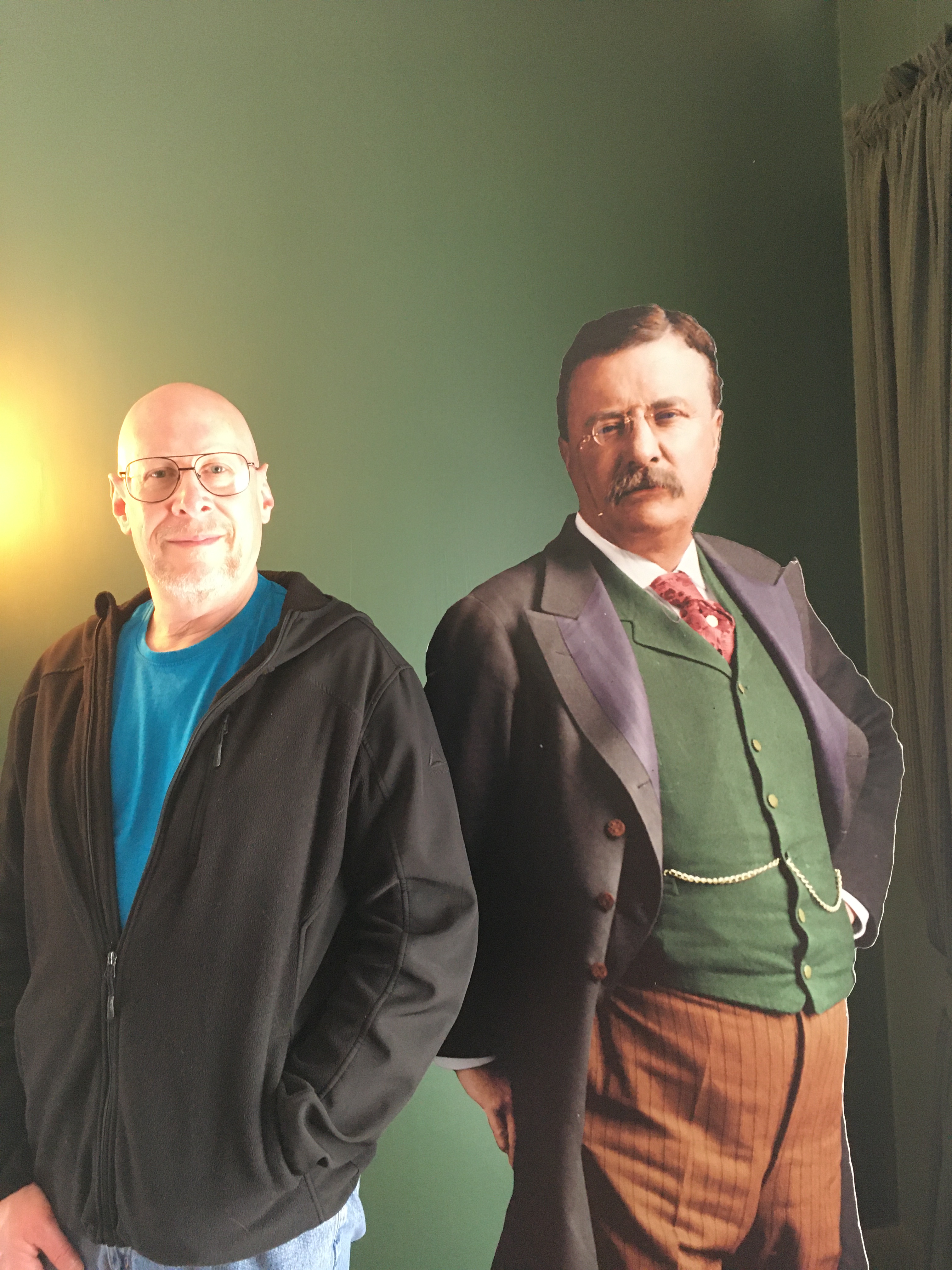
IRS with TR.
The weather, I have to note, on both Saturday and Sunday was absolutely spectacular: comfortably spring-like temperatures under a blue sky with nary a cloud in sight. Unfortunately, the weather chose not to align with the eclipse, of which, more anon.
Fillmore burial site.
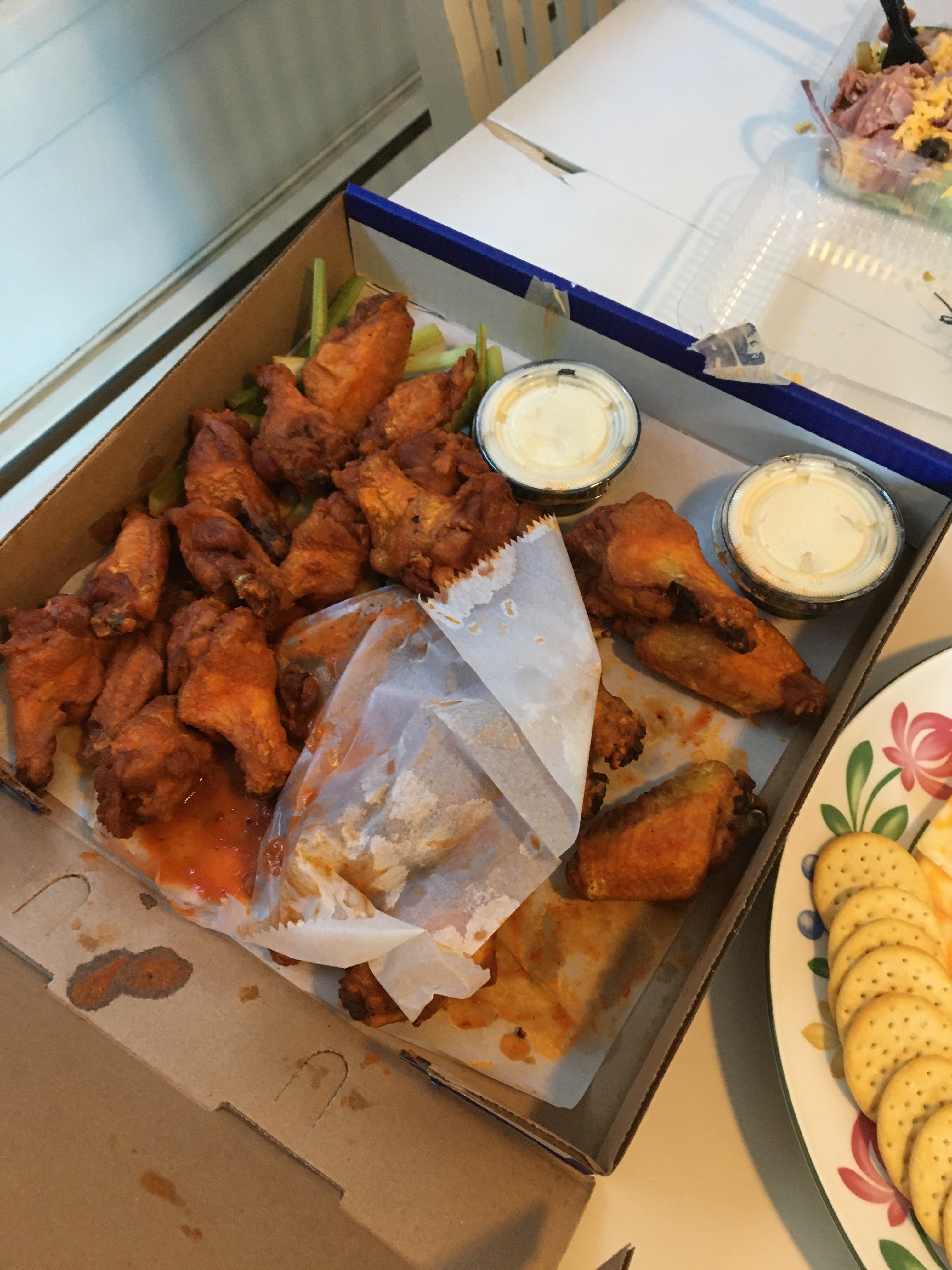
After our day of touring Buffalo, we returned to Beth and Tammy’s house for dinner with more old friends: Alec and Beverley joined us. We spent hours just reveling in each others’ presence, reminiscing about the past and catching up on each others’ presents. It was a wonderful, warm feeling. And that warmth, mind you, was not brought on by dinner. However, dinner was authentic Buffalo chicken wings (note: not Buffalo-style, but actual Buffalo chicken wings. That’s the one thing I’m a bit of a food snob about, but eating those wings again reminds me that that snobbishness is justified. Yum! [And there were left-overs, so they rode with me all through the eclipse journey of the next day, and thence home on Tuesday, and they served as dinner Tuesday night. One again, YUM!).
Chicken Wings!
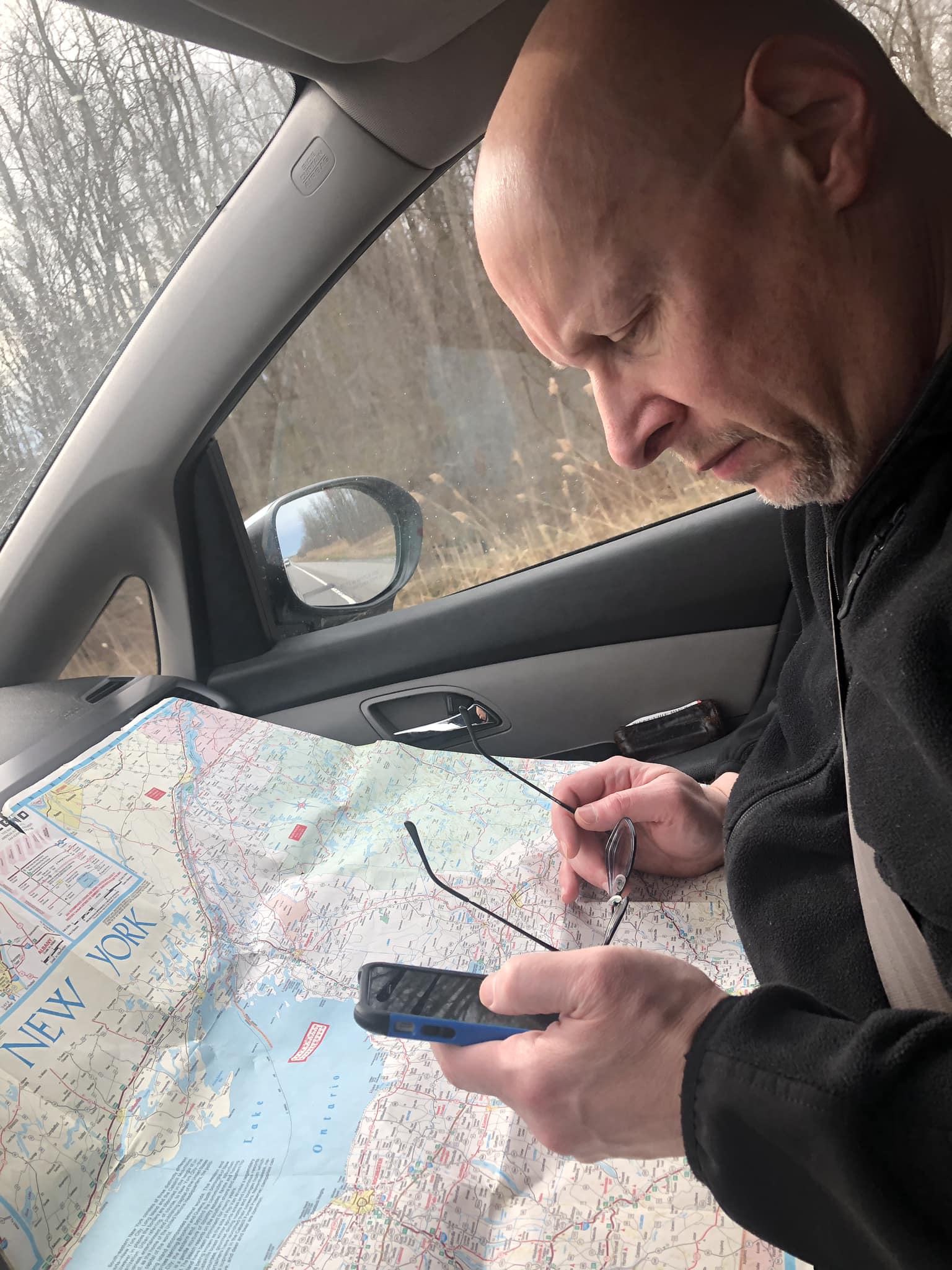
The weather predictions (and I stayed up with Beth, watching the weather forecast yet again, comparing it with the forecasts on my phone) were disappointing. Buffalo was expected high and low clouds, and I was determined to see the eclipse. So Monday morning, Laurie and I left quite early, about 8:30, and headed east and then north, on a quest to get out from under the cloud cover in time to see the eclipse.
Figuring out where to go and how to get there to see the eclipse.
We scurried across the state on I-90, back the way we’d come (again, noting all the “extreme eclipse traffic” signs without actually seeing many vehicles on the roads), and then turned north into new territory, up I-81. Thence to US-11, taking us along the northern edge of New York State. I’d never been to that part of the state before, rushing through little towns, trying to find clear sky. All along the way, there were people sitting in their driveways, or in parking lots, or parks: individuals, families, large gatherings, all to experience the eclipse. Seeing that was wonderful.
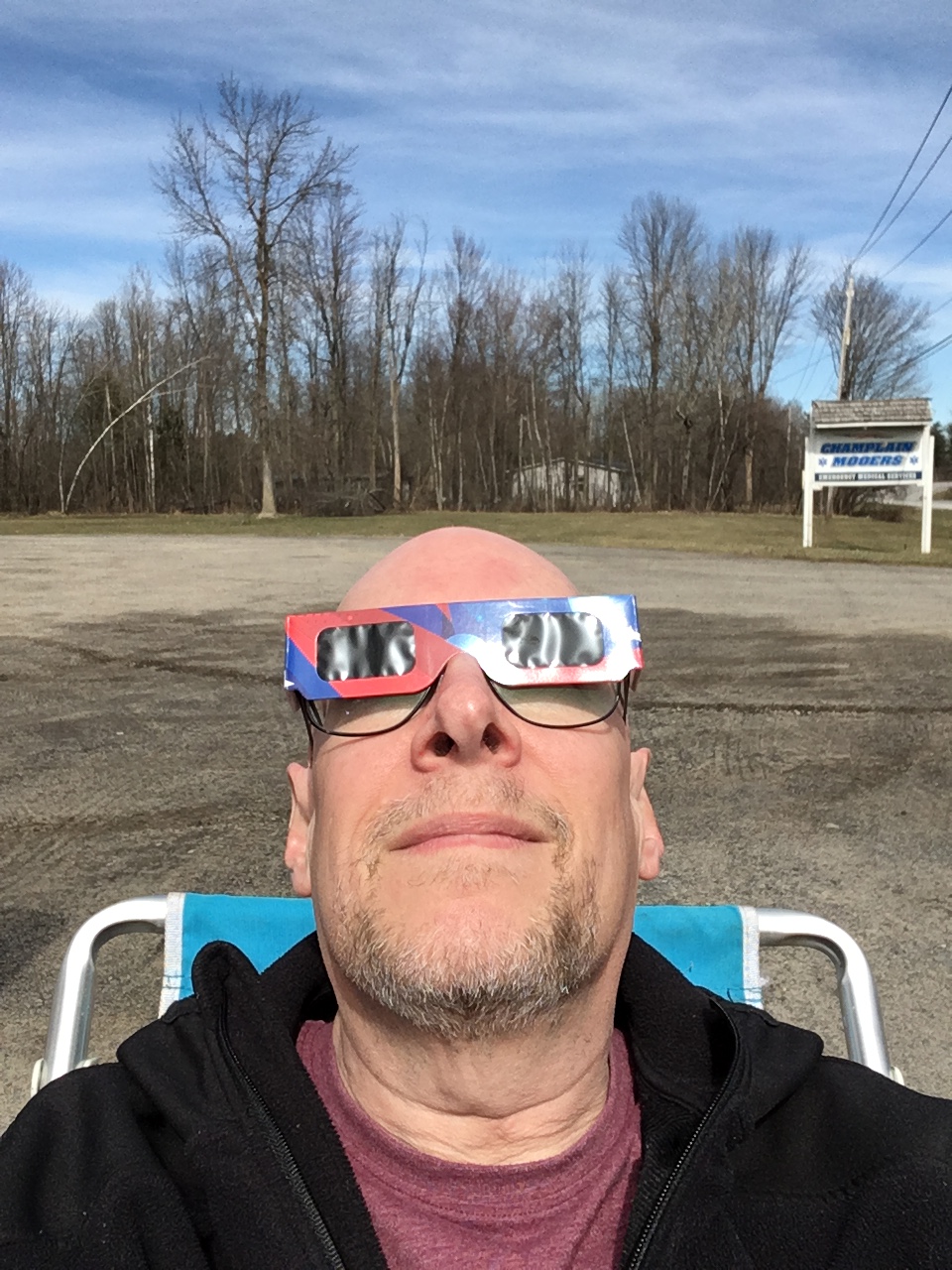
Watching the eclipse, in Mooers, New York.
The entire day, we were under thin clouds, but aimed at a small band of clear blue sky off at the horizon. As far as we drove, that unclouded blue never expanded, and a few minutes before 3:00, I accepted defeat, and we pulled off the road in Mooers, New York (which was named for Revolutionary War and War of 1812 veteran, Benjamin Mooers [who had been born in Haverhill, Massachusetts, which is where Laurie used to live]). But I grumped a little bit, so we decided to drive on another ten minutes, and finally wound up (still under those high, thin clouds), in a McDonalds parking lot just outside of Champlain, New York (according to my cell phone, at 44 degrees, 58 minutes, 54 seconds north by 73 degrees, 27 minutes, 38 seconds west, looking west-southwest about 253 degrees). I put aside my grumpiness with the clouds and just experienced the event. And what an experience it was!
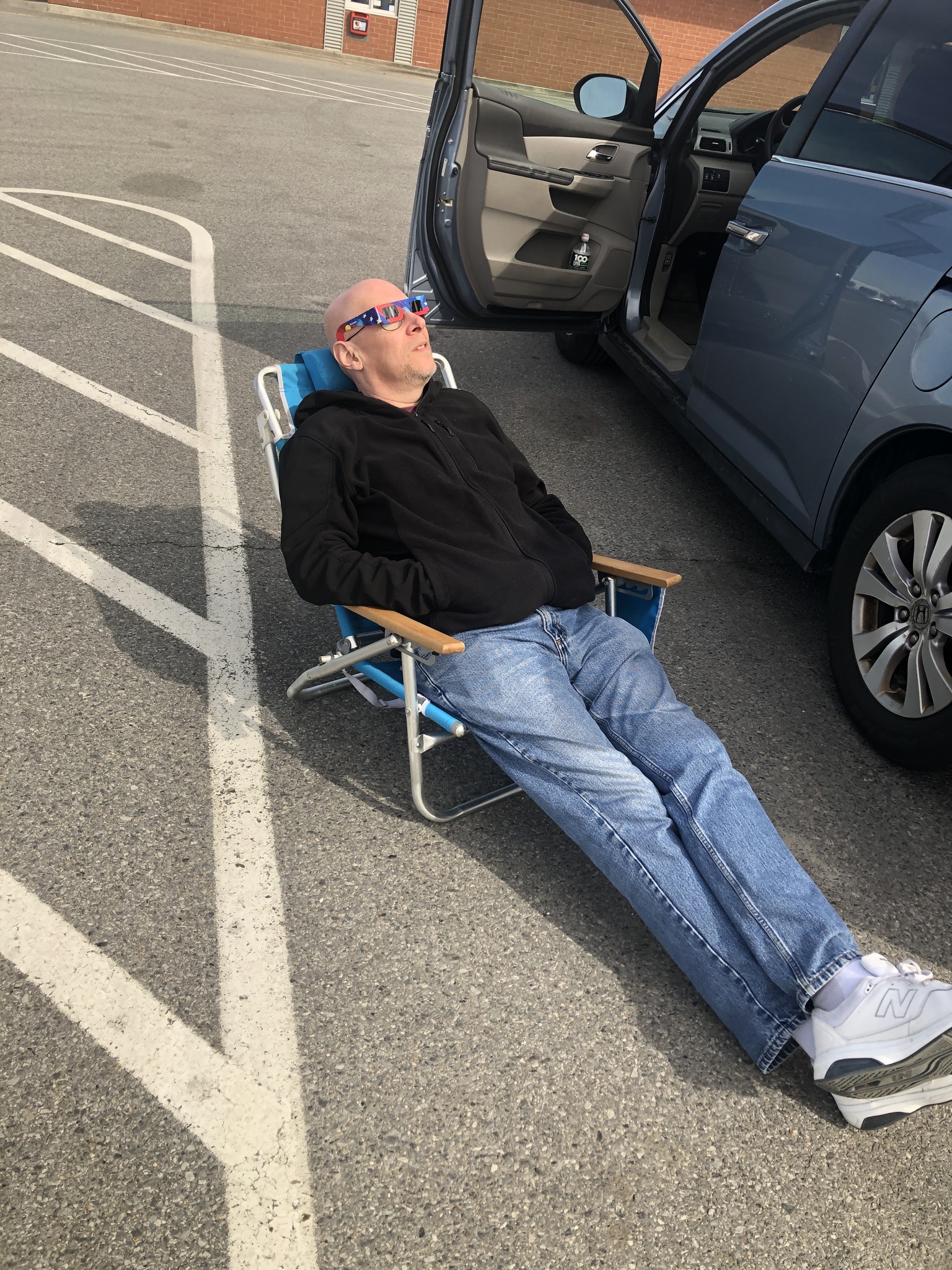
And Laurie’s view of me doing the same.
The eclipse-viewing glasses did what they were supposed to, letting me stare at the slowly shrinking sun. And then came the moment of totality, and I took off the glasses to stare at it. I’m sure you’ve seen hundreds of pictures of the event. I didn’t bother taking any; I was too busy experiencing it. And it was everything I’d hoped for. We even saw a few stars during the darkness! Then the Moon continued to move, the Sun came back, and I put the glasses back on to bask in it for another 15 or 30 minutes. Now, I think I’m going to have to find another total solar eclipse with a perfectly clear sky, just to completely experience the darkness and the corona. But this was awfully close. Laurie asked me to describe it, and I was torn between “transcendent,” “cosmic,” and “stellar.” All I know is that it was worth all the driving we’d done, and all the driving yet to come.
Eventually, we put ourselves back together, and pulled back onto the road. We’d made contact with Julie and Carl, and planned to meet up with them for dinner on our way home. We drove to Lake Champlain (I’d only seen it once, a long time ago, from the Vermont side), crossed over into Vermont, and then headed south. Our GPS navigation system warned us not to get on I-89, suggesting instead some smaller roads that would make for a faster trip. If Waze was correct, the cars on I-89 must have been moving backward. We crawled south through a very pretty Vermont on a bunch of one-lane-each-way roads. We climbed one massive mountain on Vermont-17, which I’ve only now realized brought us to the Appalachian Gap. And still later, there was one stretch of Vermont-100 which took us 45 minutes to travel the seven miles from Granville to Rochester, during which time it got dark. Eventually, we made it to Julie and Carl’s house an hour or more after they expected us. But, wonderful friends that they are, they fed us a wonderfully prepared turkey dinner, gave us beverages and dessert, and then kicked us out after an hour, because we had more traffic to come. On a normal day, the 150 miles from their house to Laurie’s would take two and a half hours to cover; it took us four and a half. All of that traffic that all of the signs had warned us about Saturday and early Monday all appeared immediately after the eclipse. It was insane. Apparently every car in registered in Massachusetts and Rhode Island had traveled to Vermont to see the eclipse, and they were all on the road home with us. But as I said, it was totally worth it.
I slept the sleep of the dead Monday night at Laurie’s, before getting a late start home today, and finally arrived in time to eat the chicken wings for dinner.
In terms of eclipse watching, my choice to go to Buffalo was probably not the best I could have made. But combined with the sight-seeing, nostalgia, and time with friends, it was the ideal way to see the Great Solar Eclipse of 2024.
Donald Trump has proven one thing beyond a shadow of a doubt: his “delay delay delay” legal strategy is brilliant, and nearly always effective.
The defendant has the right to a speedy trial, but perhaps there should be some consideration of the victim in that dictum, too. In these multiple cases, the defendant doesn’t want a speedy trial. The longer the trials are delayed, the more doubt can be sewn, and the greater the chance he can escape ever having to stand trial at all. The victims, in the meantime, have no recourse. We appear to have suffered from his actions—but await the outcomes of several trials to determine if in fact his actions caused harm and were contrary to the law. We continue to suffer from the lack of resolution of those cases, and there’s nothing we can do.
I hear the protesters, I see the outrage, and I, too, grieve for the innocent lives being lost in Gaza.
But I don’t understand why they aren’t doing anything.
What if the Hamas animals had been lurking in the tunnels under Detroit instead of Gaza? And what if, on October 7, they had crossed the Ambassador Bridge into Windsor? And what if they had raped, mutilated, and murdered a thousand people there, and kidnapped several hundred hostages back with them to the tunnels under Detroit?
If all that had happened, Canada wouldn’t be bombing Detroit; they wouldn’t have to.
Because the people of Detroit—and the entire rest of the country—would be so outraged that we would have rescued the hostages ourselves. We would have returned them to Canada, and if any of the Hamas animals survived our rescuing of the hostages, we’d be turning them over to Canadian justice.
But in Gaza, none of that has happened. We’re supposed to feel great sorrow and sympathy for all the poor innocents there. But if they’re so innocent, why aren’t they outraged enough to do something? How can they live with themselves, knowing that right there with them are Israelis, Americans, and others being held hostage by Hamas? Innocents being tortured and more? Silence is complicity. Not our silence about Israel’s attempts to destroy Hamas, but the Gazans’ acceptance of Hamas still holding all those hostages five months later.
I know it’s a tiny thing, and based on the number of times it crops up in manuscripts I receive, I imagine I’m one of the very few to notice it, but the comma or period after an italicized word should not, as a rule, be italicized, because yes, there is a difference. Similarly, neither should the space (again, there actually is a difference between an italicized space and a non-italicized space), nor, for that matter, any other punctuation mark. So why do some word processing programs seem to want to include the following space or punctuation mark when italicizing the word?
And a slightly bigger part of it: the possessive of an italicized proper noun shouldn’t be italicized (for example, when talking about the USS Enterprise’s anchor chain).
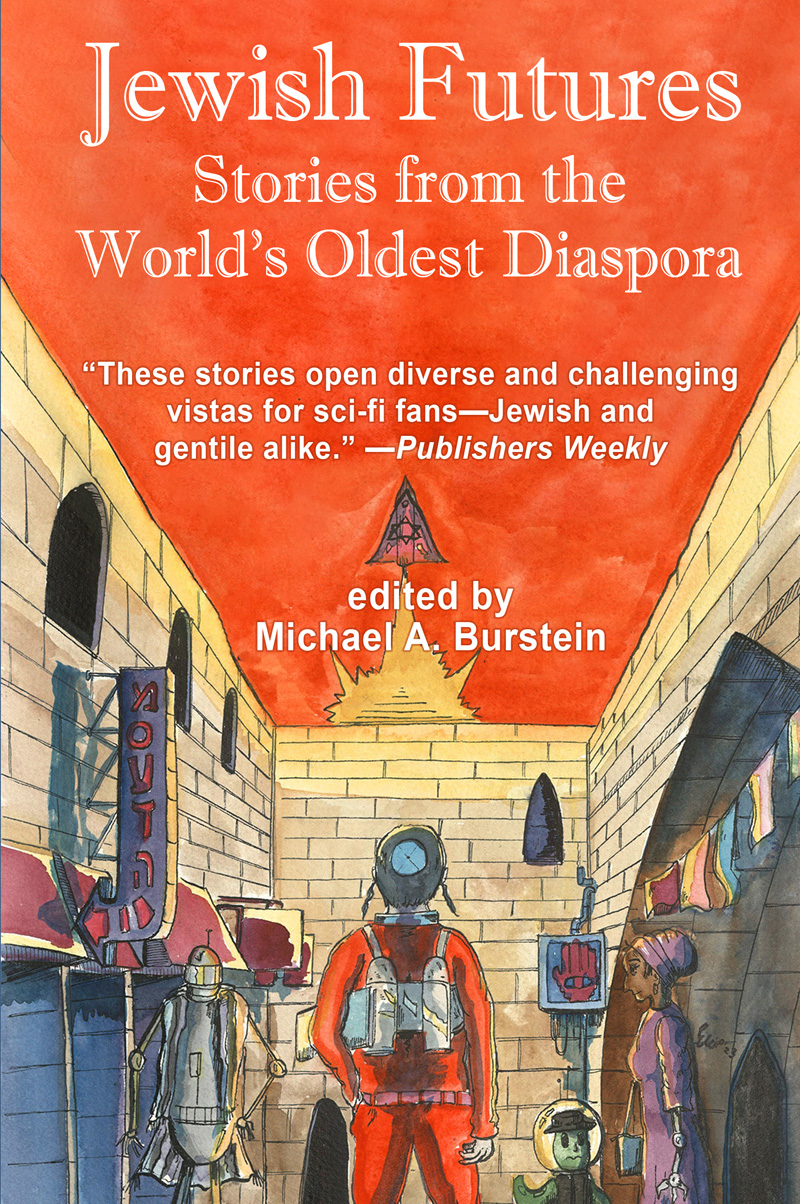
Life interfered with work a week or two back. As a result, I didn’t get a chance to tell y’all about a couple of new videos now available. Con-Tinual: The Con That Never Ends hosted two panel discussions with authors appearing in Jewish Futures. But two of our authors weren’t able to make it to those panel, so editor Michael A. Burstein interviewed them individually. All four videos are now available online, with links available in the book’s description on the linked page (scroll down to the first paragraph under “Publicity and Reviews”). If you’re a new author looking for inspiration, let me especially point you at Michael’s interview with Samantha Katz. And if you’re a long-time reader, writer, or fan, Michael’s interview with Jack Dann will definitely bring back some wonderful memories from way back when. And of course there are the panels, with Riv Begun, Nomi Burstein, Robert Greenberger, Susan Shwartz, Steven Silver (and Michael and me), and with Leah Cypess, Randee Dawn, Valerie Frankel, Jordan King-Lacroix, Barbara Krasnoff, SM Rosenberg, and Harry Turtledove. Check them all out!
A friend had an extra ticket, so tonight—for the first time in a very long time—I went to the circus.
A lot of very talented people performed many wonderful acts, and a few of them were truly mesmerizing—to the point that I didn’t even notice the other acts which were going on simultaneously. We were sitting at the end of the arena, so we could see all three “rings” without turning our heads, which made it a bit easier.
The current incarnation of Ringling Brothers and Barnum & Bailey Circus is headlined by a singer, a trio of juggling clowns, a trio of other clown-like performers (one is a percussionist and one a unicyclist). But the main thrust of the show are the acrobats: tumblers, aerialists, trapeze artists, tight-rope walkers, all sort of acrobatic performers. There was also a BMX bike troupe, a double “wheel of destiny,” and—to end the show—a human cannonball. But I was truly enthralled by the Gemini Twins, a pair of Ukrainian aerialists who “specialize in duo aerial hoops, loops, hand balancing and acrobatics.”
I did, however, sorely miss the animals. Apparently the circus misses them, too, because there is a robot dog which appeared in several interstitials throughout the evening.
The other thing I found surprising was the number of people wandering in, looking for their seats, up to 45 minutes after the show had started (at 7:00 on the dot). That’s a mind-set I just don’t understand.
But I had a great time, and crepes for dessert was a yummy topper.

 Life interfered with work a week or two back. As a result, I didn’t get a chance to tell y’all about a couple of new videos now available. Con-Tinual: The Con That Never Ends hosted two panel discussions with authors appearing in Jewish Futures. But two of our authors weren’t able to make it to those panel, so editor Michael A. Burstein interviewed them individually. All four videos are now available online, with links available in the book’s description on
 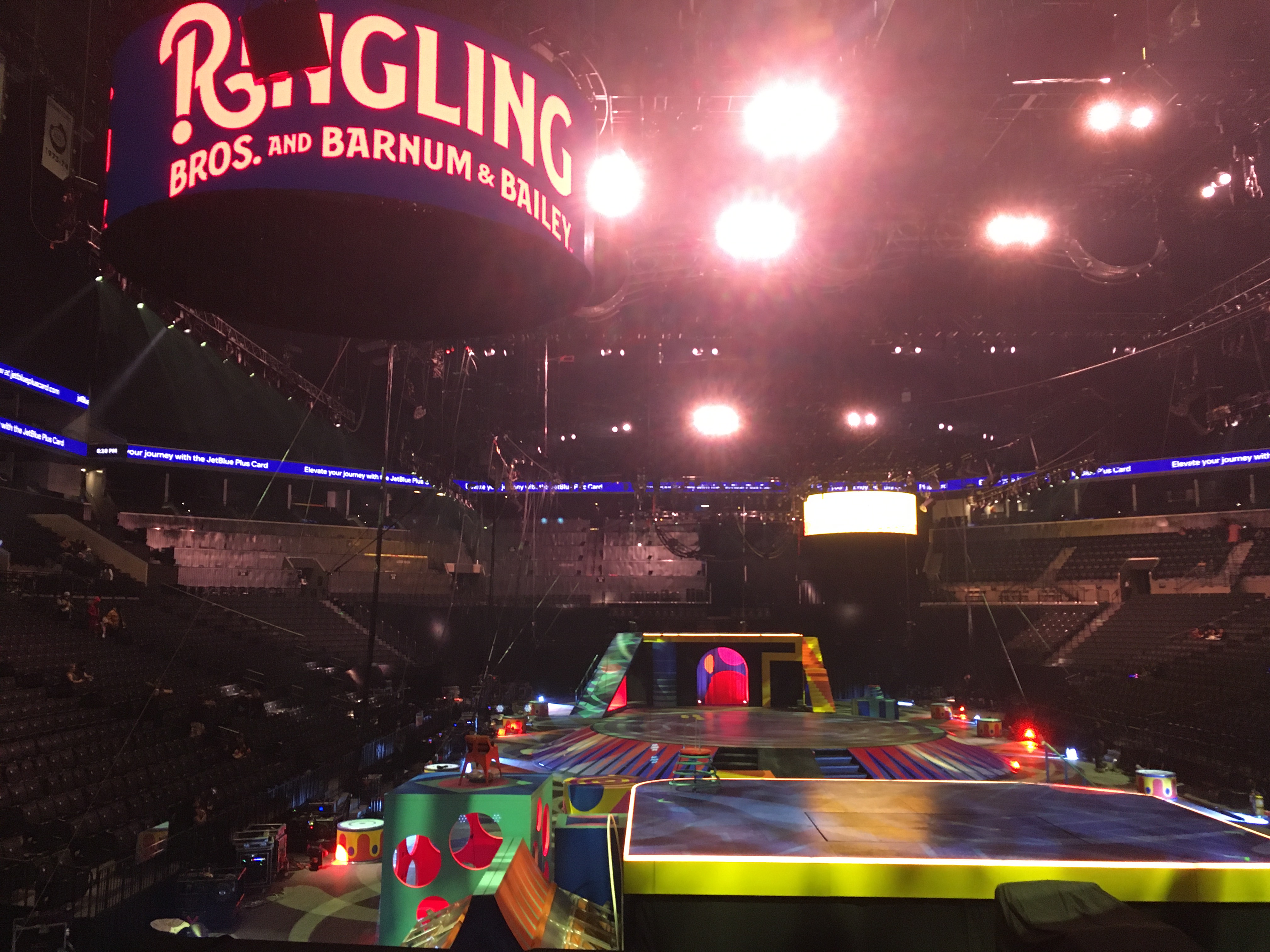 A friend had an extra ticket, so tonight—for the first time in a very long time—I went to the circus.
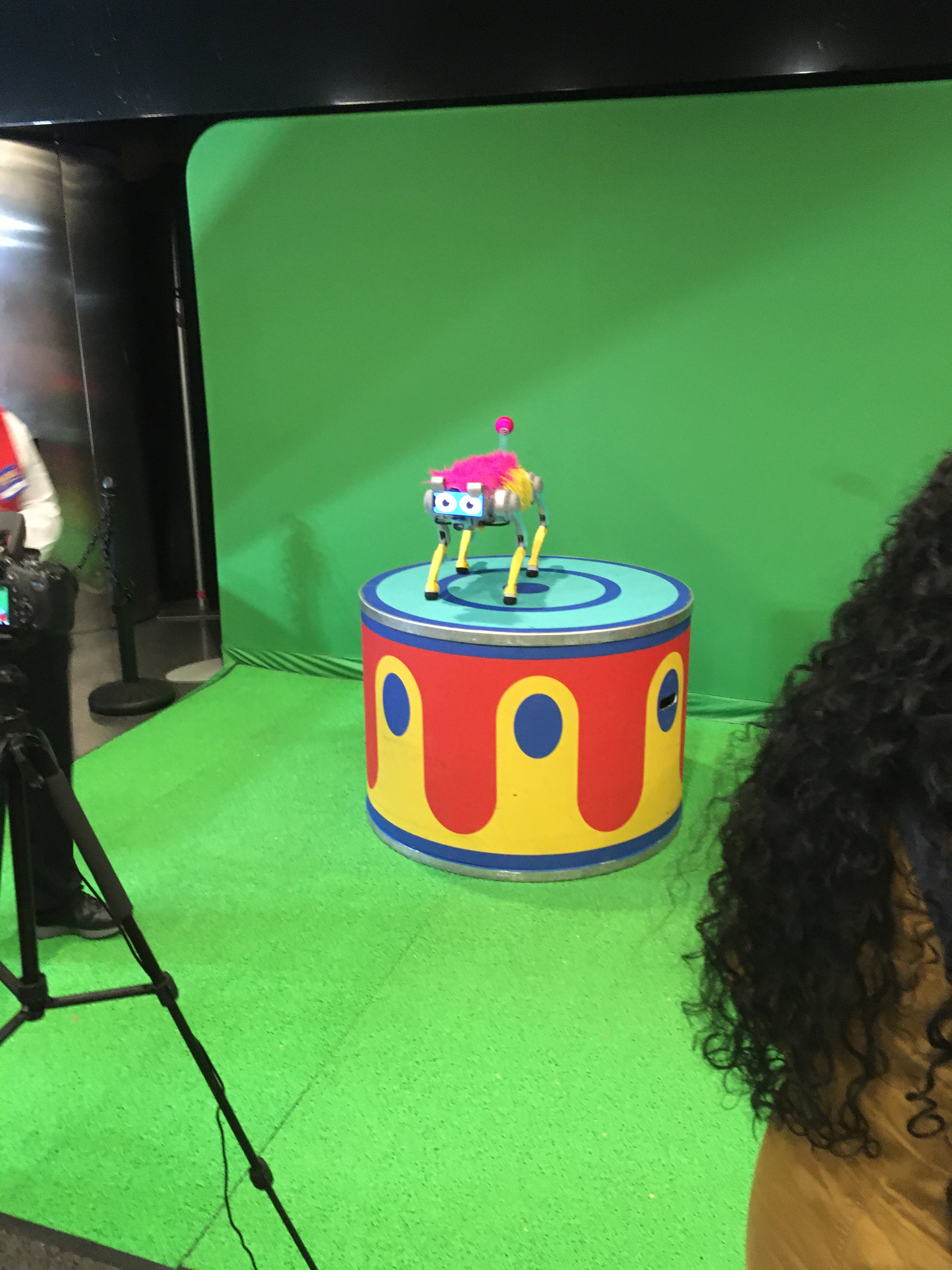 I did, however, sorely miss the animals. Apparently the circus misses them, too, because there is a robot dog which appeared in several interstitials throughout the evening.
 Ian Randal Strock