For those who haven’t heard: Donald Trump chose Ohio Senator J.D. Vance as his vice-presidential running mate in this year’s election.
I’ve been listening to the talking heads as they keep coming back to Vance’s youth: his fortieth birthday will be August 2. I’m not talking about experience, but simply his age.
While the millennials they’ve interviewed are thrilled that one of their generation is on the ticket, the talking heads have several times compared his age to Theodore Roosevelt’s (who was 42 years 128 days old when he took office as vice president, but six months later, William McKinley was assassinated, and TR became the youngest-ever president). Interestingly—at least, to me—they’re not talking about Richard Nixon, who turned 40 two weeks before he was inaugurated as vice president in 1953 (he served two terms under Dwight Eisenhower, lost the presidential election of 1960 to John Kennedy, and then was elected president in 1968).
The record-holder in terms of being the youngest vice president is John C. Breckinridge, James Buchanan’s vice president. Breckinridge was 36 years 318 days old when he was inaugurated in 1857. He had served in the House of Representatives from 1851 to 1855, and after his vice presidency, served several months in the Senate, before siding with the Confederacy (the Senate branded him a traitor, and expelled him in December 1861). He later served as the CSA’s fifth and final Secretary of War, from February to May 1865.
[And yes, for those of you paying attention, I didn’t post for the fifth: it was all dealers’ room, no programming.]
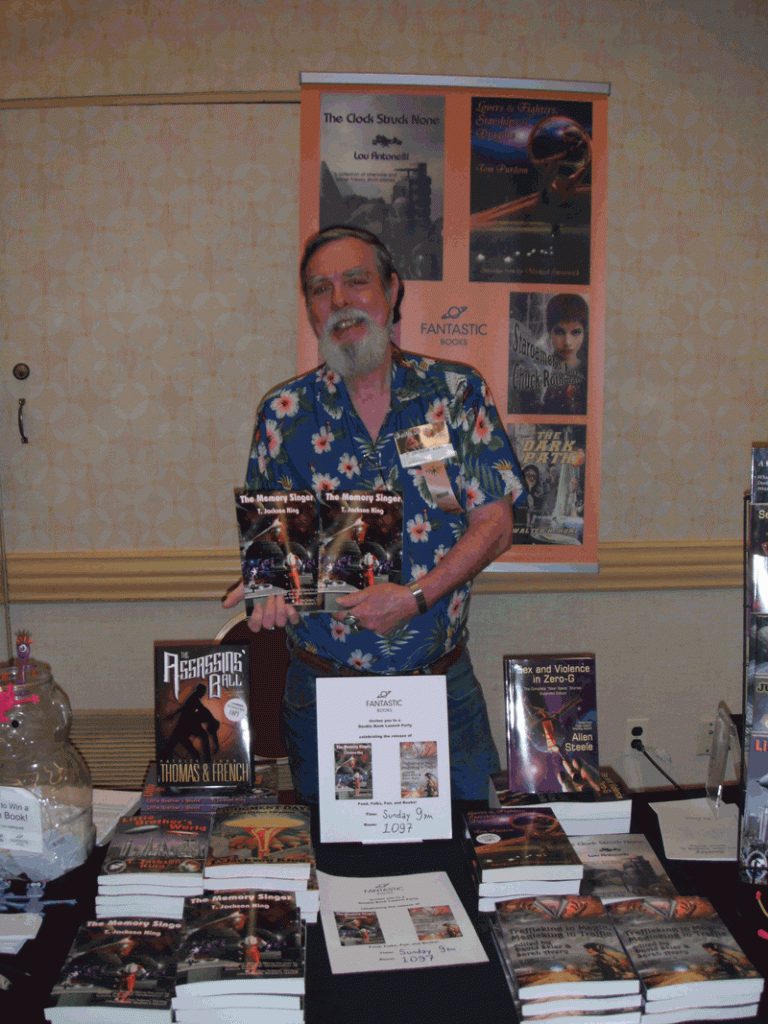
It’s another science fiction convention weekend—the first of three in a row for me. This weekend, I’ll be in Quincy, Massachusetts, for Readercon. As always, seek me out in the dealers’ room at the Fantastic Books table, where we’ll be debuting two new books: In Memoriam by Fred Lerner, and Disturbing Stories by Ron Miller. They’re both great, in completely different ways.
I’ll also be on programming, a bit. You can find me at my kaffeeklatsch Friday at 4pm in Basalt, and on the panel “The Breakup of the United States in Speculative Fiction” on Sunday at 10am in Salon 4 with Randee Dawn, Tom Greene, James Morrow, and Sarena Straus. I’ll also be at the Meet the Pros(e) event Friday night in Salon 3.
Hope to see many of you there… or the following weekend in Buffalo, New York, or the weekend after that in Lancaster, Pennsylvania (details on those two after I get back from this one)
I’ve been mulling the current presidential election season. Specifically, I’ve been wondering if Joe Biden might have more easily opted to be a one-term president if he hadn’t had to announce his attentions so far in advance of the election. After all, if he’d said—in April 2023—that he wasn’t running for another term, he would have been a lame duck for 21 months, nearly half of his term.
So I’ve dug out the data from the primary era of presidential campaigns, to see if my assumption was correct. Here’s what I found.
Lyndon Johnson was in the race ten months before election day. On March 12, 1968, he won 49 percent of the vote in the New Hampshire primary, barely beating Eugene McCarthy’s 42 percent. Four days later, Robert F. Kennedy got into the race. Johnson announced his withdrawal from the race March 31, 1968, 219 days before the election of 1968.
Richard Nixon authorized the formation of his re-election campaign committee on January 7, 1972, 305 days before the election of 1972. He won the election in one of the greatest landslides in presidential history.
Gerald Ford launched his presidential campaign July 8, 1975, one year and 117 days before the election of 1976. He lost a surprisingly close race to Jimmy Carter.
Jimmy Carter launched his re-election bid on December 4, 1979, 336 days before the election of 1980. He lost handily to Ronald Reagan.
Ronald Reagan announced his re-election campaign on January 29, 1984, 282 days before the election of 1984. His margin of victory was almost as large as Nixon’s.
George H.W. Bush announced his re-election campaign on February 12, 1992, 265 days before the election of 1992. He lost a three-way race to Bill Clinton.
Bill Clinton announced his re-election campaign on April 14, 1995, one year and 202 days before the election of 1996. He won in another three-way race, becoming the only president to win two terms without ever garnering a majority of the popular vote.
George W. Bush announced his re-election campaign on May 16, 2003, one year and 171 days before the election of 2004. He won in a less contentious election than his first.
Barack Obama announced his re-election campaign on April 4, 2011, one year and 213 days before the election of 2012. He won in a closer election than his first.
Donald Trump announced his re-election campaign on January 20, 2017—the day he was inaugurated—three years and 288 days before the election of 2020. He lost the election.
Joe Biden announced his re-election campaign on April 25, 2023, one year and 191 days before the election of 2024.
Conclusion: it wasn’t Donald Trump or the 24-hour-a-day give-us-an-election-so-we-don’t-have-to-report-actual-news news cycle that caused Joe Biden to have to announce so early. Rather, it was Bill Clinton who started this absurd trend, and Biden is just doing what his predecessors did. (I’m leaving out Ford because he was a special circumstance in so many ways.)
Also, how long before the election a president starts running for re-election doesn’t seem to have an effect on the outcome of the election.
Today is publication day for Fred Lerner’s moving novel of the Terran Diaspora, IN MEMORIAM.
In Memoriam is the story of David Bernstein, a 17-year-old member of the Remnant of Terra, who are the descendants of the 2,000 people who survived the Cataclysm that destroyed human life on Earth. For two centuries the Remnant has lived among the Wyneri, who rescued the few survivors and brought them to their world. Although the Wyneri are physically and psychologically very similar to Terrans, the two species interact only when they must. The Remnant earn their keep among their alien hosts, but otherwise remain apart, devoting themselves to preserving the cultural heritage of Terra.
David, however, is fascinated with the Wyneri and their culture, an interest shared by none of his contemporaries. Attending a Wyneri performance he meets a Wyneri girl his own age, and he and Harari strike up a taboo friendship.
While David learns about his Terran heritage, he feels very much alone in trying to also learn about the history of the Terran-Wyneri relationship. Violent Wyneri xenophobia drives David to intensify his studies, and to dig into the mysteries surrounding the Cataclysm, the rescue, and the ensuing two centuries of cover-ups. He begins to suspect a long-lived cabal that has spent the years working in secret, preparing for a return to Earth.
Harari’s murder crystallizes David’s need to explore the Terran-Wyneri history. Her posthumous message proving that the Cataclysm was caused by rogue Wyneri military personnel leads David to the Remnant’s leaders, who confirm it as genuine. Their conclusion? The time has come for Terrans to separate from the Wyneri. They enlist David’s help to persuade the Remnant to return to Earth, and to encourage the Wyneri to help them.
I’ve got a convention coming up, but I won’t have a dealer table, and I won’t be on any panels. American Mensa’s Annual Gathering will be in Kansas City, Missouri, July 3–7, and I’ll be there and busy.
Of course I’ll be at the AMC meeting all day Thursday, and the Annual Business Meeting Friday morning [in Sheraton Chicago A/B], as well as the Misster Mensa Pageant rooting for my sister Friday evening [Westin Century Ballroom], and smaller committee meetings and one-on-one sessions (this is where the governance of Mensa happens). And in my new guise as First Vice Chairman of the organization, I’ll be hosting the LocSecs Meet & Greet at noon on Saturday in Westin Pershing Place East.
But I’ll also be at various more enjoyable events, and I’m inviting everyone who’s going to join me. Events I’m planning to be at (subject, as always, to conversational stoppages in the halls, last-minute business meetings, and all the other vagaries that keep schedules from surviving contact with reality) include:
Wednesday: 1:30 pm, “L. Frank Baum: The Wizard Behind Oz” [in Sheraton New York B]. 4:30pm, “Gen X SIG Meet & Greet [Westin Pershing Place North/South]
Thursday: 6:00pm, the Joke-Off [Sheraton Atlanta]. 9:00pm, the Dance [Westin Century Ballroom]. I’ll probably step out of the dance for a while to watch the fireworks, too.
Friday: 12:00n, “Region 1 Meet & Greet” [Westin Liberty]. 1:30pm, “Editors Roundtable” [Westin Mission/Shawnee]. 3:00, “Come On Down” (game-show panel) [Sheraton Chicago A/B]. 4:30pm, either “Firehouse Meet & Greet” [Westin Pershing Place North/South] or “Presentation Karaoke” [Sheraton Chicago C].
Saturday: 9:00am, “Attracting Members” [Westin Mission/Shawnee]. 10:30am “Iran Hostage Barry Rosen” [Sheraton Atlanta]. 1:30pm “Mensa International Meet & Greet” [Westin Pershing Place East]. 4:30pm, “Webb Space Telescope” [Sheraton Atlanta].
Somewhere in there, I’m going to have to find time to get out of the hotels and cross the river into Kansas, probably for a meal, because I’ve never been in Kansas (it’s one of the last 15 states on my list to visit). Also, either Sunday or Monday morning, I’ll be going to the Harry S Truman Presidential Library and Museum, and trying to take it all in in the few hours I can spend there.
So in short, it’s going to be a busy week (leaving New York early Wednesday, coming home late Monday). And that’s just the wind-up for a month on the road: I’ll follow up the AG with three straight weekends of science fiction conventions (of which, more anon). Hope to see all you Mensans there!
What kind of siding do you need to protect your house from werewolves? Would you kill someone to prevent them from committing suicide? What would you say to him if you met Dr. Frankenstein? Imagine building a clockwork god… that truly is God. How many times can you execute a mass murderer? What is a goddess to do when her worshippers abandon her for another? Could you carry out a death sentence yourself? If you were the last person on Earth, would you know it? Forget “raised by wolves.” What about the boy raised by birds? It’s a hard life for the man who is always second. Imagine a world where nothing dies. Nothing. What would a zombie have to do to prove his status as undead?
In these Disturbing Stories, Ron Miller answers (or in some cases, asks) questions that will make you look at the world differently, and not necessarily from a position of comfort.
“Ron Miller has the rare gift of being a visionary in two ways: a superb imaginative artist who is also a fine storyteller. I’ve been an admirer of his paintings for many years; what a pleasure it is to discover that his short stories are just as wonderful. Disturbing Stories is a terrific collection; read this book, by all means.” —Allen Steele, three-time Hugo Award-winner
Disturbing Stories by Ron Miller $15.99, 268 pages, trade paperback, ISBN: 978-1-5154-5821-0
Fantastic Books is pleased to be publishing Disturbing Stories on June 11, 2024. Review copies are available upon request.
Donald Trump is a convicted felon, joining the ignominious ranks of Aaron Burr[1], John C. Breckenridge[2], and John Tyler[3]. Even though his conviction was on the least consequential of the four cases currently pending against him, we now live in a world where a former President of the United States is a convicted felon. But does it really mean anything? Those who support him so ardently will continue to support him. Those who do not support him don’t need new reasons to not support him. And the undecided voters—the key to most elections in this country—are a small and shrinking percentage this time around, since the major candidates are both completely known quantities.
The conviction itself is not the sad event. The sad event was when Donald Trump shamed the office by fomenting insurrection during the ballot counting. It was the entire year of 2020, when he spent so much effort making people mistrust the electoral system, because he knew he wouldn’t be able to win a fair election. It was when he urged others to help him cheat just to retain the office he could not legitimately claim. And those things will be adjudicated in the further trials… if they are ever allowed to proceed.
The current conviction is simply a confirmation of what we’ve known about Donald Trump all along: that he’s a liar, a grifter, a thief, who will do or say anything to protect himself, regardless of its legality or morality.
While the actual crime is fairly small potatoes, it is entirely in keeping with Trump’s character. What makes it so egregious is that it was committed by a presidential candidate. But even that is something we should (unfortunately) have come to expect from him. He keeps telling us who he is; we are the fools for constantly being surprised. He keeps begging us to pay attention only to the show that he is, to not look behind the curtain. And that’s what this case was about: the hidden back-story that is even less appealing. And that’s been his entire career. Keeping a porn star from saying he’s a sexual predator? That’s tiny. What I want to know is why is he still the only president in living memory to not release his tax returns? What is hiding in those documents that he so assiduously does not want people to know about him?
[1] Vice President Aaron Burr (1801–05) arguably committed treason by working with Mexico to overthrow Spanish rule in 1807, but was acquitted due to the paucity of evidence.
[2] Vice President John C. Breckinridge (1857–61) was representing Kentucky in the US Senate in 1861 when he declared that the Union no longer existed and that Kentucky should be free to choose her own course. He enlisted in the Confederate army, was indicted for treason in U.S. federal district court in Frankfort on November 6, 1861, and on December 2, 1861, the Senate declared him a traitor and expelled him.
[3] President John Tyler (1841–45) presided over the Washington Peace Conference in February 1861, which was an effort to prevent the Civil War. The convention sought a compromise, but Tyler voted against the conference’s resolutions. At the same time, he was elected to the Virginia Secession Convention, and presided over it as well. Tyler voted for secession, and negotiated the terms for Virginia’s entry into the Confederate States of America. On June 14, he signed the Ordinance of Secession, and then was elected to the Provisional Confederate Congress, where he served until just before his death in 1862. In November 1861, he was elected to the Confederate House of Representatives but he died of a stroke before the first session could open in February 1862. Because of his allegiance to the Confederacy, his was the only presidential death to go unrecognized in Washington.
Fantastic Books is honored to be publishing the updated-for-the-21st-century edition of the classic (Analog called it “fascinating”) Project Solar Sail.
Arthur C. Clarke’s “Sunjammer” updated an ancient dream, taking millions of readers on a sailing regatta in space. His stirring tale sparked a tech revolution that’s coming true today—interplanetary vehicles, navigating across the Solar System on inexhaustible torrents of sunlight!
Many others have since explored the coming, renewed age of sail. This intriguing anthology—updated for a new century—features both up-to-the-minute facts and future visions of solar sailing in a fascinating mix of stories, essays, and illustrations. Contributors range from JPL scientists to Isaac Asimov, Poul Anderson, Kevin Anderson, and Ray Bradbury. From classics by Arthur C. Clarke, David Brin, Joe Clifford Faust, and Larry Niven, to the latest missions by NASA and the Planetary Society. Even interstellar possibilities—explored by Robert L. Forward & Joel Davis—are now carried even farther in reports by space pioneers like Les Johnson, Robert Staehle & Louis Friedman. This 21st Century Edition, specially crafted by David Brin and Stephen W. Potts, also includes a lost gem by Jack Vance.
Of the original edition, Locus said “[T]his is not a book of dry prospects. The diversity of our strengths and the zest of the ideas unleashed is revealed by the range of fiction.… There is a ton of sense of wonder packed into this book, all about gossamer ships.”
Project Solar Sail edited by Arthur C. Clarke, David Brin, and Stephen W. Potts 224 pages, 21 illustrations Hardcover: $25.99, ISBN 978-1-5154-5819-7 Trade Paperback: $15.99, ISBN: 978-1-5154-5818-0
Project Solar Sail—and all Fantastic Books books—are distributed via Ingram. Review copies are available upon request.
Contents: Preface to the 21st Century edition by David Brin Foreword to the 20th Century edition: The Winds of Space by Arthur C. Clarke Introduction to the 20th Century edition: Sailing the Void by Isaac Asimov To Sail Beyond the Sun by Ray Bradbury and Jonathan V. Post Tripping the Light Fantastic: Lightsails in Science Fiction by Stephen W. Potts Sail 25 by Jack Vance The Wind from the Sun by Arthur C. Clarke Sailing on Light: Today and the Near Future by Les Johnson Sunjammer by Poul Anderson Lightsail by Scott E. Green The LightSail Program Propels Solar Sailing Forward by Bruce Betts The Fourth Profession by Larry Niven Sails in an Interplanetary Economy by Robert L. Staehle and Louis Friedman Rescue at L-5 by Kevin J. Anderson and Doug Beason Lightsails to the Stars by Robert L. Forward and Joel Davis Grand Tour by Charles Sheffield Riding on a Beam of Light by Steve Nadis Explorers by David Brin Goodnight, Children by Joe Clifford Faust About the Authors
Next weekend is my next science fiction convention. This time, I’ll be in the Inner Harbor area of Baltimore, Maryland, for Balticon. If you’re looking for me, as always, first check the Fantastic Books table in the dealers’ room, which will be open 2–7pm on Friday, 10am–7pm on Saturday and Sunday, and 10am–2pm on Monday.
I’ll also be on programming. Look for me on the following panels:
Friday at 4:00pm in Guilford: “What Good is an Agent?” with John Appel, Joshua Bilmes, and Shahid Mahmud
Saturday at 2:30pm in Guilford: “Punctuation and Other Things” with Sarah Avery, Carrie Gessner, and Elaine Stiles
Saturday at 8:30pm in Federal Hill: “Late Night Tales From the Slush Pile” with Neil Clarke, David Keener, Jennifer R. Povey, and Sheila Williams
Sunday at 11:30am in Gibson: “OH NO A Paradox!” with John Ashmead, Jack Campbell, Aaron M. Roth, and Martin Wilsey
Sunday at 4:00pm in Guilford: “Running a Small Press” with Neil Clarke, Shahid Mahmud, and Martin Wilsey
Sunday at 8:30pm in Mount Washington: “First Pages Party” with Joshua Bilmes, Morgan Hazelwood, and Sheila Williams
Only the third? It’ll be May. That seems to be far fewer than in usual years. Hmm…. Anyway…
I’m still on the road, and the current plans are for me to return to New York late Tuesday. Nevertheless, the wheel of conventions continues to roll on, and next weekend, I’ll be at Heliosphere in Piscataway, New Jersey.
If you’re looking to join me at the convention, I will be (as always) at the Fantastic Books table in the dealers’ room, open Friday 4–7pm, Saturday 10am–5pm, and Sunday 11am–3pm.
I’ll also be on programming, if you’re looking to join me for these fascinating discussions:
Saturday at 11:30am in Salon E: “This is How You Lose the Space Race”
Saturday at 2:30 pm in Salon E: “So You Want to Make an Anthology”
Sunday at 11:30am in Salon C: “Fact and Fiction: Hear from writers who write both”