Stand Up and Read!

Oligarchs are grabbing power, rights are being trampled, and even with millions marching in No Kings rallies, we’re feeling helpless, hopeless, and unheard.

It is time to Resist!

It is more important than ever to stand up to be noticed, stand up for the downtrodden, stand up for what’s right.

With the publication of our newest anthology, Resistance, Fantastic Books is joining the fight. Profits from the sale of this anthology will be donated to two organizations that are doing their part: the American Civil Liberties Union and Pro Publica.

The eighteen science fiction and fantasy stories in this book tell tales of standing up for what’s right, fighting against oppression and repression, showing that even one person can make a difference. All the authors represented in this volume have donated their stories to help support the cause, and four of them—Scott Edelman, Ron Kaiser, Samantha Katz, and Allen Steele (in collaboration with Ian Randal Strock)—have provided brand-new, never-before-published stories. The other authors are: E.C. Ambrose, David Brin, Michael A. Burstein, Randee Dawn, Keith R.A. DeCandido, Gregory Frost, Daniel M. Kimmel, Shariann Lewitt, Gail Z. Martin, Susan Shwartz, Hildy Silverman, Cecilia Tan, Michael A. Ventrella, and Jean Marie Ward.

Resistance
edited by Ian Randal Strock
300 pages, May 26, 2026
case laminate hardcover: $29.99, ISBN 978-1-5154-6997-1
trade paperback: $19.99, ISBN 978-1-5154-6996-4

Resistance—and all Fantastic Books books—are distributed via Ingram.

Research help needed

Looking for some research help. Specifically, I’m looking for any other religions with a concept similar to Judaism’s Shabbos goy.

For those who don’t know, a Shabbos goy is a non-Jew who is employed by Jews to perform certain types of work that Jewish religious law prohibits a Jew from doing on the Sabbath.

I’m not asking about the religious validity of the concept—whether it is allowed or not—just looking for other religions that might have a similar concept: someone not of the faith who is necessary to do things for the brethern that they are not themselves permitted to do.

Literary Abbrevs

Do you find it as jarring as I do, when reading fiction, if the narrator uses abbreviations rather than spelling out the words? Or, for that matter, uses Arabic numerals rather than spelling out the numbers (other than, you know, for ridiculously large numbers—there’s never any sense in spelling out two hundred ninety-nine million, seven hundred ninety-two thousand, four hundred and fifty-eight meters per second)?

What prompted this thought was a story I was reading, and the narrator’s voice says something about the intersection of Maple Blvd. and Elm Ave. In non-fiction or reporting, that’s fine. Indeed, it’s expected. But somehow, when I’m reading fiction, I find the abbreviations serve only to remind me that I’m reading words on a page, distancing me from the story I’m reading.

I find it even more of a literary turn-off when it occurs in dialogue, because nobody actually says “blivid,” so the writer really ought to spell out “boulevard.”

Is it just me…?

Don’t like Congress? Your opinion doesn’t matter.

RealClear Polling doesn’t show a Congressional approval rating above 40% in the last 15 years. In the short term, Ballotopedia agrees. Gallup has Congress’s job approval rating in the teens.

In other words, everywhere we look, nobody likes what Congress is doing or how they’re doing their jobs. Every news story using those numbers predicts a massive change in Congress at the midterm election, shifting control to the Democratic party, and watchers hope they’re right.

But what none of those polls and none of those pundits are doing is looking at four hundred and thirty-five individual campaigns for four hundred and thirty-five individual seats in the House of Representatives.

And that’s why I think a lot of people looking forward to that massive change are going to be very disappointed next January 3, when the 120th Congress is seated. It’s very difficult to do legitimate polling on such a granular level, but the way our government is put together, combining the results of such tiny polling samples is the only way to get a legitimate estimation of what is going to happen. Because while the sentiments of 55%, or 60%, or 70% of the voting public in the US may be with the Democrats, that doesn’t matter. What matters is which candidate gets the greater number of votes in the California 41st, and the Texas 32nd, and the Florida 9th, and the New York 15th, and on and on and on. Each district, by itself, in an election of several hundred thousand people, upon which the opinions of 99.8% of the population matters not one whit.

Congressional approval ratings are always low. People never like what Congress—as a whole—is doing, or its direction. If that were the only thing that mattered, we’d see a tidal wave of electoral defeats among Representatives every two years. But we don’t. We don’t see that tidal wave, and we won’t as long as we have a body made up of representatives by geography who have chosen the boundary lines of their own districts in order to guarantee their re-election. And we, the voters, always vote to re-elect our own Congressional representatives.

As Ballotopedia told us, in the election of 2024, fifteen Representatives running for re-election were defeated in primary or general elections. Further, they say, since 2014 (six elections), a total of 125 House incumbents were defeated: an average of 21 per election (remember, out of 435 seats).

That’s the reason we keep getting the same non-functional Congress we all hate not doing what we want: because we only vote for our own representative. It doesn’t matter what I think of the Speaker—who lives in Louisiana. And it doesn’t matter what I think of the minority leader—who lives in the next district over from mine in Brooklyn. Neither does my opinion of any of the 432 other members of the House matter. I only have a say in who will represent New York’s 9th district. And the two major political parties have done such an excellent job of choosing their voters through political gerrymandering that almost none of the 435 districts have any chance of changing the party of the person who represents them.

A year ago—in April of 2025—Fair Vote said that 81% of the House seats were already decided… for the 2026 election! And this is not surprising or new. It’s been going on for decades.

So when everyone around me expresses optimism for change following the election of 2026, I’m the Eeyore. I’m the one who is not looking forward to the results, because I don’t expect very much, if anything, to change. Unite America claimed that only 69 of the seats were competitive elections in 2024. We’ve seen absolutely no reason to think it will be any different this time around.
https://www.uniteamerica.org/articles/research-brief-why-are-most-congressional-elections-uncompetitive-2

And this is one of those times that I don’t have a solution to propose. We’re stuck. We’ve let the parties gerrymander the country too damn far, and we can’t find a way out of it. So as much as I hate that Congress has abdicated its responsibilities; as much as I hate that Congress—even if its members wanted to—can’t do anything it should; as much as I hate the political gridlock caused by extreme politicians who only campaign in the primaries because they don’t have to compete in a general election… I fear we’re stuck with it all until we can find a way to tear down walls of power that the Democans and Republicrats have built for themselves.

Put simply: we’re screwed.

Publishing Today: The New Americans #3

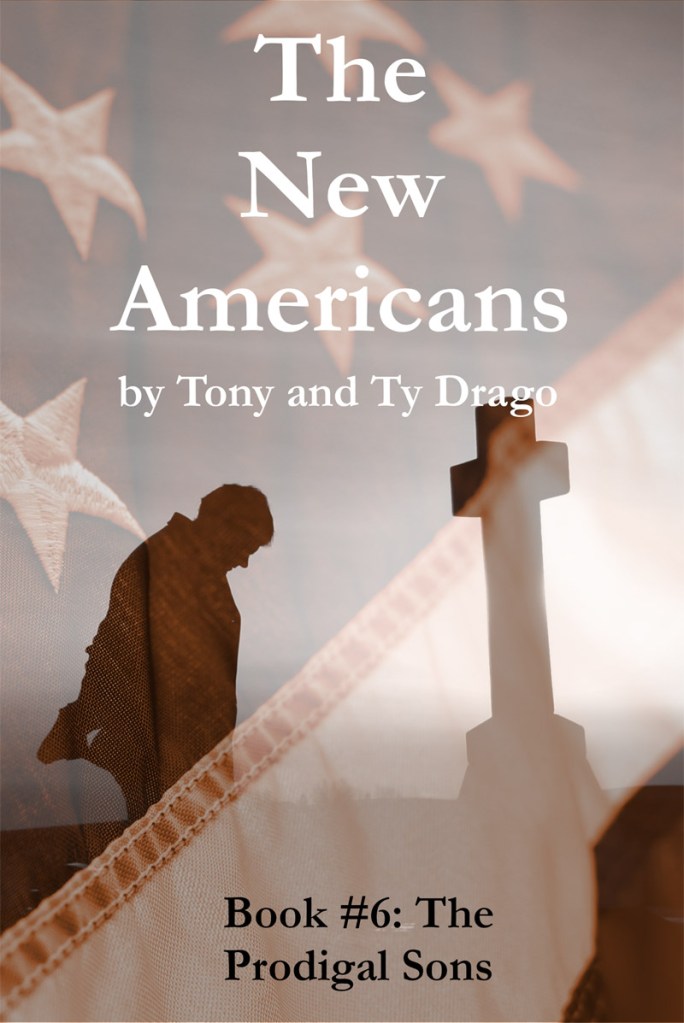
The New Americans: A Saga of Immigration and Family

After being forced to kill in order to protect their widowed mother, three brothers escape Mafia-controlled Sicily to the New World.

Life for immigrants in America during the second decade of the 1900s is difficult and often harrowing, but that’s the reality into which Peter, John, and Angelu Donatello are thrust when their ship docks in Philadelphia. As Peter tries to make his way in this new land through honest hard work, John’s talents—many learned fighting in the Great War—lead him to the seamier, but potentially more profitable, underworld. And all the while, Angelu, the youngest brother and a true innocent, struggles to just find a place for himself in a world he can never truly understand.

Prohibition may make criminals of honest men, but it also allows poor immigrants to mingle with the upper classes; the Donatellos among them. Yet, despite war and crime, marriage and loneliness, honor and betrayal, the brothers, each in their own way, cling to their creed of Supra tuttu la famigghia: Family is all.

Eventually, everything will lead them back to Sicily, to a confrontation with the forces that have shaped their lives, and to a heart-wrenching reconciliation.

Reminiscent of John Jakes’ Bicentennial series, The New Americans by Tony and Ty Drago is a wonderfully moving saga. The genesis of the story is itself a tale: in his final weeks, Tony Drago tape-recorded what his son Ty thought were simple reminiscences. It was only in the years following Tony’s death, after Ty became an established novelist, that he listened to the tapes and realized his father had left him, not a family history, but rather an emotional novel of immigration, rebirth, and growth. Milherst Publishing is honored to bring this story to the world.

The New Americans, by Tony & Ty Drago, will be released in six monthly installments, as both trade paperbacks and ebooks.

1: Fuggitivi. $10.99, 182 pages, ISBN 978-1-5154-5842-5. February 3, 2026.

2: Strangers in Paradiso. $10.99, 186 pages, ISBN: 978-1-5154-5843-2. March 3, 2026.

3: The Pursuit of Felicita. $10.99, 184 pages, ISBN: 978-1-5154-5844-9. April 7, 2026.

4: The Philly Crew. May 5, 2026.

5: A Leaf in the Turning. June 2, 2026.

6: The Prodigal Sons. July 7, 2025.

Book #3: The Pursuit of Felicita

With the end of the Great War, immigrants are no longer needed for the hard work in the Philadelphia Ship Yard, and Peter and Angelu are unceremoniously dismissed. Peter however, lands on his feet, taking employment as a delivery driver for a sugar company, a job fraught with the danger of hijackings. On another front, his continuing language lessons lead him toward a relationship that will eventually define his life. Angelu, on the other hand, feeling increasingly lost in the big, confusing city, finds himself bitterly out of his depth.

The arrival of Prohibition brings upheaval to America, but it also provides opportunities for those who can adapt. And, calling on relationships made in the Army, John is able to adapt quickly. Though he’s hiding from his brothers, he knows his mission is to ensure his family’s security… by any means necessary.

Lemuria 7 by Allen Steele

A press release from Fantastic Books:

FOR IMMEDIATE RELEASE

Is there a Bermuda Triangle on the Moon?

Billionaire inventor Edison Smith pays for the Lemuria 7 moon mission as a tourist trip, sending media into an uproar. Is it a case of conspicuous consumption? Fodder for the tabloids? Actual, privately funded scientific research? Or something else? It turns out to be all of those things at once, and more.…

When Smith, his wife Mary Alice, their daughter Amelia, Amelia’s fiancé Todd, and the crew of Lemuria 7 disappear, the only conclusion to be drawn is sudden equipment failure leading to catastrophic disaster. But there are hints that such might not be the case.

Believing it was something more—and hoping against hope that the inevitable outcome might not have been so inevitable—Merlin Feng sends robots, and then people (including himself) to the Moon to find out what happened to the Smiths, who were like family to him. That mission, too, encounters… problems.

When three-time Hugo Award winner Allen Steele is telling the tale, you can be assured there is more happening than meets the eye. Deeper mysteries and hidden motives mean that Lemuria 7 will live forever, even if the Smiths don’t.

Lemuria 7
by Allen Steele
Fantastic Books
Publication date: July 14, 2026
Trade Paperback: 204 pages, $12.99, ISBN 978-1-5154-5850-0
Hardcover: 204 pages, $21.00, ISBN 978-1-5154-5851-7
Ebook: $5.99

Lemuria 7—and all Fantastic Books books—are distributed via Ingram. Review copies are available upon request.

Artemis, but not really my Artemis

I’m watching the Artemis II pre-launch coverage with a mix of excitement and melancholy. It’s a great scientific project leading to wonderful things, but there’s a part of me ruing the fact that it’s NASA’s Artemis project, rather than The Lunar Resources Company’s Artemis Project.

For those of you who hadn’t heard of it, I was involved in a hybrid commercial/non-profit project called the Artemis Project in the late 1990s and early 2000s. Our goal was to build a colony on the Moon. We had the technology, we had the drive. The only thing we didn’t have was a method of bring in enough money quickly enough to actually do it, and eventually, we had to admit defeat.

But today, NASA is sending people back to the Moon, finally! I’m watching the coverage on TV, and on NASA’s web site, and thinking “Bummer! I should have planned to go to Florida a bit earlier.” Well, maybe I’ll be able to make it for the first peopled landing on the Moon.

Cartoon Vocabulary

The things we learn from cartoons. Eating dinner just now, I found some classic cartoons on MeTV. In the 1947 “Daffy Duck Slept Here,” Porky calls Daffy “pixilated,” and I immediately said, “What?!” I thought it was a term brought to us by the computer revolution.

So I looked it up. It not only predates the home computer and modern graphics, but it predates the Civil War. Indeed, the Oxford English Dictionary finds a first use of the word in 1848. It meant eccentric or mentally disordered, and was probably formed from a combination of “pixie” and “titillated.”

And now you know, too.

Electronic Punctilious Punctuation

I’m thrilled to announce that there is—finally—an ebook version of my latest book, Punctilious Punctuation. The book is so full of graphics, footnotes, special characters, and more, that I didn’t trust myself to turn it into an ebook, and had to get an expert to do it. Well, it’s done and it’s available!

You can get it directly from me/the publishing company on the linked page, or follow the links on that page to some of the major ebook retailers.

This is the book that Samuel R. Delany “really enjoyed,” and Joe Haldeman said contained “the best joke I’ve encountered today… well, the best grammar joke, anyway.”

Ventrella Makes the Mistakes

This is a press release from Gray Rabbit Publications’ Milherst Publishing:

Making the Mistakes So You Don’t Have to

He’s written more than a dozen books, including the highly acclaimed Terin Ostler/Fortannis fantasy series, the Teddy Roosevelt/steampunk adventure Big Stick, and the horrifically funny Bloodsuckers. He’s also edited a slew of great books, including the Fantastic Books anthologies Release the Virgins and Three Time Travelers Walk Into…, and he co-edited Across the Universe and two volumes of alternate Sherlock Holmes stories in the Baker Street Irregulars series… and that’s just his fiction output. All of that means he’s made—and learned from—the mistakes beginning writers usually make. And now, in Learn From My Mistakes, Michael A. Ventrella saves you the time of making those mistakes yet again for yourself.

This collection of essays—written over several years, usually as he was making the mistake he talks about—give a wonderful overview of the entire process, from idea to writing, editing to publishing, and selling the book and building a career. Told in an accessible style, Ventrella is someone you want to have a conversation with, to pick his brain. And this book offers just those suggestions.

Recommended for beginning writers and those who want to level up their writing game.

Learn From My Mistakes!: (Writing advice from someone who knows better)
by Michael A. Ventrella
trade paperback: 186 pages, $13.99
ebook: $4.99

Available from all the major retailers.