A problem with names

Most of my fiction is short, sometimes very short. And I write a lot of my stories in the first person, because I find it lends intimacy and immediacy to the story.

But one of the stories I am currently writing seems to be more suited to being told in third person. Fine, good. It gives some room for a narrator (which I also enjoy doing). But a skill that seems to have atrophied because of all of my first-person writing is that I’m having trouble naming and describing the characters.

With a first-person point of view, the main character will rarely or never mention his own name. And think about how often you use other people’s names: if you’re talking with someone you know, you can go a very long time without either one of you mentioning your own or the other’s name.

Similarly, unless there’s been some great change—a new hair style or an interesting outfit—you’ll rarely describe or “characterize” yourself or the other. Heck, I look in the mirror every morning, but I almost never remark on my own appearance (well, other than this week, when I’ve been watching this subconjunctival hemorrhage turning my left eye a remarkably horrifying red, but the doctor said it should resolve itself in a few days [and yes, there’s a bit of characterization that doesn’t really move the story forward, but does lend color, if you will, to the tale]).

Back to my original point: I know sometimes names are very important, and can be a large part of characterization, but far more often, character names are just indicators so the author can differentiate one from another. So how do you pick a good name—and perhaps interesting characteristics—when those aren’t the foci of the story you’re telling?

P.S.—I thought about including a picture of my eye, but decided it would gross out more people than it would attract readers.

2025: The Year in Reading and Writing

A bunch of my friends do this, and I’ve done it in the past, but let it slide the last few years. My list is not so impressive as many others’, but for… reasons.
 
The books I read in 2025:
 
The Complete Sherlock Holmes by Arthur Conan Doyle. So many of my friends and acquaintances so often talk about Holmes, and I’ve come to understand the mythos somewhat, so I finally decided it was time to read some Sherlock Holmes. Well, I decided to just read ALL of Sherlock Holmes. So now I’m caught up.
 
The Prince by Niccolo Machiavelli. Another one of those classics to which reference is often made, but which I hadn’t actually read. When I did finally finish it, I remember thinking the last few chapters seem to play (or at least pre-echo) a great deal of President Trump’s politics.
 
Godel Escher Bach by Douglas R. Hofstadter. I’d been reading this one, off and on (mostly off) for quite a long time. I finally finished it. Seems a little predictive and a little dated.
 
Tales of Galactic Pest Control edited by David Gerrold and Tom Easton. Some very good stories in this anthology, including one of mine.
 
Unidentified Funny Objects 7 edited by Alex Shvartsman. I didn’t laugh at all of them, but a good enough percentage.
 
The books I edited and published:
Ginger Snaps by A.R. Alan
Mystralhaven by Ron Kaiser
A Talent to Amuse by Daniel M. Kimmel
The Lies We Tell Others edited by Sahar Abdulaziz and Michael A. Ventrella
 
I also read and edited and worked on another seven books that will be published in 2026. I’ll talk about them in the near future.
 
By some measures, that’s not a lot. Only eighteen titles. Still, the Complete Sherlock Holmes is several books’ worth of reading. And in the cases of the books I edited, that was reading each of them two or three times (or even a few more, through various iterations). So I’m not embarrassed, but not bragging, either.
 
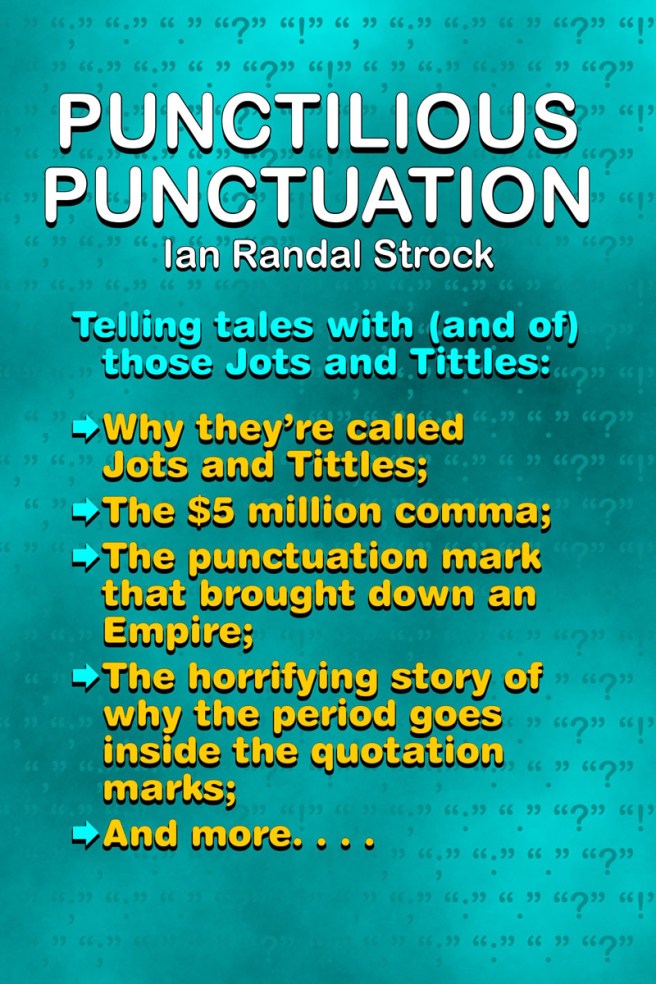
Finally, I am also a writer. And while too much time editing means very little time writing, I did manage to finishing writing and publish my book Punctilious Punctuation. And two of my stories saw print: “…a Crack of Lightning, or, The Zen Solipsist Muses Upon His Own Genesis” appeared from Amazing Stories on June 16, 2025; and “Infestation: White House” appeared in the anthology Tales of Galactic Pest Control, edited by David Gerrold and Tom Easton (July 2025).
 
Writing is a very emotionally rewarding occupation, but it isn’t exactly financially rewarding, so I’ve also joined the crowed, and set up a ko-fi page as a tip jar. If you’re so inclined, anything and everything will be gratefully appreciated, at https://ko-fi.com/ianrandalstrock . Thank you, and happy 2026. Let’s read!

Don’t Tell Me

I’ve been trying to be a better writer recently. I’ve actually been writing every day, and I’m making more of an effort to find markets for my writing (haven’t had much luck finding paying markets for my essays recently; my fiction—as does everyone’s—sometimes takes quite a while to find the right home).

Something I noticed several years ago—but which is making more of an impression as I’m making more of an effort to find places to sell my stories—is those markets requiring anonymized submissions. It’s not a terribly onerous burden—saving another copy of the story without my name on it—but I’ve been wondering who it really serves?

As a professional, I know that the most important people in the publishing ecosystem are the advertisers and the readers: those who pay for the magazine to exist. Everyone else is of secondary import. And I’m wondering if any of them care, or even notice, if the magazine or anthology in question requires anonymized submissions.

I did a quick search of publications who don’t want to know who wrote the story they’re considering, and found these examples from their guidelines:

Remember to take all author information out of your story! Tell us who you are in the space provided in the web form cover letter you get when you click on the “submit” button, NOT in your story! No headers, no bylines… just the story.

Please anonymize your work. No names or other identifying information should appear on the manuscript.

Anonymous Submissions. No identifying information should appear on your manuscript. We use anonymized submissions for our associate editors (first readers). Only upper-level editors will read your submission form information and cover letter, including any diversity statement. Failure to anonymize the manuscript will not cause us to automatically reject your story, but failure to read and follow our guidelines may affect our decisions.

Anonymity: Please do not put your name on your manuscript. All stories are assessed anonymously. [Ironically, this one requires contributors to identify as part of a specific community.]

[Magazine name] only accepts anonymous submissions. Please do not include your name, address, phone number, or other similar identifiers in the manuscript itself. All original fiction and poetry submissions will be read anonymously on first read: moving on to further consideration will depend on the merit of the work alone.

As I said, it’s not a terrible burden on the would-be writers (other than making sure the manuscript file I send is the anonymized one, not the regular one). But does anyone notice? Has any reader ever picked up a magazine and said “This is a great issue. I’m glad the submissions were anonymous.”? or “This issue would have been a lot better if the editor reading the submissions didn’t know the names of the authors before buying the stories.”?

For you readers out there: did you even know this was a thing?


It’s not a “health care” debate

One of the big topics related to the government right now is the ongoing debate over “health care.” Specifically, allowing the Affordable Care Act subsidies to expire, finding a better way to pay for health care, and blaming the other side for the mess we’re in (well, that last is pretty standard for every issue at the federal level). As a person who tries to use words precisely, to best communicate my thoughts to you, I cringe every time a politician or pundit says “health care,” because that’s never what they mean.

Health care is when I go to the doctor and say “this hurts.” The doctor checks me out, diagnoses what is causing the hurt, and treats it (or tells me what to do) so that it stops hurting. That’s health care. And in that respect, health care in the United States is great. We have excellent doctors and nurses and physician assistants and therapists and… a whole slew of people who do remarkable things to make us feel better and keep us healthy, along with the equipment and medications and more. And none of that is what they mean when the politicians and reporters talk about health care.

No, what they’re talking about is “health insurance”: a system of paying for the health care we get that keeps us going. And health insurance in the United States is a disaster, falling apart and falling fast. And none of the tweaks they keep proposing at each other are going to fix the health insurance industry, because we’ve been misusing it and expecting far more from it than it can ever possibly provide.

The thing is, health insurance isn’t some unending pool of money which pays for our every smallest medical need. Health insurance—indeed, any form of “insurance” (except the half-wager when you’re playing blackjack and the dealer has an ace showing)—is a collection of people betting on something they hope won’t happen.

Start with something slightly less controversial: car insurance. You pay a small amount every year to someone managing the money (the insurance company), against the (hopefully very small) chance of being in a crash and requiring a lot of money to repair your car (or one your actions damaged). This only works if there are a lot of people paying in for this insurance and very few of them actually get in crashes requiring large pay outs. In the ideal world, if you had enough money to cover those potential expenses, you wouldn’t bother buying insurance; you’d just pay the repair/replacement costs yourself if you ever needed to (I’m ignoring your responsibility for the other guy’s car, and why states require car insurance). What this all means is that most people pay for car insurance and don’t ever get any money from it, because the entire group of people is funding the expenses of the one or two people who will wind up actually needing it. It only works because relatively few people need it, and no one knows if they are going to be that one person who does. So everybody pays a little, and most never get anything but peace of mind from it.

Health insurance is similar to car insurance. At least, it used to be. You would pay a small amount every year against the (statistically) small chance of having a catastrophic illness or injury that would be very expensive to treat. And the few people who did have such needs would have their expenses paid for by the insurance company (again, in an ideal world), while everyone else in the insurance pool would wipe the sweat from their brows and say “I’m glad I wasn’t the one who needed the money.”

But health care has evolved. Most people used to only see a doctor when they had a major injury or illness. As we’ve developed more of the concept of wellness care, more and more of us go for regular check-ups, low-level medical treatments to prevent (or earlier detect) major problems, and so forth.

And while these are (theoretically) inexpensive health care events, we now expect “insurance” to pay for them all. (Admittedly, the costs of those inexpensive events have been rising, too. And if our politicians were serious about this whole debate, that is where they would be focusing: why does it cost hundreds of dollars for a regular check-up?) But as we expect most people to have those regular check-ups and those preventative treatments, we’re over-stressing the ability of health insurance to cover the catastrophic costs it was designed for. That’s not a fault of insurance; it isn’t a money-multiplier. Way back when, if everyone paid $100 a month for insurance, it was against the fear that one person in a hundred would have a medical problem this year that might cost $100,000 to treat. At those numbers, the insurance pool was sufficient.

But today, we’ve gotten to the stage where, instead of everyone paying in against the rare major need, everyone is paying in their $100 a month… and everyone is expecting insurance to pay the doctor $400 for our “see me in six months” regular check-ups, and we’re expecting insurance to pay for the $25-a-month prescription medicine, and suddenly there’s no money in the insurance pool for the $5,000 the emergency room is going to charge to treat your broken leg, and that $100,000 expense will be enough to bankrupt the insurance company.

The failure is that we’ve spent a couple of generations teaching people that medical treatment is health care, and it’s not just for emergencies, but that everyone should seek it out continually as a preventative. Medically, that’s a good thing. But financially, it may be ruinous. Our methods of paying for it have not kept up.

The recently signed discharge petition means the House of Representatives is going to vote on an extension of the Affordable Care Act subsidies sometime in January. Even if it passes, it’s not going to fix anything, because the entire concept of health insurance is broken. I readily admit that I don’t have the solution, either. But someone smarter than all of us is going to have to figure it out. Because if it’s something we expect most people to use, then the only way to pay for it is individually. And the costs have risen so far so fast that most people simply can not afford to pay for it.

The president’s proposed fix—“we’ll just give everyone $2,000, rather than paying the insurance companies”—is naive at best. Where is the government getting the money to give everyone $2,000? The same place the government gets all its money: from the people. It’s a non-starter.

Indeed, the whole debate has become the Second Law of Thermodynamics for finance: if everyone is paying for insurance, but everyone expects to use it, then insurance is nothing more than a drain on everyone’s wallet.

Blackjack table image by Frerk Meyer, shared under Creative Commons Attribution-Share Alike 2.0. https://upload.wikimedia.org/wikipedia/commons/thumb/7/7e/Blurry_blackjack_table.jpg/640px-Blurry_blackjack_table.jpg

Compliment and addition from Samuel Delany

I just got some very nice praise, and more information, from Samuel Delany about my latest book. He writes:

I recently enjoyed your book, Punctilious Punctuation, very much. One of the things you didn’t mention, however, is that anyone who has ever studied Greek (as I did in my youth) who learns to speak it (as I did in my time in Greece), realizes that the semicolon functions, in Greek, as a question mark. There is no mention of this in your otherwise remarkably thorough treatment of those jots and tittles.

Wow, thanks, Chip!

(And here’s a picture of the two of us from several years ago.)

WotF Podcast #358

I am the guest on the newest podcast episode of the Writers & Illustrators of the Future podcast, episode #358, which is now available at https://writersofthefuture.com/podcast/episode-358/ .

The main topic of discussion is my new book, Punctilious Punctuation, but we also go into punctuation and communication in general as well as writing clearly. Several things mentioned during the episode may have you seeking more information, so here’s a list (in the order in which they were mentioned):
Analog Science Fiction & Fact magazine: https://analogsf.com/
Asimov’s Science Fiction magazine: https://asimovs.com/
Gray Rabbit Publications / Fantastic Books: https://www.fantasticbooks.biz/
DragonCon: https://www.dragoncon.org/
Punctilious Punctuation: https://www.fantasticbooks.biz/product-page/punctilious-punctuation-by-ian-randal-strock
AP Stylebook: https://www.apstylebook.com/
Victor Borge’s spoken punctuation: https://www.youtube.com/watch?v=TIf3IfHCoiE
Eats, Shoots & Leaves by Lynne Truss: https://www.lynnetruss.com/eats-shoots-leaves

The person behind the curtain?

MSNOW’s Morning Joe just wrapped up—as it frequently does—interviewing an actor. Today, it was Simu Liu talking about the science fictional ideas behind his new series, The Copenhagen Test. He did well, talking about the nature of privacy and hacking and trusting our own sense. But as he was talking, I wondered why they weren’t interviewing the writer who came up with the idea for the show. After all, their focus was on the concept underpinning it, so wouldn’t the best interview be the person who created that?

Intellectually, I know, they interview actors because viewers know the actors and don’t know the writers. But if they’re talking about the ideas, it occurred to me, they ought to be talking with the people whose ideas they are.

The Communal Nature of Television

I’m home alone, all by myself. And White Christmas is on BBC America right now (one of my favorite musicals). I didn’t call it up from some on-demand service; I stumbled across it while flipping channels.

And watching a movie, “live,” as it were, has a very different feeling than on-demand would. I don’t quite understand it. There’s something in the knowledge that other people are watching the same thing at the same time, seeing and reacting to the same things.

I don’t know who they are, don’t know where they are, will never interact with them. And yet… yet I still find watching on television more appealing, more of a communal feeling, than on-demand or on DVD or VHS or whatever. Not communal like sitting in a movie theatre (which I think I’ve done once in the last six years), nor even with a few friends or family members in the living room. But still, there’s that hint of doing something as a group rather than all by my lonesome. Does that make any sense to you?


Bad coin design

I just sent the following email to the US Mint (at inquires@usmint.treas.gov).

Please, PLEASE tell us the obverse design of the “Enduring Liberty Half Dollar” is NOT final, and that it will be improved. Specifically, the point on the Statue of Liberty’s crown that comes out from behind her nose makes her look like Pinnochio telling a lie. Please move the tine away from the nose.

The image of next year’s half dollar (look at it small, or almost life-sized, on 
https://www.usmint.gov/news/media-kit/semiq-resources#accordion-ff8bbe2a7a-item-a383a9f54d ) is:


Saul Rubinek playing Saul Rubinek playing Shylock

I had an odd theatrical experience this past Tuesday. I went to a show, and while I’m still not sure if I liked it, I am still thinking about it, so in that respect, it was good.

The show is Playing Shylock, starring Saul Rubinek (the original version was written by Mark Leiren-Young; this was apparently an updated, modified script). It was in the Polonsky Shakespeare Center, a little theatre in Brooklyn, and the show is closing tomorrow, so at this point, I can’t really urge you to see it yourself.

The conceit is that the audience is actually there to see a production of William Shakespeare’s The Merchant of Venice. [Aside: I’d never read the play before, though I knew bits of the story, so Monday night, I watched a film version from 2004.] A voice-over tells us the second act will be delayed due to technical difficulties, and eventually, Saul Rubinek comes on stage—in costume as Shylock—to tell the audience that they will not be performing the second half of the play, because the cast accidentally learned during this intermission that the theatre has cancelled the remainder of the run, making tonight’s performance the last.

What follows is a nearly two hour-long monologue/discussion of artistic freedom, antisemitism, and virtue signaling. But also, the concepts of freedom, security, and memory; the Jewish experience in surviving (or not) the Concentration Camps in Nazi Germany; and honoring our parents as we live the better lives they worked for us to have. Thrown in are digressions about the nature of representation, artistry and artistic credit, and the never-ending debate over who actually wrote the plays of William Shakespeare. As with all of the best questions, there were no hard-and-fast answers. It was all there to make us think.

Playing on nothing more than his own memories, the script, and the all-too-limited audience reactions, Rubinek is wonderfully emotive, and incredibly moving. And with such heavy concepts and weighty thoughts, there is just the right touch of levity to keep the show from being crushingly depressing… even though he and we know that the depression has a very strong foundation, and holding back the tide of the antisemitism, the repression, and the outright hatred may not be possible.

One of the unintended sources of discomfort, for me, was his interactions with the audience. I’ve been in theatres my whole life, sometimes on the stage, more often in the audience. And in all that time, I’ve learned that the audience’s role is to watch, but not to interact. (There is, of course, the allowed interaction during lectures, which are a different animal, perhaps because the “actor” is not playing some fictitious character, but is merely himself.) But in Playing Shylock, Rubinek is playing himself—or an alternate universe version of himself—in which he is still in costume from the interrupted performance of The Merchant of Venice, except that there was no actual interrupted performance of the play, so is he actually just Saul Rubinek, or is he a fictitious Saul Rubinek? At any rate, several times he asked the audience for commentary, for responses, and I truly didn’t know if I was supposed to supply the other side of that conversation, or if those were rhetorical questions, part of the script. I suppose that added discomfort may actually have been intended, to show that the comfortable world we hope we live in is not really so scripted and easy.

Yes, I guess I did like it. Not in the “that was a lot of fun; I want to do it again” way of liking something, but in the “that made me think” way. Yes, it was an evening well spent. Bravo, Saul Rubinek, and playwright Mark Leiren-Young.