What brings you joy?

I’m planning to go to a Mensa gathering this evening, just some people getting together in a restaurant/bar for conversation. The last time this particular gathering gathered, it was fascinating. I met several new people, including some from other countries, who knew and talked about things I didn’t know, so I learned. It was a good time.

But there was one woman present who I’d only known from online interactions. Unfortunately, in person, she was the same: always complaining, angry, and put upon. Nothing was right, and everything needed to be corrected to her standards. Thinking about tonight’s gathering, I’m anticipating the good, but I’m wondering what I might say if I find myself in proximity to this woman, to short-circuit her kvetching. I think I’ll ask her what brings her joy.

That, however, makes me think she might turn the question back on me: what brings me joy? So I’ve been thinking about that.

I try to find some joy in every day: whether it’s talking with my family, hearing a new song or joke (well, new jokes are rare these days), or learning and playing games with friends, but those are little things, small joys (mind you, that doesn’t make them any less important or less cherished). But there are bigger joys, too: being on stage (thinking of the talk I gave last weekend, about punctuation and my new book), selling a story or essay, or experiencing something genuinely new, like visiting a new place.

Most of those, however, rely on other people. But there are also the joys that don’t require other people’s efforts: writing, for me, is one of those joys, whether I’m at the keyboard or out walking and the right turn of phrase comes to me. Selling what I’ve written adds another level of joy, but even without the selling, I enjoy my time choosing precisely the correct word, and ordering those correct words. My wood carving is another one of those joys; one I get to experience too seldom, especially in the colder months, since there’s no place to do it in the house. And there are a few cherished movies I’ll rewatch when I need a lift, a pick-me-up, because they always make me smile (although movies, by their very nature, require other people to have done a great deal to get them to me). It’s a similar thing with reading an especially good passage or engrossing story, when not only am I enjoying what I’m reading, but I’m trying to figure out how the writer did it, to see if I can learn from it to improve my own writing.

Anyway, that’s a short answer to the question I may ask of others this evening, but I’ll ask you, too: what brings you joy?


Where Should I Buy Your Book?

I’ve had several people ask how they should purchase my new book, which way is best for me, and I’m extremely gratified by those questions. While this question is easily extrapolated to just about any author, the answer is “it depends.” There are several answers.

What my friends and family think they’re asking is “where should I buy your book so that the most money winds up in your pocket?” And that’s a very kind question to ask. The simple answer is: “buy it directly from me, when you see me in person.” But while that method does indeed put the most money in my pocket, it works out to only two or three dollars (maybe as many as five) more than I’d earn from a sale some other way. In my particular case, with this specific book, it’s been published by one of the imprints of the independent publishing company I own. My company pays authors fifty percent of the net the company takes in on each sale. So if you buy the book from me as the publisher at a convention, it’ll be almost as much money in my pocket. That’s because neither of those sales has to give a cut to the distributor or to some other retailer.

But there are other answers to the question, other considerations.

My publishing company is an independent. While physical bookstores can order our books from our distributor, those bookstores don’t stock our books, because we don’t offer a large enough discount or the 100% returnability they require (those are topics for another essay). So the bulk of our bookstore sales come from the online retailers, of which the largest—by far—is Amazon. If you buy my book from Amazon, that helps the Amazon Sales Rank move up. And while one sale isn’t going to affect that number much, several dozen copies, a few hundred, if all made the same day or week, will indeed affect that number. And books with better Sales Ranks will be shown to more people on Amazon, hopefully leading to even more sales. So buying on Amazon, while resulting in less money in my pocket for that one book, may eventually result in many more sales.

But as important as that Sales Rank is, it’s fleeting, temporary. The number may be great this week, but if no new copies are sold next week, the number will plummet as other books are published and rise up the ranks. What has a longer-lasting effect is reviews. Reviews don’t have to be complex—you don’t have to write a four-page essay comparing and contrasting my book to, well, anything. Even just a few words is sufficient for the algorithms, because they’re focused on the number of reviews, and the average ranking of the book from the “rank this book on a scale of 1 to 5.” If you can spend just a few minutes to write a few nice words about the book, in the long run, that may wind up being the most valuable.

And that’s not unique to Amazon. Reviews on GoodReads or LibraryThing are equally important. Indeed, any sort of word of mouth (telling your friends and neighbors) is also great.

But all of that is still assuming the book in question has been published by a small press like mine, or self-published by the author. If, however, your friend has had the fortune to have the book published by one of the large publishing firms (like my first three books), the answer will again be different.

If the book has been published by a big publisher, one of the “big five” or “legacy” firms—or even a smaller traditional publisher that still has standard physical bookstore distribution—the best way to buy the book is at that brick-and-mortar bookstore. Those sales are the most likely to be counted and reported, and when the author has another book to submit to publishers, they’re going to be looking at those sales numbers to justify (or not) buying and publishing that next book. Incidentally, that points to another big difference between those large publishers and mine: if your book doesn’t sell five thousand or ten thousand copies, that large publisher is unlikely to offer a contract for the new book. On the other hand, if my company published that book, and it sells a scant one thousand copies, it’s still done a great job for my company, and I’ll be happy to publish the next.

So, back to the original question: my friends asking where/how they should buy my book. At this point, I’m still hopeful for a bit of a break-out, still hopeful to make at least a little splash in the bigger world of Amazon sales, so I’m directing my friends and family there (even though Amazon has done so much to kill publishing), foregoing the few extra dollars now in hopes of more sales a little later. That said, I’m thrilled with every single sale, and I’ll be selling copies at Capclave this weekend, HalloWeeM at the end of October, and nearly everywhere you can find me. On behalf of myself and all the other authors being asked, the greatest thing you can do is tell us you’re interested in our books, and then show us. Happy reading!
Punctilious Punctuation: a press release and a request for suggestions

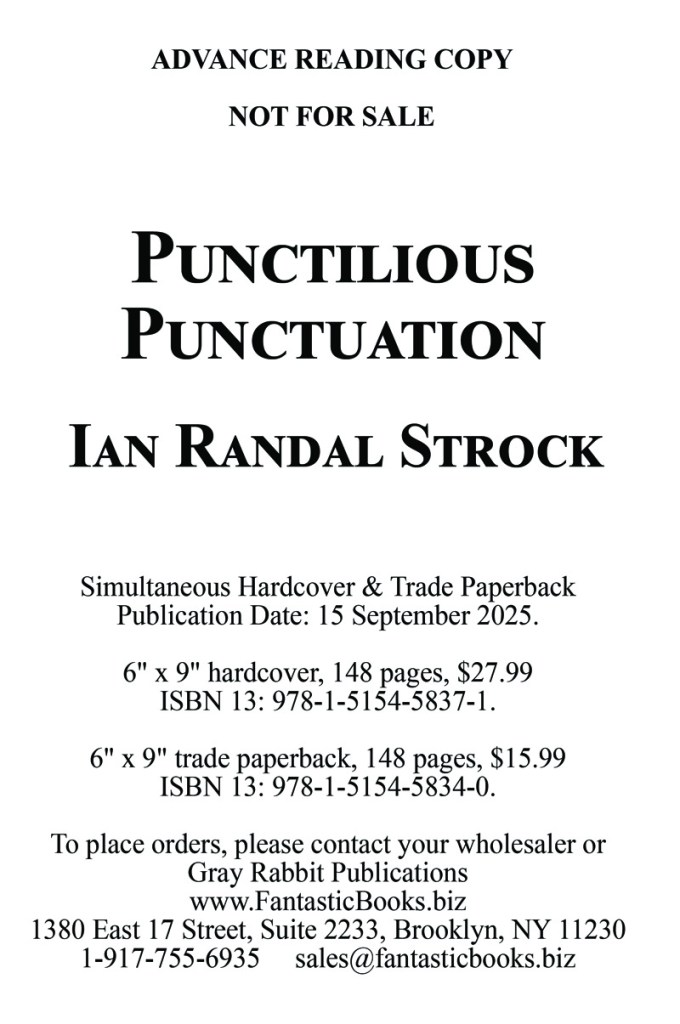
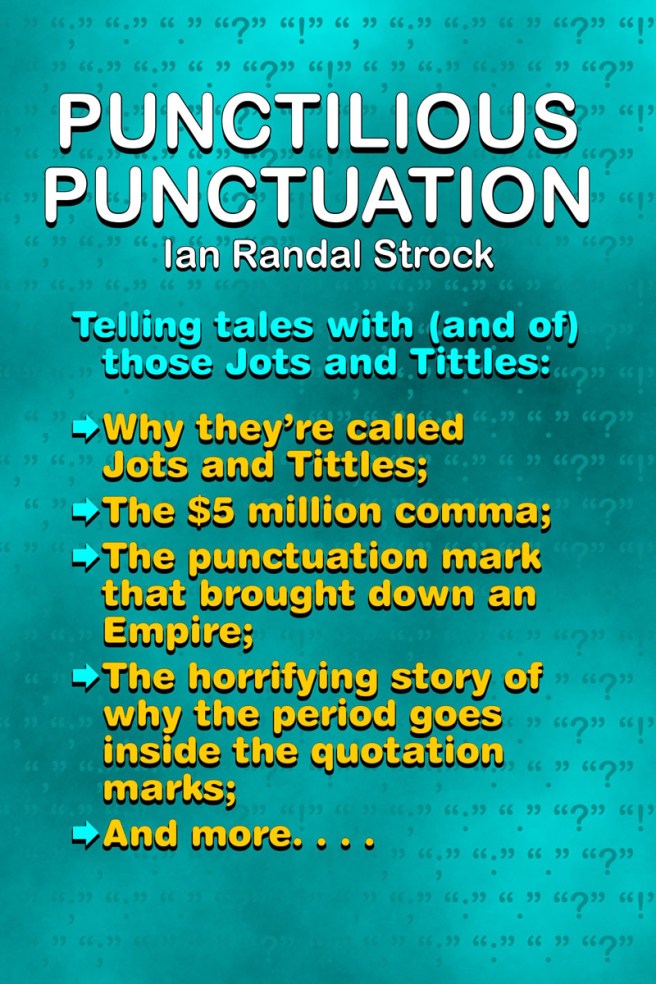
It started—as the biggest arguments do—over the smallest of things: the placement of a comma. That turned into an anecdote, and thence into a speech. And now author, editor, and punctuation lover Ian Randal Strock has turned it into a book. Punctilious Punctuation allows each and every one of those little spots and squiggles on the page to shine, with its own chapter covering the history, usage, misusage, and ancillary information of the punctuation marks. Punctuated with stories and anecdotes on the huge impact those tiny marks can have (the $5 million lawsuit, the Russian revolution, and more), Punctilious Punctuation is fully researched, footnoted, illustrated, and—of course—punctuated.

Ian Randal Strock’s three books on presidential history and trivia were published by Random House and Carrel Books. His award-winning science fiction has appeared in Analog, Nature, Amazing, and several anthologies, and some of it has recently been collected in Wandering Through Time. He has presented talks on punctuation, the presidents, and a variety of other topics to Mensa, writers’ groups, science fiction societies, the 99s, university classes, and more. He is the recipient of the 2025 Edward E. Smith Memorial “Skylark” Award, and firmly believes in the utility and necessity of the serial comma.

Punctilious Punctuation: Telling tales with (and of) those jots and tittles, including why they’re called jots and tittles, and the horrifying story of why the period goes inside the quotation marks
by Ian Randal Strock
148 pages, fully illustrated
September 15, 2025
Trade Paperback: ISBN: 978-1-5154-5834-0, $15.99
Case Laminate (library binding): ISBN: 978-1-5154-5837-1, $27.99

Punctilious Punctuation—and all Gray Rabbit Publications books—are distributed via Ingram. Review copies are available upon request.

And the request: where do you find reviews of such non-fiction titles that you appreciate? In the realm of science fiction, I know where to send galleys, but I’m trying to improve my game in non-fiction. Thanks!

Science Fiction Convention (5th of 2025)

Next weekend (not this weekend), May 23–26, I’ll be at Balticon in Baltimore’s Inner Harbor. As usual, I’ll be spending a lot of time in the dealers’ room (specifically: Friday 2–7pm, Saturday and Sunday 10am–7pm, and Monday 10am–2pm). But this year, I have a serious request: I’m currently experiencing a severe case of tendinitis (my doctor called me an over-achiever: I’ve got tennis elbow AND golfer’s elbow, simultaneously, in my left arm [the last round of golf I played was three years ago, and I haven’t played tennis in more than a decade]). As a result, I’m going to have trouble lifting the boxes of books, so if I can find a willing volunteer or two to help me unload the car and get the stuff to the dealers’ room on Friday, and/or to truck it back to and reload the car on Monday, I’d be grateful. Thank you.

And if you’re looking for me on panels, seek me out:

Friday at 8:30pm in Mount Washington: “When Writing Advice is Rong” with Scott H. Andrews, Joshua Bilmes, Dan Jolley, and Mark Painter.

Saturday at 11:30am in Gibson: “Traditional Publishing Scares Me: How to Traditionally Publish Your Book” with Joshua Bilmes, Silvia Moreno-Garcia, Sydney Olivia, and Brie Tart.

Sunday at 10:00am in Federal Hill: “Ducks and How to Make Them Pay” with Martin Berman-Gorvine, Flappy, Kelly Pierce, and Naomi S.

Sunday at 2:30pm in Mount Washington: “Jews In Space: Jewish SF On and Off The Page” with Martin Berman-Gorvine, Randee Dawn, and Alex Shvartsman.

Sunday at 8:30pm in Mount Washington: “Eye of Argon Reading” with A.L. Kaplan, Mary G. Thompson, and Jean Marie Ward.

Monday at 11:30am in St. George: “Short Fire Readings” with Scott Edelman, Miguel O. Mitchell, Mark Painter, and Andrija “Andy” Popovic.

Hoping to see many of you there!

The Outcasts Story Bundle

Outsiders. Rebels. Free-Thinkers. Who doesn’t love an underdog? Deep inside, most of us identify with those who are a little—or a lot—different. Those who choose their own path, or for whom fate chooses for them. Sometime in our lives, we’ve felt like we didn’t quite fit in.

This doesn’t have to be a bad thing.

Forging your own way builds strength, and makes for a damn good story!

Our authors have taken the outcasts and woven masterful tales of triumph despite adversity. In these times of turmoil, we all need a reminder that such difficulties can be overcome. Check out the Outcasts bundle, which I hope you will enjoy as much as I have. At the least you will get three amazing books for a steal, Amaskan’s Blood by Raven Oak, The Favored by Morgan Bolt, and Three Chords of Chaos by James Chambers. At most, you’ll score not just the three base books plus eleven bonus titles, but two bonus-bonus books thanks to Alma Alexander’s radically awesome reenvisioning of shapeshifters and her generous inclusion of her Were Chronicles Omnibus, which includes the full trilogy Random, Wolf, and Shifter

The Outcasts bundle runs for three weeks only. This is a great deal, and a great way to pick up a batch of books for those times that you need an escape from real-world issues—or just feel the urge to root for your new favorite underdogs! —Danielle Ackley-McPhail, Curator


For StoryBundle, you decide what price you want to pay. For $5 (or more, if you’re feeling generous), you’ll get the basic bundle of three books in .epub format—WORLDWIDE.

AMASKAN’S BLOOD by Raven Oak

THE FAVORED by Morgan J. Bolt

THREE CHORDS OF CHAOS by James Chambers

If you pay at least the bonus price of just $20, you get all three of the regular books, plus 11 more books, for a total of 14!

SKYFARER by Joseph Brassey

FOR THE GOOD OF THE REALM by Nancy Jane Moore

WARDEN FALL by Jennifer M. Eaton

FRANKENSTEIN: MONSTERS OF THE ABYSS by John L. French and Patrick Thomas

PHOENIX PRECINCT by Keith R.A. DeCandido

YETI LEFT HOME by Aaron Rosenberg

ETERNAL WANDERINGS by Danielle Ackley-McPhail

ESPRIT DE CORPSE by Ef Deal

RAGS by Ty Drago

THE SILVER SHIP AND THE SEA by Brenda Cooper

THE WERE CHRONICLES by Alma Alexander

This bundle is available only for a limited time via http://www.storybundle.com. It allows easy reading on computers, smartphones, and tablets as well as Kindle and other ereaders via file transfer, email, and other methods. You get a DRM-free .epub for all books!

It’s also super easy to give the gift of reading with StoryBundle, thanks to our gift cards—which allow you to send someone a code that they can redeem for any future StoryBundle bundle—and timed delivery, which allows you to control exactly when your recipient will get the gift of StoryBundle.

Why StoryBundle? Here are just a few benefits StoryBundle provides.

Get quality reads: We’ve chosen works from excellent authors to bundle together in one convenient package.

Pay what you want (minimum $5): You decide how much these fantastic books are worth. If you can only spare a little, that’s fine! You’ll still get access to a batch of exceptional titles.

Support authors who support DRM-free books: StoryBundle is a platform for authors to get exposure for their works, both for the titles featured in the bundle and for the rest of their catalog. Supporting authors who let you read their books on any device you want—restriction free—will show everyone there’s nothing wrong with ditching DRM.

Give to worthy causes: Bundle buyers have a chance to donate a portion of their proceeds to Girls Write Now!

Receive extra books: If you beat the bonus price, you’ll get the bonus books!

Strock Receives Skylark

Press Release

During the awards ceremony at this weekend’s annual Boskone science fiction convention, the members of the New England Science Fiction Association (NESFA) awarded their annual Edward E. Smith Memorial “Skylark” Award to Ian Randal Strock.

The Skylark is presented annually by NESFA “to some person, who, in the opinion of the membership, has contributed significantly to science fiction, both through work in the field and by exemplifying the personal qualities which made the late ‘Doc’ Smith well-loved by those who knew him.” (For the full definition, see below.)

The award citation reads:

This year’s Skylark winner is the editor and publisher of Fantastic Books, but he’s much more than that. He’s worked at Asimov’s and Analog and (the now defunct) Artemis magazines. At Fantastic Books, he’s not only published original works (such as the Hugo finalist Jar Jar Binks Must Die), but also kept in print works by authors as diverse as Shariann Lewitt, Walter Hunt, and Allen Steele. He is one of the nicest people in SF (and Mensa, too). We are pleased to present this year’s Skylark Award to Ian Randal Strock.

Also known as a public speaker, Strock gives talks on presidential history, publishing and writing, punctuation, and more. But in the moment, standing on that stage receiving the award, he had no coherent thoughts. “It was my worst performance on the stage ever,” he said. “I think I said ‘thank you,’ but I’m quite certain I could not come up with anything more insightful or erudite.” A few days later, he was finally able to gather his thoughts, commenting “To say the award was unexpected would be to say that I believed I might one day be nominated for it. I never even imagined I would be considered for the Skylark. I am humbled by this award, and by the awe-inspiring list of prior recipients. I will try to live up to their illustrious examples. Thank you, NESFA.”

For more information, see the following:
Ian Randal Strock, personally: http://www.IanRandalStrock.com
Strock’s publishing company: http://www.FantasticBooks.biz
NESFA: http://www.nesfa.org
The Skylark Award: http://www.nesfa.org/awards/the-skylark
Boskone: http://www.boskone.org

The Skylark is defined in NESFA’s bylaws: The Edward E. Smith Memorial Award for Imaginative Fiction, or “Skylark,” shall be presented from time to time by NESFA to some person who, in the opinion of the Membership, has contributed significantly to science fiction, both through work in the field and by exemplifying the personal qualities which made the late “Doc” Smith well-loved by those who knew him. Doc was so well thought of that he was invited to be Guest of Honor at the Second World Science Fiction Convention in Chicago, 1940 (Chicon I). Only two years before his death, Doc was given the First Fandom Hall of Fame Award at the Twenty-First World Science Fiction Convention in Washington, 1963 (Discon I). Doc Smith attended many conventions and participated in them as a pro and as a fan. He was one of the earliest enthusiasts in what are now called hall costumes and often dressed as characters from his stories—the good guys, of course. Smith was one of the old breed of SF writers who did not distinguish between pro and fan. He talked on panels; he talked informally; he never thought himself too important. He was, in a word, a mensch. It is fitting that this convention’s name was, is, and always will be Boskone and that the Skylark Award was, is, and always will be given out to someone who exemplifies Doc’s qualities both as a professional contributor to the field and as a human being.

Barry N. Malzberg (1939-2024)

Late last night, I learned that Barry N. Malzberg had died. Born July 24, 1939, he was a writer and editor. His daughter, Erika, wrote: “My dad passed away this evening, around 4:30pm. My sister had been with him for a few hours and I was just getting back after having visited with my mother. He took his last breath almost the moment I arrived. It was very, very peaceful and we are so grateful.”

His fiction was ground-breaking and seemingly everywhere moments after he started publishing (his first science fiction story, “We’re Coming Through the Window,” was published in the August 1967 issue of Galaxy), but I’ll probably remember him more for his non-fiction: his essays on science fiction, literature, and the people in the field, which was his stock-in-trade for the last couple of decades.

I remember Barry as a fixture at the science fiction conventions I attended when I first got into the field, but I never really got to know him: there were too many bright and shiny new things and people clamoring for my attention for me to seek out the austere, somewhat foreboding looking fellow he was. Now, reading the reminiscences of so many of my friends, I’m realizing just how much I missed out by not getting to know him better. Rather than trying to recapitulate them, I commend to you posts on Facebook by John Kessel (https://www.facebook.com/john.kessel3), Adam-Troy Castro (https://www.facebook.com/adamtroycastro), and Kristine Kathryn Rusch (https://www.facebook.com/kristinekathrynrusch). I’m sure there will be more in the coming days.

He was nominated for a dozen Hugo and Nebula Awards, and his novel Beyond Apollo won the inaugural John W. Campbell Memorial Award in 1973. His nonfiction works won two Locus Awards: The Engines of the Night (1983), and Breakfast in the Ruins: Science Fiction in the Last Millennium (2008), and I was pleased and honored to publish his third volume, The Bend at the End of the Road (2018).

Book Birthday!

I’m so excited!

Today is publication day for my first fiction collection, Wandering Through Time!

I’ve been writing short fiction and being professionally published for a long time, but now, finally, I’ve collected those stories which appear in magazines and anthologies into a collection all my own. I’ve also written introductions for each story, to tell the reader a little about my writing process, and show from whence come the ideas behind them.

Today, I’m hoping all my friends, fans, and followers will do me the huge favor of sharing this post, to help me spread the word. Thank you!

I asked my friend and mentor Stanley Schmidt, who was the editor of Analog from 1978 to 2012, to give me a blurb for the collection. He read it, and then wrote “The short-short story is one of the hardest kinds of fiction to pull off, and few since Fredric Brown have done it as often or as well as Ian Randal Strock. But that’s not all he does. Wandering Through Time displays a delightful diversity of his thought-provoking ideas and engaging storytelling.”

His successor at Analog, Trevor Quachri, who also buys my stories for publication, wrote “This is the kind of classic, clever idea-oriented SF you’d find in the Golden Age, but built for today. Recommended for your witty friends, history buffs, time-travel fans, and anyone curious for a peek behind the curtain at magazine publishing.”

Hugo Award-winner Robert J. Sawyer offered these kind words: “Ian Randal Strock is a literal genius—a card-carrying member of Mensa—and his intellect shines through on every page of this fabulous collection. From the man who helped steer Analog for many years comes this wonderful sampler of just the sort of stories I love to read.”

And Andrew Andrews at True Review reviewed the book and wrote: “Ian Randal Strock is the Harry Turtledove of short-short SF. His alternate-history stories have punch. The take on a geographically divided America in the time of the Civil War rings strongly in ‘Shall Not Perish from the Earth.’ I think it’s Strock’s best tale. In ‘The Necessary Enemy,’ it’s always wars, it seems, that drive humankind’s progress and destiny. ‘Rockefeller on the Rocks’ proves that unique tales, true or not, of U.S. vice presidents could perhaps work, with sufficiently advanced technology. Why can’t we replace veeps with robots? Who would know?”

Again, thank you for all your support over the years, and for helping me spread the word to feel even more like a real writer today!

WotF Podcast Appearance

Less than a fortnight ago, John Goodwin interviewed me for his Writers of the Future podcast. That hour-long interview is now live at this link: https://soundcloud.com/writersofthefuture/297-ian-randal-strock-the-importance-of-short-fiction?si=8200bff4a422459ab8fc6c6c9d08524f&utm_source=clipboard&utm_medium=text&utm_campaign=social_sharing&fbclid=IwY2xjawFuhFtleHRuA2FlbQIxMAABHSB2IR4NX79JtYEK9Vb_IlQ1woNklLXy3cOMT_Ynz42mtDJiLn0M_eBX7g_aem_4LRGlWsM0VNcypTPo68mzQ

Listening to it, I realize I referred to a lot of things listeners might be interested in learning more about, so I’m providing this list of references and web links. Enjoy!

Artemis Society International, which is now the Moon Society: https://www.moonsociety.org/

Analog Science Fiction and Fact: https://www.analogsf.com/

Asimov’s Science Fiction magazine: https://www.asimovs.com/

The Daily Free Press: https://dailyfreepress.com/

https://en.wikipedia.org/wiki/Newspaper

https://en.wikipedia.org/wiki/Classified_advertising

Random House Bantam Doubleday Dell: https://www.penguinrandomhouse.com/

Wandering Through Time: https://www.fantasticbooks.biz/product-page/wandering-through-time-by-ian-randal-strock

The Presidential Book of Lists, Ranking the First Ladies, and Ranking the Vice Presidents: https://ianrandalstrock.com/home/writer/books/

Altered States of the Union: https://www.goodreads.com/book/show/31180369-altered-states-of-the-union

Carren Strock: https://carrenstrock.com/

Jack Ryan series by Tom Clancy: https://en.wikipedia.org/wiki/Ryanverse

https://en.wikipedia.org/wiki/Recursive_science_fiction

Mike Resnick: https://en.wikipedia.org/wiki/Mike_Resnick

Lezli Robyn: https://lezlirobyn.com/

Galaxy’s Edge: https://www.galaxysedge.com/

Alice Henderson: http://www.alicehenderson.com/

Gray Rabbit Publications / Fantastic Books: https://www.fantasticbooks.biz/

Reviews!

The new issue of True Review has just been posted. In this one, they’ve reviewed two Fantastic Books titles: one six years old, the other still two months from being published.

Of Susan Casper’s The Red Carnival, reviewer Andrew Andrews writes “I love Casper’s style. It is truly gritty, edgy, compelling, dark and emotional. In this case, there is a stark and sinister force at this carny in the town of Somerset that makes all the festival lights turn red. There is a ride that appears out of nowhere, not attested to by the carny operators, called ‘Golgotha, Place of Skulls,’ and there comes a frenzy of violence by the carnygo’ers and carny staff. There is an impulsivity to this narrative that is disturbing, yet almost amusing.”

That’s a good review of a very good book, and I don’t want to take anything away from it.

But of far more personal import is his review of my forthcoming collection, Wandering Through Time. He writes: “Ian Randal Strock is the Harry Turtledove of short-short SF. His alternate-history stories have punch. The take on a geographically divided America in the time of the Civil War rings strongly in ‘Shall Not Perish from the Earth.’ I think it’s Strock’s best tale. In ‘The Necessary Enemy,’ it’s always wars, it seems, that drive humankind’s progress and destiny. ‘Rockefeller on the Rocks’ proves that unique tales, true or not, of U.S. vice presidents could perhaps work, with sufficiently advanced technology. Why can’t we replace veeps with robots? Who would know?”

I’m thrilled, honored, and a humbled to be compared to Harry Turtledove. My book is being released on December 3.