I’m so excited!
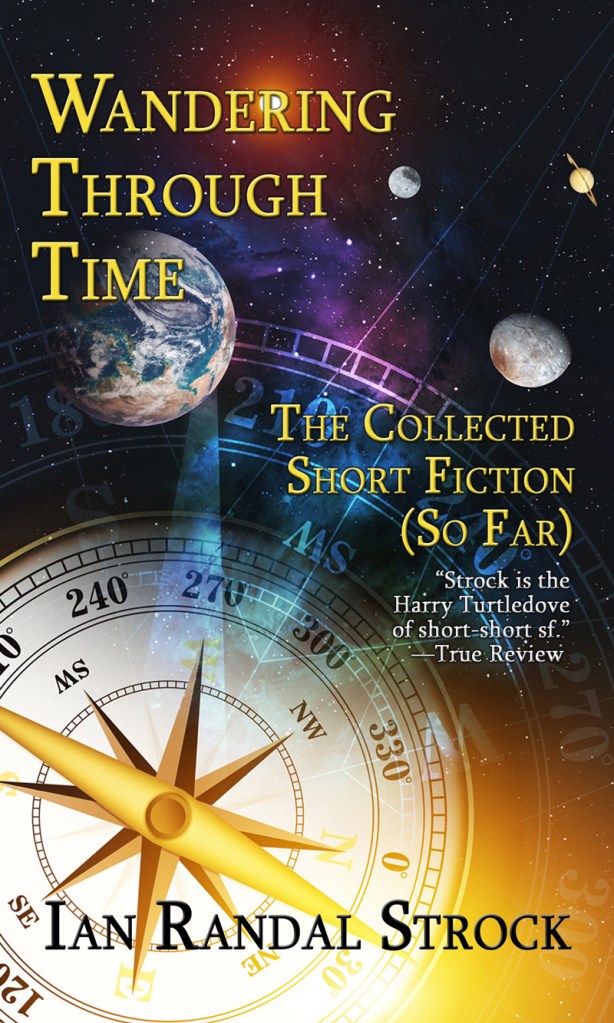
Today is publication day for my first fiction collection, Wandering Through Time!
I’ve been writing short fiction and being professionally published for a long time, but now, finally, I’ve collected those stories which appear in magazines and anthologies into a collection all my own. I’ve also written introductions for each story, to tell the reader a little about my writing process, and show from whence come the ideas behind them.
Today, I’m hoping all my friends, fans, and followers will do me the huge favor of sharing this post, to help me spread the word. Thank you!
I asked my friend and mentor Stanley Schmidt, who was the editor of Analog from 1978 to 2012, to give me a blurb for the collection. He read it, and then wrote “The short-short story is one of the hardest kinds of fiction to pull off, and few since Fredric Brown have done it as often or as well as Ian Randal Strock. But that’s not all he does. Wandering Through Time displays a delightful diversity of his thought-provoking ideas and engaging storytelling.”
His successor at Analog, Trevor Quachri, who also buys my stories for publication, wrote “This is the kind of classic, clever idea-oriented SF you’d find in the Golden Age, but built for today. Recommended for your witty friends, history buffs, time-travel fans, and anyone curious for a peek behind the curtain at magazine publishing.”
Hugo Award-winner Robert J. Sawyer offered these kind words: “Ian Randal Strock is a literal genius—a card-carrying member of Mensa—and his intellect shines through on every page of this fabulous collection. From the man who helped steer Analog for many years comes this wonderful sampler of just the sort of stories I love to read.”
And Andrew Andrews at True Review reviewed the book and wrote: “Ian Randal Strock is the Harry Turtledove of short-short SF. His alternate-history stories have punch. The take on a geographically divided America in the time of the Civil War rings strongly in ‘Shall Not Perish from the Earth.’ I think it’s Strock’s best tale. In ‘The Necessary Enemy,’ it’s always wars, it seems, that drive humankind’s progress and destiny. ‘Rockefeller on the Rocks’ proves that unique tales, true or not, of U.S. vice presidents could perhaps work, with sufficiently advanced technology. Why can’t we replace veeps with robots? Who would know?”
Again, thank you for all your support over the years, and for helping me spread the word to feel even more like a real writer today!
 Ian Randal Strock