Tough Trivia, 5/19/21

Science for today’s Tough Trivia question: The Saturn V rocket stack was the super heavy-lift launch vehicle that took the US manned space program to the Moon. It was—and remains—the tallest, heaviest, and most powerful rocket brought to operational status. It holds the records for the heaviest payload launched and largest payload capacity to low Earth orbit (310,000 pounds). It is also, still, the only launch vehicle to carry humans beyond low Earth orbit. Fifteen were built, but only thirteen were flown, all launching from Kennedy Space Center, in Florida, between November 9, 1967 (the uncrewed Apollo 4) and May 14, 1973 (Skylab). Do you know how tall it was? How heavy? And what percentage of the stack actually returned to Earth from the Apollo missions to the Moon?

***

Rembrandt_Harmensz._van_Rijn_132
Rembrandt

Yesterday’s question was: It seems our most famous artists are either mononymous or pseudonymous, but before they were artists, they were children who were given full names by their parents. How many of these noms d’art can you fill out as they would have appeared on their birth certificates (if birth certificates had been a thing when and where they were born): Donatello, Michelangelo, Raphael, Titian, El Greco, Rembrandt, Hokusai, Hiroshige, Grandma Moses, Toulouse-Lautrec, Erté, Christo, Jeanne-Claude?

The answers are:

Donatello: Donato di Niccolo di Betto Bardi (born circa 1386, lived his whole life in Florence, died December 13, 1466)

Michelangelo: Michelangelo di Lodovico Buonarroti Simoni (born March 6, 1475 in Caprese, Republic of Florence [now Tuscany, Italy]; died in Rome on February 18, 1564)

Raphael: Raffaello Sanzio da Urbino (born March 28 or April 6, 1483, in Urbino, Italy; died April 6, 1520, in Rome)

Titian: Tiziano Vecelli (born circa 1488–1490, lived his whole life in Venice, died August 27, 1576)

El Greco: Domenikos Theotokopoulos (born in Heraklion, Crete, on October 1, 1541; died in Toledo, Spain, on April 7, 1614)

Grandma_Moses_NYWTS
Grandma Moses in 1953.

Rembrandt: Rembrandt Harmenszoon van Rijn (born in Leiden, Dutch Republic, on July 15, 1606; died in Amsterdam, Dutch Republic, on October 4, 1669)

Hokusai: Katsushika Hokusai (born about October 31, 1760, lived his whole life in Edo, Japan, died May 10, 1849)

Hiroshige: Utagawa Hiroshige (born in 1797, lived his whole life in Edo, Japan, died on October 12, 1858)

Grandma Moses: Anna Mary Robertson Moses (born in Greenwich, Connecticut, on September 7, 1860; died in Hoosick Falls, New York, on December 13, 1961)

Toulouse-Lautrec: Henri Marie Raymond de Toulouse-Lautrec-Monfa (born in Tarn, France on November 24, 1864; died in Saint-Andre-du-Bois, France, on September 9, 1901)

Erté: Romain de Tirtoff (born in St. Petersburg, Russia, on November 23, 1892; died in Paris, France, on April 21, 1990)

Christo: Christo Vladimirov Javacheff (born in Gabrovo, Bulgaria, on June 13, 1935; died in New York City on May 31, 2020)

Jeanne-Claude: Jeanne-Claude Denat de Guillebohn (born in Casablanca, Morocco, on June 13, 1935; died in New York City on November 18, 2009). Christo and Jeanne-Claude met in Paris, discovered that they shared a birthday, and created installation art projects together for the rest of their lives.

***

Ian’s Tough Trivia is a daily feature of this blog (Monday’s category is History; Tuesday is Arts; Wednesday is Science; Thursday is Entertainment; and Friday is Grab Bag). Each day, I post a tough question, as well as the answer to the previous day’s question. Simply comment on this post with your answer. I’ll approve the comments after the next question is posted. Sure, you can probably find the answers by searching the web, but what’s the fun in that?

And if you’ve got a favorite trivia question—or even just a topic for which you’d like to see a question—let me know! Reader participation is warmly encouraged.

Tough Trivia, 5/18/21

Today’s Tough trivia question in the Arts category: It seems our most famous artists are either mononymous or pseudonymous, but before they were artists, they were children who were given full names by their parents. How many of these noms d’art can you fill out as they would have appeared on their birth certificates (if birth certificates had been a thing when and where they were born): Donatello, Michelangelo, Raphael, Titian, El Greco, Rembrandt, Hokusai, Hiroshige, Grandma Moses, Toulouse-Lautrec, Erté, Christo, Jeanne-Claude?

***

Yesterday’s question was:

800px-Lincoln_Highway_marker_by_Matthew_BisanzLanes, roads, streets, avenues, boulevards, turnpikes, highways: the American road system is one of the iconic representations of the country. But it wasn’t always so; they were a creation of the automobile, which itself is barely more than a century old. Before the coming of our modern interstate highway system (about which there will be a question in the future), the two most famous roadways were the Lincoln Highway and Route 66. The Lincoln Highway was conceived in 1912, and formally dedicated on October 31, 1913. Route 66—also known as the Will Rogers Highway—was one of the original highways in the US Highway System. It was established on November 11, 1926, with road signs erected in 1927. Which states were crossed by the Lincoln Highway, and which by Route 66? (Bonus points if you know which states hosted both highways.) Further bonus if you know which of the two was longer (and can guess how many miles they covered).

The answer is:

At the time, it was a grand achievement in connecting the United States, but the Lincoln Highway had room for improvement. Riding in an Army convoy on the Lincoln Highway in 1915 convinced Dwight Eisenhower, when he was president four decades later, that the Interstate Highway System was a necessity. The Lincoln Highway ran from coast to coast, from Times Square in New York City to Lincoln Park in San Francisco. It originally ran through New York, New Jersey, Pennsylvania, Ohio, Indiana, Illinois, Iowa, Nebraska, Colorado, Wyoming, Utah, Nevada, and California, covering 3,389 miles. In 1915, the “Colorado Loop” was removed, and in 1928, a realignment shifted the highway to pass through northern West Virginia as well. By 1924, it had been improved, realigned, and shortened to 3,142 miles. In 1928,

IMG_4778
Ian Randal Strock at “the corner” in Winslow, Arizona, on Route 66.

Route 66 has been known as the Main Street of America and the Mother Road. It was memorialized in song, such as “(Get Your Kicks on) Route 66” by Bobby Troup, and the CBS television series Route 66 (which aired from 1960 to 1964), though it has largely been bypassed by the Eisenhower Interstate Highway System. Route 66 originally ran from Chicago, Illinois, to Santa Monica, California. It covered 2,448 miles, and passed through Illinois, Missouri, Kansas, Oklahoma, Texas, New Mexico, Arizona, and California.

***

Ian’s Tough Trivia is a daily feature of this blog (Monday’s category is History; Tuesday is Arts; Wednesday is Science; Thursday is Entertainment; and Friday is Grab Bag). Each day, I post a tough question, as well as the answer to the previous day’s question. Simply comment on this post with your answer. I’ll approve the comments after the next question is posted. Sure, you can probably find the answers by searching the web, but what’s the fun in that?

And if you’ve got a favorite trivia question—or even just a topic for which you’d like to see a question—let me know! Reader participation is warmly encouraged.

Tough Trivia, 5/17/21

New week, new questions (and answers). Today’s Tough Trivia question is a History question: Lanes, roads, streets, avenues, boulevards, turnpikes, highways: the American road system is one of the iconic representations of the country. But it wasn’t always so; they were a creation of the automobile, which itself is barely more than a century old. Before the coming of our modern interstate highway system (about which there will be a question in the future), the two most famous roadways were the Lincoln Highway and Route 66. The Lincoln Highway was conceived in 1912, and formally dedicated on October 31, 1913. Route 66—also known as the Will Rogers Highway—was one of the original highways in the US Highway System. It was established on November 11, 1926, with road signs erected in 1927. Which states were crossed by the Lincoln Highway, and which by Route 66? (Bonus points if you know which states hosted both highways.) Further bonus if you know which of the two was longer (and can guess how many miles they covered).

***

Friday’s question was: As a writer, I’ve been having a disagreement with one of my editors about punctuation. I disagree—emphatically—with his blind adherence to the AP’s drive toward punctuational minimalism. To my mind, the AP is trying to kill the comma for the sake of saving precious column inches in newspapers, but doing so is removing a feature of the written word that adds nuance and meaning. For example, I see a significant difference when the comma is removed from the sentence “We laughed, and were friends for three years.” The editor I’m dealing with says the comma should not be there, but I think removing the comma means we laughed for three years, while using the comma means we laughed briefly, and that laughter made us friends.

Be that as it may, your Tough Trivia question for today is: name the 15 generally accepted punctuation marks in the English language (assuming you’re not the AP or my editor).

The answer is: 

apostrophe ‘ ’
braces { }
brackets [ ]
colon :
comma ,
ellpisis …
em dash —
en dash –
exclamation point !
hyphen –
parantheses ( )
period .
question mark ?
quotation mark “ ”
semicolon ;

***

Ian’s Tough Trivia is a daily feature of this blog (Monday’s category is History; Tuesday is Arts; Wednesday is Science; Thursday is Entertainment; and Friday is Grab Bag). Each day, I post a tough question, as well as the answer to the previous day’s question. Simply comment on this post with your answer. I’ll approve the comments after the next question is posted. Sure, you can probably find the answers by searching the web, but what’s the fun in that?

And if you’ve got a favorite trivia question—or even just a topic for which you’d like to see a question—let me know! Reader participation is warmly encouraged.

Tough Trivia, 5/14/21

As a writer, I’ve been having a disagreement with one of my editors about punctuation. I disagree—emphatically—with his blind adherence to the AP’s drive toward punctuational minimalism. To my mind, the AP is trying to kill the comma for the sake of saving precious column inches in newspapers, but doing so is removing a feature of the written word that adds nuance and meaning. For example, I see a significant difference when the comma is removed from the sentence “We laughed, and were friends for three years.” The editor I’m dealing with says the comma should not be there, but I think removing the comma means we laughed for three years, while using the comma means we laughed briefly, and that laughter made us friends.

Be that as it may, your Tough Trivia question for today is: name the 15 generally accepted punctuation marks in the English language (assuming you’re not the AP or my editor).

***

South_Park_main_charactersYesterday’s question was: Trey Parker and Matt Stone are a creative duo known for several long-running comic projects. Two of their best-known award-winners—in widely divergent media—were both subjects of concern due to religious protests. Can you name them?
The answer is:

The animated television series South Park debuted in 1997. More than 300 episodes have been broadcast to date, and the series has garnered five Primetime Emmy Awards. Isaac Hayes, who played the character Chef, left the show in protest of a 2005 episode denouncing Scientology.

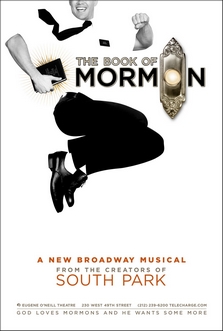
The_Book_of_Mormon_posterThe Book of Mormon is a musical comedy satirizing its eponymous religion. It debuted on Broadway, in the Eugene O’Neill Theatre, on March 24, 2011. It won nine Tony Awards and one Grammy, spawned several national tours and a London production, and only stopped running when the Covid pandemic shut down all Broadway productions.

***

Ian’s Tough Trivia is a daily feature of this blog (Monday’s category is History; Tuesday is Arts; Wednesday is Science; Thursday is Entertainment; and Friday is Grab Bag). Each day, I post a tough question, as well as the answer to the previous day’s question. Simply comment on this post with your answer. I’ll approve the comments after the next question is posted. Sure, you can probably find the answers by searching the web, but what’s the fun in that?

And if you’ve got a favorite trivia question—or even just a topic for which you’d like to see a question—let me know! Reader participation is warmly encouraged.

Tough Trivia, 5/13/21

Today’s Tough Trivia question is the first of the new Entertainment category: Trey Parker and Matt Stone are a creative duo known for several long-running comic projects. Two of their best-known award-winners—in widely divergent media—were both subjects of concern due to religious protests. Can you name them?

***

Yesterday’s question was: Temperature scales are all designed to do the same thing: tell us if we need to put on a sweater or head for the beach. And they all have two fixed points, based on that most necessary of terrestrial substances. So, what are the freezing and boiling points of water in degrees Fahrenheit, Celsius, Kelvin, and Rankine? Bonus points if you know the average human body temperature on those scales.

The answers are:

Fahrenheit: water freezes at 32 degrees, and boils at 212. Body temp: 98.

Celsius: water freezes at 0 degrees, and boils at 100. Body temp: 37.

Kelvin: water freezes at 273.15, and boils at 373.15. Body temp: 310.15.

Rankine: water freezes at 491.67 degrees, and boils at 671.67. Body temp: 558.

***

Ian’s Tough Trivia is a daily feature of this blog (Monday’s category is History; Tuesday is Arts; Wednesday is Science; Thursday is Entertainment; and Friday is Grab Bag). Each day, I post a tough question, as well as the answer to the previous day’s question. Simply comment on this post with your answer. I’ll approve the comments after the next question is posted. Sure, you can probably find the answers by searching the web, but what’s the fun in that?

And if you’ve got a favorite trivia question—or even just a topic for which you’d like to see a question—let me know! Reader participation is warmly encouraged.

Tough Trivia, 5/12/21

Today’s Tough trivia question is the first under the new categorical rotation as a Science question: Temperature scales are all designed to do the same thing: tell us if we need to put on a sweater or head for the beach. And they all have two fixed points, based on that most necessary of terrestrial substances. So, what are the freezing and boiling points of water in degrees Fahrenheit, Celsius, Kelvin, and Rankine? Bonus points if you know the average human body temperature on those scales.

***

Yesterday’s question was: Stars of comic books, television, and movies, the Teenage Mutant Ninja Turtles are actually named after four classic artists. Name the artists… in order of their birth (the artists, not the turtles).

The answer is:

Donatello was born Donato di Niccolo di Betto Bardi around the year 1386 and died December 13, 1466, in Florence.

Leonardo da Vinci was born Leonardo di ser Piero da Vinci on April 15, 1452, in Vinci, Italy. He died on May 2, 1519, in Amboise, France.

Michelangelo di Lodovico Buonarroti Simoni was born March 6, 1475, in Tuscany, Italy, and die February 18, 1564, in Rome.

Raphael was born Raffaello Sanzio da Urbino on either March 28 or April 6, 1483 in Urbino, Italy. He died on April 6, 1520, in Rome.

***

Ian’s Tough Trivia is a daily feature of this blog (Monday’s category is History; Tuesday is Arts; Wednesday is Science; Thursday is Entertainment; and Friday is Grab Bag). Each day, I post a tough question, as well as the answer to the previous day’s question. Simply comment on this post with your answer. I’ll approve the comments after the next question is posted. Sure, you can probably find the answers by searching the web, but what’s the fun in that?

And if you’ve got a favorite trivia question—or even just a topic for which you’d like to see a question—let me know! Reader participation is warmly encouraged.

Tough Trivia, 5/11/21

Today’s Tough trivia question — the first in our new categorical rotation for the Arts category — is: Stars of comic books, television, and movies, the Teenage Mutant Ninja Turtles are actually named after four classic artists. Name the artists… in order of their birth (the artists, not the turtles).

***

Yesterday’s question (the first of the new History questions) was: This is one of my favorite trivia questions when I give talks on the Presidents. I usually present it as a series of hints sprinkled through the talk, but for you, I’ll give all the hints at once. Name the only two people who have received electoral votes in five different elections.

Hint 1: They were members of two different political parties.

Hint 2: They each had a win-lose record of 4 and 1.

Hint 3: They were both active in the 20th century.

The answers are: Franklin Delano Roosevelt and Richard M. Nixon.

FDR was the Democratic nominee for Vice President in the election of 1920 (James M. Cox was the presidential contender), and they lost. Then FDR was elected President in 1932, 1936, 1940, and 1944 — the only President to be elected more than twice.

Nixon was one of the youngest Vice Presidents when he was elected on Republican Dwight Eisenhower’s ticket in 1952 and again in 1956. In 1960, Nixon lost the very close presidential election to John Kennedy. He went on to lose the election for governor of California in 1962. But then Nixon made a come-back, and won the presidential elections in 1968 and 1972, the 1972 election by one of the largest margins of victory.

***

Ian’s Tough Trivia is a daily feature of this blog (Monday’s category is History; Tuesday is Arts; Wednesday is Science; Thursday is Entertainment; and Friday is Grab Bag). Each day, I post a tough question, as well as the answer to the previous day’s question. Simply comment on this post with your answer. I’ll approve the comments after the next question is posted. Sure, you can probably find the answers by searching the web, but what’s the fun in that?

And if you’ve got a favorite trivia question—or even just a topic for which you’d like to see a question—let me know! Reader participation is warmly encouraged.

Tough Trivia, 5/10/21

I’ve been gratified by the positive responses I’ve been getting to these Tough Trivia questions, so I’ll be continuing them indefinitely. But in the coming days, I’m going to make a few tweaks. The questions are going to go onto a regular daily category rotation (I’m still working out the details), and I’m also hoping for more input from you. Do you have a favorite trivia question you’d be willing to share? (Don’t post it, but do drop me a private message with it.) Is there a specific category or theme you’d like to see more of? (Feel free to post it in a comment.) Stick around: I hope you’ll enjoy it as much as I do. And now, on to today’s question:

This is one of my favorite trivia questions when I give talks on the Presidents. I usually present it as a series of hints sprinkled through the talk, but for you, I’ll give all the hints at once. Name the only two people who have received electoral votes in five different elections.

Hint 1: They were members of two different political parties.

Hint 2: They each had a win-lose record of 4 and 1.

Hint 3: They were both active in the 20th century.

***

Stars-fig4Friday’s question was: Can you name all the five-star generals (and admirals) who ever served in the US military? (There are probably fewer of them than you think.)

The answer is:

The US military established five-star ranks in 1944, to remedy the awkwardness of some US commanders being placed in the position of commanding allied officers of higher rank. The five-star rank was retired in 1981, upon the death of Omar Bradley.

The Fleet Admirals were:

  • William D. Leahy (appointed December 15, 1944, at the age of 69; died July 20, 1959)
  • Ernest King (appointed December 17, 1944, at the age of 66; died June 25, 1956)
  • Chester W. Nimitz (appointed December 19, 1944, at the age of 59; died February 20, 1966)
  • William Halsey, Jr. (appointed December 11, 1945, at the age of 63; died August 16, 1959)

General of the Army was a four-star rank in the years after the Civil War (granted to Ulysses Grant, William Sherman, and Philip Sheridan, who died in 1888). During World War II, it was established as a five-star rank. The Generals of the Army were:

  • George Marshall (appointed December 16, 1944, at the age of 64; died October 16, 1959)
  • Douglas MacArthur (appointed December 18, 1944, at the age of 64; died April 5, 1964)
  • Dwight D. Eisenhower (appointed December 20, 1944, at the age of 54; served as President, 1953–1961; died March 28, 1969)
  • Henry H. Arnold (appointed December 21, 1944, at the age of 58; became the only five-star general of the Air Force when the Air Force was formed in 1947; died January 15, 1950)
  • Omar Bradley (appointed September 22, 1950, at the age of 57, while serving as Chairman of the Joint Chiefs of Staff; died April 8, 1981)

In addition, two officers who had previously been promoted beyond four stars were retroactively granted five-star rank: Admiral of the Navy George Dewey (appointed in 1903, but the appointment was made retroactive to 1897; he died in 1917), and General of the Armies John J. Pershing (appointed in 1919, he died in 1948).

And finally, as part of the bicentennial celebrations, George Washington was posthumously made permanently senior to all other offices with the title of General of the Armies on July 4, 1976, and the appointment was made retroactive to July 4, 1776.

***

Ian’s Tough Trivia is a daily feature of this blog. Each day, I post a tough question, as well as the answer to the previous day’s question. At some point, I’ll offer a prize for whoever has the most correct answers, and another for whoever participates most often (I’ll take into account people coming in after the start: regular participation starting later is just as good as regular participation starting earlier). There may also be a prize for the funniest or most amusing wrong answer. Simply comment on this post with your answer. I’ll approve the comments after the next question is posted. Sure, you can probably find the answers by searching the web, but what’s the fun in that?

Tough Trivia, 5/7/21

500dollarbillToday’s Tough Trivia question is: Can you name all the five-star generals (and admirals) who ever served in the US military? (There are probably fewer of them than you think.)

***

Yesterday’s question was: Obsolete US currencies. Currently, the US Bureau of Engraving and Printing (the division of the Treasury Department that produces paper money), prints and distributes paper money in these denominations: $1, $2, $5, $10, $20, $50, and $100. In days gone by, there were larger bills in circulation in denominations of $500, $1,000, $5,000, $10,000, and $100,000 (though the $100,000 bill never circulated, and was used only for internal government transactions [remember, no electronic funds transfers at the time]). The government stopped producing them in the 1940s, and recalled them in 1969 (withdrawing them from circulation and destroying whenever they made their way into the federal reserve system), but they are still legal tender. Whose portraits graced the fronts of those bills?

The answer is:

100000dollarbill$500: William McKinley (President, 1897–1901).
$1,000: Grover Cleveland (President, 1885–89 and 1893–97).
$5,000: James Madison (President, 1809–17).
$10,000: Salmon P. Chase (Secretary of the Treasury, 1861–64; Chief Justice of the United States, 1864–73).
$100,000: Woodrow Wilson (President, 1913–21).
An interesting story about $10,000 bills is the old horseshoe of a million dollars in Binion’s Horseshoe Casino: https://www.lasvegasadvisor.com/question/binions-million-dollars/ .

***

Ian’s Tough Trivia is a daily feature of this blog. Each day, I post a tough question, as well as the answer to the previous day’s question. At some point, I’ll offer a prize for whoever has the most correct answers, and another for whoever participates most often (I’ll take into account people coming in after the start: regular participation starting later is just as good as regular participation starting earlier). There may also be a prize for the funniest or most amusing wrong answer. Simply comment on this post with your answer. I’ll approve the comments after the next question is posted. Sure, you can probably find the answers by searching the web, but what’s the fun in that?

Financial support in the form of tips is very much appreciated: paypal.me/ianrandalstrock

Tough Trivia, 5/6/21

Today’s Tough Trivia question is: Obsolete US currencies. Currently, the US Bureau of Engraving and Printing (the division of the Treasury Department that produces paper money), prints and distributes paper money in these denominations: $1, $2, $5, $10, $20, $50, and $100. In days gone by, there were larger bills in circulation in denominations of $500, $1,000, $5,000, $10,000, and $100,000 (though the $100,000 bill never circulated, and was used only for internal government transactions [remember, no electronic funds transfers at the time]). The government stopped producing them in the 1940s, and recalled them in 1969 (withdrawing them from circulation and destroying whenever they made their way into the federal reserve system), but they are still legal tender. Whose portraits graced the fronts of those bills?

***

Yesterday’s question was: How many national flags use only the colors red, white, and blue? Bonus points if you know how many use all three of those colors.

And the answer is:

IMG_137845 countries. 24 of them use all three; 16 use red and white only, and 5 use blue and white only. (No country’s flag is entirely red, white, or blue.)

Red white and blue: Australia, Chile, Cook Islands, Costa Rica, Cuba, Czechia, France, Iceland, North Korea, Laos, Liberia, Luxembourg, Nepal, Netherlands, New Zealand, Norway, Panama, Russia, Samoa, Slovakia, Taiwan, Thailand, the United Kingdom, and the USA.

Red and white: Austria, Bahrain, Canada, Denmark, Georgia, Indonesia, Japan, Monaco, Peru, Poland, Qatar, Singapore, Switzerland, Tonga, Tunisia, and Turkey.

Blue and white: Finland, Greece, Honduras, Israel, and Somalia.

***

Ian’s Tough Trivia is a daily feature of this blog. Each day, I post a tough question, as well as the answer to the previous day’s question. At some point, I’ll offer a prize for whoever has the most correct answers, and another for whoever participates most often (I’ll take into account people coming in after the start: regular participation starting later is just as good as regular participation starting earlier). There may also be a prize for the funniest or most amusing wrong answer. Simply comment on this post with your answer. I’ll approve the comments after the next question is posted. Sure, you can probably find the answers by searching the web, but what’s the fun in that?

Financial support in the form of tips is very much appreciated: paypal.me/ianrandalstrock