For years, I’ve been talking to beginning writers, both in solo presentations and on convention panels. One of the things all we experienced writers and editors tell them is to not use too many said-bookisms—that is, all those words one might use as a dialogue tag instead of “said.” And for all those years, to me it was just a term, one I never bothered to investigate, to figure out from whence it came.
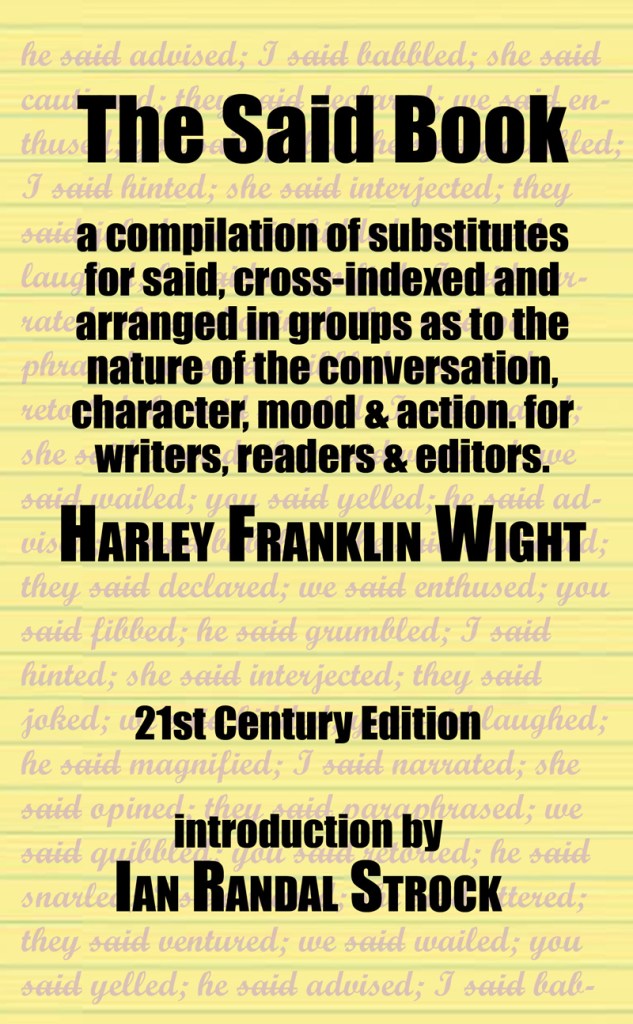
I recently learned that the term “said-bookism” comes from… wait for it… THE SAID BOOK! Yes, there is an actual book called The Said Book, which is a thesaurus for the word “said.” And it’s got a subtitle big enough to choke a moose: “a compilation of substitutes for said, cross-indexed and arranged in groups as to the nature of the conversation, character, mood & action. For writers, readers & editors.”
At the time it was published—in the 1930s—apparently using the word “said” was a horrible thing that writers needed to avoid at all costs, so Harley Franklin Wight (he is credited as H.F. Wight on the original cover) put together this book to help them not write “said.” Now, the book is mostly a historical artifact, an oddity, and a look at a fashion from the past.
Due to its publication history, the book has been nigh unto impossible to find. Until now. I’ve found the book, corrected several mistakes in the original (including sections that were mis-alphabetized), and brought it back into print, for those of you whose writing is littered with too many saids, and who are looking for guide to all those other words. Or not. But it’s a fun look at the past. With a new introduction I wrote, just to put the book in a slightly wider context.