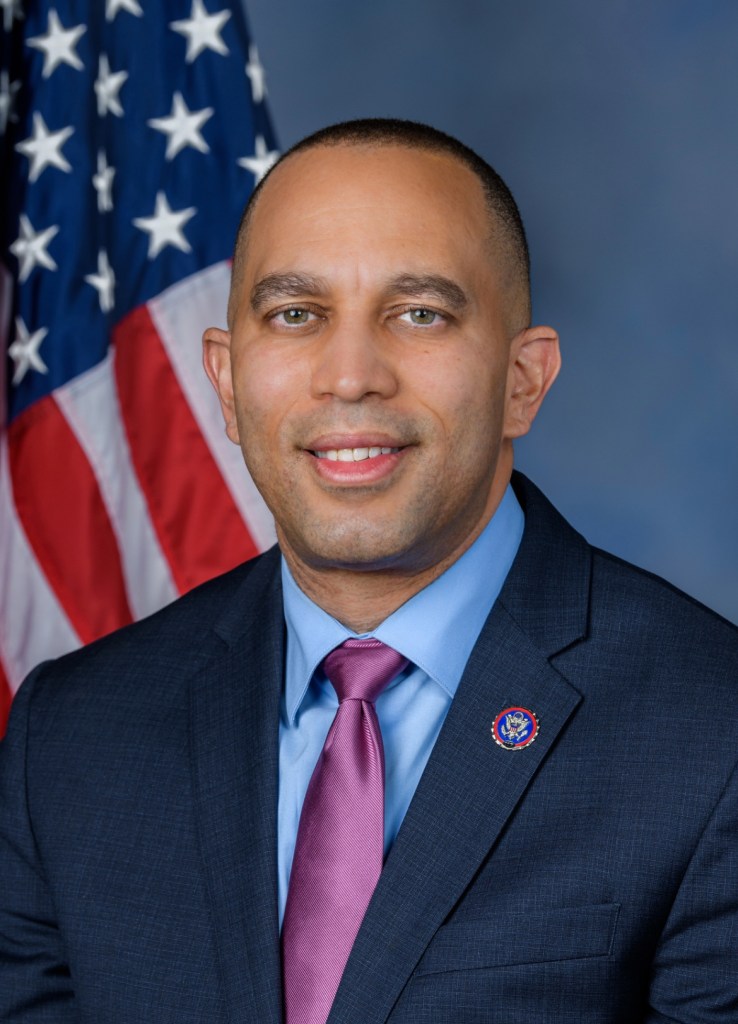
Staying up late last night watching election returns (as I do), one thing the commentators kept saying was it was a day of firsts, historic results. And it got me thinking about one of those anticipated firsts: assuming there are no more surprises, New York’s Hakeem Jeffries is poised to become the first Black person to be Speaker of the House.
Beyond the fact itself, what caught my attention is that we normally associate “firsts” with increasing levels of difficulty. The first person to row across the Atlantic Ocean came before the first to row across the Pacific, because the Pacific is larger, more difficult. The first people to climb Mt. Everest came after all the shorter, less dangerous mountains had been summitted. Similarly, we unconsciously rank political offices in order of difficulty: President ranks above Vice President, which (in our minds) ranks above Speaker of the House, and so on. And yet, the first Black person to be President, Barack Obama (2009–17) came before the first Black Vice President, Kamala Harris (2021–25), who came before the expected for Black Speaker.
On the other hand, the first woman to be Speaker, Nancy Pelosi (2007–11 and 2019–23), came before the first woman to be Vice President (Kamala Harris, 2021–25), while we still await the first woman to be President (and yes, Hillary Clinton won the popular vote for President in 2016, but she didn’t win the electoral vote).
A few other political firsts in that lineage:
John Willis Menard of Louisiana was the first Black person elected to the House of Representatives, in 1868 (but the election was contested, so he wasn’t seated).
Hiram Revels of Mississippi was the first Black person elected to the US Senate, in 1870. That same year, Joseph Rainey of South Carolina was the first Black person to serve in the House of Representatives. In 1874, Rainey was the first Black person to preside over the House, serving as Speaker pro tempore.
In 1879, Blanche K. Bruce of Mississippi became the first Black person to preside over the Senate. He was also the first to serve a full term as Senator (1875–81); Revels served just over a year. In 1881, Bruce became the first Black person whose signature appeared on US paper currency, in his new role as Register of the Treasury.
Robert C. Weaver was the first Black Cabinet Secretary, serving as the first Secretary of Housing and Urban Development (1966–68).
In 1967, Thurgood Marshall was the first Black person appointed to the Supreme Court.
In 1989, Colin Powell was the first Black person to serve as Chairman the Joint Chiefs, and in 2001, he became the first to be Secretary of State.
The first Black person to be elected a governor was Douglas Wilder in Virginia in 1990.
And a few other female firsts:
First woman to serve as President pro tempore of the Senate: Patty Murray of Washington (2023–25).
First woman to serve as Secretary of State: Madeleine Albright (1997–2001).
First woman to serve in the Cabinet: Frances Perkins, who was Secretary of Labor (1933–45).
First woman to serve on the Supreme Court: Sandra Day O’Connor (1981–2006).
First woman to be elected to the Senate: Hattie Caraway of Arkansas (1931–45). Fifteen states have not elected any female Senators: Colorado, Connecticut, Idaho, Indiana, Kentucky, Montana, New Jersey, New Mexico, Ohio Oklahoma, Pennsylvania, Rhode Island, Utah, Vermont, and Virginia.
First woman to be elected to the House of Representatives: Jeannette Rankin of Montana (1917–19 and 1941–43). She is the only woman ever to represent Montana in House. Mississippi is the only remaining state to have never sent a woman to the House of Representatives.
First woman to be elected governor: Nellie Tayloe Ross of Wyoming (1925–27). She is the only woman to have served as governor of Wyoming, and then became the first woman to be director of the US Mint (1933–53). Ross beat Miriam Ferguson of Texas to the governor’s office by 15 days.
 The current election is interesting for a few other reasons. One of them — one rarely commented on in the media — is the presidential line of succession. If something dire were to happen to both the President and the Vice President, the next in line to succeed to the presidency is the Speaker of the House. But since there is no Speaker at the moment, the line of succession would move on to the next eligible person, the President pro tempore of the Senate, Patty Murray of Washington. Incidentally, Murray became President pro temp on January 3rd, when the retiring Patrick Leahy left the Senate, and she was elected to the post. She is the first woman to be President pro temp. Following her is the Secretary of State, Antony Blinken, and on through the Cabinet.

