Do good fences make good strangers?

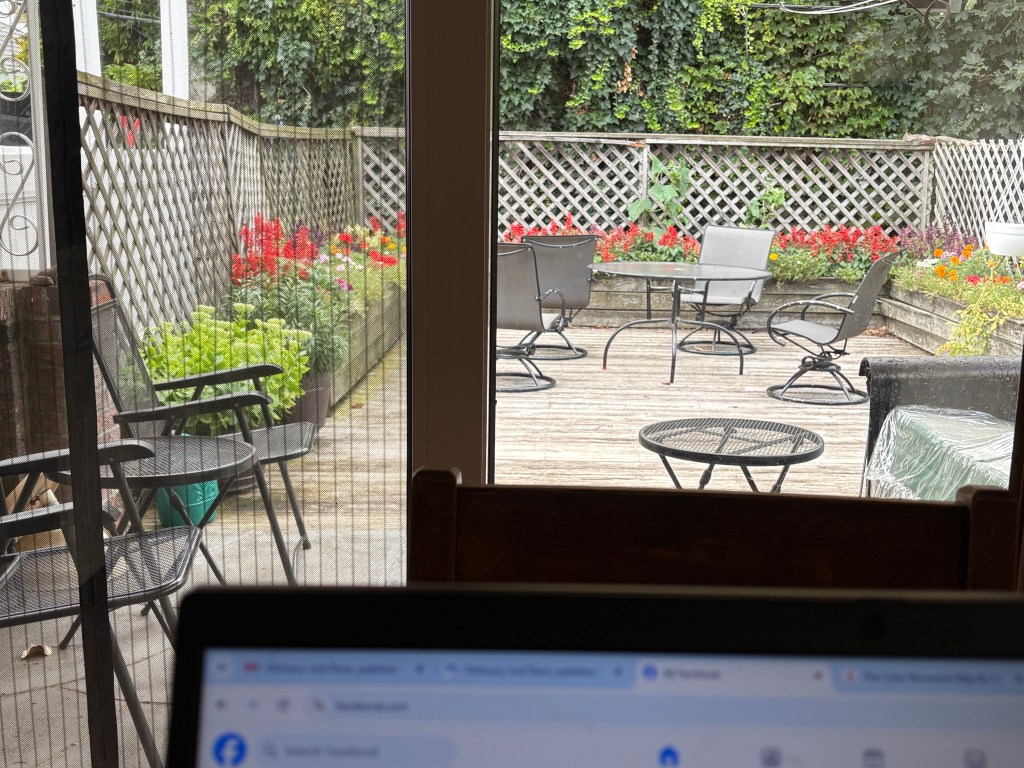
Michael Smerconish, on his CNN Sunday program, just had a story about homeowners wanting fewer white picket fences and more taller, privacy fences (I tuned in part-way through, and so missed the introduction of his guest who wrote the article that caught his attention and caused him to tell the story). He mentioned that fences break up the landscape, separate us from our neighbors, and so forth. That resonated with me.

I get a similar feeling in dealers’ rooms at the conventions I attend. Way back when, dealers would have their wares on tables, and customers would look at those wares, but could glance up to see across the room, see all the people and tables. And we dealers could see each other, look around to see if there were crowds of customers somewhere in the room even if they weren’t at our tables, subconsciously feel we were all in it together. But over the last bunch of years, table displays have gotten taller and more complex, with huge banners back-stopping the table. Lines of tables all together in a room have turned into series of caves. The aisles between the tables have turned into deep chasms, with nothing visible except the few at arm’s length and the ceiling above. We’ve lost sight of all the other dealers except the one directly across the aisle, and I feel so closed in, almost claustrophobic.

During the story, Smerconish quoted the phrase “good fences make good neighbors,” which we’ve all heard. But do we ever consider the rest of the poem (“Mending Wall” by Robert Frost) in which the phrase appears? Indeed, the speaker of “good fences make good neighbors” never explains what he means or why. But the narrator, talking with him, goes on to ponder

Why do they make good neighbours? Isn’t it
Where there are cows? But here there are no cows.
Before I built a wall I’d ask to know
What I was walling in or walling out.…

Are fences—in general—a response to our increasingly electronically connected world? Is it that we let everyone into our lives on our screens, so we feel a greater need to keep them out of our physical spaces? I can sort of accept that reasoning. But in the dealers’ rooms, I just find it uncomfortable. I’ve found that, when I’m setting up my table in the middle of a row, I won’t put up my large banners behind me until the vendor backing my table has set up and erected whatever large display will be there, facing the other aisle, walling me out. And in the rare event that my back-to-back neighbor does not have a sight-line cutting display, I won’t put up the banners. It’s my little protest against the walling off, the sectioning off, of the dealers’ room.

Perhaps, being taller than average, I have a different view of such things. On a crowded subway car, my face isn’t pressed into my neighbor’s back; I can see above all the heads in the car, to the few other tall people. Perhaps it’s that usual long view that makes the walling-in especially unpleasant to me.

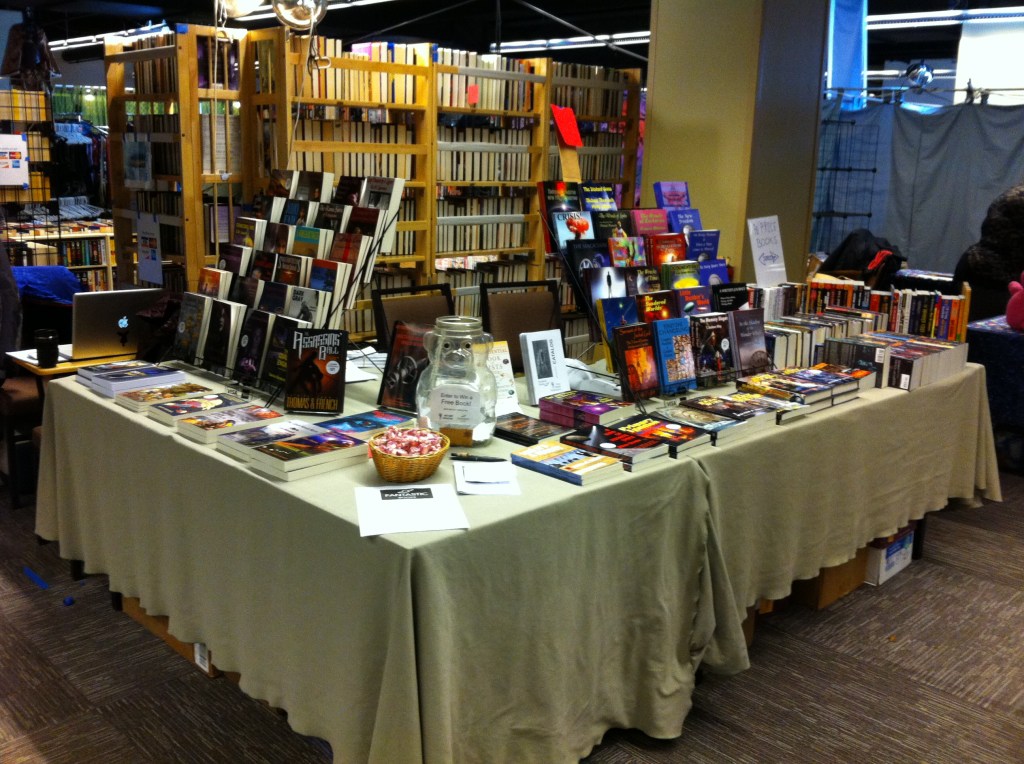
And I know, for many dealers, it’s been like an arms race. The first to distribute free colorful bookmarks grabbed a lot of notice from potential readers browsing the freebie table. But now there are dozens of those bookmarks, and they can no longer be seen individually (consider trees in a forest). Similarly, the first to have a huge banner behind the table attracted attention from across the room. But now that everyone has one, the banner no longer attracts attention, but only serves as a wall, a backdrop. I try to make my display as low as possible—I’ve stopped using the racks that stand two feet tall on my table—so that I can see my customers and they can see me. (The attached picture is, for example, the Fantastic Books table in the dealers’ room at Arisia 2015.)

I’ve occasionally thought that if I were running a dealers’ room, I would ask vendors the heights of their displays, and then put all the tall displays together in one corner of the room—or at least in the back—and let those with short displays be in the front of the room, so that it would feel more open, larger, for customers walking in to be able to see everything, and for vendors to be able to see them.

My house doesn’t have a front yard, so no fence is necessary. And even though I’m a city dweller, I still like, enjoy, need those open spaces, those long views, that make me feel connected, make me feel a small part of it all, rather than a large resident of a tiny cell. How about you? Are you busily building fences and walls to keep me out?

The Fantastic Books table in the dealers' room of Arisia 2015, feeling pretty walled-in.


Tips gratefully accepted: https://ko-fi.com/ianrandalstrock

Please knock… if you don’t want to be noticed.

Do you still use the doorbell?

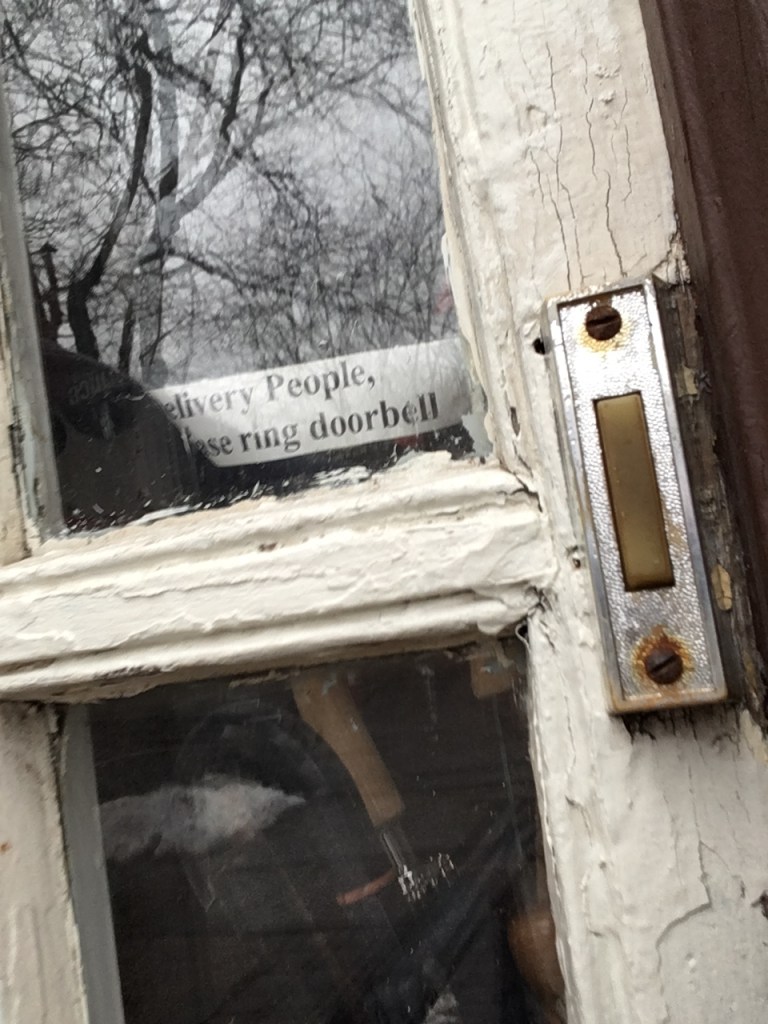
Increasingly, I’m noticing that people coming to the house, seeking my attention, ignore the doorbell (which is just to the right of the door) in favor of knocking on the door. Mind you, that’s the outer door. There’s also a thick, insulated inner door. The only reason I knew there was someone knocking just now is that I opened the insulated door to see if the mail had been delivered yet, and saw something blue and billowy through the windows in the door (yes, you can look through the front door to see that it fronts on a vestibule which has a thicker door farther in). Had I not opened that door, the fellow holding that blue umbrella would have been knocking in vain. (It turns out he was canvassing for signatures on a petition, but wasn’t terribly clear about the purpose of the petition, so I declined to sign.)

Delivery folks, who see hundreds of doors every day, never can find that doorbell. It is not a rare occasion that I’ll be home all day, waiting for a delivery, only to open the door late in the day for some other reason, and discover the package sitting on the top step, delivered but unheralded.

And while I can sort of understand the neighbors not wanting to use the doorbell when signaling for our attention on the sabbath (we live in an orthodox Jewish neighborhood), the other six days a week, too, bring far more knocks than ding-dongs.

So what is it? Why is the doorbell getting no love? Is this something that happens in your neighborhood, too?

Measuring Art and Judging Math

I’m watching and enjoying the Olympics, as always (at least, when I can find competition, rather than filler, being broadcast). But looking back on the Olympic competitions I remember from when I was younger, I think I’m seeing a change.

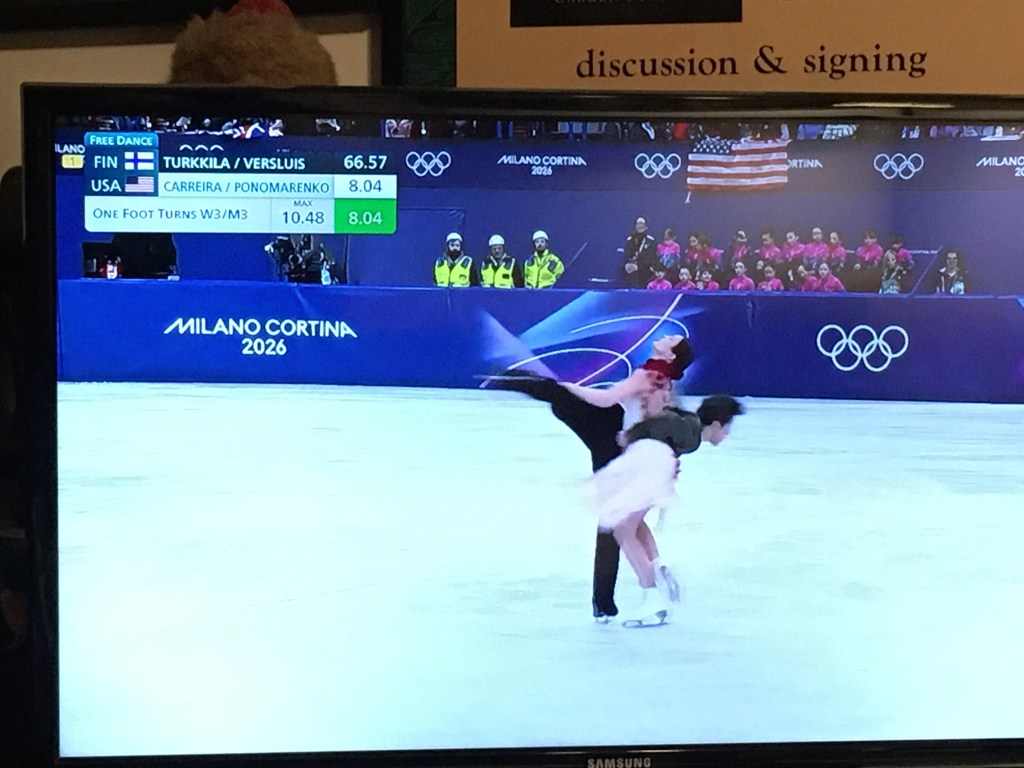
Sports which were (at least, to my memory) almost entirely judged artistic competitions, such as the various ice dancing events (or the gymnastics and equestrian events of summer), now seem to have more and more mathematically required elements in the scores. Indeed, NBC shows a box in the top left corner of “this element, if completed correctly, adds this many points,” and it’s measured down to hundredths. And that number updates in seeming real-time as the competitors are performing.

And sports which (again, I think I remember this correctly) were entirely numerical measurements not open to interpretation, such as ski jumping (which I thought was “how far down the slope did the competitor fly, and was the competitor able to land on the skis, or was it a wipe-out?”) now has a judged component: “Oops, he kind of wobbled a bit when he landed, and his feet were too close together” or something like that.

I’m still amazed that timed events like luge are measured down to thousandths of a second, and that the commentators think we can see any real difference between competitors when the final standings, after four 53-second runs, have six athletes separated by less than two seconds.

But are we seeing a blending of judged events and those measuring absolute values? How long before there’s an artistic component figured into curling or ice hockey?

The Communal Nature of Television

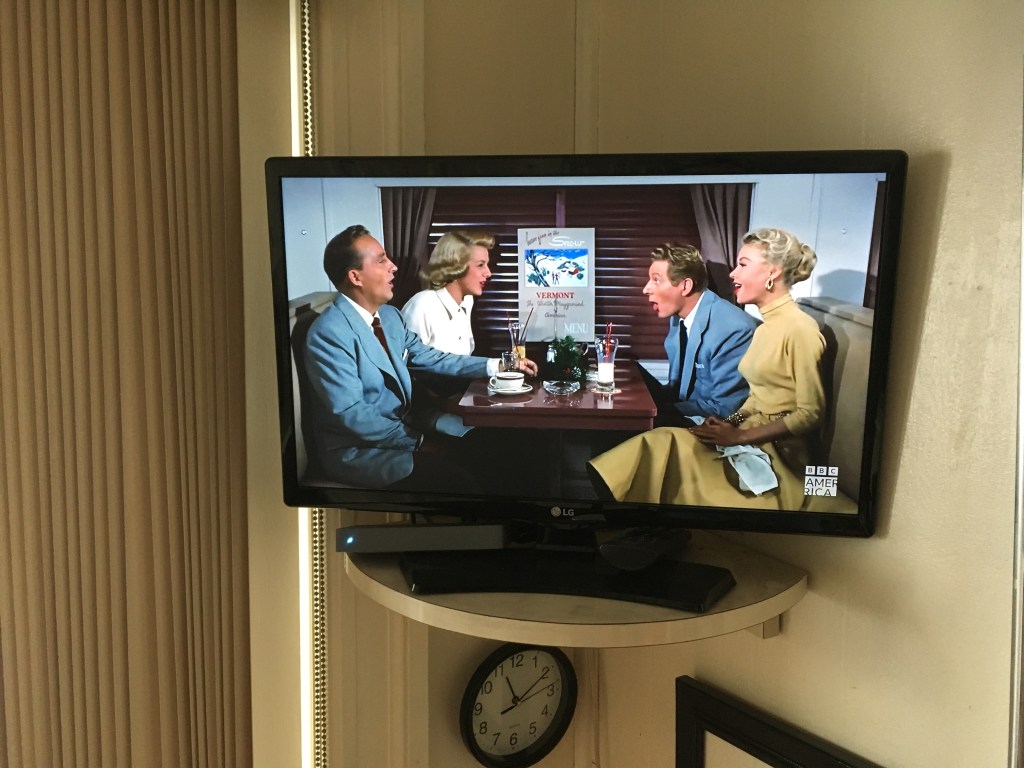
I’m home alone, all by myself. And White Christmas is on BBC America right now (one of my favorite musicals). I didn’t call it up from some on-demand service; I stumbled across it while flipping channels.

And watching a movie, “live,” as it were, has a very different feeling than on-demand would. I don’t quite understand it. There’s something in the knowledge that other people are watching the same thing at the same time, seeing and reacting to the same things.

I don’t know who they are, don’t know where they are, will never interact with them. And yet… yet I still find watching on television more appealing, more of a communal feeling, than on-demand or on DVD or VHS or whatever. Not communal like sitting in a movie theatre (which I think I’ve done once in the last six years), nor even with a few friends or family members in the living room. But still, there’s that hint of doing something as a group rather than all by my lonesome. Does that make any sense to you?


If thou art god, why art thou pissing off everyone else?

In one of Allen Steele’s Coyote novels, he introduces the alien religion known as Sa Tong Tas, which the humans come to translate as “thou art god.” When first I read it, it was an interesting concept for an ideal world, but I know that I do not live in an ideal world, so it just percolated in the back of my mind.

In the last few days, several real-world experiences have brought this concept to the forefront of my mind. On Thursday, riding the bus home from Boston, the woman behind me did not stop pulling on the back of my seat, except for the hour and a half she was speaking loudly on her speaker phone in a foreign language. It was only as we were arriving in New York that I realized she was not being malicious; she simply did not think about the fact that her actions affected anyone else.

Saturday morning, at the convention hotel, I went swimming. There was one woman in the pool when I got there, but she left soon after I arrived. I met her Saturday evening, and she explained that she had to get out because the water had become too rough while I was swimming. I try not to flail about or splash or make a big production of my swimming, and she said it was not my conscious fault, but I am a large person, and when swimming at my regular speed, I tend to leave a wake. In a smaller hotel pool, that wake reflects off the walls of the pool, interfering and combining to make larger waves and splashes. Sunday morning, while I was swimming by myself, I tried to be a bit more conscious of what I was doing to the surface of the water, and realized that I do tend to swim fairly smoothly, but indeed, I’m leaving a wake. There is not much I can do about this other than not swim, but now I will be more conscious of how my swimming affects others.

The reason I am writing this is because of an incident that occurred Saturday night at a party at the convention. I was talking with a writer, new to me, who is very successful. He has about two dozen books in print, and makes six figures a year from his writing. He was giving me advice and suggestions and talking about the business, which could have been extremely valuable to me. The problem, however, was that a struggling writing also joined in the conversation. It wasn’t the art of writing we were talking about; it was the business, which comes after the writing is done. The successful writer’s method was to describe a problem he’d encountered, a hurdle to overcome, a general condition that interferes with success, and then to talk about what he’d learned, how he overcame the problem, what he does to be successful. Unfortunately for me—and for the struggling writer himself—the struggling writer heard the problem, and then felt the need to interrupt to detail his own form of the problem and why it was so vitally important to solve it. If the struggling writer had realized the successful writer was offering some of the potential solutions the struggling writer was seeking, the struggling writer might have clammed up, and both he and I could have benefitted from the successful writer’s willingness to share his accumulated wisdom. Instead, by not noticing how his actions affected anyone outside himself, he deprived us both of a fantastic chance to learn to be more successful.

I’m not saying we should diminish ourselves for others’ benefits. But simply realizing that no action occurs in a vacuum, that what we do—consciously or not—affects others may cause us to think about those others, may make the world a better place (and incidentally, benefit ourselves in the long run).

N.B. — This is not directed at anyone with whom I may have had a telephone conversation during the past week.