Strock Receives Skylark

Press Release

During the awards ceremony at this weekend’s annual Boskone science fiction convention, the members of the New England Science Fiction Association (NESFA) awarded their annual Edward E. Smith Memorial “Skylark” Award to Ian Randal Strock.

The Skylark is presented annually by NESFA “to some person, who, in the opinion of the membership, has contributed significantly to science fiction, both through work in the field and by exemplifying the personal qualities which made the late ‘Doc’ Smith well-loved by those who knew him.” (For the full definition, see below.)

The award citation reads:

This year’s Skylark winner is the editor and publisher of Fantastic Books, but he’s much more than that. He’s worked at Asimov’s and Analog and (the now defunct) Artemis magazines. At Fantastic Books, he’s not only published original works (such as the Hugo finalist Jar Jar Binks Must Die), but also kept in print works by authors as diverse as Shariann Lewitt, Walter Hunt, and Allen Steele. He is one of the nicest people in SF (and Mensa, too). We are pleased to present this year’s Skylark Award to Ian Randal Strock.

Also known as a public speaker, Strock gives talks on presidential history, publishing and writing, punctuation, and more. But in the moment, standing on that stage receiving the award, he had no coherent thoughts. “It was my worst performance on the stage ever,” he said. “I think I said ‘thank you,’ but I’m quite certain I could not come up with anything more insightful or erudite.” A few days later, he was finally able to gather his thoughts, commenting “To say the award was unexpected would be to say that I believed I might one day be nominated for it. I never even imagined I would be considered for the Skylark. I am humbled by this award, and by the awe-inspiring list of prior recipients. I will try to live up to their illustrious examples. Thank you, NESFA.”

For more information, see the following:
Ian Randal Strock, personally: http://www.IanRandalStrock.com
Strock’s publishing company: http://www.FantasticBooks.biz
NESFA: http://www.nesfa.org
The Skylark Award: http://www.nesfa.org/awards/the-skylark
Boskone: http://www.boskone.org

The Skylark is defined in NESFA’s bylaws: The Edward E. Smith Memorial Award for Imaginative Fiction, or “Skylark,” shall be presented from time to time by NESFA to some person who, in the opinion of the Membership, has contributed significantly to science fiction, both through work in the field and by exemplifying the personal qualities which made the late “Doc” Smith well-loved by those who knew him. Doc was so well thought of that he was invited to be Guest of Honor at the Second World Science Fiction Convention in Chicago, 1940 (Chicon I). Only two years before his death, Doc was given the First Fandom Hall of Fame Award at the Twenty-First World Science Fiction Convention in Washington, 1963 (Discon I). Doc Smith attended many conventions and participated in them as a pro and as a fan. He was one of the earliest enthusiasts in what are now called hall costumes and often dressed as characters from his stories—the good guys, of course. Smith was one of the old breed of SF writers who did not distinguish between pro and fan. He talked on panels; he talked informally; he never thought himself too important. He was, in a word, a mensch. It is fitting that this convention’s name was, is, and always will be Boskone and that the Skylark Award was, is, and always will be given out to someone who exemplifies Doc’s qualities both as a professional contributor to the field and as a human being.

Barry N. Malzberg (1939-2024)

Late last night, I learned that Barry N. Malzberg had died. Born July 24, 1939, he was a writer and editor. His daughter, Erika, wrote: “My dad passed away this evening, around 4:30pm. My sister had been with him for a few hours and I was just getting back after having visited with my mother. He took his last breath almost the moment I arrived. It was very, very peaceful and we are so grateful.”

His fiction was ground-breaking and seemingly everywhere moments after he started publishing (his first science fiction story, “We’re Coming Through the Window,” was published in the August 1967 issue of Galaxy), but I’ll probably remember him more for his non-fiction: his essays on science fiction, literature, and the people in the field, which was his stock-in-trade for the last couple of decades.

I remember Barry as a fixture at the science fiction conventions I attended when I first got into the field, but I never really got to know him: there were too many bright and shiny new things and people clamoring for my attention for me to seek out the austere, somewhat foreboding looking fellow he was. Now, reading the reminiscences of so many of my friends, I’m realizing just how much I missed out by not getting to know him better. Rather than trying to recapitulate them, I commend to you posts on Facebook by John Kessel (https://www.facebook.com/john.kessel3), Adam-Troy Castro (https://www.facebook.com/adamtroycastro), and Kristine Kathryn Rusch (https://www.facebook.com/kristinekathrynrusch). I’m sure there will be more in the coming days.

He was nominated for a dozen Hugo and Nebula Awards, and his novel Beyond Apollo won the inaugural John W. Campbell Memorial Award in 1973. His nonfiction works won two Locus Awards: The Engines of the Night (1983), and Breakfast in the Ruins: Science Fiction in the Last Millennium (2008), and I was pleased and honored to publish his third volume, The Bend at the End of the Road (2018).

Future Boston

A press release from Fantastic Books:

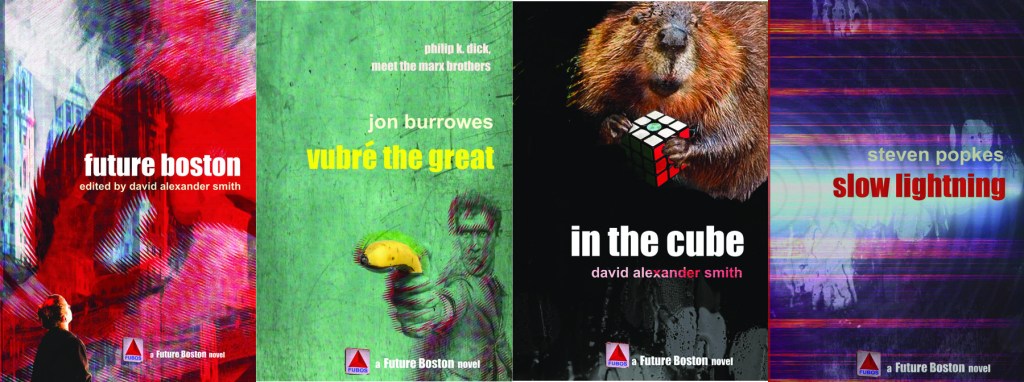
Fantastic Books is pleased to bring the Future Boston series back into print.

First appearing in 1994, this four-book cycle tells the history of New England’s most populous city from 1990 to 2100. In those years, Boston is slowly sinking into the sea. The citizens of Boston plan a revolution against the governments of Earth. Alien races occupy the city and must decide if the human race deserves full galactic citizenship—or total destruction.

The mosaic novel Future Boston is the sweeping saga of a handful of dreamers—artists and scientists, scufflers and survivors, revolutionaries and thieves—who dream of a new society as their ancestors did before them. From slums to Brahmin boardrooms, Future Boston is a rich mosaic of history and human drama, as real as the great metropolis that inspired it. It features the work of Jon Burrowes, Alexander Jablokov, Geoffrey Landis, Resa Nelson, Steven Popkes, David Alexander Smith, and Sarah Smith.

Publishers Weekly called it “Adventure-filled… a wealth of evocative detail.… The real star is a painstakingly constructed future Boston,” while Locus said “Future Boston is more than the sum of its parts—and its parts are very good.”

Following Future Boston is Jon Burrowes’ novel Vubré the Great, in which a space ship breaks down, and the aliens check into little old Motel-o Earth-o to see if they can find a new conduction bolt for their night-drive. And the next thing you know, alien technology and ideas are erasing the cultures of Earth forever.

In David Alexander Smith’s In the Cube, private detective Beverly O’Meara is paired with Akktry, a small, sharp-clawed animal that has an inhuman affinity with the past and an ability to recreate the history of any place or person from the remains of the present. They’re on the trail of Diana Sherwood, the missing daughter of the most powerful—and hated—woman in sinking Boston. Unfortunately, that trail leads straight into the Basement, the oldest, lowest, most dangerous part of Boston. The part below sea level. The part you can down in…

Hugo, Nebula, and Locus award-winning author James Patrick Kelly said “In the Cube is David Alexander Smith’s best book.… Not only do his humans live and breathe, but he has drawn some of the strangest and most convincing aliens you’ll ever meet.”

Rounding out the series is Steven Popkes’ Slow Lightning, in which Ira and Gray find an egg on an abandoned ferryboat. It’s wrinkled, with smears of red and yellow, and bigger than a basketball. They’re not sure why it’s there, only that it must have been left there on purpose.

Science fiction Grand Master Poul Anderson said “Slow Lightning does a remarkable job of conveying the sheer strangeness of the universe and the future.”

Future Boston
Edited by David Alexander Smith
ISBN: 978-1-5154-5823-4
$17.99, 328 pages, trade paperback; $7.99 ebook

Vubré the Great
by Jon Burrowes
ISBN: 978-1-5154-5824-1
$16.99, 256 pages, trade paperback; $7.99 ebook

In the Cube
by David Alexander Smith
ISBN: 978-1-5154-5825-8
$16.99, 242 pages, trade paperback; $7.99 ebook

Slow Lightning
by Steven Popkes
ISBN: 978-1-5154-8526-1
$12.99, 124 pages, trade paperback; $6.99 ebook

The Future Boston series—and all Fantastic Books books—are distributed via Ingram. Review copies are available upon request.

Book Birthday!

I’m so excited!

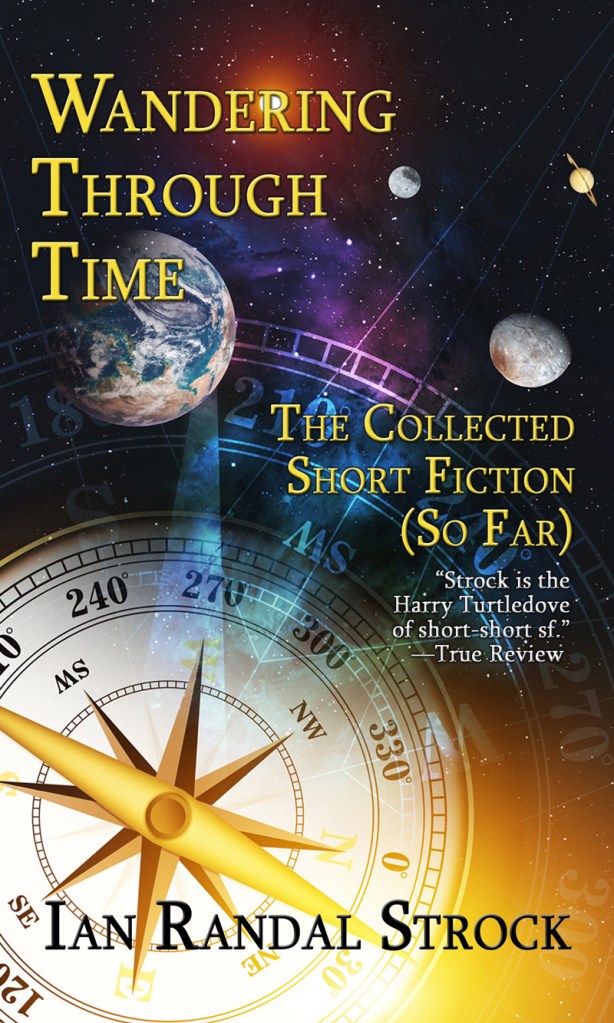
Today is publication day for my first fiction collection, Wandering Through Time!

I’ve been writing short fiction and being professionally published for a long time, but now, finally, I’ve collected those stories which appear in magazines and anthologies into a collection all my own. I’ve also written introductions for each story, to tell the reader a little about my writing process, and show from whence come the ideas behind them.

Today, I’m hoping all my friends, fans, and followers will do me the huge favor of sharing this post, to help me spread the word. Thank you!

I asked my friend and mentor Stanley Schmidt, who was the editor of Analog from 1978 to 2012, to give me a blurb for the collection. He read it, and then wrote “The short-short story is one of the hardest kinds of fiction to pull off, and few since Fredric Brown have done it as often or as well as Ian Randal Strock. But that’s not all he does. Wandering Through Time displays a delightful diversity of his thought-provoking ideas and engaging storytelling.”

His successor at Analog, Trevor Quachri, who also buys my stories for publication, wrote “This is the kind of classic, clever idea-oriented SF you’d find in the Golden Age, but built for today. Recommended for your witty friends, history buffs, time-travel fans, and anyone curious for a peek behind the curtain at magazine publishing.”

Hugo Award-winner Robert J. Sawyer offered these kind words: “Ian Randal Strock is a literal genius—a card-carrying member of Mensa—and his intellect shines through on every page of this fabulous collection. From the man who helped steer Analog for many years comes this wonderful sampler of just the sort of stories I love to read.”

And Andrew Andrews at True Review reviewed the book and wrote: “Ian Randal Strock is the Harry Turtledove of short-short SF. His alternate-history stories have punch. The take on a geographically divided America in the time of the Civil War rings strongly in ‘Shall Not Perish from the Earth.’ I think it’s Strock’s best tale. In ‘The Necessary Enemy,’ it’s always wars, it seems, that drive humankind’s progress and destiny. ‘Rockefeller on the Rocks’ proves that unique tales, true or not, of U.S. vice presidents could perhaps work, with sufficiently advanced technology. Why can’t we replace veeps with robots? Who would know?”

Again, thank you for all your support over the years, and for helping me spread the word to feel even more like a real writer today!

Science fiction convention (twelfth of 2024)

Next Friday I’ll be at Philcon, which is my last scheduled convention of the year. Last! (For those of you counting along at home, I’ve already been to eleven sf conventions and seven Mensa conventions, and that’s not counting meetings, speeches, and more personal out-of-town trips.)

If you’re looking for me at Philcon (in Cherry Hill, New Jersey), I will, as always, be spending a lot of time at the Fantastic Books table in the dealers’ room. But I’m also on programming. You’ll be able to see me at:

Friday at 7:00pm in Grand Ballroom: “Whose Line, SFF Style!” with Melody Cryptid, Randee Dawn, Odele Pax, Michael A. Ventrella, and Abigail Welsher.

Friday at 9:00pm in Crystal 3: “A Funny Thing Happened on the Way to the Con” with Tony Finan, Brian T. Price, Roberta Rogow, and Michael A. Ventrella.

Saturday at 12:00n in Plaza 5: “Remembering Tom Purdom” with Barbara Purdom, Mark Roth-Whitworth, and Michael Swanwick.

Saturday at 6:00pm in Plaza 5: “How to Write a Cover Letter for Your Novel” with Ken Altabef, Isabel J. Kim, and David Walton.

Hoping to see many of you there, because I don’t have another convention scheduled for more than two months.

Blurbage, part 3

I just received an awesome blurb from Stanley Schmidt, who was the editor of Analog Science Fiction and Fact from 1978 to 2012, and who is a 35-time Hugo Award nominee. Stan writes of my upcoming collection:

“The short-short story is one of the hardest kinds of fiction to pull off, and few since Fredric Brown have done it as often or as well as Ian Randal Strock. But that’s not all he does. Wandering Through Time displays a delightful diversity of his thought-provoking ideas and engaging storytelling.”

Read some sf today

On several pages, I’m seeing that today is National Science Fiction Day, so chosen because it coincides with Isaac Asimov’s birthday. Well, I’m a science fiction writer and publisher, so that’s as good a reason as any to encourage you to go read some science fiction.
It also reminds me that, next Saturday, I’ll be the monthly speaker for Eastern Oklahoma Mensa, talking about “A Century of Asimov” and my time with him. I won’t actually be in Oklahoma (which is one of the 15 states I have not yet visited), but I’ll be using the formerly science fictional method of Zoom to join them electronically.
garfieldcelebratesasimov2527sbirthday

Virtual Convention Weekend

Virtual convention weekend: Philcon has moved most of the con online, and I’m doing four panels for them (the most I’ve had at any virtual convention this year). One of them was already this evening, but the two tomorrow and one Sunday I thought I had are actually three on Saturday (November 21):

10am: “Heinlein’s Third Rule of Writing” with Barbara Barnett, Lawrence M. Schoen, Michael Swanwick, and Elektra Hammond.

2:30pm: “Kickstarting Your Next Project” with Keith DeCandido, Danielle Ackley-Mcphail, Neil Clarke, and Alex Shvartsman.

8:30pm: “What Else Might Have Changed?” with Simone Zelitch, Miriam Scheiber Seidel, and Tom Doyle.

The panels are on Zoom, with after-panel discussions on Discord. Details on the Philcon web site.

Our Most Important Books

A week or two back, a friend of mine posted on Facebook:

If you are a reader: what’s that book that is so important to you that if you can’t find your copy (say from when you read it five years ago) you just buy another like groceries. Any genre from religious/philosophical to bath-room joke book, media-tie in novel to Proust, cook-book to metahistory, graphic novel to translation of a epic (etc.).

or

What’s the one book you give copies of to people you Love??

I responded: I’m interested by the responses, because I don’t have any qualifying titles to add to the list. There are books I reread occasionally for the fun or the mental-popcorn nature of it (to give me a break from reality), and books I recommend (though it varies with the person receiving the recommendation and the situation), but no special book that has such a pull on my soul.

Then I mirrored his post on my own Facebook page, and the responses were phenomenal! So many, and such passion. The responses make for a fascinating list, so rather than attempting to digest or sort it, I’m sharing them here with you in no order except chronological by when someone made the suggestion. The line spaces are between respondents (so you can see that many had more than one suggestion). In some cases, my respondents offered abbreviated titles; I’ve tried to clean them up to give you the full title/author.


The Last Unicorn by Peter S. Beagle
Zen and the Art of Motorcycle Maintenance by Robert M. Pirsig
The Women’s Room by Marilyn French
Dandelion Wine by Ray Bradbury
The Moon is a Harsh Mistress by Robert A. Heinlein

Picking Cotton: Our Memoir of Injustice and Redemption by Jennifer Thompson-Cannino, Ronald Cotton, and Erin Torneo
Revenge, A Story of Hope by Laura Blumenfeld
Finding Fish: A Memoir by Antwone Q. Fisher and Mim E. Rivas

Still Life with Woodpecker by Tom Robbins

The Grand Inquisitor by Fyodor Dostoyevsky (translated by Constance Garnett, introduction by William Hubben)

The Graveyard Book by Neil Gaiman

Stranger in a Strange Land by Robert A. Heinlein

Watership Down by Richard Adams
Geek Love by Katherine Dunn
Let’s Talk About Love: Why Other People Have Such Bad Taste by Carl Wilson

The Water-Method Man by John Irving

Horton Hears a Who by Dr. Seuss
The People’s Almanac (volumes 1-3) by David Wallechinsky and Irving Wallace
The Book of Lists (volumes 1-3) by by David Wallechinsky, Amy D. Wallace, Ira Basen, and Jane Farrow

The Social Construction of Reality: A Treatise in the Sociology of Knowledge by Peter L. Berger and Thomas Luckmann

Earth Abides by George R. Stewart

Incidents in the Life of a Slave Girl, Written by Herself by Harriet Ann Jacobs, writing as Linda Brent

Good Omens by Neil Gaiman and Terry Pratchett

The Hobbit by J.R.R. Tolkien

We Are in a Book, or any of the other Elephant and Piggy books by Mo Willem
Small Gods by Terry Pratchett

Science and Sanity: An Introduction to Non-Aristotelian Systems and General Semantics by Alfred Korzybski

Fahrenheit 451 by Ray Bradbury
Time Enough for Love by Robert A. Heinlein
Alas, Babylon by Pat Frank

Tigana by Guy Gavriel Kay

The Sparrow by Mary Doria Russell

The Princess Bride by William Goldman

My Bible
Boundaries [which seems to be a series] by Henry Cloud and John Townsend
What I Was Doing While You Were Breeding by Kristin Newman

The Psychology of Everyday Things by Don Norman
Walls Around Us: The Thinking Person’s Guide to How a House Works by David Owen
The Phoenix Guards by Steven Brust

Ex Libris: Confessions of a Common Reader by Anne Fadiman

Mockingbird by Walter Tevis

Rendezvous with Rama by Arthur C. Clarke
Breach the Hull edited by Mike McPhail

You Can Heal Your Life by Louise Hay
Choice Words: How Our Language Affects Children’s Learning by Peter H. Johnston
Love of Seven Dolls by Paul Gallico

Think and Grow Rich by Napoleon Hill

The Alchemist by Paulo Coelho
Rising Strong by Brene Brown

The Lord of the Rings by J.R.R. Tolkien

The Left Hand of Darkness by Ursula K. Le Guin

The Glass Castle by Jeannette Walls

The Power of One by Bryce Courtenay
Bel Canto by Ann Pratchett

The Moon Is a Harsh Mistress by Robert A. Heinlein
Telling Lies for Fun and Profit by Lawrence Block

Time Enough for Love by Robert A. Heinlein

Job by Robert A. Heinlein

To Kill a Mockingbird by Harper Lee
The Handmaid’s Tale by Margaret Atwood
Pride and Prejudice by Jane Austen
Little Women by Louisa May Alcott
The Odyssey by Homer

A New Earth: Awakening to Your Life’s Promise by Eckhart Tolle
Ask and it is Given: Learning to Manifest Your Desires by Esther Hicks and Jerry Hicks
The Non-Designer’s Design Book by Robin Williams [not the comedian]

Dune by Frank Herbert
In God We Trust: All Others Pay Cash by Jean Shepherd

Galactic Patrol by E.E. “Doc” Smith

The Lord of the Rings by J.R.R. Tolkien

The Scarlet Letter by Nathaniel Hawthorne
The Great Gatsby by F. Scott Fitzgerald
Borgel by Daniel Pinkwater
Driven to Distraction: Recognizing and Coping with Attention Deficit Disorder from Childhood Through Adulthood by Edward M. Hallowell, MD, and John J. Ratey, MD

Lizard Music by Daniel Pinkwater
The Hoboken Chicken Emergency by Daniel Pinkwater
Borgel by Daniel Pinkwater
The Neddiad: How Neddie Took the Train, Went to Hollywood, and Saved Civilization by Daniel Pinkwater

The Hitchhiker’s Guide to the Galaxy by Douglas Adams
The Complete Works of William Shakespeare

The Bible, to which someone else responded: “There’s a whole lotta ‘books’ in the Bible. Any specific book or books within? I’m partial to Proverbs myself.”

Starship Troopers by Robert A. Heinlein

Playboy, June 1997 issue. This was later revealed to be a joke answer, but in response, another answered seriously: Playboy, September 1971 issue. And the “Women of Mensa” issue of Playboy (November 1985).

A Shropshire Lad by A.E. Housman
The Collected Poems of A.E. Housman

The Past Through Tomorrow by Robert A. Heinlein
Rendezvous with Rama by Arthur C. Clarke

Siddhartha by Herman Hesse

Bartlett’s Book of Familiar Quotations

The Man Who Folded Himself by David Gerrold
Wild Seed by Octavia E. Butler

A Moveable Feast by Earnest Hemingway

The Essential Calvin and Hobbes by Bill Watterson

Hamlet by William Shakespeare

A Big Storm Knocked it Over by Laurie Colwin

Hancer’s Price Guide to Paperback Books, Third Edition by Kevin B. Hancer, R. Reginald, Rahn Kollander [this respondent also offered an explanation: “Bookscans, Ace Image Library, Abebooks can give me certain data easily enough but there’s no substitute for that book.”]
The Harmony Illustrated Encyclopedia of Rock by Nick Logan and Bob Woffinden
The Illustrated New Musical Express Encyclopedia of Rock by Nick Logan

The Vampire Lestat by Anne Rice
Uhura’s Song by Janet Kagan
Mirabile by Janet Kagan
The Collected Kagan by Janet Kagan
Hellspark by Janet Kagan
The Dragon Variation by Sharon Lee & Steve Miller
Korval’s Game by Sharon Lee & Steve Miller
Agent of Change by Sharon Lee & Steve Miller

The Road Less Traveled by M. Scott Peck

A Confederacy of Dunces by John Kennedy Toole

The War Against the Rull by A.E. Van Vogt

The Unstrung Harp or Mr Earbrass Writes a Novel by Edward Gorey [The respondent said “I keep a stash of that book to give away. The single best description of the process of writing I have even encountered. And I’ve watched the real process A LOT.”]
The Complete Aubrey/Maturin Novels by Patrick O’Brian
Jane Eyre by Charlotte Bronte

The Little Prince by Antoine de Saint-Exupéry
Man’s Search for Meaning by Viktor Frankl

Stranger in a Strange Land by Robert A. Heinlein

Hellspark by Janet Kagan
My Father’s Dragon by Ruth Stiles Gannett
Agnes and the Hitman by Jennifer Crusie
War for the Oaks by Emma Bull
Edison’s Eve: A Magical History of the Quest for Mechanical Life by Gaby Wood

Frankenstein by Mary Shelley

Wherever You Go There You Are by Jon Kabat-Zinn

War and Peace by Leo Tolstoy (translated by Louise and Aylmer Maude)
The Left Hand of Darkness by Ursula K. Le Guin

East of Eden by John Steinbeck

Mythology: Timeless Tales of Gods and Heroes by Edith Hamilton
The Alienist by Caleb Carr
From Here to Eternity: Traveling the World to Find the Good Death by Caitlin Doughty

Gray’s Anatomy by Henry Gray

Disease Proof Your Child: Feeding Kids Right by Joel Fuhrman, MD
Go Away, Big Green Monster! by Ed Emberley
How To Talk So Kids Will Listen & Listen So Kids Will Talk by Adele Faber and Elaine Mazlish
The Presidential Book of Lists by Ian Randal Strock [like I said, these people are my friends!]

Pride and Prejudice by Jane Austen
The Count of Monte Cristo by Alexandre Dumas

When Things Fall Apart: Heart Advice for Difficult Times by Pema Chodron

The Hitchhiker’s Guide to the Galaxy by Douglas Adams

The Elements of Style by William Strunk Jr. and E.B. White

War for the Oaks by Emma Bull

Atlas Shrugged by Ayn Rand

Pride and Prejudice by Jane Austen
The Shockwave Rider by John Brunner
The Moon is a Harsh Mistress by Robert A. Heinlein

***

I’m not terribly surprised that so many books on this list are science fiction and fantasy, based simply on how I connected with most of my Facebook friends. I am a little surprised that there are so many from the Self Help section of the book store.

Repeated authors and titles

That was a lot of people listing a lot of books, but there were a few that came to mind for more than one person:

Robert A. Heinlein: Job, The Moon is a Harsh Mistress (three times), The Past Through Tomorrow, Starship Troopers, Stranger in a Strange Land (twice), and Time Enough for Love (twice).

Jane Austen: Pride and Prejudice three times.

J.R.R. Tolkien: three times (The Hobbit once, and The Lord of the Rings twice).

Douglas Adams: The Hitchhiker’s Guide to the Galaxy twice.

The Bible: twice.

Ray Bradbury: one each for Dandelion Wine and Fahrenheit 451.

Emma Bull: War for the Oaks twice.

Arthur C. Clarke: Rendezvous with Rama twice.

Neil Gaiman and Terry Pratchett were each mentioned twice, once for Good Omens (which they co-wrote), and once each for The Graveyard Book (Gaiman) and Small Gods (Pratchett).

Janet Kagan: two people mentioned her novel Hellspark; one of them mentioned her other two novels and her short fiction collection.

Ursula K. Le Guin: The Left Hand of Darkness twice.

Daniel Pinkwater: mentioned by two respondents. Both listed Borgel, and one listed three other titles as well.

William Shakespeare: one mentioned Hamlet, the other mentioned the complete works.


And there are those of my friends who can’t decide on a book, but still want to participate, leaving comments such as:

“All books by Georgette Heyer.”

“Heinlein is on my ‘can’t wait for next book’ list along with John Grisham.” [Unfortunately for him, Heinlein died in 1988.]

Andre Norton
Allan Eckert

“all of Salinger”

“Any of the Foundation books by Asimov.”

“All of Rex Stout.”

“No one book but [Lois McMaster] Bujold both is enjoyable and I feel like I get another layer each reread.”

Mark Helprin novels
Anthony Hecht poetry

***

There you have it. If you’ve been looking for a suggestion of what to read next, there are a bunch of them!

Like what you’re reading? Donate here!