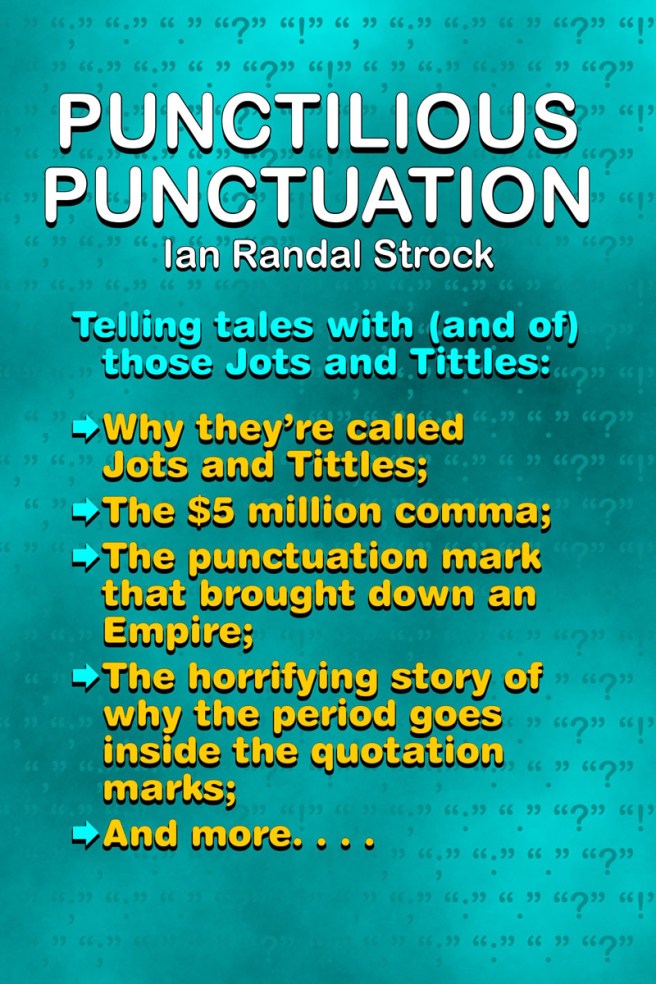
I’ve had several people ask how they should purchase my new book, which way is best for me, and I’m extremely gratified by those questions. While this question is easily extrapolated to just about any author, the answer is “it depends.” There are several answers.
What my friends and family think they’re asking is “where should I buy your book so that the most money winds up in your pocket?” And that’s a very kind question to ask. The simple answer is: “buy it directly from me, when you see me in person.” But while that method does indeed put the most money in my pocket, it works out to only two or three dollars (maybe as many as five) more than I’d earn from a sale some other way. In my particular case, with this specific book, it’s been published by one of the imprints of the independent publishing company I own. My company pays authors fifty percent of the net the company takes in on each sale. So if you buy the book from me as the publisher at a convention, it’ll be almost as much money in my pocket. That’s because neither of those sales has to give a cut to the distributor or to some other retailer.
But there are other answers to the question, other considerations.
My publishing company is an independent. While physical bookstores can order our books from our distributor, those bookstores don’t stock our books, because we don’t offer a large enough discount or the 100% returnability they require (those are topics for another essay). So the bulk of our bookstore sales come from the online retailers, of which the largest—by far—is Amazon. If you buy my book from Amazon, that helps the Amazon Sales Rank move up. And while one sale isn’t going to affect that number much, several dozen copies, a few hundred, if all made the same day or week, will indeed affect that number. And books with better Sales Ranks will be shown to more people on Amazon, hopefully leading to even more sales. So buying on Amazon, while resulting in less money in my pocket for that one book, may eventually result in many more sales.
But as important as that Sales Rank is, it’s fleeting, temporary. The number may be great this week, but if no new copies are sold next week, the number will plummet as other books are published and rise up the ranks. What has a longer-lasting effect is reviews. Reviews don’t have to be complex—you don’t have to write a four-page essay comparing and contrasting my book to, well, anything. Even just a few words is sufficient for the algorithms, because they’re focused on the number of reviews, and the average ranking of the book from the “rank this book on a scale of 1 to 5.” If you can spend just a few minutes to write a few nice words about the book, in the long run, that may wind up being the most valuable.
And that’s not unique to Amazon. Reviews on GoodReads or LibraryThing are equally important. Indeed, any sort of word of mouth (telling your friends and neighbors) is also great.
But all of that is still assuming the book in question has been published by a small press like mine, or self-published by the author. If, however, your friend has had the fortune to have the book published by one of the large publishing firms (like my first three books), the answer will again be different.
If the book has been published by a big publisher, one of the “big five” or “legacy” firms—or even a smaller traditional publisher that still has standard physical bookstore distribution—the best way to buy the book is at that brick-and-mortar bookstore. Those sales are the most likely to be counted and reported, and when the author has another book to submit to publishers, they’re going to be looking at those sales numbers to justify (or not) buying and publishing that next book. Incidentally, that points to another big difference between those large publishers and mine: if your book doesn’t sell five thousand or ten thousand copies, that large publisher is unlikely to offer a contract for the new book. On the other hand, if my company published that book, and it sells a scant one thousand copies, it’s still done a great job for my company, and I’ll be happy to publish the next.
So, back to the original question: my friends asking where/how they should buy my book. At this point, I’m still hopeful for a bit of a break-out, still hopeful to make at least a little splash in the bigger world of Amazon sales, so I’m directing my friends and family there (even though Amazon has done so much to kill publishing), foregoing the few extra dollars now in hopes of more sales a little later. That said, I’m thrilled with every single sale, and I’ll be selling copies at Capclave this weekend, HalloWeeM at the end of October, and nearly everywhere you can find me. On behalf of myself and all the other authors being asked, the greatest thing you can do is tell us you’re interested in our books, and then show us. Happy reading!


 The weekend was also remarkable for a certain group of attendees. We managed to take a picture with five of the six Region 1 Regional Vice Chairman who are in attendance. Left to right are: Lisa Maxwell (2015-17), Deb Stone (1999-2000), Teresa Campbell (2021- ), Lori Norris (2007-11), Ian Randal Strock (2017-21). Not pictured, but at the RG: Andrew Heffernan (2011-15). And talk about Mensa leadership positions: Lisa also served as Secretary. Deb was Chairman and Treasurer (the first person to serve on the AMC in another role after serving as chairman), and is currently a trustee of the Mensa Foundation. Lori is currently the First Vice Chairman, and was Secretary. And I’m currently the Secretary of the American Mensa Committee (the board of directors of this member-led organization).
 Ian Randal Strock