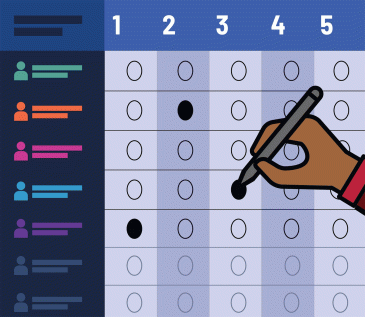
 In New York City today, the big news is that we’re using Ranked Choice Voting for Primary Election Day (of which, more anon). Ranked Choice Voting: every media outlet, every government official, and 90% of the television and radio commercials, have been harping on it for the last two months, reminding voters that we can rank our top five choices. The problem with Ranked Choice Voting is that we still have the same mediocre candidates. It doesn’t improve the candidate pool, and doesn’t give our votes any more power: it just means that, if the first mediocre candidate I choose has no other support, my second mediocre choice might have a shot, and so on down to my fifth choice. Meh.
As a test of the new Ranked Choice Voting system, perhaps today makes sense. But as a primary election day, it is becoming increasingly absurd to waste taxpayer money on this “election.” A primary, as we all know, is simply a means for a club (in this case, the Democratic Party and the Republican Party) to determine which of its members it is going to support in the election (which comes in November). In voting as it used to be—one person, one vote; a plurality takes the election—I could (sort of) justify the parties’ need to have a primary, because multiple candidates from one party might cannibalize each others’ votes, and possibly give the election to a different party with only one candidate on the ballot. But with Ranked Choice Voting, that’s not an issue. There is no reason I, as a voter who doesn’t belong to those political clubs, shouldn’t have my choice of all the candidates on today’s ballot in the November election. But the parties want to be able to spend all their money and effort supporting only one candidate, so they have once again conspired with each other to make all of us—whether we’re part of the club or not—pay for their internal decision process, and that I do not like. There would be nothing wrong with forcing the Democratic Party to pay for its own primary election (or however else it chooses to select one candidate from its members). They’re going to be pumping millions of dollars into advertising later this year for their chosen candidate, so obviously they have the financial wherewithal to fund this primary. But instead, I’m forced to help pay for this opportunity to limit my choices in November.
And then there was my personal experience just now, going to the polling place (with my parents, who are registered members of one of those parties). I walked in with my bar-coded voter ID card (bar-coded, so it’s touch-less; nevertheless, the clueless poll worker insisted on taking the card from each voter to scan it and hand it back. So much for the antiseptic nature of “touch-less”). My parents each checked in and received their ballots. Then she scanned my card, and was confused. The screen quite clearly said “No election” or some words to that effect, which meant “don’t give this one a ballot.” But apparently my district is so heavily Democratic that she was ready to hand me a provisional ballot simply because I was there. She couldn’t conceive of the possibility that I might not be a member of her Democratic Party. I was pleased that the system was properly programmed: it recognized me as a registered voter, and also recognized I was not part of a political party. But that’s my problem: it shouldn’t be our public voting system running and paying for this private, club-members-only primary.
My parents completed their ballots and scanned them, and it was fairly efficient. And there were only four or five poll-workers (of the 25 in the room) who were wearing their chin straps (really?! After fifteen months of pandemic, these morons still don’t know how to wear a face mask?). Now we have to wait a month or two to learn the results of today’s exercise. The computer system really ought to be able to process all the ballots in less than a day, but apparently we have to wait for all the mail-in ballots to arrive up to a week from now, and there has to be time to “cure” the ballots that are questionable, so the Board of Elections doesn’t anticipate having all of the ballots before the middle of July. Well, at least that may mean a respite from the relentless spate of campaign ads (silver lining).
 Ian Randal Strock