Here’s one I missed. Jimmy Carter’s death means that the sitting president is also the oldest living president. Joe Biden, born in 1942, is older than Bill Clinton, George W. Bush, and Donald Trump (all born in 1946—the only year to see the births of three future presidents) and Barack Obama (born in 1961).
The last time that happened was when Ronald Reagan was president (1981–89). Born in 1911, he was older than Richard Nixon and Gerald Ford (both born in 1913) and Jimmy Carter (1924).
The other times the sitting president was also the oldest were:
All of George Washington’s tenure (1789–97), as the only president.
From December 14, 1799—George Washington’s death—until he left office on March 4, 1801, John Adams was also the only living president.
From June 28, 1836—James Monroe’s death—until he left office on March 4, 1837, Andrew Jackson was both the current and oldest president. His predecessor, John Quincy Adams, was born four months after Jackson in 1767.
From July 31, 1875—Andrew Johnson’s death—until he left office on March 4, 1877, Ulysses Grant was the only living president.
From January 17, 1893—Rutherford Hayes’ death—until he left office on March 4, 1893, Benjamin Harrison was both the current and oldest president (he was three and a half years older than his successor and predecessor, Grover Cleveland).
From June 24, 1908—Grover Cleveland’s death—until he left office on March 4, 1909, Theodore Roosevelt (the youngest ever to become president) was the only living president. Roosevelt’s successor, William Howard Taft, was a year older than Roosevelt, so he was the current and oldest president for his entire term, 1909–13. Woodrow Wilson was nine months older than Taft, so he was the current and oldest president for his entire term, 1913–21.
From January 5, 1933—Calvin Coolidge’s death—until he left office on March 4 of that year, Herbert Hoover was the only living president.
From January 22, 1973—Lyndon Johnson’s death—until he resigned in August of that year, Richard Nixon was the only living president.
President James Earl “Jimmy” Carter, Jr. died today (December 29, 2024). He was the first of the modern presidents to run—and be elected—as an “outsider” (not part of the Washington, DC, political establishment, though he had served four years in the Georgia State Senate, and was governor of that state from 1971 to 1975). He defeated President Gerald Ford in the surprisingly close election of 1976 (after Ford’s pardon of President Richard Nixon, his defeat was all but assured). Carter was an engineer who tried to bring an engineer’s sensibilities to the Oval Office. Unfortunately for his presidency, that skill set could not overcome other external political factors, leading to his landslide defeat after only one term in the White House. His post-presidency, however, was far more impressive, and will leave a much stronger, more enduring legacy. From the Carter Center to his work with Habitat for Humanity, he was the ideal former president. The Carter Center, with its goal to advance human rights and alleviate human suffering, is best known for its international election monitoring, but also works to build democratic institutions, help mediate conflicts, advocate for human rights, and treat diseases.
As president, in 1978, Carter brokered the Camp David Peace Accords between Israel and Egypt, for which Israeli Prime Minister Menachem Begin and Egyptian President Anwar Sadat shared the Nobel Peace Prize. Carter’s own Nobel Prize was awarded in 2002, for his work “to find peaceful solutions to international conflicts, to advance democracy and human rights, and to promote economic and social development” through the Carter Center.
Carter was born in Plains, Georgia, on October 1, 1924. He graduated from the Naval Academy in 1946 (part of the accelerated class of 1947)—the only president to do so, although he was the fifth straight Navy veteran to serve as president. He met his future wife, Eleanor Rosalynn Smith, while he was a cadet. They married on July 7, 1946. Carter retired from active duty in 1953, to take over the family’s peanut farming business, though he was in the inactive Navy Reserve until 1961. He left the service with the rank of lieutenant.
After losing his re-election bid, Carter told the White House press corps he intended to emulate Harry Truman, and not use his presidential retirement to enrich himself. He continued to live in the same modest house in Plains, Georgia, until his death. During his retirement, he wrote more than 30 books, ranging from memoirs to children’s books.
Carter’s state funeral will be in Washington, DC, with details announced in the next few days. He will be buried at his home in Plains. Carter is survived by his four children, 11 grandchildren (one grandson pre-deceased him), and 14 great-grandchildren. His eldest son, Jack, lost the 2006 Senate race in Nevada. Jack’s son Jason served in the Georgia State Senate, and lost the 2014 race for Governor of Georgia.
Carter retired from the presidency on January 20, 1981, at the relatively young age of 56. He was younger than his two successors (Ronald Reagan was 13 years older than Carter; George H.W. Bush was born 111 days before Carter).
Carter had been the senior living president since Gerald Ford’s death December 26, 2006. That title now belongs to Bill Clinton, who was president from 1993 to 2001.
On September 7, 2012, Carter exceeded Herbert Hoover’s record as the longest-retired president: that mark now stands at 43 years 343 days. Clinton will surpass that record in 2042, at the age of 96.
On March 22, 2019, Carter surpassed George H.W. Bush’s mark as the longest-lived president (Bush had died 111 days earlier, at the age of 94 years 171 days). That record now stands at 100 years 89 days. The oldest living president is now Joe Biden, who was born on November 20, 1942. The longest-lived vice president, John Nance Garner (1933–41), died at the age of 98 years 350 days old on November 7, 1967.
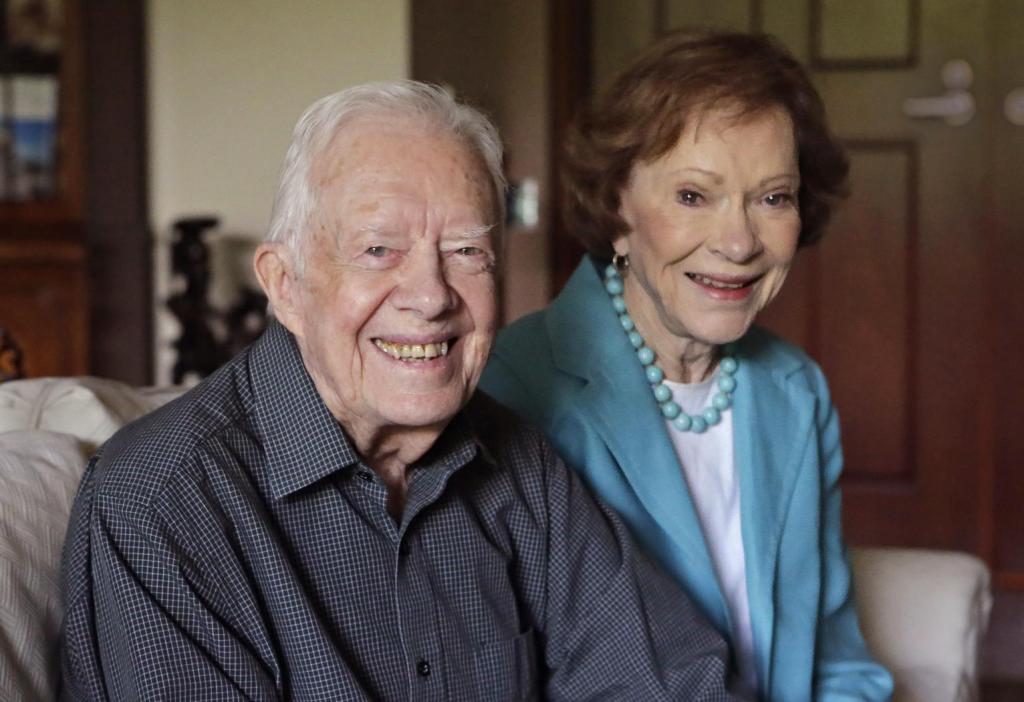
Jimmy and Rosalynn Carter enjoyed the longest marriage of any presidential couple, from July 7, 1946, until her death on November 19, 2023: an astonishing 77 years 135 days. The previous record-holders, George H.W. and Barbara Bush, were married from January 6, 1945 until her death on April 17, 2018: 73 years 101 days. The current longest-married presidential couple are Bill and Hillary Clinton, who were married on October 11, 1975.
Following Carter’s death, there are now five living presidents: Bill Clinton (1993–2001), George W. Bush (2001–09), Barack Obama (2009–17), Donald Trump (2017–21), and Joe Biden (2021– ).
Thinking about Donald Trump’s choices of appointees for his upcoming administration.
His supposed business acumen apparently doesn’t extend into the realm of choosing the right people to do the jobs. I mean, look at all the people he’s hired and then fired. Uppermost in my mind at the moment is Christopher Wray, who he hired as Director of the FBI. Wray is resigning coincident with the end of Joe Biden’s term because Trump has made it quite clear that if he stays, Trump will fire him—even though the job has a ten-year term to keep it out of the political realm (see former director James Comey’s commentary in this article). And Trump keeps bad-mouthing Jerome Powell, who he appointed chair of the Federal Reserve in 2018, which similarly is supposed to be above politics.
Fair warning: I initially thought Trump had fired far more Cabinet secretaries than he has. But these numbers don’t take into account other appointees, aides, and advisors, such as White House Communications Director, Press Secretary, lawyers, and so on.
During the first Trump administration, he fired four Cabinet secretaries (three others resigned under suspicion of ethics violations or misuse of funds) and two chiefs of staff. In fact, he had 24 Secretaries and five Acting Secretaries lead the 15 Cabinet departments.
By way of comparison, only two of Biden’s Cabinet secretaries left office in the middle of the term (one to become Executive Director of the National Hockey League Players’ Association, the other to leave public life).
So Trump does have a track record for picking people who won’t stick around too long (either by their choice or his).
For a historical perspective, when I wrote The Presidential Book of Lists, I also looked at presidential cabinets. At that time, Theodore Roosevelt topped the list for the president who had the greatest number of people serve in one cabinet post: he had six Secretaries of the Navy during his seven and a half years in office. Three others (and TR himself) had five people serve in one post: Andrew Jackson (Secretary of the Treasury), John Tyler (Secretary of the Navy), Ulysses Grant (Secretary of War and Attorney General), and Theodore Roosevelt (Postmaster General). Trump joined the list with five Attorneys General (two confirmed, and three acting). He and Tyler are the only ones to do it in single four-year terms.
I also looked at the presidents who had the greatest number of people serve in their cabinets. That list naturally skewed toward the more recent Presidents because the size of the Cabinet has changed over time, from the four officers who served Washington (Secretaries of State, Treasury, War, and Attorney General) to the 15 who currently serve. Harry S Truman topped the list with 34 Cabinet officers, an average of 3.4 per department. Ronald Reagan was right behind him, with 33 Cabinet officers (2.5 per department; only one of his Secretaries served the full eight-year term). Tied for third were Richard Nixon (31 Cabinet officers, 2.6 per department) and George W. Bush (31 Cabinet officers, 2.2 per department—the Department of Homeland Security was created during his term). Tied for fifth place were Theodore Roosevelt (29 Cabinet officers, 3.2 per department) and Bill Clinton (29 Cabinet officers, 2.1 per department—four of Clinton’s Cabinet officers served out his entire eight-year term). Now we can add Donald Trump’s first term to that tie.
To take account of the growing number of Cabinet departments, I also calculated the number of officers per Cabinet department (and then split the list between one-term and two-term presidents). Topping the list of those serving two terms was Ulysses Grant (3.6 officers per department—25 Secretaries, 7 departments). Tied for second were James Madison (3.2—16 Secretaries, five departments), Andrew Jackson (19 Secretaries, six departments), Theodore Roosevelt (29 Secretaries, nine departments), and Harry Truman (34 Secretaries, 10 departments). Topping the list of one-termers was John Tyler (3.5 officers per department—21 Secretaries, six departments). Next was Chester Arthur (2.4—17 Secretaries, seven departments). Third was Gerald Ford (2.1—23 Secretaries, 11 departments). Fourth was James Buchanan (2.0—14 Secretaries, 7 departments). And then Andrew Johnson (1.86—13 Secretaries, 7 departments). Donald Trump joined the list slightly ahead of Johnson (1.93 officers per department—29 Secretaries, 15 departments).
Only four Presidents served their terms without replacing any Cabinet officers: William Henry Harrison (admittedly, he died one month after being inaugurated), Zachary Taylor (died sixteen months into his term), Franklin Pierce (the only President to have served a full term with his original Cabinet), and James Garfield (died six months into his term).
[Edited several hours after posting to add:] A friend asked: How did you count those Secretaries who resigned in the wake of the events of January 6, 2021.
I’m embarrassed to say I didn’t. Skipped right over them. However, I did count Attorney General William Barr’s resignation on December 23.
Other than Barr: * Secretary of Transportation Elaine Chao resigned January 11, 2021. * Secretary of Education Betsy DeVos resigned January 8, 2021. * Acting Secretary of Homeland Security Chad Wolf resigned January 11, 2021. In his resignation letter, he cited “recent events, including the ongoing and meritless court rulings regarding the validity of my authority as Acting Secretary.” Two days after he resigned, Wolf said that Trump was partly responsible for the storming of the Capitol.
The reason I left them out of my analysis is that their resignations did not result in new Secretaries or even acting Secretaries. Their workloads were picked up by the deputies, who were never appointed to the Secretary’s position.
On Sunday, I voted (early) in this year’s elections. I voted for Kamala Harris for president, and I think you should, too.
Why did I vote for her? Let me tell you.
I voted for her not for any specific policy promise or rhetorical flourish. I voted for her because I think that when she is sitting at the Resolute Desk in the Oval Office, and an issue is brought before her that she needs to decide, her first thought is going to be “what is the best decision for the country?” If Donald Trump is sitting at that desk, however, I think his first thought will be “what is the best decision for me and my friends?” That difference is the only reason I needed to make my decision. But I’ll go a little further for the rest of you.
I think Kamala Harris will surround herself with appointees, advisors, and assistants who will also be thinking “what is best for the country?” I think she will seek out the smartest, most capable people possible. Donald Trump, on the other hand, has already told us who he’ll be looking to appoint, and who he won’t, and I don’t think they’ll be working for our best interests. I don’t trust the cadre around him, and I don’t trust his judgment in finding more appointees or advisors.
You can look at any of the campaign nonsense you want—taxes and tariffs, deplorables and enemies, fascism and greatness—none of what they’re saying today will matter after the inauguration. The only thing that will matter is who is making the decisions, and what is uppermost in their minds when they make those decisions. That’s why I voted for Kamala Harris, and why I urge you to do the same.
It’s been a horrific election season. Supporters on both sides are quite certain the other candidate can’t be human. Maybe we’d be better off voting for an actual monster!
Should being outed as a real vampire disqualify one from running for the presidency of the United States? Michael A. Ventrella’s hilarious Bloodsuckers answers that question.
Disgraced journalist Steven Edwards considers the “Batties”—the loonies who believe that vampires are real and Norman Mark is one—just another crazy tin-foil-hat extremist group. Then someone shoots at Mark, changes into a bat, and flies away before Steve’s eyes, leaving him as the prime suspect. With the help of the Batties, Steve goes underground. The only way he can establish his innocence is by proving vampires exist—not an easy task while on the run from both the FBI and the bloodsuckers.
Fantastic Books is releasing a new edition of Bloodsuckers right now, timed to coincide with “the most consequential presidential election in American history.” But aren’t they all? We’ve been tuned in to news of this election non-stop for years; it’s time to take a break. Read Bloodsuckers, and put it all into perspective.
Bloodsuckers: A Vampire Runs for President Michael A. Ventrella $15.99, 250 pages, trade paperback (ebook $7.99) publication date: October 29, 2024 ISBN: 978-1-5154-5828-9
Bloodsuckers—and all Fantastic Books books—are distributed via Ingram. Review copies are available upon request.
A friend asked me how many Republican presidents have carried the electoral votes of New York State. It’s a simple enough question. But I think it may be masking something else. My friend may be wondering if the present is monolithic: that the way things are is the way they have always been, and always will be.
New York is currently overwhelmingly Democratic—so much so that it’s nearly inconceivable that New York would vote Republican for president. In 2004, 58.37% of the vote in New York was for John Kerry, the Democrat (he earned 48.3% of the popular vote nationwide). In 2008, Barack Obama took 62.88% of New York (52.9% nationwide). In 2012, Obama got 63.35% of New York (51.1% nationwide). In 2016, Hilary Clinton took 59.01% of New York (48.2% nationwide). And in 2020, Joe Biden garnered 60.87% of New York (51.3% nationwide).
But reality is not quite so unchanging.
There have been 42 elections with a Republican candidate on the ballot for president (the first was John C. Fremont in 1856). In those elections, New York has voted for the Republican candidate 20 times, and 22 times for the Democrat. When New York votes Republican, that candidate has won 17 times (New York voted for unsuccessful Republicans Fremont in 1856, Hughes in 1916, and Dewey in 1948). When New York votes Democratic, that candidate has won 15 times (New York voted for unsuccessful Democrats Seymour in 1868, Tilden in 1876, Humphrey in 1968, Dukakis in 1988, Gore in 2000, Kerry in 2004, and Hilary Clinton in 2016).
So yes, in the current era, New York state voting Republican is highly unlikely. But such was not always the case. And it may not always be the case in the future. The key take-away from these numbers is: things change. The Republicans may be able to divorce themselves from the insanity of the Trumpian party, and once again field rational candidates for national office. The Democrats may become unhinged through their own acceptance of a radical fringe. The one thing we know for certain is that humans are very good at extrapolating trends, but absolutely terrible and foreseeing inflection points in those trends.
I’ve been mulling the current presidential election season. Specifically, I’ve been wondering if Joe Biden might have more easily opted to be a one-term president if he hadn’t had to announce his attentions so far in advance of the election. After all, if he’d said—in April 2023—that he wasn’t running for another term, he would have been a lame duck for 21 months, nearly half of his term.
So I’ve dug out the data from the primary era of presidential campaigns, to see if my assumption was correct. Here’s what I found.
Lyndon Johnson was in the race ten months before election day. On March 12, 1968, he won 49 percent of the vote in the New Hampshire primary, barely beating Eugene McCarthy’s 42 percent. Four days later, Robert F. Kennedy got into the race. Johnson announced his withdrawal from the race March 31, 1968, 219 days before the election of 1968.
Richard Nixon authorized the formation of his re-election campaign committee on January 7, 1972, 305 days before the election of 1972. He won the election in one of the greatest landslides in presidential history.
Gerald Ford launched his presidential campaign July 8, 1975, one year and 117 days before the election of 1976. He lost a surprisingly close race to Jimmy Carter.
Jimmy Carter launched his re-election bid on December 4, 1979, 336 days before the election of 1980. He lost handily to Ronald Reagan.
Ronald Reagan announced his re-election campaign on January 29, 1984, 282 days before the election of 1984. His margin of victory was almost as large as Nixon’s.
George H.W. Bush announced his re-election campaign on February 12, 1992, 265 days before the election of 1992. He lost a three-way race to Bill Clinton.
Bill Clinton announced his re-election campaign on April 14, 1995, one year and 202 days before the election of 1996. He won in another three-way race, becoming the only president to win two terms without ever garnering a majority of the popular vote.
George W. Bush announced his re-election campaign on May 16, 2003, one year and 171 days before the election of 2004. He won in a less contentious election than his first.
Barack Obama announced his re-election campaign on April 4, 2011, one year and 213 days before the election of 2012. He won in a closer election than his first.
Donald Trump announced his re-election campaign on January 20, 2017—the day he was inaugurated—three years and 288 days before the election of 2020. He lost the election.
Joe Biden announced his re-election campaign on April 25, 2023, one year and 191 days before the election of 2024.
Conclusion: it wasn’t Donald Trump or the 24-hour-a-day give-us-an-election-so-we-don’t-have-to-report-actual-news news cycle that caused Joe Biden to have to announce so early. Rather, it was Bill Clinton who started this absurd trend, and Biden is just doing what his predecessors did. (I’m leaving out Ford because he was a special circumstance in so many ways.)
Also, how long before the election a president starts running for re-election doesn’t seem to have an effect on the outcome of the election.
We’ve spent nearly a year in this incredibly lengthened election season, started early because Donald Trump tried to forestall his criminal indictments. We still have more than nine months to go before election day. And all along, we’ve heard the politicians and pundits telling us the only thing that matters is the votes on November 5 (plus all the early voting and absentee ballots).
But now, as a dozen Republicans have already decided they have no chance, we’re hearing so many saying Nikki Haley, too, should quit, because she has no chance to beat Trump for the nomination.
Mind you, today is just the first primary (in New Hampshire), and the only voters who’ve already expressed their opinions were the 110,272 who participated in the Iowa caucuses. Those 110,272 represent just 0.07% of the 158 million who cast votes in 2020—that is, a rounding error. They don’t even represent a majority of Iowa voters (1,690,871 voted in 2020). Indeed, they’re only 14.6% of the registered Republicans in the state. We’ve spent a year waiting to see the outcome of the primaries, but just as they’re starting, we’re told the rest of them don’t matter, because one in fourteen Republicans in Iowa (56,243) expressed a preference for Trump.
Major news outlets stopped reporting election results while the polls were still open after 1980, when there was great consternation that doing so might have suppressed the vote in the western states. But now we’re told that we don’t even have to wait for the polls to open in the other 99+% of the country: the few Iowans who cared to join the caucuses are enough. No, just no. I say, let ’em run until the end.
I find it ironic that Donald Trump keeps pushing for “complete and total presidential immunity” to block his forthcoming trials for orchestrating an attempted coup (see, for example, this article). Follow it through logically: if a president has complete and total immunity, wouldn’t President Biden ordered Trump’s immediate imprisonment, probably in a supermax prison or a deep hole in the ground? “For the national good,” of course. But even if he shouldn’t do it, well, complete and total presidential immunity.
In other presidential news, last night I spoke to Central Texas Mensa about the presidents. My talk, “Hail to the Chiefs! (and their Vice Presidents, and First Ladies…)” was very well received, and I was thrilled with the audience. I’m available to speak to your group, as well.

 Ian Randal Strock