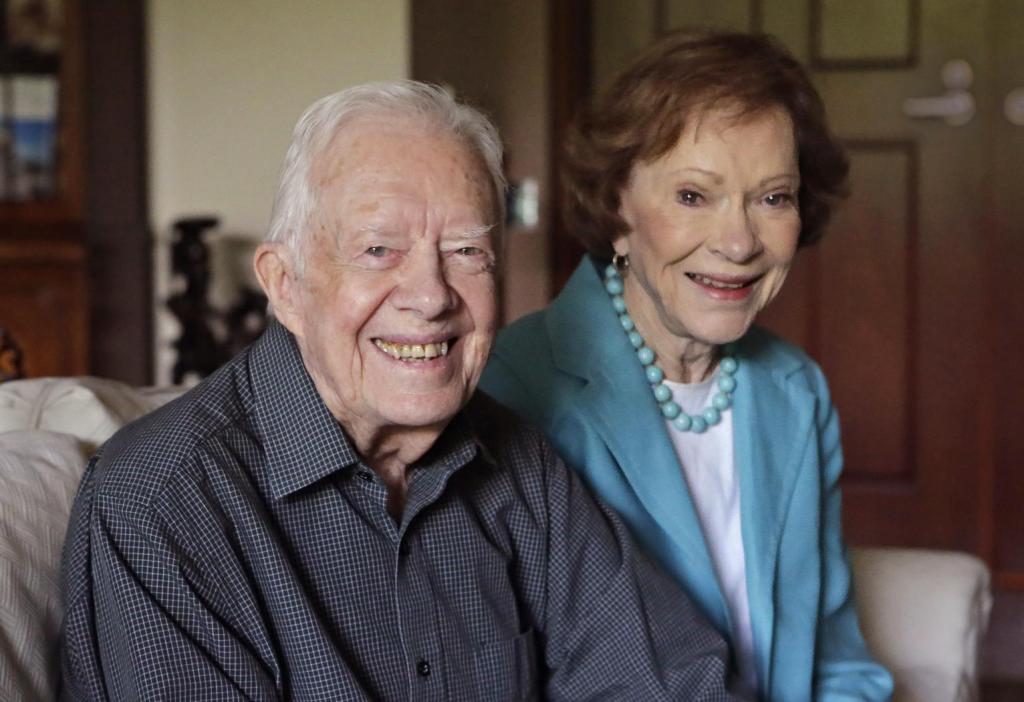
President Jimmy Carter (1924-2024)

President James Earl “Jimmy” Carter, Jr. died today (December 29, 2024). He was the first of the modern presidents to run—and be elected—as an “outsider” (not part of the Washington, DC, political establishment, though he had served four years in the Georgia State Senate, and was governor of that state from 1971 to 1975). He defeated President Gerald Ford in the surprisingly close election of 1976 (after Ford’s pardon of President Richard Nixon, his defeat was all but assured). Carter was an engineer who tried to bring an engineer’s sensibilities to the Oval Office. Unfortunately for his presidency, that skill set could not overcome other external political factors, leading to his landslide defeat after only one term in the White House. His post-presidency, however, was far more impressive, and will leave a much stronger, more enduring legacy. From the Carter Center to his work with Habitat for Humanity, he was the ideal former president. The Carter Center, with its goal to advance human rights and alleviate human suffering, is best known for its international election monitoring, but also works to build democratic institutions, help mediate conflicts, advocate for human rights, and treat diseases.

As president, in 1978, Carter brokered the Camp David Peace Accords between Israel and Egypt, for which Israeli Prime Minister Menachem Begin and Egyptian President Anwar Sadat shared the Nobel Peace Prize. Carter’s own Nobel Prize was awarded in 2002, for his work “to find peaceful solutions to international conflicts, to advance democracy and human rights, and to promote economic and social development” through the Carter Center.

Carter was born in Plains, Georgia, on October 1, 1924. He graduated from the Naval Academy in 1946 (part of the accelerated class of 1947)—the only president to do so, although he was the fifth straight Navy veteran to serve as president. He met his future wife, Eleanor Rosalynn Smith, while he was a cadet. They married on July 7, 1946. Carter retired from active duty in 1953, to take over the family’s peanut farming business, though he was in the inactive Navy Reserve until 1961. He left the service with the rank of lieutenant.

After losing his re-election bid, Carter told the White House press corps he intended to emulate Harry Truman, and not use his presidential retirement to enrich himself. He continued to live in the same modest house in Plains, Georgia, until his death. During his retirement, he wrote more than 30 books, ranging from memoirs to children’s books.

Carter’s state funeral will be in Washington, DC, with details announced in the next few days. He will be buried at his home in Plains. Carter is survived by his four children, 11 grandchildren (one grandson pre-deceased him), and 14 great-grandchildren. His eldest son, Jack, lost the 2006 Senate race in Nevada. Jack’s son Jason served in the Georgia State Senate, and lost the 2014 race for Governor of Georgia.

Carter retired from the presidency on January 20, 1981, at the relatively young age of 56. He was younger than his two successors (Ronald Reagan was 13 years older than Carter; George H.W. Bush was born 111 days before Carter).

Carter had been the senior living president since Gerald Ford’s death December 26, 2006. That title now belongs to Bill Clinton, who was president from 1993 to 2001.

On September 7, 2012, Carter exceeded Herbert Hoover’s record as the longest-retired president: that mark now stands at 43 years 343 days. Clinton will surpass that record in 2042, at the age of 96.

On March 22, 2019, Carter surpassed George H.W. Bush’s mark as the longest-lived president (Bush had died 111 days earlier, at the age of 94 years 171 days). That record now stands at 100 years 89 days. The oldest living president is now Joe Biden, who was born on November 20, 1942. The longest-lived vice president, John Nance Garner (1933–41), died at the age of 98 years 350 days old on November 7, 1967.

Jimmy and Rosalynn Carter enjoyed the longest marriage of any presidential couple, from July 7, 1946, until her death on November 19, 2023: an astonishing 77 years 135 days. The previous record-holders, George H.W. and Barbara Bush, were married from January 6, 1945 until her death on April 17, 2018: 73 years 101 days. The current longest-married presidential couple are Bill and Hillary Clinton, who were married on October 11, 1975.

Following Carter’s death, there are now five living presidents: Bill Clinton (1993–2001), George W. Bush (2001–09), Barack Obama (2009–17), Donald Trump (2017–21), and Joe Biden (2021– ).

Jimmy and Rosalynn Carter in 2016.

Donald Trump Sure Can’t Pick ’em

Thinking about Donald Trump’s choices of appointees for his upcoming administration.

His supposed business acumen apparently doesn’t extend into the realm of choosing the right people to do the jobs. I mean, look at all the people he’s hired and then fired. Uppermost in my mind at the moment is Christopher Wray, who he hired as Director of the FBI. Wray is resigning coincident with the end of Joe Biden’s term because Trump has made it quite clear that if he stays, Trump will fire him—even though the job has a ten-year term to keep it out of the political realm (see former director James Comey’s commentary in this article). And Trump keeps bad-mouthing Jerome Powell, who he appointed chair of the Federal Reserve in 2018, which similarly is supposed to be above politics.

Fair warning: I initially thought Trump had fired far more Cabinet secretaries than he has. But these numbers don’t take into account other appointees, aides, and advisors, such as White House Communications Director, Press Secretary, lawyers, and so on.

During the first Trump administration, he fired four Cabinet secretaries (three others resigned under suspicion of ethics violations or misuse of funds) and two chiefs of staff. In fact, he had 24 Secretaries and five Acting Secretaries lead the 15 Cabinet departments.

By way of comparison, only two of Biden’s Cabinet secretaries left office in the middle of the term (one to become Executive Director of the National Hockey League Players’ Association, the other to leave public life).

So Trump does have a track record for picking people who won’t stick around too long (either by their choice or his).

For a historical perspective, when I wrote The Presidential Book of Lists, I also looked at presidential cabinets. At that time, Theodore Roosevelt topped the list for the president who had the greatest number of people serve in one cabinet post: he had six Secretaries of the Navy during his seven and a half years in office. Three others (and TR himself) had five people serve in one post: Andrew Jackson (Secretary of the Treasury), John Tyler (Secretary of the Navy), Ulysses Grant (Secretary of War and Attorney General), and Theodore Roosevelt (Postmaster General). Trump joined the list with five Attorneys General (two confirmed, and three acting). He and Tyler are the only ones to do it in single four-year terms.

I also looked at the presidents who had the greatest number of people serve in their cabinets. That list naturally skewed toward the more recent Presidents because the size of the Cabinet has changed over time, from the four officers who served Washington (Secretaries of State, Treasury, War, and Attorney General) to the 15 who currently serve. Harry S Truman topped the list with 34 Cabinet officers, an average of 3.4 per department. Ronald Reagan was right behind him, with 33 Cabinet officers (2.5 per department; only one of his Secretaries served the full eight-year term). Tied for third were Richard Nixon (31 Cabinet officers, 2.6 per department) and George W. Bush (31 Cabinet officers, 2.2 per department—the Department of Homeland Security was created during his term). Tied for fifth place were Theodore Roosevelt (29 Cabinet officers, 3.2 per department) and Bill Clinton (29 Cabinet officers, 2.1 per department—four of Clinton’s Cabinet officers served out his entire eight-year term). Now we can add Donald Trump’s first term to that tie.

To take account of the growing number of Cabinet departments, I also calculated the number of officers per Cabinet department (and then split the list between one-term and two-term presidents). Topping the list of those serving two terms was Ulysses Grant (3.6 officers per department—25 Secretaries, 7 departments). Tied for second were James Madison (3.2—16 Secretaries, five departments), Andrew Jackson (19 Secretaries, six departments), Theodore Roosevelt (29 Secretaries, nine departments), and Harry Truman (34 Secretaries, 10 departments). Topping the list of one-termers was John Tyler (3.5 officers per department—21 Secretaries, six departments). Next was Chester Arthur (2.4—17 Secretaries, seven departments). Third was Gerald Ford (2.1—23 Secretaries, 11 departments). Fourth was James Buchanan (2.0—14 Secretaries, 7 departments). And then Andrew Johnson (1.86—13 Secretaries, 7 departments). Donald Trump joined the list slightly ahead of Johnson (1.93 officers per department—29 Secretaries, 15 departments).

Only four Presidents served their terms without replacing any Cabinet officers: William Henry Harrison (admittedly, he died one month after being inaugurated), Zachary Taylor (died sixteen months into his term), Franklin Pierce (the only President to have served a full term with his original Cabinet), and James Garfield (died six months into his term).

[Edited several hours after posting to add:] A friend asked: How did you count those Secretaries who resigned in the wake of the events of January 6, 2021.

I’m embarrassed to say I didn’t. Skipped right over them. However, I did count Attorney General William Barr’s resignation on December 23.

Other than Barr:
* Secretary of Transportation Elaine Chao resigned January 11, 2021.
* Secretary of Education Betsy DeVos resigned January 8, 2021.
* Acting Secretary of Homeland Security Chad Wolf resigned January 11, 2021. In his resignation letter, he cited “recent events, including the ongoing and meritless court rulings regarding the validity of my authority as Acting Secretary.” Two days after he resigned, Wolf said that Trump was partly responsible for the storming of the Capitol.

The reason I left them out of my analysis is that their resignations did not result in new Secretaries or even acting Secretaries. Their workloads were picked up by the deputies, who were never appointed to the Secretary’s position.

Thanks for catching that oversight.

Can New York Vote Republican?

A friend asked me how many Republican presidents have carried the electoral votes of New York State. It’s a simple enough question. But I think it may be masking something else. My friend may be wondering if the present is monolithic: that the way things are is the way they have always been, and always will be.

New York is currently overwhelmingly Democratic—so much so that it’s nearly inconceivable that New York would vote Republican for president. In 2004, 58.37% of the vote in New York was for John Kerry, the Democrat (he earned 48.3% of the popular vote nationwide). In 2008, Barack Obama took 62.88% of New York (52.9% nationwide). In 2012, Obama got 63.35% of New York (51.1% nationwide). In 2016, Hilary Clinton took 59.01% of New York (48.2% nationwide). And in 2020, Joe Biden garnered 60.87% of New York (51.3% nationwide).

But reality is not quite so unchanging.

There have been 42 elections with a Republican candidate on the ballot for president (the first was John C. Fremont in 1856). In those elections, New York has voted for the Republican candidate 20 times, and 22 times for the Democrat. When New York votes Republican, that candidate has won 17 times (New York voted for unsuccessful Republicans Fremont in 1856, Hughes in 1916, and Dewey in 1948). When New York votes Democratic, that candidate has won 15 times (New York voted for unsuccessful Democrats Seymour in 1868, Tilden in 1876, Humphrey in 1968, Dukakis in 1988, Gore in 2000, Kerry in 2004, and Hilary Clinton in 2016).

So yes, in the current era, New York state voting Republican is highly unlikely. But such was not always the case. And it may not always be the case in the future. The key take-away from these numbers is: things change. The Republicans may be able to divorce themselves from the insanity of the Trumpian party, and once again field rational candidates for national office. The Democrats may become unhinged through their own acceptance of a radical fringe. The one thing we know for certain is that humans are very good at extrapolating trends, but absolutely terrible and foreseeing inflection points in those trends.

The Election of 2022 Was Against Things and People, Not For Them

I’m watching the election returns (and still watching them). One thing I keep hearing is surprise that the predicted “red wave” did not materialize. I think the fact that the pundits expected one is a result of poor polling.

Specifically, I think political polls are too cut-and-dried, too black-or-white, without enough shades of gray. But none of us are so one-dimensional. I answered one phone call this election season which was a poll, and I tried to give them my thoughts. But the poll wasn’t robust enough to properly record them. The first question was “which is the most important issue for you when you’re voting this November.” The problem is, I’m not a one-issue voter, and I’ve a hunch most of us aren’t. But every poll which focused on “the economy/inflation” as the one issue voters would find most important missed the nuances.

Certainly, the economy is one of the issues I considered. But it’s not the only one. I also considered crime, and health care, and national defense, and voters’ rights, and the intrusion of the nanny state, and the environment, and appointments to the federal judiciary, and… well, you get the point. I think about all the ways the government can affect my life (for good or ill), and then I consider the candidates, and I choose those who I think will do the most good and the least bad. Asking me which one issue matters, and then which candidate I’ll vote for to serve that issue, means you’re gathering data that doesn’t reflect reality.

Another failing I saw in this year’s polling was the focus on President Biden’s approval rating, which is indeed quite low. But the polls only considered that, historically, a president with a low approval rating saw the other party win most of the seats in Congress. They didn’t consider that we can think poorly of Joe Biden’s job performance, while at the same time not wanting the Trumpian party candidates to win election and lend any more credence to that grifter.

Unfortunately, that’s the pity of most of our recent elections: very few of us are voting for the candidates; we’re voting against their opponents. I’m going to write directly to both Governor Hochul and Attorney General James, to tell them that my votes for them were not part of any mandate they might consider their elections to be. Rather my votes were against their opponents (well, in the case of James, I do favor certain of her ongoing cases that I fear would have been dropped had her opponent won).

I think that may be the big story no one is telling about the current election cycle: not many of us are truly happy with any of our choices. We’re voting to preserve what we have and improve our lives despite our representatives, not through them.

Democrats keep attacking themselves

The Democrats are doing it again: they’re so busy fighting amongst themselves that the Republicans and the Trumpians can just sit back and laugh, knowing they’re going to win because the Democrats are their own worst enemy. How many of them are yelling at Senators Manchin and Sinema to change the filibuster rule in the Senate, instead of yelling at the Republicans and the Trumpians to protect voters’ rights? They’re just wrong. The reason the original filibuster existed—and the current horrible incarnation of it is in place—is to prevent the tyranny of the majority over the minority. Yes, of course, the majority should decide. But if the slimmest of majorities can stomp all over the largest of minorities, that’s not what we want either. And overturning the filibuster now will only result in even unhappier Democrats in the future, because the pendulum continues to swing, and there will be a time when the Democrats are a minority.

Every time there’s a political debate, it’s the same story: the Republicans yell at the Democrats, the Trumpians yell at the Democrats and threaten the Republicans, and the Democrats yell at… other Democrats. Just the latest instance of the gang who couldn’t shoot straight, DC edition. If they ever focus on those who are actually in the wrong on the issue, they might be able to accomplish great things.