President James Earl “Jimmy” Carter, Jr. died today (December 29, 2024). He was the first of the modern presidents to run—and be elected—as an “outsider” (not part of the Washington, DC, political establishment, though he had served four years in the Georgia State Senate, and was governor of that state from 1971 to 1975). He defeated President Gerald Ford in the surprisingly close election of 1976 (after Ford’s pardon of President Richard Nixon, his defeat was all but assured). Carter was an engineer who tried to bring an engineer’s sensibilities to the Oval Office. Unfortunately for his presidency, that skill set could not overcome other external political factors, leading to his landslide defeat after only one term in the White House. His post-presidency, however, was far more impressive, and will leave a much stronger, more enduring legacy. From the Carter Center to his work with Habitat for Humanity, he was the ideal former president. The Carter Center, with its goal to advance human rights and alleviate human suffering, is best known for its international election monitoring, but also works to build democratic institutions, help mediate conflicts, advocate for human rights, and treat diseases.
As president, in 1978, Carter brokered the Camp David Peace Accords between Israel and Egypt, for which Israeli Prime Minister Menachem Begin and Egyptian President Anwar Sadat shared the Nobel Peace Prize. Carter’s own Nobel Prize was awarded in 2002, for his work “to find peaceful solutions to international conflicts, to advance democracy and human rights, and to promote economic and social development” through the Carter Center.
Carter was born in Plains, Georgia, on October 1, 1924. He graduated from the Naval Academy in 1946 (part of the accelerated class of 1947)—the only president to do so, although he was the fifth straight Navy veteran to serve as president. He met his future wife, Eleanor Rosalynn Smith, while he was a cadet. They married on July 7, 1946. Carter retired from active duty in 1953, to take over the family’s peanut farming business, though he was in the inactive Navy Reserve until 1961. He left the service with the rank of lieutenant.
After losing his re-election bid, Carter told the White House press corps he intended to emulate Harry Truman, and not use his presidential retirement to enrich himself. He continued to live in the same modest house in Plains, Georgia, until his death. During his retirement, he wrote more than 30 books, ranging from memoirs to children’s books.
Carter’s state funeral will be in Washington, DC, with details announced in the next few days. He will be buried at his home in Plains. Carter is survived by his four children, 11 grandchildren (one grandson pre-deceased him), and 14 great-grandchildren. His eldest son, Jack, lost the 2006 Senate race in Nevada. Jack’s son Jason served in the Georgia State Senate, and lost the 2014 race for Governor of Georgia.
Carter retired from the presidency on January 20, 1981, at the relatively young age of 56. He was younger than his two successors (Ronald Reagan was 13 years older than Carter; George H.W. Bush was born 111 days before Carter).
Carter had been the senior living president since Gerald Ford’s death December 26, 2006. That title now belongs to Bill Clinton, who was president from 1993 to 2001.
On September 7, 2012, Carter exceeded Herbert Hoover’s record as the longest-retired president: that mark now stands at 43 years 343 days. Clinton will surpass that record in 2042, at the age of 96.
On March 22, 2019, Carter surpassed George H.W. Bush’s mark as the longest-lived president (Bush had died 111 days earlier, at the age of 94 years 171 days). That record now stands at 100 years 89 days. The oldest living president is now Joe Biden, who was born on November 20, 1942. The longest-lived vice president, John Nance Garner (1933–41), died at the age of 98 years 350 days old on November 7, 1967.
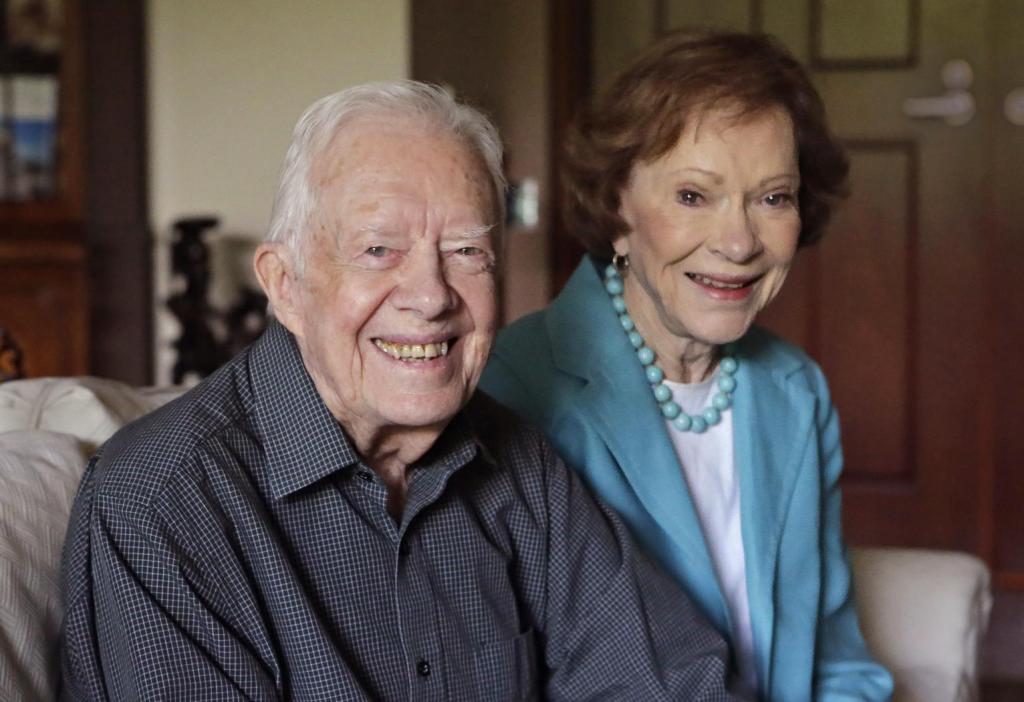
Jimmy and Rosalynn Carter enjoyed the longest marriage of any presidential couple, from July 7, 1946, until her death on November 19, 2023: an astonishing 77 years 135 days. The previous record-holders, George H.W. and Barbara Bush, were married from January 6, 1945 until her death on April 17, 2018: 73 years 101 days. The current longest-married presidential couple are Bill and Hillary Clinton, who were married on October 11, 1975.
Following Carter’s death, there are now five living presidents: Bill Clinton (1993–2001), George W. Bush (2001–09), Barack Obama (2009–17), Donald Trump (2017–21), and Joe Biden (2021– ).


 I’ve just learned of the death of Jessica Young, on November 23. I knew it was coming for a long time, but that doesn’t make it any easier to accept. Last February, she emailed to tell me she had inoperable pancreatic cancer (the same thing that killed my grandmother two decades ago), and that she’d just been through a year of chemotherapy and high intensity radiation treatment. So I spent the last year sending her chatty emails every month or so, just to let her know I was thinking of her, and because I really was thinking of her.
 I first met her at the Mensa Annual Gathering in St. Louis in 1995, where she took me to the Gateway Arch. We ran into each other again a few years later, at the AG in Philadelphia in 2000, which cemented our friendship. After that, we saw each other intermittently, at Annual Gatherings. With the coming of smart phones, we communicated more often, sharing fireworks photos when we weren’t at Independence Day celebrations together. We saw each other only rarely, but every time, it was just picking up where we’d left off the last time, one long friendship.
 Only once did we see each other outside of Mensa: In February 2016, her chorus sang at Carnegie Hall, and she was in New York for nearly a week. I got to see her most of the days she was in town, showing her around my home town, enjoying her concert, seeing a Broadway show, just hanging out, as good friends do.
 Ian Randal Strock