Last year, President Donald Trump was railing against wind power, urging the UK to shut down their wind power farms in favor “cheap and reliable” oil. His Big Beautiful Bill (which seems much more like a Frankenbill) cancelled tax breaks for solar and wind power in the US.
Three weeks ago, he launched a hot war against Iran.
In response—a response any first-year political science student could have predicted—Iran threatened the safety of shipping through the Strait of Hormuz, sending the cost of oil skyrocketing and imperiling the global flow of oil. And now Trump is calling for other countries to pledge military support to secure the Strait, in effect, demanding they clean up after his mistake.
The United States, which is nearly self-sufficient in terms of oil, is not threatened by that bottleneck. Prices, however, skyrocketed. And last week, Trump reminded the world “when oil prices go up, we make a lot of money.”
Who benefits?
The “we” in that Trump quote is not the average American; it’s the oil companies in the US. And quite possibly Trump himself and his close advisors. The US oil companies, for whom the cost of producing and distributing oil and gasoline have not changed, now get to sell their product for more money.
Global instability also leads to lower values for national currencies, increasing interest in those media which are not tied to any nation, such as cryptocurrencies. In October 2025, Bitcoin peaked at a value around $126,000 per coin. It then plummeted to about $62,000 in February. Since Trump launched this war, it is back up to $74,000, a 20% increase. Ethereum—one of the cryptocurrencies in the president’s personal portfolio—has followed a similar trajectory.
Saudi Arabia is almost the undisputed power in the Gulf region. Indeed, the only country that can threaten them is Iran, which is lead by people who are unpredictable and dangerous. Reports March 16 say that the crown prince of Saudi Arabia, Mohammed Bin Salman, is speaking regularly with Trump, urging him to continue attacking Iran harshly.
Meanwhile, since the onset of this war, you haven’t thought about the Trump-Epstein Files, have you?
Is this all far-fetched, doom-and-gloom, dystopian theorizing? Probably. I hope certainly. Nevertheless, it is a topic of conversation which keeps cropping up, so…
I know how Donald Trump is going to attempt to stay in office beyond the end of his term. It’s Section 3 of the 20th Amendment. Section 3 talks about who shall become President or act as President (two different things) if there is no President elect or if the President elect is not qualified to serve as President. The final clause of that Section reads “the Congress may by law provide for the case wherein neither a President elect nor a Vice President elect shall have qualified, declaring who shall then act as President, or the manner in which one who is to act shall be selected, and such person shall act accordingly until a President or Vice President shall have qualified.” In other words, if the election is somehow prevented from occurring—and despite Article II, Section 1, and Amendment 20, Section 1—I think Donald Trump’s sycophants are relying on this phrase to enable the Congress to “select” him to “act” as President “until a President or Vice President shall have qualified” (by being elected).
This revelation came while I was researching the essay I thought I was going to write, noting that, regardless of what Trump and the Trumpians try to do to the election of 2028, a lack of an incoming President does not enable the current President to remain in office.
I was going to quote Article II, Section 1 of the Constitution, which says the President “shall hold his office during the Term of four Years”—thus limiting the time the President serves to four years, whether a successor has been elected or not.
I was going to go on to the 12th Amendment, which says “…no person constitutionally ineligible to the office of President shall be eligible to that of Vice-President of the United States.” Thus preventing the President from becoming Vice President, only to succeed to the Presidency with the removal of the new President.
Then comes the first Section of the 20th Amendment: “The terms of the President and the Vice President shall end at noon on the 20th day of January, and the terms of Senators and Representatives at noon on the 3d day of January, of the years in which such terms would have ended if this article had not been ratified; and the terms of their successors shall then begin.” Repeating and emphasizing the Article II quote above: the President’s term ends, regardless of whether or not there is a successor waiting.
And, of course, the first Section of the 22nd Amendment: “No person shall be elected to the office of the President more than twice, and no person who has held the office of President, or acted as President, for more than two years of a term to which some other person was elected President shall be elected to the office of the President more than once.”
But then I stumbled upon Section 3 of the 20th Amendment, as I said above. That’s the “well, there may be a way around the Constitution” that the most ardent Trumpians have been hinting at. It’s fairly simple, if we assume they can somehow prevent the next Presidential election. And one doesn’t have to be too creative to figure out ways to do that: declare a state of emergency, ban gatherings “for public safety” during the first week in November, so that an election cannot be held (that’s why they keep pushing to get rid of mail-in ballots and early voting; so that there will be no ballots to count). Or, perhaps easier, would be to look at the fifth paragraph of Article II, Section 1: “The Congress may determine the Time of chusing the Electors, and the Day on which they shall give their Votes; which Day shall be the same throughout the United States.” Such an emergency declaration could simply prevent the Electors from gathering to cast their votes in December. No electoral votes, therefore nothing to count on January 6, and no President elect. Blocking that, rather than the general election, would mean that there would still be a new Congress elected who would then be charged with selecting that person who shall act as President.
Therefore, Congress needs to adopt a new law, by a veto-proof margin, saying “No person who is ineligible to be elected President may act as President.”
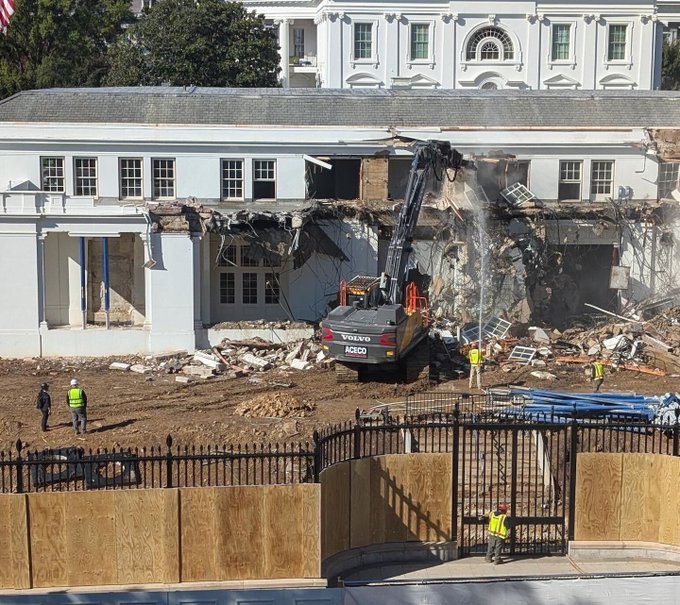
To those comparing Donald Trump’s wanton destruction of the East Wing of the White House to the complete rebuild of the entire building during Harry Truman’s administration, you’re using a false equivalency.
In January 1948, the Commissioner of Public Buildings warned of the “imminent collapse” of the second floor of the mansion. In February, the presidents of the American Institute of Architects and of the American Society of Civil Engineers made a structural survey of the safety of the White House, and concluded that the second floor structure was a fire hazard and was in danger of collapse. In September, the White House Architect announced that the White House’s “structural nerves” had been damaged, and the second floor would need to be rebuilt. He estimated the cost of repairs might be $1 million (Congress had previously approved more than $800,000 for repairs). On November 3, 1948 (the day after election day), the Federal Works Agency told the president he needed to vacate the White House so critical repairs could be effected. On November 7, the news was made public, and the Trumans left town for two weeks. They returned to Blair House, which would serve as the president’s home for most of his second term.
During 1949, the architectural and engineering designs were finalized. The plans were to completely replace the interior of the building, expand the third floor, add more basement levels, and more. Congress created the Commission on the Renovation of the Executive Mansion in March, granting the commission the authority to act on behalf of the federal government in the execution of the project, and late in the year, authorized funding of $5.4 million for the project to reconstruct the White House while keeping the exterior walls in place.
In September 1949, the Commission invited bids from general contractors, and by October, had received 15 bids ranging from $100,000 to $950,000 (that’s in addition to the costs of labor and materials). They went with low bidder John McShain, Inc, who reportedly lost about $200,000 on the project.
Work started in December 1949, and after four months, the removal of historic material slated for salvage was complete. By the middle of 1950, the walls enclosed an empty space, and then a brand-new interior was built, from foundations up.
The Truman family returned to the White House on March 27, 1952.
Currently, the White House is managed by the National Park Service (NPS) but operated by the Executive Office of the President (EOP). Proposed changes to the building are supposed to begin through the Office of the Curator and the White House Facilities Management Division. The NPS, operating under the Presidential Residence Act and National Historic Preservation Act (NHPA), must review all alterations for compliance with the NHPA. This requires assessing potential impacts on historic and cultural resources in consultation with the Advisory Council on Historic Preservation (ACHP) and the DC State Historic Preservation Office (SHPO).
The National Capital Planning Commission (NCPC) evaluates all major federal projects in the National Capital Region, including work on the White House grounds, for design, planning, and environmental impacts under the National Environmental Policy Act (NEPA). Public comment and design reviews are part of that process.
The US Commission of Fine Arts reviews and advises on the design and appearance of any exterior modifications to the White House or its grounds.
After approvals from NPS, NCPC, and CFA, the Office of Management and Budget (OMB) and the White House Chief Usher / Facilities Management Office finalize funding, scheduling, and logistics. All of that is required before any major construction or demolition of the White House.
Apparently Trump—in his roles of dictator and general contractor (how much is he skimming from the cost of this project?)—ignored all of that.
I’m starting to feel like the frog in the slowly heating pot of water.
National Guard troops patrolling Los Angeles. A judge just ruled it’s a violation of the Posse Comitatus Act, but that ruling doesn’t change much.
The military take-over of the federal district. “Crime is out of control,” according to the White House, though the city’s administration says those figures are a lie. No matter who’s right, we’re becoming inured to seeing troops in the streets.
Talk of next sending the troops into Chicago or some other major city. We’ll survive that, won’t we? After all, New Yorkers have gotten used to heavily armed people in fatigues at major events and gatherings. Those troops may not have chosen to be here, but we still have to thank them for their service.
Pair that increasing military presence at home with the spate of national emergencies the president is in love with declaring: the national emergency over immigration that the administration is using to justify increasing number of deportations. And the national emergency over international trade that was the justification for illegally imposed tariffs. And now there’s talk of the president declaring a national emergency over housing, because people in their 20s and 30s can’t afford to buy houses, because not enough new houses are being built.
Add in the president’s continual whining about that elections aren’t “secure,” that we can’t trust the mail-in paper ballots, or the electronic voting machines, or any other facet of the system, and that the federal government is going to have to take over the machinery of elections, just to ensure that they’re fair.
Do you see where this is going? This is all in the first seven months of this presidential administration. We are being inculcated to the steady stream of major emergencies demanding extraordinary governmental intervention. We are being taught to distrust the institutions of free and open government that have served us so well for two centuries. And we are growing desensitized to the elements of control such as the Army patrolling our cities.
It isn’t very much of a leap of reasoning to imagine we’ll be told we have to respond to some emergency in the summer of 2028, while the government is trying to make our electoral system “safe,” which will require a delay in election day, perhaps “just a few months.”
I think we’re in trouble. I feel the temperature of this water rising, but will we be smart enough to turn off the gas before it starts boiling?
President Trump on Monday tweeted about his dismissal of Federal Reserve Governor Lisa Cook. His “reasoning” is that he claims Cook made false statements on mortgage documents, which was evidence of “gross negligence” and “potentially criminal.”
The evidence he is basing this decision on? Federal Housing Finance Agency Director Bill Pulte sent a letter to Attorney General Pam Bondi accusing Cook of taking out mortgages for homes in Michigan and Georgia in 2021, and telling banks in both cases that she planned to use the homes as her primary residences. Pulte alleges that was a fraudulent attempt to gain more favorable lending terms. Cook has not been convicted of anything, not even been indicted. But Caesar’s wife must be above reproach.
Sound familiar?
In the case commonly known as New York v Trump (2023–2024), the judge ruled that “In order to borrow more and at lower rates, defendants submitted blatantly false financial data to the accountants, resulting in fraudulent financial statements.”
The pot calling the kettle back? It takes one to know one? The crime he’s accusing Cook of committing is the smaller version of the crime of which he was convicted. He says it’s a disqualifying crime (mind you, the accusation; there has been no trial) to serve on the Fed’s Board of Governors, but that the much larger version (which was adjudicated) is not disqualifying for him to serve as president.
I’m embarrassed that he’s the president, and I’m scared of what he’ll do next.
The Republican redistricting scheme currently causing so much consternation in and toward Texas gives me hope. Not, perhaps, in the way you might think. But in it, I see the seeds of potentially, maybe, if if if, a solution to the gerrymandering that has plagued this country for two centuries.
Allow me to explain.
I’ve been railing against gerrymandering for years. Gerrymandering is the drawing of boundaries on political districts in order to group blocks of voters together, either to increase the power of one group, or to decrease the power of another. Sometimes it is used to increase the chances that a member of a minority group can win an election. But far more often these days, it is used to cement a political party’s hold on a district, to make it “safe.” (For the problems safe districts cause, see my previous writings.)
In normal times, Congressional district boundaries are redrawn every ten years, after the decennial census data is received, so that the districts accurately represent where the people live and what those people want. These are not normal times.
Governor Abbott of Texas, kowtowing to President Trump’s request, is urging the Texas legislature to redraw the state’s Congressional map right now, half-way through a decennial period, in order to concentrate the Democratic minority voters into fewer districts, and thus give the Republicans, potentially, three to five more seats in the House of Representatives. Democratic members of the Texas legislature have left the state, in order to prevent the legislature from reaching a quorum, which would—at least, in theory— prevent action on the proposal. But they’ve tried such a quorum-break in the past; it has not been successful. I doubt it will be this time, either.
So we have to accept the reality that Texas is about to further marginalize their Democratic population and flip five of their seats in the House to the Republican party.
Governor Newsom of California has been making noises about attempting the same scheme in his state, which would flip several seats from the Republicans to the Democrats. There’ve been whispers elsewhere—such as Governor Hochul in New York—that other states might do something similar if Abbot and Trump get their way in Texas. The problem I foresee is an ongoing character flaw of the Democrats: the party insists that it must be holier than thou, purer than thou, that it will play be the rules even when their opponents have shown absolutely no compunction about violating those rules. While doing so may give them a moral victory, it will inevitably lead to an actual loss. To my mind, in these cases, the Democrats are those crying “life isn’t fair.” No, it isn’t. Everyone should follow the rules. Everyone should be a good, moral, decent human being. Everyone should be more interested in the good of us all than in our individual results.
But not everyone is.
We don’t need Governor Newsom and Governor Hochul warning “don’t do it or we might do something, too.” We need him and his fellow Democratic governors to act! Today! We need them to implement precisely the schemes Abbot and the Texans are planning. We need to gerrymander the country to a fare-thee-well, to legislate out of existence those last 40 competitive seats in the House.
Because then, and only then, will we all see just how egregious the gerrymandering has become. Only then will it be brought to the Supreme Court. And to my mind, regardless of the Court’s political slant, there is no way it can allow such outrageous diminution of the minorities to survive. In such a case, I think, the Supreme Court will only be able to rule that the gerrymandering violates the people’s rights to be fairly represented, and that political maps must be drawn in a fair, impartial manner.
(Yes, I know, I’m an idealist. It may not work out that way. But I don’t see any other way to fix the mess we’re in.)
And if, IF my dream comes true, may I humbly suggest new legislation regarding how districts are drawn? A fairly simple test, actually:
No Congressional district, when drawn on a Mercator projection map, shall be drawn in such a way that a straight line drawn on that map shall be able to cross into the district more than once. That is, except in cases where the state border itself violates this dictum.
I don’t expect any of this to happen. I expect the Democrats will continue to purge their own ranks, as they threw out Al Franken. I expect they’ll yell and whine and do nothing, while Texas rejiggers their Congressional map, and that the election of 2026 will result in a Trumpian increase in the House, and we’ll continue bitching and moaning about their self-serving actions for years to come.
But wouldn’t it be nice if I was wrong, and we could actually make things better?
Donald Trump left the G7 summit in Canada early, “because he needed to be close to his advisors in the White House, to decide on our course of action with regard to Israel and Iran.” But once he got home, he decided to maybe make a decision… in two weeks. Honestly, no one should have expected anything sooner, because the only things he acts on today are the internal culture wars he keeps fighting. Real policy decision, things of global import, those are the things that are always “in two weeks,” because he doesn’t want the blame for actually doing something. Remember “I’ll end the war in Ukraine on day one”? Remember “I’ll negotiate trade deals with every country in the world”? Remember “we’ll take over the Gaza Strip and turn it into a tourist destination”? Remember “we need to take over Canada, or Greenland”?
As Jen Psaki very clearly lays out in this segment, “two weeks” is Donald Trump’s version of “I talk big, but I’m not actually going to do anything, and you’ll forget about it.” He’s been “two weeks”ing us since he took office the first time.
I’ve been thinking about his two weeks, and comparing it to Ben Bova’s story “Crisis of the Month.” In Bova’s story, the heads of the news media get together when they realize the public’s attention span for any story peters out after a month, so they need a new story with which to entrance and enrage the public every four weeks. Bova wrote it in 1988, before the internet and the 24-hour news cycle. Apparently, Trump has learned that Bova’s one month span has dropped to two weeks or less, so that by the time his “two weeks” rolls around, we’ve already forgotten whatever it was we needed him to say or do, and we’re on to the next story.
It’s time we realized that when he says “in two weeks,” what he actually means is “I’m not doing anything. Forget it, please.” Or we could just look at his record: he’s done a great deal with executive orders, but none of it is the least bit presidential, none of it is what we elect a president for, and none of it can be taken seriously.
Edited June 21, 2025 at 21:50 EDT: Sure, the one time he decides to act in less than two weeks. Oy.
I find it ironic that two of the news channels both quoted the same Harvard Youth Poll, which was taken by the Institute of Politics at the Harvard Kennedy School (see it here: https://iop.harvard.edu/youth-poll/50th-edition-spring-2025), this afternoon. On CNN, they touted the finding that—among young adults—President Trump’s approval rating is 31%. On Fox, they touted the finding that—among young adults—the approval rating of Democrats in Congress is 23%. Neither one (at least, while I was watching) mentioned the approval rating of Republicans in Congress (for the record: 29%).
A little more color on those numbers. Previous iterations of the poll were run in Spring 2017 and Fall 2020. Those numbers (in order) were: Trump: 32%, 29%, 31%. So he’s been remarkably steady, and the only one to improve since the previous poll. Republicans: 28%, 31%, 29%. Again, steady. Democrats: 42%, 48%, 23%. The biggest drop of the three. They should be embarrassed.
Both used the poll to show that those on the other side of the political aisle are in trouble, by quoting one or two specific numbers. But hearing them both within minutes of each other made me wonder: just what do those young people approve of? So I went dug out the poll itself. The answer, at least among the top ten issues this report is talking about, is “not much.” This group of young people is not happy with pretty much anything having to do with the government, world, or social issues.
They have very little sense of community, almost none of them think the country is heading in the right direction, their life goals are not the same as their forebears’, and very few of them trust the federal government to do the right thing.
Both CNN and Fox used the survey to make political hay, though only briefly and in passing. But neither, it seems, took the time to realize the survey says something far more important: it doesn’t matter which political party you support, your party is not doing a good job of serving the people, and the next generation is noticing. Bloviating and blaming the other side is easy, but it’s not enthusing anyone who isn’t already a dyed-in-the-wool supporter of the bloviators and the blamers.
What is the value of intellectual freedom? of academic integrity? of political independence? The story just now on MSNBC was about the forthcoming meeting and negotiations between Harvard University and the Trump administration; that the government is demanding… well, I’m not entirely sure, other than the Trumpians are angry with the “liberal agenda supported by colleges and universities.”
I’m wondering what will happen if the leadership at Harvard can bring themselves to say “Our intellectual freedom, our academic integrity, is more important to the Harvard community than our federal funding. We have this massive endowment, so we’re going to draw on it to make up for the shortfall in federal funding. President Trump: you can shove your ideology.” Such a move, I think, would lead to an alumni fund-raising windfall. While the Trumpians might tout it as cutting needless federal spending, it could be viewed as a win by both sides. And who better to take that hit to show that Trumpism is not forever and ever than a university which was founded more than a century before the country in which it stands?
Mind you, I am emphatically in favor of rooting out the antisemitism poisoning college campuses. But it doesn’t seem to me that Harvard is dragging their feet on this issue.
And I’m going to throw in a few numbers which caught my ear. According to that MSNBC story, Harvard receives “$9 billion in federal grants and contracts.” Though the same report did also say that Columbia, after having theoretically acquiesced to similar demands, is still waiting for the $400 million in federal funds it receives to be restored.
I question that $9 billion, which may actually be an aggregate of many universities. This Washington Times piece from 2023 said Harvard had $3.3 billion in grants and contracts over the 2018–2022 period.
And in January, the Harvard Crimson said “In fiscal year 2024, the University received $686 million from federal agencies, accounting for two-thirds of its total sponsored research expenditures and eleven percent of the University’s operating revenue.”
But the point remains: can—should—a university bow to political whims, and change its policies to suit a presidential administration, which is by design temporary?
Yes, there is no place on college campuses—or anywhere else in the country—for supporters of kidnappers, rapists, and murderers. But on the other side of the discussion: is this what we have a government for? Isn’t this rather an issue to which a true Republican would have a laissez-faire attitude? Let the market decide, such a Republican would say. If people disagree with the university’s policies, they’ll stop donating to it, stop applying to be students there, stop respecting it. Apparently, the Trumpians are not so secure in their own beliefs to think they’ll win out in the marketplace of ideas, so they have to put the government’s financial thumb on the scale.
I’ve said it before in a different context: when only one side is playing by the rules, they’re setting themselves up for a moral victory accompanied by a crushing actual defeat.
The Democratic party’s insistence on moral purity is what led them to purge their own Senator Al Franken. It’s what allowed Antonin Scalia’s Supreme Court seat to sit vacant for ten months, while Ruth Bader Ginsburg’s was filled in ten days. And it’s what continues to cause massive headaches for those of us who actually worry about the future of the country.
Chuck Schumer was absolutely correct in his vote for the “continuing resolution” to keep the government funded: voting against it is what the Trumpians wanted. There may have been moral purity in rejecting the bill, but then what? Shut down the government? Declare moral purity by not voting for the bill? That is exactly what the Trumpians wanted.
Indeed, they’re already doing it. Look at what has happened during Trump 2.0: USAID has been shut down. NOAA has been shut down. The Department of Education is nearly shut down. They’re shutting down the government piecemeal while patriotic ex-employees file pitiable lawsuits, hoping to keep their jobs.
Not adopting Speaker Mike Johnson’s continuing resolution would have done in one fell swoop what Trump & Co. are doing slowly, department by department: it would have shut everything down.
“But then shutting down the government would have been the Republicans’ fault,” the purest of the pure cry.
“So what?” respond the rational people. “That’s what they’re doing today. That’s what they want to do.” And that appears to be what the voters asked for.
Regardless of Speaker Emerita Nancy Pelosi’s commentary, there was no pathway to negotiate a clean four-week extension. If that negotiation could have occurred, it would have happened weeks ago. But Trump’s minions in the House had no interest in doing so. They have the majority there, so they don’t need to talk to the Democrats about anything.
Had the staunch Democrats succeeded in delaying the bill and shutting down the government, the Trumpians would have been celebrating. And they would have had no reason to negotiate anything to re-open it. We would be suffering through a government shutdown that would last until the next election, all while Trump and Elon Musk determine which pieces of the government are “necessary” and which are not. They would have had the time of their lives, selling off pieces of the government to their cronies at bargain prices, while the Democrats would be mewling for negotiations to fund and re-open the government.
I disagree—vehemently—with almost every action taken by the president and his gang of thieves. I disagree with their policies, their stated goals, and their methods. But the moral purity of the Democrats is a danger we can no longer afford. Adherence to the rules is a path to victory only if both sides are playing by the rules, and if the judges of the contest care about them. November 5, 2024, showed us that a plurality of American voters don’t care about following the rules, and that saddens me. But if we’re going to save our country from the predations of Trump 2.0, we’re going to have to get dirty, get down in the mud with our foes to fight back, hard.
Was Schumer morally impure for allowing the continuing resolution to pass the Senate? Yes. But was it the right thing to do in an attempt to save the country? Also, yes.


 Ian Randal Strock