Last night, I was at Readercon for about 25 minutes. I went to the hotel just to drop off the boxes of books which I’ll be setting up today. Then I returned the luggage cart, and in the forty feet I had to walk from leaving the luggage cart to exiting the hotel door to get back to the car, I stopped and talked with five people I know. (In other words, a standard convention: can’t walk down a hall without stopping to talk.)
Each of them asked how I was doing, and to each, I gave the same flippant answer I’ve been using for years: “I’m properly insane.” With those three words, I usually intend to convey the fact that I’m busy, doing many things, but they’re the things I should be doing.
But last night, getting ready for bed, I had something of an epiphany. Sure, I’m busy, but actually the answer to “how am I doing?” is “pretty damn good!”
RESISTANCE (the anthology I edited to help support the ACLU and Pro Publica) is doing well, and people are appreciating it.
I’m excited to be publishing Allen Steele’s newest novel, LEMURIA 7, on Tuesday.
I’m just about finished editing a really great book about film that I’ve been enjoying.
I’m excited to be working with a brand-new author on a two-book science fiction tale that I think a lot of people are going to like as much as I do.
I’ve got several more authors waiting for my close attention, most of them waiting patiently.
And in the few brief moments I give myself to do my own writing, it feels like I’m improving. And when I finish the stories I’m working on, I have some confidence I’ll be able to find an editor who agrees that they’re good, and wants to publish them.
I’m doing a job I want to be doing. My friends seem to value and like me, and I’m very glad to have them in my life.
And now I have to leave to go set up those books at the convention, because selling books and talking on panels to appreciative audiences is my day job.
Sure, I’m busy, trying to think in several different directions at once. But you know what? I’m doing pretty damn good!
Michael Smerconish, on his CNN Sunday program, just had a story about homeowners wanting fewer white picket fences and more taller, privacy fences (I tuned in part-way through, and so missed the introduction of his guest who wrote the article that caught his attention and caused him to tell the story). He mentioned that fences break up the landscape, separate us from our neighbors, and so forth. That resonated with me.
I get a similar feeling in dealers’ rooms at the conventions I attend. Way back when, dealers would have their wares on tables, and customers would look at those wares, but could glance up to see across the room, see all the people and tables. And we dealers could see each other, look around to see if there were crowds of customers somewhere in the room even if they weren’t at our tables, subconsciously feel we were all in it together. But over the last bunch of years, table displays have gotten taller and more complex, with huge banners back-stopping the table. Lines of tables all together in a room have turned into series of caves. The aisles between the tables have turned into deep chasms, with nothing visible except the few at arm’s length and the ceiling above. We’ve lost sight of all the other dealers except the one directly across the aisle, and I feel so closed in, almost claustrophobic.
During the story, Smerconish quoted the phrase “good fences make good neighbors,” which we’ve all heard. But do we ever consider the rest of the poem (“Mending Wall” by Robert Frost) in which the phrase appears? Indeed, the speaker of “good fences make good neighbors” never explains what he means or why. But the narrator, talking with him, goes on to ponder
Why do they make good neighbours? Isn’t it Where there are cows? But here there are no cows. Before I built a wall I’d ask to know What I was walling in or walling out.…
Are fences—in general—a response to our increasingly electronically connected world? Is it that we let everyone into our lives on our screens, so we feel a greater need to keep them out of our physical spaces? I can sort of accept that reasoning. But in the dealers’ rooms, I just find it uncomfortable. I’ve found that, when I’m setting up my table in the middle of a row, I won’t put up my large banners behind me until the vendor backing my table has set up and erected whatever large display will be there, facing the other aisle, walling me out. And in the rare event that my back-to-back neighbor does not have a sight-line cutting display, I won’t put up the banners. It’s my little protest against the walling off, the sectioning off, of the dealers’ room.
Perhaps, being taller than average, I have a different view of such things. On a crowded subway car, my face isn’t pressed into my neighbor’s back; I can see above all the heads in the car, to the few other tall people. Perhaps it’s that usual long view that makes the walling-in especially unpleasant to me.
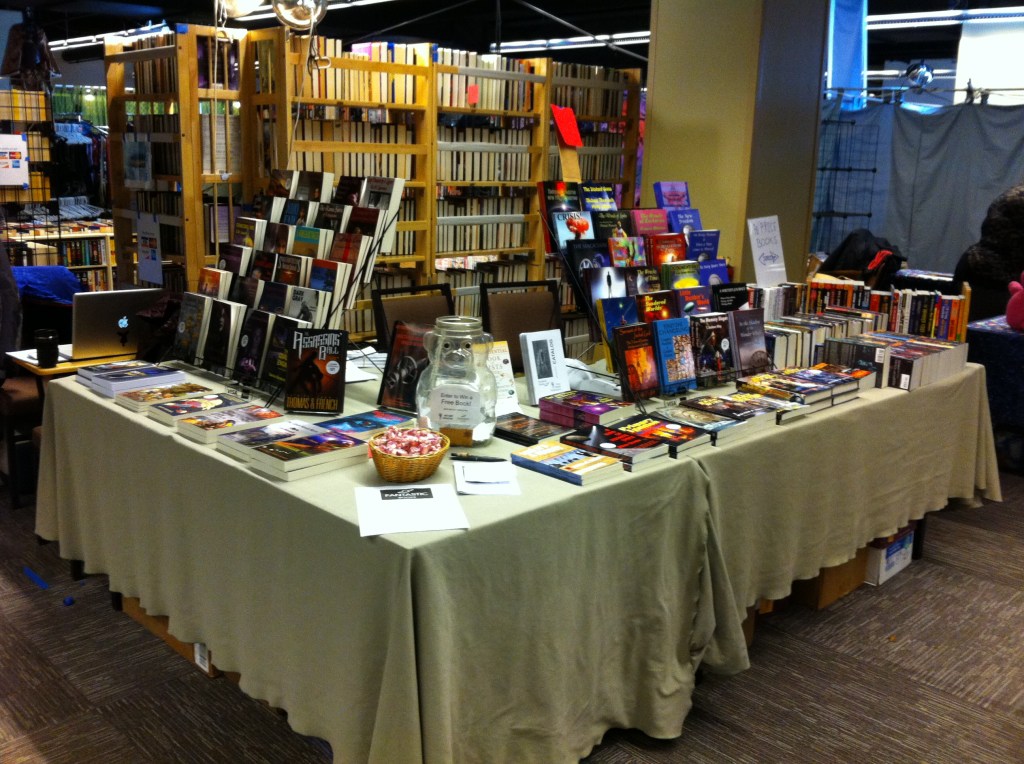
And I know, for many dealers, it’s been like an arms race. The first to distribute free colorful bookmarks grabbed a lot of notice from potential readers browsing the freebie table. But now there are dozens of those bookmarks, and they can no longer be seen individually (consider trees in a forest). Similarly, the first to have a huge banner behind the table attracted attention from across the room. But now that everyone has one, the banner no longer attracts attention, but only serves as a wall, a backdrop. I try to make my display as low as possible—I’ve stopped using the racks that stand two feet tall on my table—so that I can see my customers and they can see me. (The attached picture is, for example, the Fantastic Books table in the dealers’ room at Arisia 2015.)
I’ve occasionally thought that if I were running a dealers’ room, I would ask vendors the heights of their displays, and then put all the tall displays together in one corner of the room—or at least in the back—and let those with short displays be in the front of the room, so that it would feel more open, larger, for customers walking in to be able to see everything, and for vendors to be able to see them.
My house doesn’t have a front yard, so no fence is necessary. And even though I’m a city dweller, I still like, enjoy, need those open spaces, those long views, that make me feel connected, make me feel a small part of it all, rather than a large resident of a tiny cell. How about you? Are you busily building fences and walls to keep me out?
I’m planning to go to a Mensa gathering this evening, just some people getting together in a restaurant/bar for conversation. The last time this particular gathering gathered, it was fascinating. I met several new people, including some from other countries, who knew and talked about things I didn’t know, so I learned. It was a good time.
But there was one woman present who I’d only known from online interactions. Unfortunately, in person, she was the same: always complaining, angry, and put upon. Nothing was right, and everything needed to be corrected to her standards. Thinking about tonight’s gathering, I’m anticipating the good, but I’m wondering what I might say if I find myself in proximity to this woman, to short-circuit her kvetching. I think I’ll ask her what brings her joy.
That, however, makes me think she might turn the question back on me: what brings me joy? So I’ve been thinking about that.
I try to find some joy in every day: whether it’s talking with my family, hearing a new song or joke (well, new jokes are rare these days), or learning and playing games with friends, but those are little things, small joys (mind you, that doesn’t make them any less important or less cherished). But there are bigger joys, too: being on stage (thinking of the talk I gave last weekend, about punctuation and my new book), selling a story or essay, or experiencing something genuinely new, like visiting a new place.
Most of those, however, rely on other people. But there are also the joys that don’t require other people’s efforts: writing, for me, is one of those joys, whether I’m at the keyboard or out walking and the right turn of phrase comes to me. Selling what I’ve written adds another level of joy, but even without the selling, I enjoy my time choosing precisely the correct word, and ordering those correct words. My wood carving is another one of those joys; one I get to experience too seldom, especially in the colder months, since there’s no place to do it in the house. And there are a few cherished movies I’ll rewatch when I need a lift, a pick-me-up, because they always make me smile (although movies, by their very nature, require other people to have done a great deal to get them to me). It’s a similar thing with reading an especially good passage or engrossing story, when not only am I enjoying what I’m reading, but I’m trying to figure out how the writer did it, to see if I can learn from it to improve my own writing.
Anyway, that’s a short answer to the question I may ask of others this evening, but I’ll ask you, too: what brings you joy?