Should I just give up, or should I continue to cringe when I hear people using the word “fulsome” when they mean “full” or “large”? Because it grates on my ears. And yes, before I looked up this source, I hadn’t realized that the modern usage of just meaning “full” but with more syllables is actually the original meaning from the 1200s.
Dictionary.com offers the following on the word fulsome:
adjective
offensive to good taste, especially as being excessive; overdone or gross. Example: fulsome praise that embarrassed her deeply; fulsome décor.
disgusting; sickening; repulsive. Example: a table heaped with fulsome mounds of greasy foods.
excessively or insincerely lavish. Example: fulsome admiration.
encompassing all aspects; comprehensive. Example: a fulsome survey of the political situation in Central America.
abundant or copious.
adjective
excessive or insincere, esp in an offensive or distasteful way Example: fulsome compliments
[not standard] extremely complimentary
[informal] full, rich or abundant Examples: a fulsome figure a fulsome flavour fulsome detail
[archaic] disgusting; loathsome
Note: In the 13th century when it was first used, fulsome meant simply “abundant or copious.” It later developed additional senses of “offensive, gross” and “disgusting, sickening,” probably by association with foul, and still later a sense of excessiveness: a fulsome disease; a fulsome meal, replete with too much of everything. For some centuries fulsome was used exclusively, or nearly so, with these unfavorable meanings. Today, both fulsome and fulsomely are also used in senses closer to the original one: The sparse language of the new Prayer Book contrasts with the fulsome language of Cranmer’s Book of Common Prayer. Later they discussed the topic more fulsomely. These uses are often criticized on the grounds that fulsome must always retain its connotations of “excessive” or “offensive.” The common phrase fulsome praise is thus sometimes ambiguous in modern use.
Is this all far-fetched, doom-and-gloom, dystopian theorizing? Probably. I hope certainly. Nevertheless, it is a topic of conversation which keeps cropping up, so…
I know how Donald Trump is going to attempt to stay in office beyond the end of his term. It’s Section 3 of the 20th Amendment. Section 3 talks about who shall become President or act as President (two different things) if there is no President elect or if the President elect is not qualified to serve as President. The final clause of that Section reads “the Congress may by law provide for the case wherein neither a President elect nor a Vice President elect shall have qualified, declaring who shall then act as President, or the manner in which one who is to act shall be selected, and such person shall act accordingly until a President or Vice President shall have qualified.” In other words, if the election is somehow prevented from occurring—and despite Article II, Section 1, and Amendment 20, Section 1—I think Donald Trump’s sycophants are relying on this phrase to enable the Congress to “select” him to “act” as President “until a President or Vice President shall have qualified” (by being elected).
This revelation came while I was researching the essay I thought I was going to write, noting that, regardless of what Trump and the Trumpians try to do to the election of 2028, a lack of an incoming President does not enable the current President to remain in office.
I was going to quote Article II, Section 1 of the Constitution, which says the President “shall hold his office during the Term of four Years”—thus limiting the time the President serves to four years, whether a successor has been elected or not.
I was going to go on to the 12th Amendment, which says “…no person constitutionally ineligible to the office of President shall be eligible to that of Vice-President of the United States.” Thus preventing the President from becoming Vice President, only to succeed to the Presidency with the removal of the new President.
Then comes the first Section of the 20th Amendment: “The terms of the President and the Vice President shall end at noon on the 20th day of January, and the terms of Senators and Representatives at noon on the 3d day of January, of the years in which such terms would have ended if this article had not been ratified; and the terms of their successors shall then begin.” Repeating and emphasizing the Article II quote above: the President’s term ends, regardless of whether or not there is a successor waiting.
And, of course, the first Section of the 22nd Amendment: “No person shall be elected to the office of the President more than twice, and no person who has held the office of President, or acted as President, for more than two years of a term to which some other person was elected President shall be elected to the office of the President more than once.”
But then I stumbled upon Section 3 of the 20th Amendment, as I said above. That’s the “well, there may be a way around the Constitution” that the most ardent Trumpians have been hinting at. It’s fairly simple, if we assume they can somehow prevent the next Presidential election. And one doesn’t have to be too creative to figure out ways to do that: declare a state of emergency, ban gatherings “for public safety” during the first week in November, so that an election cannot be held (that’s why they keep pushing to get rid of mail-in ballots and early voting; so that there will be no ballots to count). Or, perhaps easier, would be to look at the fifth paragraph of Article II, Section 1: “The Congress may determine the Time of chusing the Electors, and the Day on which they shall give their Votes; which Day shall be the same throughout the United States.” Such an emergency declaration could simply prevent the Electors from gathering to cast their votes in December. No electoral votes, therefore nothing to count on January 6, and no President elect. Blocking that, rather than the general election, would mean that there would still be a new Congress elected who would then be charged with selecting that person who shall act as President.
Therefore, Congress needs to adopt a new law, by a veto-proof margin, saying “No person who is ineligible to be elected President may act as President.”
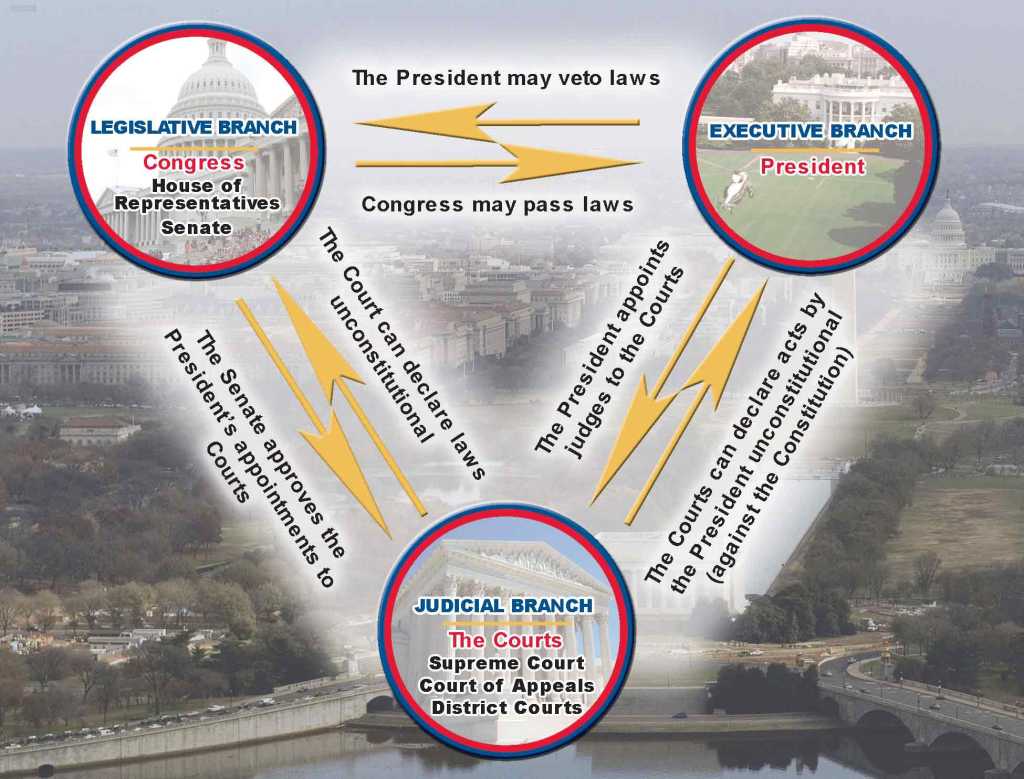
As angry as I am with many of President Trump’s statements and actions—some of which are immoral and unworthy of the presidency, and some of which are demonstrably criminal—my ire today is reserved for Congress and the Supreme Court. Part of the genius of our Constitution is that it organized a government that is not dictated solely by one person or one body, but rather has three co-equal branches, each of which has certain powers over the other two, and other responsibilities to the other two. As we learned in elementary school: the Legislative branch (Congress) makes the laws, the Executive branch (the President and his departments) enforces the laws, and the Judicial branch (the Supreme Court) interprets the laws (tells us what they mean, and if they are in keeping with the Constitution).
The President appoints the members of the Supreme Court, but the Senate has to agree. The President spends the money, but only according to the budget that Congress creates. Congress writes the laws that the President can veto or accept, but the Supreme Court can say “no, that law is not Constitutional.” Congress can remove the President and the members of the Supreme Court for “high crimes and misdemeanors.”
According to Article I of the Constitution, Section 8, the powers of Congress include the power to lay and collect taxes, duties, imposts and excises; to regulate commerce with foreign nations; to declare war; “to provide for calling forth the Militia to execute the Laws of the Union, suppress Insurrections and repel Invasions”; and a slew of others.
Article II, Section 2, lists the powers of the President, including serving as the Commander in Chief of the Army, Navy, and Militia, “when called into the actual Service of the United States”; making treaties, appointing ambassadors, Supreme Court judges, “and all other Officers of the United States,” all “by and with the Advice and Consent of the Senate”; and other things.
Article III vests “the judicial Power of the United States” in the Supreme Court and other inferior courts. Section 3, interestingly reads “Treason against the United States, shall consist only in levying War against them, or in adhering to their Enemies, giving them Aid and Comfort.”
This system of checks and balances among the three co-equal sections of the United States government worked pretty well for a long time. The relative power of the executive and legislative branches waxed and waned over the decades, but all three branches maintained their shared powers through the strength of their leaders over the years. Congressional leaders have worked with and against presidents, the Supreme Court has allowed and denied laws over the years, but always, the holders of those offices upheld the power of their position, the importance of their branch, and kept the tripod standing.
Lately, the tripod has collapsed, because two of those legs have been allowed to weaken before the onslaught of the third. Obviously, this collapse has been going on for longer than just the last decade, but no one looking at Ronald Reagan’s relationship with Tip O’Neill ever thought either one of them was subservient to the other. Since that time, however, we’ve been stuck with a series of ideologues who realized that the way to enforce their partisan will long beyond their service would be to enable a collapse of the system of checks and balances. Thus, Mitch McConnell’s lies and machinations have unbalanced the Supreme Court: in early 2016, he told us the Senate could not appoint a new Supreme Court justice during an election year, and kept Antonin Scalia’s seat vacant for 11 months, until Donald Trump’s election. Four years later, McConnell told us to ignore his four-year-old words, and that the Senate had to fill a vacant Supreme Court seat when Ruth Bader Ginsburg died a month and a half before the election of 2020. That’s the same Mitch McConnell who, on January 6, 2021, called Donald Trump “practically and morally responsible” for the attack on the Capitol, but then voted to acquit Trump of those charges at his second impeachment. McConnell is no longer the leader of the Senate, but his successor, John Thune, has not shown himself to be any more of a leader. His every utterance proclaims his subservience to the office of the President.
Chief Justice John Roberts has used his ideological majority of the Court to grant the president nearly complete immunity for anything he may do during his term of office, since the president in question supports his views. He also can’t imagine any of our recent or potential presidents hailing from the Democratic party ever running so far beyond the pale as Donald Trump has, so he’s not worried about karma coming back.
And now we have the Speaker of the House, Mike Johnson, who has completely subsumed his authority to Donald Trump’s will. He has decided the House shouldn’t actually be conducting any business, because the president is happier to have the government shut down, so he can rampage however he wants.
The Supreme Court, unfortunately, is beyond our power to correct in the near term. The way the Justices are chosen requires waiting for those currently in office to leave in order to replace them. And let’s face it, there doesn’t appear to be anyone even on the horizon with the strength of John Marshall or the moral fiber of David Davis.
The make-up Congress, however, is—at least, theoretically (but see my several previous pieces on Gerrymandering)—something we can affect. I say it is time to elect Senators and Representatives who will stand up, not necessarily for me and my views, but for the strength of the Congress. Congress needs to restore itself to its role as a co-equal branch of the government.
Far too often, among the Republicans and Trumpians in the Congress, we see people who are far more interested in doing what Trump wants so that he won’t attack them. Can they possibly be proud of their service? Or are they merely keeping their seats warm? Liz Cheney stood up for right over party, and was punished for it by losing her seat. But as much as I disagree with many of her views, she earned my respect. The problem was, she was one voice in a vast sea of the voiceless, and thus, easy to target. The other members of Congress need to find their voices, to stand up, not to keep knuckling under.
I may not have agreed with their policies or their actions, but did anyone ever doubt the Congressional allegiance, the strength, the patriotism, of prior Senate Majority Leaders such as Robert Byrd, Mike Mansfield, Everett Dirksen, Lyndon Baines Johnson, or Henry Cabot Lodge? Similarly, will the House of Representatives ever feel the need to remember the service of Mike Johnson as it does Tip O’Neill, Carl Albert, Sam Rayburn, or Nicholas Longworth?
Donald Trump has gone off the rails. He cares nothing for the Constitution, law, or tradition, and is interested only in lining his own pockets and glorifying his own name. But if the rest of the government was functioning as it should, the damage Trump could inflict would be minimized. But with the Supreme Court saying only “Yes, sir,” while Congress’s leaders say “We’ll do whatever Trump wants,” our government, our nation, is in danger.
And yes, I know I’ve not mentioned the Democratic leaders. Chuck Schumer and Hakeem Jeffries, too, are falling down on their jobs. They’re doing what they can in their minorities, but it sure feels like they could be doing, could be saying, more. And their younger colleagues, the flaming liberal branch of the party who don’t recognize that good government is negotiation, compromise, and not getting everything? They, too, are not doing us any favors.
Term limits are not, and never have been, the answer. But whether you vote Republican or Democratic, I urge you—in the strongest terms possible—to vote for someone who wants to serve in Congress, not someone who wants only to kowtow to or attack the president.
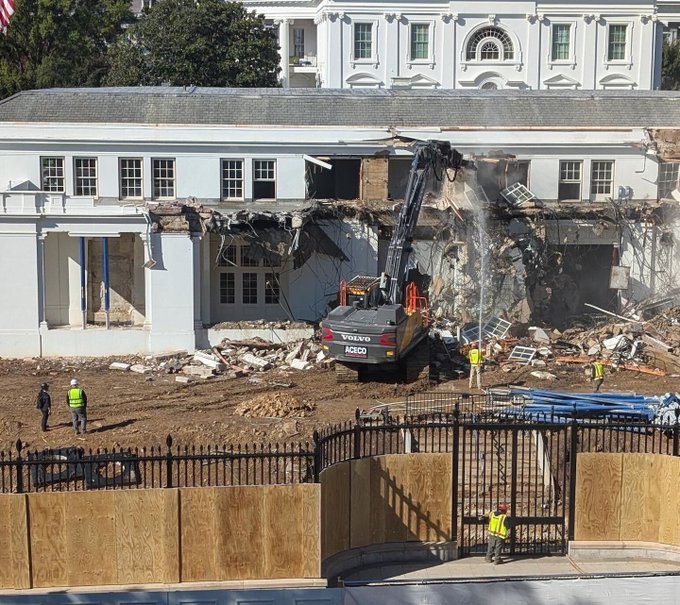
To those comparing Donald Trump’s wanton destruction of the East Wing of the White House to the complete rebuild of the entire building during Harry Truman’s administration, you’re using a false equivalency.
In January 1948, the Commissioner of Public Buildings warned of the “imminent collapse” of the second floor of the mansion. In February, the presidents of the American Institute of Architects and of the American Society of Civil Engineers made a structural survey of the safety of the White House, and concluded that the second floor structure was a fire hazard and was in danger of collapse. In September, the White House Architect announced that the White House’s “structural nerves” had been damaged, and the second floor would need to be rebuilt. He estimated the cost of repairs might be $1 million (Congress had previously approved more than $800,000 for repairs). On November 3, 1948 (the day after election day), the Federal Works Agency told the president he needed to vacate the White House so critical repairs could be effected. On November 7, the news was made public, and the Trumans left town for two weeks. They returned to Blair House, which would serve as the president’s home for most of his second term.
During 1949, the architectural and engineering designs were finalized. The plans were to completely replace the interior of the building, expand the third floor, add more basement levels, and more. Congress created the Commission on the Renovation of the Executive Mansion in March, granting the commission the authority to act on behalf of the federal government in the execution of the project, and late in the year, authorized funding of $5.4 million for the project to reconstruct the White House while keeping the exterior walls in place.
In September 1949, the Commission invited bids from general contractors, and by October, had received 15 bids ranging from $100,000 to $950,000 (that’s in addition to the costs of labor and materials). They went with low bidder John McShain, Inc, who reportedly lost about $200,000 on the project.
Work started in December 1949, and after four months, the removal of historic material slated for salvage was complete. By the middle of 1950, the walls enclosed an empty space, and then a brand-new interior was built, from foundations up.
The Truman family returned to the White House on March 27, 1952.
Currently, the White House is managed by the National Park Service (NPS) but operated by the Executive Office of the President (EOP). Proposed changes to the building are supposed to begin through the Office of the Curator and the White House Facilities Management Division. The NPS, operating under the Presidential Residence Act and National Historic Preservation Act (NHPA), must review all alterations for compliance with the NHPA. This requires assessing potential impacts on historic and cultural resources in consultation with the Advisory Council on Historic Preservation (ACHP) and the DC State Historic Preservation Office (SHPO).
The National Capital Planning Commission (NCPC) evaluates all major federal projects in the National Capital Region, including work on the White House grounds, for design, planning, and environmental impacts under the National Environmental Policy Act (NEPA). Public comment and design reviews are part of that process.
The US Commission of Fine Arts reviews and advises on the design and appearance of any exterior modifications to the White House or its grounds.
After approvals from NPS, NCPC, and CFA, the Office of Management and Budget (OMB) and the White House Chief Usher / Facilities Management Office finalize funding, scheduling, and logistics. All of that is required before any major construction or demolition of the White House.
Apparently Trump—in his roles of dictator and general contractor (how much is he skimming from the cost of this project?)—ignored all of that.
The Republican redistricting scheme currently causing so much consternation in and toward Texas gives me hope. Not, perhaps, in the way you might think. But in it, I see the seeds of potentially, maybe, if if if, a solution to the gerrymandering that has plagued this country for two centuries.
Allow me to explain.
I’ve been railing against gerrymandering for years. Gerrymandering is the drawing of boundaries on political districts in order to group blocks of voters together, either to increase the power of one group, or to decrease the power of another. Sometimes it is used to increase the chances that a member of a minority group can win an election. But far more often these days, it is used to cement a political party’s hold on a district, to make it “safe.” (For the problems safe districts cause, see my previous writings.)
In normal times, Congressional district boundaries are redrawn every ten years, after the decennial census data is received, so that the districts accurately represent where the people live and what those people want. These are not normal times.
Governor Abbott of Texas, kowtowing to President Trump’s request, is urging the Texas legislature to redraw the state’s Congressional map right now, half-way through a decennial period, in order to concentrate the Democratic minority voters into fewer districts, and thus give the Republicans, potentially, three to five more seats in the House of Representatives. Democratic members of the Texas legislature have left the state, in order to prevent the legislature from reaching a quorum, which would—at least, in theory— prevent action on the proposal. But they’ve tried such a quorum-break in the past; it has not been successful. I doubt it will be this time, either.
So we have to accept the reality that Texas is about to further marginalize their Democratic population and flip five of their seats in the House to the Republican party.
Governor Newsom of California has been making noises about attempting the same scheme in his state, which would flip several seats from the Republicans to the Democrats. There’ve been whispers elsewhere—such as Governor Hochul in New York—that other states might do something similar if Abbot and Trump get their way in Texas. The problem I foresee is an ongoing character flaw of the Democrats: the party insists that it must be holier than thou, purer than thou, that it will play be the rules even when their opponents have shown absolutely no compunction about violating those rules. While doing so may give them a moral victory, it will inevitably lead to an actual loss. To my mind, in these cases, the Democrats are those crying “life isn’t fair.” No, it isn’t. Everyone should follow the rules. Everyone should be a good, moral, decent human being. Everyone should be more interested in the good of us all than in our individual results.
But not everyone is.
We don’t need Governor Newsom and Governor Hochul warning “don’t do it or we might do something, too.” We need him and his fellow Democratic governors to act! Today! We need them to implement precisely the schemes Abbot and the Texans are planning. We need to gerrymander the country to a fare-thee-well, to legislate out of existence those last 40 competitive seats in the House.
Because then, and only then, will we all see just how egregious the gerrymandering has become. Only then will it be brought to the Supreme Court. And to my mind, regardless of the Court’s political slant, there is no way it can allow such outrageous diminution of the minorities to survive. In such a case, I think, the Supreme Court will only be able to rule that the gerrymandering violates the people’s rights to be fairly represented, and that political maps must be drawn in a fair, impartial manner.
(Yes, I know, I’m an idealist. It may not work out that way. But I don’t see any other way to fix the mess we’re in.)
And if, IF my dream comes true, may I humbly suggest new legislation regarding how districts are drawn? A fairly simple test, actually:
No Congressional district, when drawn on a Mercator projection map, shall be drawn in such a way that a straight line drawn on that map shall be able to cross into the district more than once. That is, except in cases where the state border itself violates this dictum.
I don’t expect any of this to happen. I expect the Democrats will continue to purge their own ranks, as they threw out Al Franken. I expect they’ll yell and whine and do nothing, while Texas rejiggers their Congressional map, and that the election of 2026 will result in a Trumpian increase in the House, and we’ll continue bitching and moaning about their self-serving actions for years to come.
But wouldn’t it be nice if I was wrong, and we could actually make things better?
Sad news: Harrison Ruffin Tyler has died at the age of 96. Through a family quirk (marrying twice and fathering children late in life), his grandfather was far and away the earliest president to have living grandchildren. Harrison’s father, Lyon Gardiner Tyler, was born in 1853, and died in 1935 (when his son, Harrison, was six years old). Lyon’s first wife died in 1921, after they had three children, and Lyon married Sue Ruffin, who was 35 years younger than he. Lyon and Sue had three more children: Lyon Jr. (1925–2020), Harrison (1928–2025), and Henry, who died in infancy. Lyon’s father was tenth US President John Tyler (born in 1790). John and his first wife, Letitia, had eight children. Letitia died in 1842, a year and a half after President William Henry Harrison died, making Tyler the first vice president to succeed to the presidency. In 1844, Tyler married Julia Gardiner, who was 30 years younger than he. After leaving the White House, they had seven children (Lyon was the fifth). The president died in 1862, when Lyon was eight years old.
In addition to his family pedigree, Harrison lived a full life. After graduating from Virginia Tech, he worked for Virginia-Carolina Chemical Corporation. He received a patent in water treatment pertaining to shiny aluminum. In 1963, Virginia-Carolina Chemical Corporation was acquired by Mobil, and Tyler left the company to found ChemTreat, Inc. (a water treatment company headquartered in Glen Allen, Virginia) with partner William P. Simmons. In 2000, Tyler led an employee stock ownership program at his company. ChemTreat was acquired by the Danaher Corporation in 2007.
Tyler married Frances Payne Bouknight in 1957. They had three children: Julia Gardiner Tyler Samaniego (born 1958), Harrison Ruffin Tyler Jr. (born 1960), and William Bouknight Tyler (born 1961).
Tyler purchased the Sherwood Forest Plantation—President Tyler’s home—from relatives in 1975 and oversaw its restoration. In 2001, he donated $5 million and 22,000 books and documents from his father to the College of William & Mary department of history.
Frances died in 2019, and Tyler broke with family tradition by not remarrying. He suffered a series of mini-strokes in 2012, and died in the nursing home where he was living on May 25, 2025.
Here’s one I missed. Jimmy Carter’s death means that the sitting president is also the oldest living president. Joe Biden, born in 1942, is older than Bill Clinton, George W. Bush, and Donald Trump (all born in 1946—the only year to see the births of three future presidents) and Barack Obama (born in 1961).
The last time that happened was when Ronald Reagan was president (1981–89). Born in 1911, he was older than Richard Nixon and Gerald Ford (both born in 1913) and Jimmy Carter (1924).
The other times the sitting president was also the oldest were:
All of George Washington’s tenure (1789–97), as the only president.
From December 14, 1799—George Washington’s death—until he left office on March 4, 1801, John Adams was also the only living president.
From June 28, 1836—James Monroe’s death—until he left office on March 4, 1837, Andrew Jackson was both the current and oldest president. His predecessor, John Quincy Adams, was born four months after Jackson in 1767.
From July 31, 1875—Andrew Johnson’s death—until he left office on March 4, 1877, Ulysses Grant was the only living president.
From January 17, 1893—Rutherford Hayes’ death—until he left office on March 4, 1893, Benjamin Harrison was both the current and oldest president (he was three and a half years older than his successor and predecessor, Grover Cleveland).
From June 24, 1908—Grover Cleveland’s death—until he left office on March 4, 1909, Theodore Roosevelt (the youngest ever to become president) was the only living president. Roosevelt’s successor, William Howard Taft, was a year older than Roosevelt, so he was the current and oldest president for his entire term, 1909–13. Woodrow Wilson was nine months older than Taft, so he was the current and oldest president for his entire term, 1913–21.
From January 5, 1933—Calvin Coolidge’s death—until he left office on March 4 of that year, Herbert Hoover was the only living president.
From January 22, 1973—Lyndon Johnson’s death—until he resigned in August of that year, Richard Nixon was the only living president.
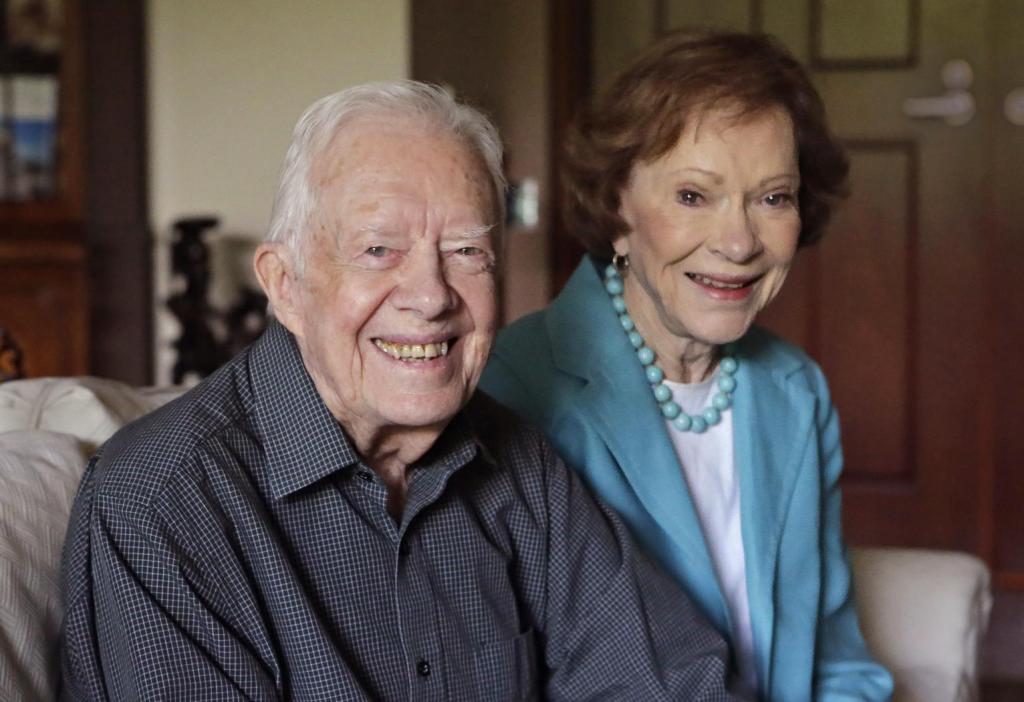
President James Earl “Jimmy” Carter, Jr. died today (December 29, 2024). He was the first of the modern presidents to run—and be elected—as an “outsider” (not part of the Washington, DC, political establishment, though he had served four years in the Georgia State Senate, and was governor of that state from 1971 to 1975). He defeated President Gerald Ford in the surprisingly close election of 1976 (after Ford’s pardon of President Richard Nixon, his defeat was all but assured). Carter was an engineer who tried to bring an engineer’s sensibilities to the Oval Office. Unfortunately for his presidency, that skill set could not overcome other external political factors, leading to his landslide defeat after only one term in the White House. His post-presidency, however, was far more impressive, and will leave a much stronger, more enduring legacy. From the Carter Center to his work with Habitat for Humanity, he was the ideal former president. The Carter Center, with its goal to advance human rights and alleviate human suffering, is best known for its international election monitoring, but also works to build democratic institutions, help mediate conflicts, advocate for human rights, and treat diseases.
As president, in 1978, Carter brokered the Camp David Peace Accords between Israel and Egypt, for which Israeli Prime Minister Menachem Begin and Egyptian President Anwar Sadat shared the Nobel Peace Prize. Carter’s own Nobel Prize was awarded in 2002, for his work “to find peaceful solutions to international conflicts, to advance democracy and human rights, and to promote economic and social development” through the Carter Center.
Carter was born in Plains, Georgia, on October 1, 1924. He graduated from the Naval Academy in 1946 (part of the accelerated class of 1947)—the only president to do so, although he was the fifth straight Navy veteran to serve as president. He met his future wife, Eleanor Rosalynn Smith, while he was a cadet. They married on July 7, 1946. Carter retired from active duty in 1953, to take over the family’s peanut farming business, though he was in the inactive Navy Reserve until 1961. He left the service with the rank of lieutenant.
After losing his re-election bid, Carter told the White House press corps he intended to emulate Harry Truman, and not use his presidential retirement to enrich himself. He continued to live in the same modest house in Plains, Georgia, until his death. During his retirement, he wrote more than 30 books, ranging from memoirs to children’s books.
Carter’s state funeral will be in Washington, DC, with details announced in the next few days. He will be buried at his home in Plains. Carter is survived by his four children, 11 grandchildren (one grandson pre-deceased him), and 14 great-grandchildren. His eldest son, Jack, lost the 2006 Senate race in Nevada. Jack’s son Jason served in the Georgia State Senate, and lost the 2014 race for Governor of Georgia.
Carter retired from the presidency on January 20, 1981, at the relatively young age of 56. He was younger than his two successors (Ronald Reagan was 13 years older than Carter; George H.W. Bush was born 111 days before Carter).
Carter had been the senior living president since Gerald Ford’s death December 26, 2006. That title now belongs to Bill Clinton, who was president from 1993 to 2001.
On September 7, 2012, Carter exceeded Herbert Hoover’s record as the longest-retired president: that mark now stands at 43 years 343 days. Clinton will surpass that record in 2042, at the age of 96.
On March 22, 2019, Carter surpassed George H.W. Bush’s mark as the longest-lived president (Bush had died 111 days earlier, at the age of 94 years 171 days). That record now stands at 100 years 89 days. The oldest living president is now Joe Biden, who was born on November 20, 1942. The longest-lived vice president, John Nance Garner (1933–41), died at the age of 98 years 350 days old on November 7, 1967.
Jimmy and Rosalynn Carter enjoyed the longest marriage of any presidential couple, from July 7, 1946, until her death on November 19, 2023: an astonishing 77 years 135 days. The previous record-holders, George H.W. and Barbara Bush, were married from January 6, 1945 until her death on April 17, 2018: 73 years 101 days. The current longest-married presidential couple are Bill and Hillary Clinton, who were married on October 11, 1975.
Following Carter’s death, there are now five living presidents: Bill Clinton (1993–2001), George W. Bush (2001–09), Barack Obama (2009–17), Donald Trump (2017–21), and Joe Biden (2021– ).
Which rabbit hole did I just get lost down? Well, it started with a reference to Alfred Ely Beach (1826-96) and his pneumatic subway line in New York City (1870-73). That lead to the song “Sub-Rosa Subway” (1976) by the group Klaatu. There was also a side trip to FDR’s secret train station under the Waldorf-Astoria, Track 61.
Beach’s pneumatic subway was just a demonstration model, which ran one block under Broadway, from Warren Street to Murray Street. For 25 cents, riders could take the trip forward and then back. Beach’s plan was eventually to stretch the line all the way up to Central Park, but political difficulties followed by financial difficulties killed the project in its infancy.
“Sub-Rosa Subway” tells the whole story of Beach’s attempt in a soft-rock format. A nice tune, a good song.
Track 61 was something I’d known about, a rail yard which was built as part of Grand Central Terminal (the big train station in Manhattan: I worked across the street from the main building the first three years I was at Asimov’s and Analog). Since Park Avenue and the buildings lining it north of Grand Central are all actually elevated, built over the many tracks that make up Grand Central, the Waldorf-Astoria Hotel just happened to be built over Track 61. There’s a small platform there, and an elevator traveling from the tracks into the hotel. It was used by (among others), President Franklin Roosevelt during World War II, as an unobtrusive way to leave his train and get to the streets of New York City.
Click the links up in the first paragraph to read a bit more. Fascinating history.
Today’s Tough Trivia question: Mint marks are small letters which denote which mint produced which coin, and today, in the United States, they appear near the date (though that was not always the case: some earlier coins had the mint marks on the opposite side of the coin from the date). Currently, there are four US mints producing and marking coins. Name them by their letter codes. Previously, there were five other US Mints marking coins. Can you name them?
***
Yesterday’s question was: Ignoring the conspiracy theorists and science deniers, we know that twelve people have so far walked on Earth’s Moon. How many of them can you name? (Bonus: which of the Apollo missions did not land on the Moon?)
The answer is:
Apollo 11 crew (left to right): Neil Armstrong, Michael Collins, and Buzz Aldrin.
Apollo 11, launched July 16 and returned July 24, 1969. Commander Neil Armstrong and Lunar Module Pilot Edwin “Buzz” Aldrin were on the Moon for 21 hours, 36 minutes, from July 20 to 21, while Command Module Pilot Michael Collins remained in lunar orbit.
Apollo 12, launched November 14 returned November 24, 1969. Commander Charles “Pete” Conrad and Lunar Module Pilot Alan Bean spent almost 32 hours on the Moon, from November 19 to 20, while Command Module Pilot Richard Gordon remained in lunar orbit.
Apollo 14, launched January 31 and returned February 9, 1971. Commander Alan Shepard and Lunar Module Pilot Edgar Mitchell spent 33 hours on the Moon, from February 5 to 6, while Command Module Pilot Stuart Roosa remained in lunar orbit.
Apollo 15, launched July 26 and returned August 7, 1971. On the first mission to use the lunar rover, Commander David Scott and Lunar Module Pilot James Irwin spent 67 hours on the Moon, from July 30 to August 2, while Command Module Pilot Alfred Worden remained in lunar orbit.
Apollo 16, launched April 16 and returned April 27, 1972. Commander John Young and Lunar Module Pilot Charles Duke spent 71 hours on the Moon, from April 21 to 24, while Command Module Pilot Stuart Roosa remained in lunar orbit.
Apollo 17, launched December 7 and returned December 19, 1972. Commander Eugene Cernan and Lunar Module Pilot Harrison Schmitt spent 75 hours on the Moon, from December 11 to 14, while Command Module Pilot Ronald Evans remained in lunar orbit.
Apollo 13 did not reach the Moon. Launched April 11, 1970, an explosion in one of the oxygen tanks on April 13 severely damaged the spacecraft and prevented it from landing on the Moon. Commander James Lovell, Lunar Module Pilot Fred Haise, and Command Module Pilot Jack Swigert returned safely on April 17, 1970.
***
Ian’s Tough Trivia is a daily feature of this blog. Each day, I post a tough question, as well as the answer to the previous day’s question. At some point, I’ll offer a prize for whoever has the most correct answers, and another for whoever participates most often (I’ll take into account people coming in after the start: regular participation starting later is just as good as regular participation starting earlier). There may also be a prize for the funniest or most amusing wrong answer. Simply comment on this post with your answer. I’ll approve the comments after the next question is posted. Sure, you can probably find the answers by searching the web, but what’s the fun in that?
Financial support in the form of tips is very much appreciated: paypal.me/ianrandalstrock

 Which rabbit hole did I just get lost down? Well, it started with a reference to
 Ian Randal Strock