I had an odd theatrical experience this past Tuesday. I went to a show, and while I’m still not sure if I liked it, I am still thinking about it, so in that respect, it was good.
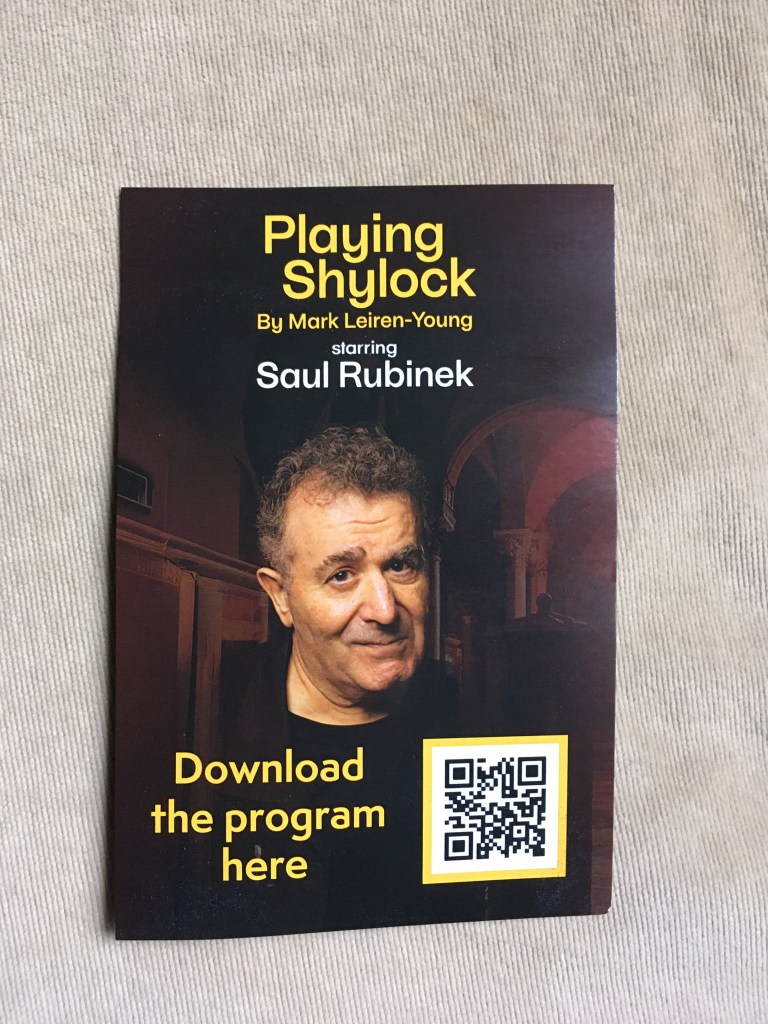
The show is Playing Shylock, starring Saul Rubinek (the original version was written by Mark Leiren-Young; this was apparently an updated, modified script). It was in the Polonsky Shakespeare Center, a little theatre in Brooklyn, and the show is closing tomorrow, so at this point, I can’t really urge you to see it yourself.
The conceit is that the audience is actually there to see a production of William Shakespeare’s The Merchant of Venice. [Aside: I’d never read the play before, though I knew bits of the story, so Monday night, I watched a film version from 2004.] A voice-over tells us the second act will be delayed due to technical difficulties, and eventually, Saul Rubinek comes on stage—in costume as Shylock—to tell the audience that they will not be performing the second half of the play, because the cast accidentally learned during this intermission that the theatre has cancelled the remainder of the run, making tonight’s performance the last.
What follows is a nearly two hour-long monologue/discussion of artistic freedom, antisemitism, and virtue signaling. But also, the concepts of freedom, security, and memory; the Jewish experience in surviving (or not) the Concentration Camps in Nazi Germany; and honoring our parents as we live the better lives they worked for us to have. Thrown in are digressions about the nature of representation, artistry and artistic credit, and the never-ending debate over who actually wrote the plays of William Shakespeare. As with all of the best questions, there were no hard-and-fast answers. It was all there to make us think.
Playing on nothing more than his own memories, the script, and the all-too-limited audience reactions, Rubinek is wonderfully emotive, and incredibly moving. And with such heavy concepts and weighty thoughts, there is just the right touch of levity to keep the show from being crushingly depressing… even though he and we know that the depression has a very strong foundation, and holding back the tide of the antisemitism, the repression, and the outright hatred may not be possible.
One of the unintended sources of discomfort, for me, was his interactions with the audience. I’ve been in theatres my whole life, sometimes on the stage, more often in the audience. And in all that time, I’ve learned that the audience’s role is to watch, but not to interact. (There is, of course, the allowed interaction during lectures, which are a different animal, perhaps because the “actor” is not playing some fictitious character, but is merely himself.) But in Playing Shylock, Rubinek is playing himself—or an alternate universe version of himself—in which he is still in costume from the interrupted performance of The Merchant of Venice, except that there was no actual interrupted performance of the play, so is he actually just Saul Rubinek, or is he a fictitious Saul Rubinek? At any rate, several times he asked the audience for commentary, for responses, and I truly didn’t know if I was supposed to supply the other side of that conversation, or if those were rhetorical questions, part of the script. I suppose that added discomfort may actually have been intended, to show that the comfortable world we hope we live in is not really so scripted and easy.
Yes, I guess I did like it. Not in the “that was a lot of fun; I want to do it again” way of liking something, but in the “that made me think” way. Yes, it was an evening well spent. Bravo, Saul Rubinek, and playwright Mark Leiren-Young.
 Ian Randal Strock