Don’t like Congress? Your opinion doesn’t matter.

RealClear Polling doesn’t show a Congressional approval rating above 40% in the last 15 years. In the short term, Ballotopedia agrees. Gallup has Congress’s job approval rating in the teens.

In other words, everywhere we look, nobody likes what Congress is doing or how they’re doing their jobs. Every news story using those numbers predicts a massive change in Congress at the midterm election, shifting control to the Democratic party, and watchers hope they’re right.

But what none of those polls and none of those pundits are doing is looking at four hundred and thirty-five individual campaigns for four hundred and thirty-five individual seats in the House of Representatives.

And that’s why I think a lot of people looking forward to that massive change are going to be very disappointed next January 3, when the 120th Congress is seated. It’s very difficult to do legitimate polling on such a granular level, but the way our government is put together, combining the results of such tiny polling samples is the only way to get a legitimate estimation of what is going to happen. Because while the sentiments of 55%, or 60%, or 70% of the voting public in the US may be with the Democrats, that doesn’t matter. What matters is which candidate gets the greater number of votes in the California 41st, and the Texas 32nd, and the Florida 9th, and the New York 15th, and on and on and on. Each district, by itself, in an election of several hundred thousand people, upon which the opinions of 99.8% of the population matters not one whit.

Congressional approval ratings are always low. People never like what Congress—as a whole—is doing, or its direction. If that were the only thing that mattered, we’d see a tidal wave of electoral defeats among Representatives every two years. But we don’t. We don’t see that tidal wave, and we won’t as long as we have a body made up of representatives by geography who have chosen the boundary lines of their own districts in order to guarantee their re-election. And we, the voters, always vote to re-elect our own Congressional representatives.

As Ballotopedia told us, in the election of 2024, fifteen Representatives running for re-election were defeated in primary or general elections. Further, they say, since 2014 (six elections), a total of 125 House incumbents were defeated: an average of 21 per election (remember, out of 435 seats).

That’s the reason we keep getting the same non-functional Congress we all hate not doing what we want: because we only vote for our own representative. It doesn’t matter what I think of the Speaker—who lives in Louisiana. And it doesn’t matter what I think of the minority leader—who lives in the next district over from mine in Brooklyn. Neither does my opinion of any of the 432 other members of the House matter. I only have a say in who will represent New York’s 9th district. And the two major political parties have done such an excellent job of choosing their voters through political gerrymandering that almost none of the 435 districts have any chance of changing the party of the person who represents them.

A year ago—in April of 2025—Fair Vote said that 81% of the House seats were already decided… for the 2026 election! And this is not surprising or new. It’s been going on for decades.

So when everyone around me expresses optimism for change following the election of 2026, I’m the Eeyore. I’m the one who is not looking forward to the results, because I don’t expect very much, if anything, to change. Unite America claimed that only 69 of the seats were competitive elections in 2024. We’ve seen absolutely no reason to think it will be any different this time around.
https://www.uniteamerica.org/articles/research-brief-why-are-most-congressional-elections-uncompetitive-2

And this is one of those times that I don’t have a solution to propose. We’re stuck. We’ve let the parties gerrymander the country too damn far, and we can’t find a way out of it. So as much as I hate that Congress has abdicated its responsibilities; as much as I hate that Congress—even if its members wanted to—can’t do anything it should; as much as I hate the political gridlock caused by extreme politicians who only campaign in the primaries because they don’t have to compete in a general election… I fear we’re stuck with it all until we can find a way to tear down walls of power that the Democans and Republicrats have built for themselves.

Put simply: we’re screwed.

Donald Trump is Congress’ Fault

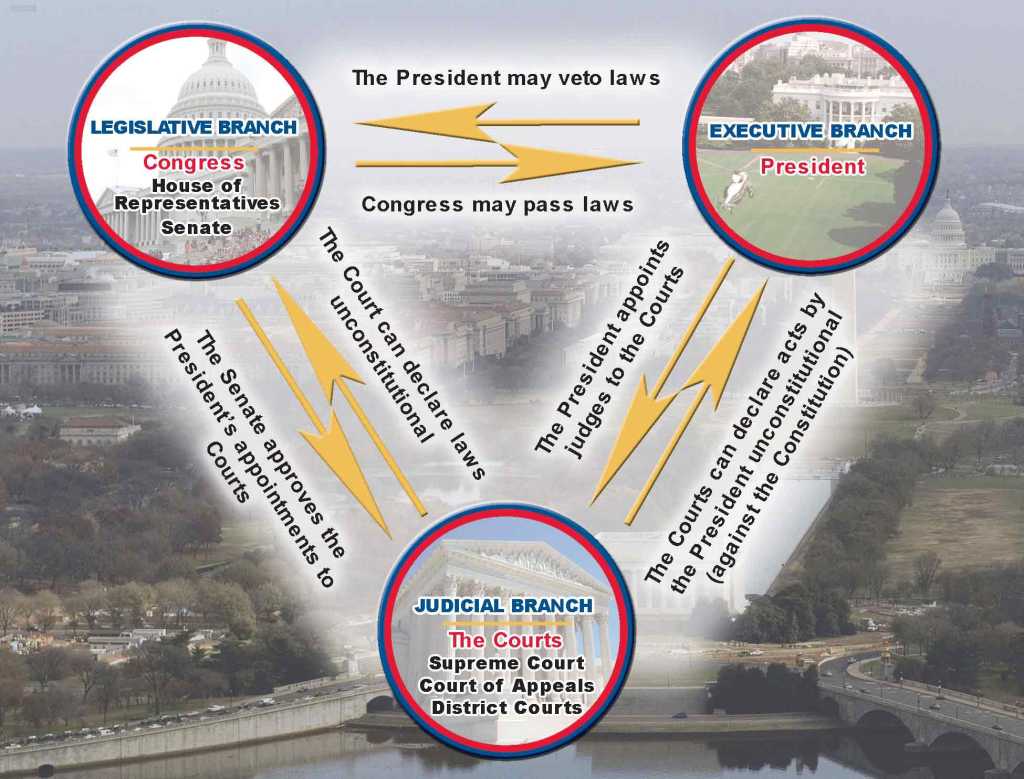
As angry as I am with many of President Trump’s statements and actions—some of which are immoral and unworthy of the presidency, and some of which are demonstrably criminal—my ire today is reserved for Congress and the Supreme Court. Part of the genius of our Constitution is that it organized a government that is not dictated solely by one person or one body, but rather has three co-equal branches, each of which has certain powers over the other two, and other responsibilities to the other two. As we learned in elementary school: the Legislative branch (Congress) makes the laws, the Executive branch (the President and his departments) enforces the laws, and the Judicial branch (the Supreme Court) interprets the laws (tells us what they mean, and if they are in keeping with the Constitution).

The President appoints the members of the Supreme Court, but the Senate has to agree. The President spends the money, but only according to the budget that Congress creates. Congress writes the laws that the President can veto or accept, but the Supreme Court can say “no, that law is not Constitutional.” Congress can remove the President and the members of the Supreme Court for “high crimes and misdemeanors.”

According to Article I of the Constitution, Section 8, the powers of Congress include the power to lay and collect taxes, duties, imposts and excises; to regulate commerce with foreign nations; to declare war; “to provide for calling forth the Militia to execute the Laws of the Union, suppress Insurrections and repel Invasions”; and a slew of others.

Article II, Section 2, lists the powers of the President, including serving as the Commander in Chief of the Army, Navy, and Militia, “when called into the actual Service of the United States”; making treaties, appointing ambassadors, Supreme Court judges, “and all other Officers of the United States,” all “by and with the Advice and Consent of the Senate”; and other things.

Article III vests “the judicial Power of the United States” in the Supreme Court and other inferior courts. Section 3, interestingly reads “Treason against the United States, shall consist only in levying War against them, or in adhering to their Enemies, giving them Aid and Comfort.”

This system of checks and balances among the three co-equal sections of the United States government worked pretty well for a long time. The relative power of the executive and legislative branches waxed and waned over the decades, but all three branches maintained their shared powers through the strength of their leaders over the years. Congressional leaders have worked with and against presidents, the Supreme Court has allowed and denied laws over the years, but always, the holders of those offices upheld the power of their position, the importance of their branch, and kept the tripod standing.

Lately, the tripod has collapsed, because two of those legs have been allowed to weaken before the onslaught of the third. Obviously, this collapse has been going on for longer than just the last decade, but no one looking at Ronald Reagan’s relationship with Tip O’Neill ever thought either one of them was subservient to the other. Since that time, however, we’ve been stuck with a series of ideologues who realized that the way to enforce their partisan will long beyond their service would be to enable a collapse of the system of checks and balances. Thus, Mitch McConnell’s lies and machinations have unbalanced the Supreme Court: in early 2016, he told us the Senate could not appoint a new Supreme Court justice during an election year, and kept Antonin Scalia’s seat vacant for 11 months, until Donald Trump’s election. Four years later, McConnell told us to ignore his four-year-old words, and that the Senate had to fill a vacant Supreme Court seat when Ruth Bader Ginsburg died a month and a half before the election of 2020. That’s the same Mitch McConnell who, on January 6, 2021, called Donald Trump “practically and morally responsible” for the attack on the Capitol, but then voted to acquit Trump of those charges at his second impeachment. McConnell is no longer the leader of the Senate, but his successor, John Thune, has not shown himself to be any more of a leader. His every utterance proclaims his subservience to the office of the President.

Chief Justice John Roberts has used his ideological majority of the Court to grant the president nearly complete immunity for anything he may do during his term of office, since the president in question supports his views. He also can’t imagine any of our recent or potential presidents hailing from the Democratic party ever running so far beyond the pale as Donald Trump has, so he’s not worried about karma coming back.

And now we have the Speaker of the House, Mike Johnson, who has completely subsumed his authority to Donald Trump’s will. He has decided the House shouldn’t actually be conducting any business, because the president is happier to have the government shut down, so he can rampage however he wants.

The Supreme Court, unfortunately, is beyond our power to correct in the near term. The way the Justices are chosen requires waiting for those currently in office to leave in order to replace them. And let’s face it, there doesn’t appear to be anyone even on the horizon with the strength of John Marshall or the moral fiber of David Davis.

The make-up Congress, however, is—at least, theoretically (but see my several previous pieces on Gerrymandering)—something we can affect. I say it is time to elect Senators and Representatives who will stand up, not necessarily for me and my views, but for the strength of the Congress. Congress needs to restore itself to its role as a co-equal branch of the government.

Far too often, among the Republicans and Trumpians in the Congress, we see people who are far more interested in doing what Trump wants so that he won’t attack them. Can they possibly be proud of their service? Or are they merely keeping their seats warm? Liz Cheney stood up for right over party, and was punished for it by losing her seat. But as much as I disagree with many of her views, she earned my respect. The problem was, she was one voice in a vast sea of the voiceless, and thus, easy to target. The other members of Congress need to find their voices, to stand up, not to keep knuckling under.

I may not have agreed with their policies or their actions, but did anyone ever doubt the Congressional allegiance, the strength, the patriotism, of prior Senate Majority Leaders such as Robert Byrd, Mike Mansfield, Everett Dirksen, Lyndon Baines Johnson, or Henry Cabot Lodge? Similarly, will the House of Representatives ever feel the need to remember the service of Mike Johnson as it does Tip O’Neill, Carl Albert, Sam Rayburn, or Nicholas Longworth?

Donald Trump has gone off the rails. He cares nothing for the Constitution, law, or tradition, and is interested only in lining his own pockets and glorifying his own name. But if the rest of the government was functioning as it should, the damage Trump could inflict would be minimized. But with the Supreme Court saying only “Yes, sir,” while Congress’s leaders say “We’ll do whatever Trump wants,” our government, our nation, is in danger.

And yes, I know I’ve not mentioned the Democratic leaders. Chuck Schumer and Hakeem Jeffries, too, are falling down on their jobs. They’re doing what they can in their minorities, but it sure feels like they could be doing, could be saying, more. And their younger colleagues, the flaming liberal branch of the party who don’t recognize that good government is negotiation, compromise, and not getting everything? They, too, are not doing us any favors.

Term limits are not, and never have been, the answer. But whether you vote Republican or Democratic, I urge you—in the strongest terms possible—to vote for someone who wants to serve in Congress, not someone who wants only to kowtow to or attack the president.

Young Adults are Not Happy

I find it ironic that two of the news channels both quoted the same Harvard Youth Poll, which was taken by the Institute of Politics at the Harvard Kennedy School (see it here: https://iop.harvard.edu/youth-poll/50th-edition-spring-2025), this afternoon. On CNN, they touted the finding that—among young adults—President Trump’s approval rating is 31%. On Fox, they touted the finding that—among young adults—the approval rating of Democrats in Congress is 23%. Neither one (at least, while I was watching) mentioned the approval rating of Republicans in Congress (for the record: 29%).

A little more color on those numbers. Previous iterations of the poll were run in Spring 2017 and Fall 2020. Those numbers (in order) were:
Trump: 32%, 29%, 31%. So he’s been remarkably steady, and the only one to improve since the previous poll.
Republicans: 28%, 31%, 29%. Again, steady.
Democrats: 42%, 48%, 23%. The biggest drop of the three. They should be embarrassed.

Both used the poll to show that those on the other side of the political aisle are in trouble, by quoting one or two specific numbers. But hearing them both within minutes of each other made me wonder: just what do those young people approve of? So I went dug out the poll itself. The answer, at least among the top ten issues this report is talking about, is “not much.” This group of young people is not happy with pretty much anything having to do with the government, world, or social issues.

They have very little sense of community, almost none of them think the country is heading in the right direction, their life goals are not the same as their forebears’, and very few of them trust the federal government to do the right thing.

Both CNN and Fox used the survey to make political hay, though only briefly and in passing. But neither, it seems, took the time to realize the survey says something far more important: it doesn’t matter which political party you support, your party is not doing a good job of serving the people, and the next generation is noticing. Bloviating and blaming the other side is easy, but it’s not enthusing anyone who isn’t already a dyed-in-the-wool supporter of the bloviators and the blamers.

Why don’t they listen during Congressional “hearings”?

The news programs keep showing clips from Congressional committee “hearings.” I keep watching them. And I keep wondering: when last did a Congressperson sitting on one of those committees ask a question of a witness to which the Congressperson did not know the answer? And when last did a committee, holding one of those hearings, learn something new that informed their decisions on pending legislation?

It may be that the media only show those clips they deem “entertaining” enough, rather than all the business, and that indeed there is some information exchange in these hearings. But it sure seems as if the only reason they hold these hearings is so that the Congressfolk can pontificate, can act outraged, can make speeches that can then be excerpted into television commercials in their never-ending quest to be re-elected. Today, it was Bernie Sanders yelling at the CEO of Starbucks. Yesterday, it was a Ted Cruz calling the Secretary of Homeland Security a liar.

When I sit on a board of directors, when I listen to the debate on the motions before we vote, I actually listen, to learn my fellow directors’ opinions, and sometimes to help me decide which course of action is best for the organization. I don’t go in to every meeting with my mind made up, looking only to score points. But then perhaps that’s the reason I’m not in Congress.

I’m embarrassed by MTG, and I don’t even live in her district

Listening to the latest proof that Marjorie Taylor Greene is unfit for office, I’m also hearing half of Congress being upset, and all sorts of pundits opining on her. But the one thing I’m not hearing—the thing I want to hear—is the reaction of the people in Georgia’s 14th Congressional district. Those 732,000 people are the ones who gave her this seat in Congress (229,000 of them actually voted for her). Does she speak for them? Is she representing their views when she says these ignorant, inflammatory things? Should I be fearful if I have to travel to that district in northwest Georgia?

We can be outraged all we want, we can call on the other members of the House of Representatives to “do something.” But if she really is representing the views of her constituents, we don’t need to silence her: we need to send educators to that district. We need to teach away the ignorance and stupidity, because she’s just a symptom.

And if her words do not represent the opinions of her constituents, well, what the heck are they doing? If it was my Representative spouting such nonsense, I’d be sitting in her office, demanding that she justify her very existence, and making sure the world knew she didn’t speak for me.