It’s another science fiction convention weekend, this time with an over-stuffed Saturday! This weekend, I’ll be at the Doubletree in Cherry Hill, New Jersey, for Philcon.
As always, you can find me in the Dealers’ Room, open Friday, 4:00–7:00 pm; Saturday 10:00 am–6:00 pm; and Sunday 10:00 am–3:00 pm.
You can also find me on programming:
Saturday at 12:00N in Plaza 3: “Meet More Editors!” with Danielle Ackley-McPhail, Michael D. Pederson, Alex Shvartsman, and Ann Stolinsky
Saturday at 3:00PM in Plaza 4: “How Do I Get Publishers to Notice Me?” with Aaron Rosenberg, Neil Clarke, and Michael A. Ventrella
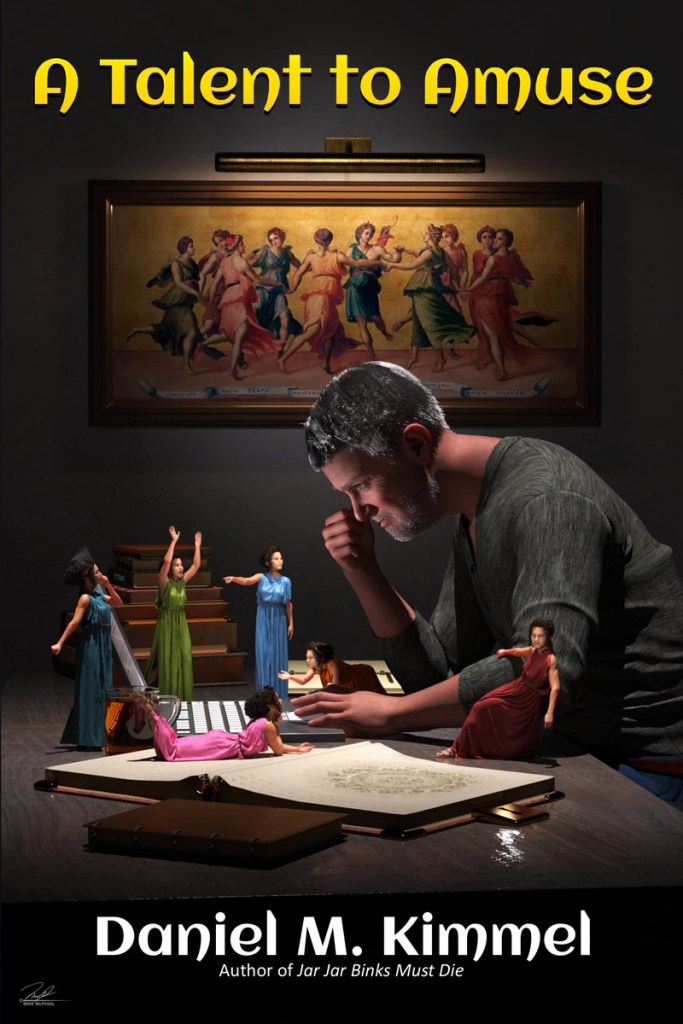
Saturday from 6:00 pm to 7:30 pm in the Con Suite: book launch party for Daniel M. Kimmel’s A Talent to Amuse, as well as Dragonwell Publishing’s new book by Bernie Mojzes.
Saturday at 8:00PM in the Grand Ballroom: I’ll be emceeing the Masquerade.
Sunday at 11:00AM in Plaza 3: “Assembling an Anthology” with Danielle Ackley-McPhail, Neil Clarke, Alex Shvartsman, and Michael A. Ventrella
If you read that schedule closely, you’ll notice I have to be in the dealers’ room and the con suite and the masquerade Saturday afternoon/evening, probably all three at the same time, so I don’t really know where I’ll be: setting up for the launch party in the con suite before 6:00; closing the table in the dealers’ room at 6:00; and preparing for the masquerade before 8:00. You, however, as an attendee, will be able to do all three with no overlap.
Dan’s book, A Talent to Amuse, is a wonderful romantasy. In it, a professional writer is looking for the inspiration to take his writing to the next level. He meets an out-of-work Muse, who is looking for some inspiration of her own. And together, they may find something even more.
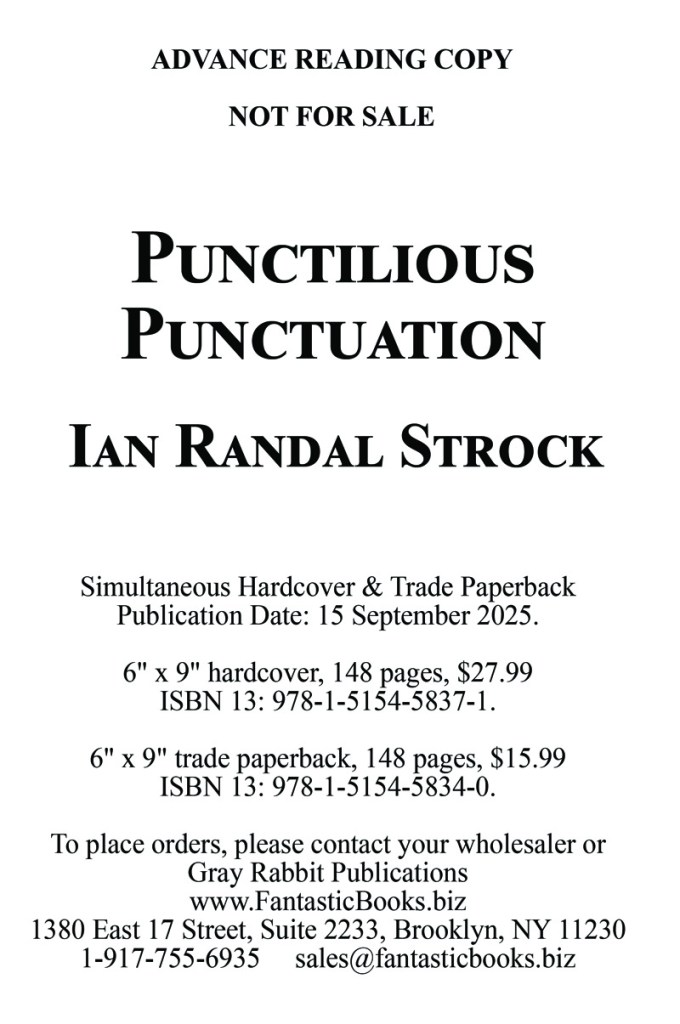
I’m told today is… wait for it… National Punctuation Day! I had no idea — when I published Punctilious Punctuation — that such a day even existed on the calendar; now I’m ashamed that I didn’t, or that I didn’t tie last week’s publication day to today’s celebration. Nevertheless, if you (like I) love punctuation, then you know that it shouldn’t be one scant day out of 365, but *every* day that we use punctuation, use it well, use it properly.
The book, by the way, was very well received this past weekend at Capclave. I am gratified and humbled by the response. Thank you all!
I’ve had several people ask how they should purchase my new book, which way is best for me, and I’m extremely gratified by those questions. While this question is easily extrapolated to just about any author, the answer is “it depends.” There are several answers.
What my friends and family think they’re asking is “where should I buy your book so that the most money winds up in your pocket?” And that’s a very kind question to ask. The simple answer is: “buy it directly from me, when you see me in person.” But while that method does indeed put the most money in my pocket, it works out to only two or three dollars (maybe as many as five) more than I’d earn from a sale some other way. In my particular case, with this specific book, it’s been published by one of the imprints of the independent publishing company I own. My company pays authors fifty percent of the net the company takes in on each sale. So if you buy the book from me as the publisher at a convention, it’ll be almost as much money in my pocket. That’s because neither of those sales has to give a cut to the distributor or to some other retailer.
But there are other answers to the question, other considerations.
My publishing company is an independent. While physical bookstores can order our books from our distributor, those bookstores don’t stock our books, because we don’t offer a large enough discount or the 100% returnability they require (those are topics for another essay). So the bulk of our bookstore sales come from the online retailers, of which the largest—by far—is Amazon. If you buy my book from Amazon, that helps the Amazon Sales Rank move up. And while one sale isn’t going to affect that number much, several dozen copies, a few hundred, if all made the same day or week, will indeed affect that number. And books with better Sales Ranks will be shown to more people on Amazon, hopefully leading to even more sales. So buying on Amazon, while resulting in less money in my pocket for that one book, may eventually result in many more sales.
But as important as that Sales Rank is, it’s fleeting, temporary. The number may be great this week, but if no new copies are sold next week, the number will plummet as other books are published and rise up the ranks. What has a longer-lasting effect is reviews. Reviews don’t have to be complex—you don’t have to write a four-page essay comparing and contrasting my book to, well, anything. Even just a few words is sufficient for the algorithms, because they’re focused on the number of reviews, and the average ranking of the book from the “rank this book on a scale of 1 to 5.” If you can spend just a few minutes to write a few nice words about the book, in the long run, that may wind up being the most valuable.
And that’s not unique to Amazon. Reviews on GoodReads or LibraryThing are equally important. Indeed, any sort of word of mouth (telling your friends and neighbors) is also great.
But all of that is still assuming the book in question has been published by a small press like mine, or self-published by the author. If, however, your friend has had the fortune to have the book published by one of the large publishing firms (like my first three books), the answer will again be different.
If the book has been published by a big publisher, one of the “big five” or “legacy” firms—or even a smaller traditional publisher that still has standard physical bookstore distribution—the best way to buy the book is at that brick-and-mortar bookstore. Those sales are the most likely to be counted and reported, and when the author has another book to submit to publishers, they’re going to be looking at those sales numbers to justify (or not) buying and publishing that next book. Incidentally, that points to another big difference between those large publishers and mine: if your book doesn’t sell five thousand or ten thousand copies, that large publisher is unlikely to offer a contract for the new book. On the other hand, if my company published that book, and it sells a scant one thousand copies, it’s still done a great job for my company, and I’ll be happy to publish the next.
So, back to the original question: my friends asking where/how they should buy my book. At this point, I’m still hopeful for a bit of a break-out, still hopeful to make at least a little splash in the bigger world of Amazon sales, so I’m directing my friends and family there (even though Amazon has done so much to kill publishing), foregoing the few extra dollars now in hopes of more sales a little later. That said, I’m thrilled with every single sale, and I’ll be selling copies at Capclave this weekend, HalloWeeM at the end of October, and nearly everywhere you can find me. On behalf of myself and all the other authors being asked, the greatest thing you can do is tell us you’re interested in our books, and then show us. Happy reading!

Fantastic Books is thrilled to be publishing a major new fantasy novel by first-time novelist Ron Kaiser, who Paul Witcover calls “a bold new voice in epic fantasy.” Mystralhaven is the tale of Baz, the Mossbringer, who may be able to save humanity, if only she can figure out her own powers before she is enslaved or killed.
Sebsastien de Castell (author of the Greatcoats and Spellsinger series) says the book blends “classic epic fantasy adventure with modern themes,” and that it “is a fast-paced, emotionally charged tale of magic, duty and the complex nature of heroism. Ron Kaiser’s fearless protagonist discovers not only the burden of destiny but the difficult balance between fighting exploitation and believing in redemption.”
Can she figure out what she is in time to save humanity?
The coming of Baz, the Mossbringer, has been foretold: she has powers far beyond those of even the most gifted around her. And had her mother lived, she certainly would have been able to guide Baz through her dawning awareness of her abilities.
But even if Baz learns how to control and use those powers, it may not be enough to save the monks who want to use her, the Borderforges who want to enslave her, or the people who fear her. Can she trust Rendwyll—who is more sand than person—to guide her into her new awareness? With the fate of the world hanging in the balance, can she afford not to?
“This thrilling hero’s quest is a pulse-pounding journey. Ron Kaiser’s epic novel had me thoroughly gripped, from start to finish.” —David Yoo, author of The Choke Artist and The Detention Club
“Artful prose, strong characterization and a freewheeling imagination lights up this fascinating tale. This one is in the top echelon of modern fantasy.” —Bram Stoker Award-winner John Shirley, author of A Sorcerer of Atlantis
It started—as the biggest arguments do—over the smallest of things: the placement of a comma. That turned into an anecdote, and thence into a speech. And now author, editor, and punctuation lover Ian Randal Strock has turned it into a book. Punctilious Punctuation allows each and every one of those little spots and squiggles on the page to shine, with its own chapter covering the history, usage, misusage, and ancillary information of the punctuation marks. Punctuated with stories and anecdotes on the huge impact those tiny marks can have (the $5 million lawsuit, the Russian revolution, and more), Punctilious Punctuation is fully researched, footnoted, illustrated, and—of course—punctuated.
Ian Randal Strock’s three books on presidential history and trivia were published by Random House and Carrel Books. His award-winning science fiction has appeared in Analog, Nature, Amazing, and several anthologies, and some of it has recently been collected in Wandering Through Time. He has presented talks on punctuation, the presidents, and a variety of other topics to Mensa, writers’ groups, science fiction societies, the 99s, university classes, and more. He is the recipient of the 2025 Edward E. Smith Memorial “Skylark” Award, and firmly believes in the utility and necessity of the serial comma.
Punctilious Punctuation: Telling tales with (and of) those jots and tittles, including why they’re called jots and tittles, and the horrifying story of why the period goes inside the quotation marks by Ian Randal Strock 148 pages, fully illustrated September 15, 2025 Trade Paperback: ISBN: 978-1-5154-5834-0, $15.99 Case Laminate (library binding): ISBN: 978-1-5154-5837-1, $27.99
Punctilious Punctuation—and all Gray Rabbit Publications books—are distributed via Ingram. Review copies are available upon request.
And the request: where do you find reviews of such non-fiction titles that you appreciate? In the realm of science fiction, I know where to send galleys, but I’m trying to improve my game in non-fiction. Thanks!
Next weekend (not this weekend), May 23–26, I’ll be at Balticon in Baltimore’s Inner Harbor. As usual, I’ll be spending a lot of time in the dealers’ room (specifically: Friday 2–7pm, Saturday and Sunday 10am–7pm, and Monday 10am–2pm). But this year, I have a serious request: I’m currently experiencing a severe case of tendinitis (my doctor called me an over-achiever: I’ve got tennis elbow AND golfer’s elbow, simultaneously, in my left arm [the last round of golf I played was three years ago, and I haven’t played tennis in more than a decade]). As a result, I’m going to have trouble lifting the boxes of books, so if I can find a willing volunteer or two to help me unload the car and get the stuff to the dealers’ room on Friday, and/or to truck it back to and reload the car on Monday, I’d be grateful. Thank you.
And if you’re looking for me on panels, seek me out:
Friday at 8:30pm in Mount Washington: “When Writing Advice is Rong” with Scott H. Andrews, Joshua Bilmes, Dan Jolley, and Mark Painter.
Saturday at 11:30am in Gibson: “Traditional Publishing Scares Me: How to Traditionally Publish Your Book” with Joshua Bilmes, Silvia Moreno-Garcia, Sydney Olivia, and Brie Tart.
Sunday at 10:00am in Federal Hill: “Ducks and How to Make Them Pay” with Martin Berman-Gorvine, Flappy, Kelly Pierce, and Naomi S.
Sunday at 2:30pm in Mount Washington: “Jews In Space: Jewish SF On and Off The Page” with Martin Berman-Gorvine, Randee Dawn, and Alex Shvartsman.
Sunday at 8:30pm in Mount Washington: “Eye of Argon Reading” with A.L. Kaplan, Mary G. Thompson, and Jean Marie Ward.
Monday at 11:30am in St. George: “Short Fire Readings” with Scott Edelman, Miguel O. Mitchell, Mark Painter, and Andrija “Andy” Popovic.
Outsiders. Rebels. Free-Thinkers. Who doesn’t love an underdog? Deep inside, most of us identify with those who are a little—or a lot—different. Those who choose their own path, or for whom fate chooses for them. Sometime in our lives, we’ve felt like we didn’t quite fit in.
This doesn’t have to be a bad thing.
Forging your own way builds strength, and makes for a damn good story!
Our authors have taken the outcasts and woven masterful tales of triumph despite adversity. In these times of turmoil, we all need a reminder that such difficulties can be overcome. Check out the Outcasts bundle, which I hope you will enjoy as much as I have. At the least you will get three amazing books for a steal, Amaskan’s Blood by Raven Oak, The Favored by Morgan Bolt, and Three Chords of Chaos by James Chambers. At most, you’ll score not just the three base books plus eleven bonus titles, but two bonus-bonus books thanks to Alma Alexander’s radically awesome reenvisioning of shapeshifters and her generous inclusion of her Were Chronicles Omnibus, which includes the full trilogy Random, Wolf, and Shifter
The Outcasts bundle runs for three weeks only. This is a great deal, and a great way to pick up a batch of books for those times that you need an escape from real-world issues—or just feel the urge to root for your new favorite underdogs! —Danielle Ackley-McPhail, Curator
For StoryBundle, you decide what price you want to pay. For $5 (or more, if you’re feeling generous), you’ll get the basic bundle of three books in .epub format—WORLDWIDE.
AMASKAN’S BLOOD by Raven Oak
THE FAVORED by Morgan J. Bolt
THREE CHORDS OF CHAOS by James Chambers
If you pay at least the bonus price of just $20, you get all three of the regular books, plus 11 more books, for a total of 14!
SKYFARER by Joseph Brassey
FOR THE GOOD OF THE REALM by Nancy Jane Moore
WARDEN FALL by Jennifer M. Eaton
FRANKENSTEIN: MONSTERS OF THE ABYSS by John L. French and Patrick Thomas
PHOENIX PRECINCT by Keith R.A. DeCandido
YETI LEFT HOME by Aaron Rosenberg
ETERNAL WANDERINGS by Danielle Ackley-McPhail
ESPRIT DE CORPSE by Ef Deal
RAGS by Ty Drago
THE SILVER SHIP AND THE SEA by Brenda Cooper
THE WERE CHRONICLES by Alma Alexander
This bundle is available only for a limited time via http://www.storybundle.com. It allows easy reading on computers, smartphones, and tablets as well as Kindle and other ereaders via file transfer, email, and other methods. You get a DRM-free .epub for all books!
It’s also super easy to give the gift of reading with StoryBundle, thanks to our gift cards—which allow you to send someone a code that they can redeem for any future StoryBundle bundle—and timed delivery, which allows you to control exactly when your recipient will get the gift of StoryBundle.
Why StoryBundle? Here are just a few benefits StoryBundle provides.
Get quality reads: We’ve chosen works from excellent authors to bundle together in one convenient package.
Pay what you want (minimum $5): You decide how much these fantastic books are worth. If you can only spare a little, that’s fine! You’ll still get access to a batch of exceptional titles.
Support authors who support DRM-free books: StoryBundle is a platform for authors to get exposure for their works, both for the titles featured in the bundle and for the rest of their catalog. Supporting authors who let you read their books on any device you want—restriction free—will show everyone there’s nothing wrong with ditching DRM.
Give to worthy causes: Bundle buyers have a chance to donate a portion of their proceeds to Girls Write Now!
Receive extra books: If you beat the bonus price, you’ll get the bonus books!
During the awards ceremony at this weekend’s annual Boskone science fiction convention, the members of the New England Science Fiction Association (NESFA) awarded their annual Edward E. Smith Memorial “Skylark” Award to Ian Randal Strock.
The Skylark is presented annually by NESFA “to some person, who, in the opinion of the membership, has contributed significantly to science fiction, both through work in the field and by exemplifying the personal qualities which made the late ‘Doc’ Smith well-loved by those who knew him.” (For the full definition, see below.)
The award citation reads:
This year’s Skylark winner is the editor and publisher of Fantastic Books, but he’s much more than that. He’s worked at Asimov’s and Analog and (the now defunct) Artemis magazines. At Fantastic Books, he’s not only published original works (such as the Hugo finalist Jar Jar Binks Must Die), but also kept in print works by authors as diverse as Shariann Lewitt, Walter Hunt, and Allen Steele. He is one of the nicest people in SF (and Mensa, too). We are pleased to present this year’s Skylark Award to Ian Randal Strock.
Also known as a public speaker, Strock gives talks on presidential history, publishing and writing, punctuation, and more. But in the moment, standing on that stage receiving the award, he had no coherent thoughts. “It was my worst performance on the stage ever,” he said. “I think I said ‘thank you,’ but I’m quite certain I could not come up with anything more insightful or erudite.” A few days later, he was finally able to gather his thoughts, commenting “To say the award was unexpected would be to say that I believed I might one day be nominated for it. I never even imagined I would be considered for the Skylark. I am humbled by this award, and by the awe-inspiring list of prior recipients. I will try to live up to their illustrious examples. Thank you, NESFA.”
The Skylark is defined in NESFA’s bylaws: The Edward E. Smith Memorial Award for Imaginative Fiction, or “Skylark,” shall be presented from time to time by NESFA to some person who, in the opinion of the Membership, has contributed significantly to science fiction, both through work in the field and by exemplifying the personal qualities which made the late “Doc” Smith well-loved by those who knew him. Doc was so well thought of that he was invited to be Guest of Honor at the Second World Science Fiction Convention in Chicago, 1940 (Chicon I). Only two years before his death, Doc was given the First Fandom Hall of Fame Award at the Twenty-First World Science Fiction Convention in Washington, 1963 (Discon I). Doc Smith attended many conventions and participated in them as a pro and as a fan. He was one of the earliest enthusiasts in what are now called hall costumes and often dressed as characters from his stories—the good guys, of course. Smith was one of the old breed of SF writers who did not distinguish between pro and fan. He talked on panels; he talked informally; he never thought himself too important. He was, in a word, a mensch. It is fitting that this convention’s name was, is, and always will be Boskone and that the Skylark Award was, is, and always will be given out to someone who exemplifies Doc’s qualities both as a professional contributor to the field and as a human being.
I’ve just learned of the death of Thomas King, Jr., who wrote as several dozen books as T. Jackson King, on December 3, at the age of 76. In his last post on Facebook, dated November 24, he wrote:
Sorry for the delay on AI SURVIVAL [his planned next novel]. 2024 has been traumatic for me. Wife divorced me. Coping with Diabetes and Asthma. Now diagnosed with Congestive Heart Failure! Still hanging in there. Planning to write on the novel come Jan. 1, 2025. Thanks for being loyal readers! Tom. FYI, Readers can contact me via email. Or visit my Facebook page for T. Jackson King. Tom.
His YA novel, Little Brother’s World, was one of the first original books I accepted for Fantastic Books. In 2014, we launched his novel The Memory Singer at Balticon, which is when I met him in real life (whence the attached picture; apparently I didn’t get a picture of the two of us together). I think that convention was the only time we were physically in the same space together, but he seemed to relish life, taking great joy from whatever he was doing. And his tales of his life beyond the walls of the convention hotel seemed to reflect that, too.
He was much more than just a science fiction writer, but it’s probably easiest to let him tell that story (this is his biography from his web site, https://www.tjacksonking.com/):
T. Jackson King (Tom) is a professional archaeologist and journalist. He writes hard science fiction, anthropological sci-fi, dark fantasy/horror and contemporary fantasy/magic realism—but that didn’t happen until he was 38.
Before then, college years spent in Paris and in Tokyo led Tom into antiwar activism, hanging out with some Japanese hippies and learning how often governments lie to their citizens. The latter lesson led him and a college buddy to publish the Shinjuku Sutra English language underground tabloid in Japan in 1967. That was followed by helping shut down the University of Tennessee at Knoxville campus in 1968 and a bus trip to Washington, D.C., for the Second March on Washington where thousands demanded an end to the Vietnam War.
Temporary sanity returned when Tom worked in a radiocarbon lab at UC Riverside and earned an MA degree in Archaeology from UCLA. His interests in ancient history, ancient cultures and journalism got him several government agency jobs that paid the bills, led him to roam the raw landscape of the Western United States, and helped him and his wife Leslee raise three kids.
A funny thing happened on the way to normality. By the time he was 38 and doing federal arky work in Colorado, Tom’s first novel Star Traders was a stage play in his head that wouldn’t go away. So he wrote it down. It got rejected. His next novel was published as Retread Shop (Warner Books, 1988). It was off to the writing races and Tom’s many voyages of imaginative discovery have led to 24 published novels, a book of poetry, and a conviction that when Humans reach the stars, we will find them crowded with space-going Aliens. We will be the New Kids On The Block! This theme appears in much of Tom’s short fiction and novel writing.
Tom lives in Santa Fe, New Mexico, USA and hangs with a group of smart and tolerant Westerners. Divorce has taught him to smile a lot and to work at being a Nice Guy. Still, he is pretty weird. Has been since fourth grade when he began reading sci-fi. Since then, he and Authority have rarely been in agreement.
Fantastic Books is pleased to bring the Future Boston series back into print.
First appearing in 1994, this four-book cycle tells the history of New England’s most populous city from 1990 to 2100. In those years, Boston is slowly sinking into the sea. The citizens of Boston plan a revolution against the governments of Earth. Alien races occupy the city and must decide if the human race deserves full galactic citizenship—or total destruction.
The mosaic novel Future Boston is the sweeping saga of a handful of dreamers—artists and scientists, scufflers and survivors, revolutionaries and thieves—who dream of a new society as their ancestors did before them. From slums to Brahmin boardrooms, Future Boston is a rich mosaic of history and human drama, as real as the great metropolis that inspired it. It features the work of Jon Burrowes, Alexander Jablokov, Geoffrey Landis, Resa Nelson, Steven Popkes, David Alexander Smith, and Sarah Smith.
Publishers Weekly called it “Adventure-filled… a wealth of evocative detail.… The real star is a painstakingly constructed future Boston,” while Locus said “Future Boston is more than the sum of its parts—and its parts are very good.”
Following Future Boston is Jon Burrowes’ novel Vubré the Great, in which a space ship breaks down, and the aliens check into little old Motel-o Earth-o to see if they can find a new conduction bolt for their night-drive. And the next thing you know, alien technology and ideas are erasing the cultures of Earth forever.
In David Alexander Smith’s In the Cube, private detective Beverly O’Meara is paired with Akktry, a small, sharp-clawed animal that has an inhuman affinity with the past and an ability to recreate the history of any place or person from the remains of the present. They’re on the trail of Diana Sherwood, the missing daughter of the most powerful—and hated—woman in sinking Boston. Unfortunately, that trail leads straight into the Basement, the oldest, lowest, most dangerous part of Boston. The part below sea level. The part you can down in…
Hugo, Nebula, and Locus award-winning author James Patrick Kelly said “In the Cube is David Alexander Smith’s best book.… Not only do his humans live and breathe, but he has drawn some of the strangest and most convincing aliens you’ll ever meet.”
Rounding out the series is Steven Popkes’ Slow Lightning, in which Ira and Gray find an egg on an abandoned ferryboat. It’s wrinkled, with smears of red and yellow, and bigger than a basketball. They’re not sure why it’s there, only that it must have been left there on purpose.
Science fiction Grand Master Poul Anderson said “Slow Lightning does a remarkable job of conveying the sheer strangeness of the universe and the future.”
Future Boston Edited by David Alexander Smith ISBN: 978-1-5154-5823-4 $17.99, 328 pages, trade paperback; $7.99 ebook
Vubré the Great by Jon Burrowes ISBN: 978-1-5154-5824-1 $16.99, 256 pages, trade paperback; $7.99 ebook
In the Cube by David Alexander Smith ISBN: 978-1-5154-5825-8 $16.99, 242 pages, trade paperback; $7.99 ebook
Slow Lightning by Steven Popkes ISBN: 978-1-5154-8526-1 $12.99, 124 pages, trade paperback; $6.99 ebook
The Future Boston series—and all Fantastic Books books—are distributed via Ingram. Review copies are available upon request.