Where are reviewers hiding?

When I worked for Analog and Asimov’s, we had a perennial question: Analog routinely outsold Asimov’s by five or ten percent, but when it came to awards time, stories from Asimov’s always got lots of nominations and awards, while Analog garnered almost none. We knew Analog readers actually read the stories, because they wrote letters and kept renewing their subscriptions; they simply weren’t people who were interested in nominating or voting for awards. And I felt badly for the writers who didn’t see that external recognition, but there was nothing we could do to convince those readers to get into the award-nominating and -voting mindset.

Now I’m experiencing something similar, but not talking about awards. I know Fantastic Books books are selling and being read. For instance, the anthology Resistance was the #1 new release in American Literature Anthologies on Amazon, it is selling copies, and several readers have commented to me on individual stories in the book. But like most of the books my company publishes, it was yet to see a single reader review on either Amazon or GoodReads, or LibraryThing, or anywhere else I can find.

In the modern bookselling world, reader reviews are important. They make books more findable, increase their visibility on the bookselling platforms, and apparently translate to better sales numbers. But I have simply not been able to figure out why my readers are among those who don’t post reader reviews. In the old days, at Analog and Asimov’s, those readers who wanted to comment on stories had to write physical letters, in envelopes with stamps sent through the mail, and they did: we received dozens of letters every week. But today, those reader reviews are as simple as “click here, click a number of stars, type a couple of words.” Literally, just four or five words is sufficient: “I liked the book.” or “The story with the AI was cool.” And yet, nothing.

So I’m asking y’all: how do you urge readers to write those reviews? Or for those of you who do: what urges you to write a review?
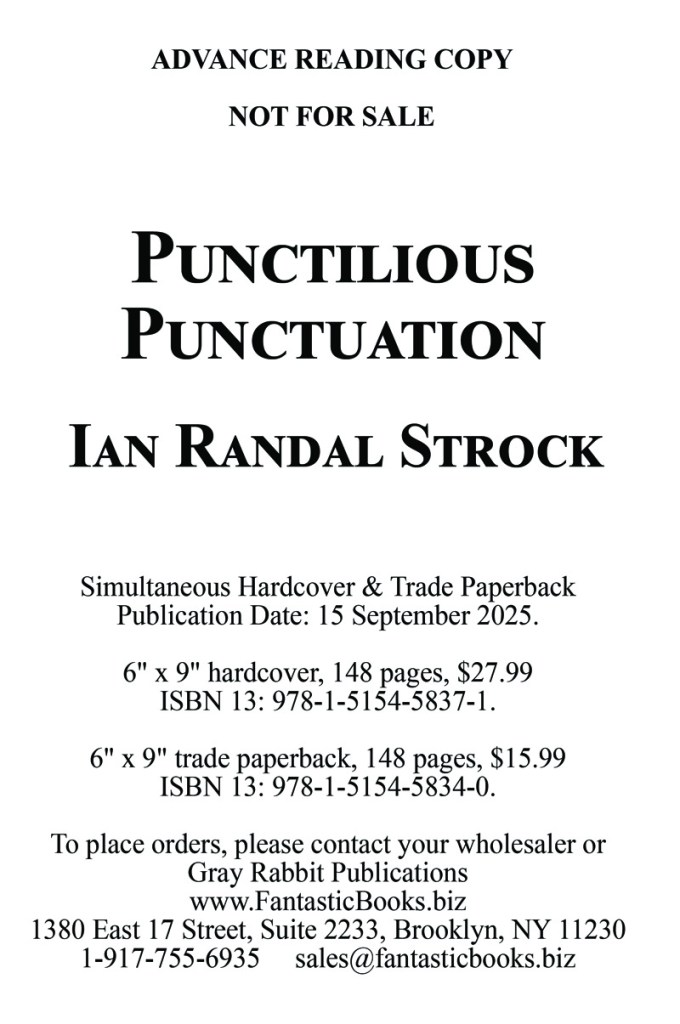
Punctilious Punctuation: a press release and a request for suggestions

It started—as the biggest arguments do—over the smallest of things: the placement of a comma. That turned into an anecdote, and thence into a speech. And now author, editor, and punctuation lover Ian Randal Strock has turned it into a book. Punctilious Punctuation allows each and every one of those little spots and squiggles on the page to shine, with its own chapter covering the history, usage, misusage, and ancillary information of the punctuation marks. Punctuated with stories and anecdotes on the huge impact those tiny marks can have (the $5 million lawsuit, the Russian revolution, and more), Punctilious Punctuation is fully researched, footnoted, illustrated, and—of course—punctuated.

Ian Randal Strock’s three books on presidential history and trivia were published by Random House and Carrel Books. His award-winning science fiction has appeared in Analog, Nature, Amazing, and several anthologies, and some of it has recently been collected in Wandering Through Time. He has presented talks on punctuation, the presidents, and a variety of other topics to Mensa, writers’ groups, science fiction societies, the 99s, university classes, and more. He is the recipient of the 2025 Edward E. Smith Memorial “Skylark” Award, and firmly believes in the utility and necessity of the serial comma.

Punctilious Punctuation: Telling tales with (and of) those jots and tittles, including why they’re called jots and tittles, and the horrifying story of why the period goes inside the quotation marks
by Ian Randal Strock
148 pages, fully illustrated
September 15, 2025
Trade Paperback: ISBN: 978-1-5154-5834-0, $15.99
Case Laminate (library binding): ISBN: 978-1-5154-5837-1, $27.99

Punctilious Punctuation—and all Gray Rabbit Publications books—are distributed via Ingram. Review copies are available upon request.

And the request: where do you find reviews of such non-fiction titles that you appreciate? In the realm of science fiction, I know where to send galleys, but I’m trying to improve my game in non-fiction. Thanks!