Word Counts

In the current issue of the Mensa Bulletin, Richard Lederer’s article is about Mark Twain, including several quotes from Twain. One of them caught Mom’s attention: “I never write metropolis for seven cents because I can get the same price for city. I never write policeman because I can get the same money for cop.” She lauded that thinking, and to a degree, she’s right: a word is a word, and if one is getting paid per word, shorter indeed may be better. (Although I am a staunch proponent of precisely the right word, because there are nuances of difference in Twain’s examples.)

The stumbling point for me was that when I started working for Analog and Asimov’s, one of my jobs was writing up the contracts for stories the editors were buying. We had a formula for calculating words: count the spaces in an average-long line, multiply by the number of lines on the page, and then by the number of pages in the manuscript, and then divide by six to get the number of words we were paying for and then publishing. This formula thus included spaces and punctuation marks in the rate of pay, but it did not count actual words. It did, however, give an accurate length, which helped when putting together the puzzle pieces that were stories in an issue of a printed magazine. Also, recall that this was the end of the typewriter era, just as writers were starting to use computers. So actually counting the number discrete words in a document was almost always an inaccurate approximation. Thus, in that era, from those magazines, a writer was actually paid more for a longer word than for a shorter one. I had that epiphany after selling my first couple of stories, and tried to use longer character names for just that reason (“Tom” was worth 3 cents when they were paying 6 cents per six-character “word”; “Christopher,” however, was worth almost 12 cents). When I was publishing Artemis Magazine, I kept the approximation for figuring out pay rates.

Writing this now, when everything is computers and electronic submissions, I’m realizing I rely far more on the word processing program’s calculation of a number of “words” in a document, but the number of words only really matters when I’m publishing an anthology, and now the approximation I’m most interested in is “how many pages will this story fill.”

Anyway, it struck me as an interesting change. Ignoring the fact that Twain (who died in 1910) was getting seven cents a word, while writers today are lucky to find a fiction market paying that much, I’m wondering if the varying ways in which we count words has affected writers’ earning ability by any appreciable amount.
Research help needed

Looking for some research help. Specifically, I’m looking for any other religions with a concept similar to Judaism’s Shabbos goy.

For those who don’t know, a Shabbos goy is a non-Jew who is employed by Jews to perform certain types of work that Jewish religious law prohibits a Jew from doing on the Sabbath.

I’m not asking about the religious validity of the concept—whether it is allowed or not—just looking for other religions that might have a similar concept: someone not of the faith who is necessary to do things for the brethern that they are not themselves permitted to do.

Literary Abbrevs

Do you find it as jarring as I do, when reading fiction, if the narrator uses abbreviations rather than spelling out the words? Or, for that matter, uses Arabic numerals rather than spelling out the numbers (other than, you know, for ridiculously large numbers—there’s never any sense in spelling out two hundred ninety-nine million, seven hundred ninety-two thousand, four hundred and fifty-eight meters per second)?

What prompted this thought was a story I was reading, and the narrator’s voice says something about the intersection of Maple Blvd. and Elm Ave. In non-fiction or reporting, that’s fine. Indeed, it’s expected. But somehow, when I’m reading fiction, I find the abbreviations serve only to remind me that I’m reading words on a page, distancing me from the story I’m reading.

I find it even more of a literary turn-off when it occurs in dialogue, because nobody actually says “blivid,” so the writer really ought to spell out “boulevard.”

Is it just me…?

Electronic Punctilious Punctuation

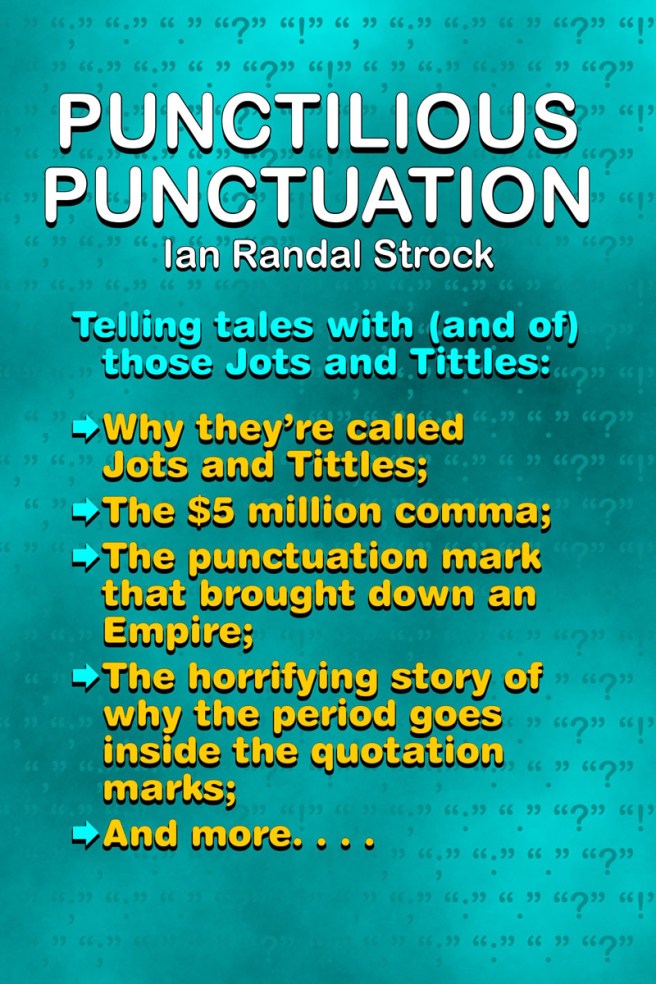
I’m thrilled to announce that there is—finally—an ebook version of my latest book, Punctilious Punctuation. The book is so full of graphics, footnotes, special characters, and more, that I didn’t trust myself to turn it into an ebook, and had to get an expert to do it. Well, it’s done and it’s available!

You can get it directly from me/the publishing company on the linked page, or follow the links on that page to some of the major ebook retailers.

This is the book that Samuel R. Delany “really enjoyed,” and Joe Haldeman said contained “the best joke I’ve encountered today… well, the best grammar joke, anyway.”

A problem with names

Most of my fiction is short, sometimes very short. And I write a lot of my stories in the first person, because I find it lends intimacy and immediacy to the story.

But one of the stories I am currently writing seems to be more suited to being told in third person. Fine, good. It gives some room for a narrator (which I also enjoy doing). But a skill that seems to have atrophied because of all of my first-person writing is that I’m having trouble naming and describing the characters.

With a first-person point of view, the main character will rarely or never mention his own name. And think about how often you use other people’s names: if you’re talking with someone you know, you can go a very long time without either one of you mentioning your own or the other’s name.

Similarly, unless there’s been some great change—a new hair style or an interesting outfit—you’ll rarely describe or “characterize” yourself or the other. Heck, I look in the mirror every morning, but I almost never remark on my own appearance (well, other than this week, when I’ve been watching this subconjunctival hemorrhage turning my left eye a remarkably horrifying red, but the doctor said it should resolve itself in a few days [and yes, there’s a bit of characterization that doesn’t really move the story forward, but does lend color, if you will, to the tale]).

Back to my original point: I know sometimes names are very important, and can be a large part of characterization, but far more often, character names are just indicators so the author can differentiate one from another. So how do you pick a good name—and perhaps interesting characteristics—when those aren’t the foci of the story you’re telling?

P.S.—I thought about including a picture of my eye, but decided it would gross out more people than it would attract readers.

Don’t Tell Me

I’ve been trying to be a better writer recently. I’ve actually been writing every day, and I’m making more of an effort to find markets for my writing (haven’t had much luck finding paying markets for my essays recently; my fiction—as does everyone’s—sometimes takes quite a while to find the right home).

Something I noticed several years ago—but which is making more of an impression as I’m making more of an effort to find places to sell my stories—is those markets requiring anonymized submissions. It’s not a terribly onerous burden—saving another copy of the story without my name on it—but I’ve been wondering who it really serves?

As a professional, I know that the most important people in the publishing ecosystem are the advertisers and the readers: those who pay for the magazine to exist. Everyone else is of secondary import. And I’m wondering if any of them care, or even notice, if the magazine or anthology in question requires anonymized submissions.

I did a quick search of publications who don’t want to know who wrote the story they’re considering, and found these examples from their guidelines:

Remember to take all author information out of your story! Tell us who you are in the space provided in the web form cover letter you get when you click on the “submit” button, NOT in your story! No headers, no bylines… just the story.

Please anonymize your work. No names or other identifying information should appear on the manuscript.

Anonymous Submissions. No identifying information should appear on your manuscript. We use anonymized submissions for our associate editors (first readers). Only upper-level editors will read your submission form information and cover letter, including any diversity statement. Failure to anonymize the manuscript will not cause us to automatically reject your story, but failure to read and follow our guidelines may affect our decisions.

Anonymity: Please do not put your name on your manuscript. All stories are assessed anonymously. [Ironically, this one requires contributors to identify as part of a specific community.]

[Magazine name] only accepts anonymous submissions. Please do not include your name, address, phone number, or other similar identifiers in the manuscript itself. All original fiction and poetry submissions will be read anonymously on first read: moving on to further consideration will depend on the merit of the work alone.

As I said, it’s not a terrible burden on the would-be writers (other than making sure the manuscript file I send is the anonymized one, not the regular one). But does anyone notice? Has any reader ever picked up a magazine and said “This is a great issue. I’m glad the submissions were anonymous.”? or “This issue would have been a lot better if the editor reading the submissions didn’t know the names of the authors before buying the stories.”?

For you readers out there: did you even know this was a thing?


Good(ish) rejection

Like all writers, I get far more rejection notes than acceptances. It’s just part of the process of being a writer, and nearly all of them, regardless of the words, are just a way of saying “no, we’re not going to publish this story”: mark it in the submission log, find another potential market for the story, and move on. Today, however, I received a very surprising rejection. The first two paragraphs are just standard form rejection, but then the editor appended this third paragraph:

Personal note: This was a fascinating and experimental piece to read. It was unpredictably and beautifully eerie. Your prose succeeds at building and sustaining the tension driving this story.

Other than the in-person rejections from friends, this is the nicest I’ve ever received. In the long run, it doesn’t really matter: the story still hasn’t sold, and the rejection isn’t going to make it any easier to sell the story, but for a few moments today, it feels nice.