In the crush of book publication day, I’ve neglected to tell you I’ll be at Capclave this weekend, in Rockville, Maryland.
As is usual at these conventions, I’ll be spending a lot of time in the Dealers’ Room, at the Fantastic Books table. The room will be open Friday, 3–6pm; Saturday, 10am–6pm; and Sunday, 10am–2pm. Additionally, I’ll be participating in the mass signing event Saturday from 7 to 9pm.
I’ll also be on programming, so you can seek me out at the following:
Friday, 8pm in Washington Theater: “Turning Points in Alternate Histories” with J.L. Gribble, Elektra Hammond, Bjorn Hasseler, and Walter H. Hunt.
Friday, 10pm in Washington Theater: “The Eye of Argon” with Ide Hennessy, Michael A. Ventrella, and Jean Marie Ward.
Saturday, 9:30pm in Adams: I’ll be doing an author reading. Will it be fiction? Will I talk about punctuation? Come to the reading and tell me!
Sunday, 12n in Washington Theater: “Small Press of Self-Publishing or Big Press” with Shahid Mahmud, Mike McPhail, Nathan W. Toronto, and Michael A. Ventrella.
Sunday, 1pm in Jackson: “Ask Me Anything—Publishers” with Danielle Ackley-McPhail, Joshua Palmatier, and Nathan W. Toronto.
I’ve had several people ask how they should purchase my new book, which way is best for me, and I’m extremely gratified by those questions. While this question is easily extrapolated to just about any author, the answer is “it depends.” There are several answers.
What my friends and family think they’re asking is “where should I buy your book so that the most money winds up in your pocket?” And that’s a very kind question to ask. The simple answer is: “buy it directly from me, when you see me in person.” But while that method does indeed put the most money in my pocket, it works out to only two or three dollars (maybe as many as five) more than I’d earn from a sale some other way. In my particular case, with this specific book, it’s been published by one of the imprints of the independent publishing company I own. My company pays authors fifty percent of the net the company takes in on each sale. So if you buy the book from me as the publisher at a convention, it’ll be almost as much money in my pocket. That’s because neither of those sales has to give a cut to the distributor or to some other retailer.
But there are other answers to the question, other considerations.
My publishing company is an independent. While physical bookstores can order our books from our distributor, those bookstores don’t stock our books, because we don’t offer a large enough discount or the 100% returnability they require (those are topics for another essay). So the bulk of our bookstore sales come from the online retailers, of which the largest—by far—is Amazon. If you buy my book from Amazon, that helps the Amazon Sales Rank move up. And while one sale isn’t going to affect that number much, several dozen copies, a few hundred, if all made the same day or week, will indeed affect that number. And books with better Sales Ranks will be shown to more people on Amazon, hopefully leading to even more sales. So buying on Amazon, while resulting in less money in my pocket for that one book, may eventually result in many more sales.
But as important as that Sales Rank is, it’s fleeting, temporary. The number may be great this week, but if no new copies are sold next week, the number will plummet as other books are published and rise up the ranks. What has a longer-lasting effect is reviews. Reviews don’t have to be complex—you don’t have to write a four-page essay comparing and contrasting my book to, well, anything. Even just a few words is sufficient for the algorithms, because they’re focused on the number of reviews, and the average ranking of the book from the “rank this book on a scale of 1 to 5.” If you can spend just a few minutes to write a few nice words about the book, in the long run, that may wind up being the most valuable.
And that’s not unique to Amazon. Reviews on GoodReads or LibraryThing are equally important. Indeed, any sort of word of mouth (telling your friends and neighbors) is also great.
But all of that is still assuming the book in question has been published by a small press like mine, or self-published by the author. If, however, your friend has had the fortune to have the book published by one of the large publishing firms (like my first three books), the answer will again be different.
If the book has been published by a big publisher, one of the “big five” or “legacy” firms—or even a smaller traditional publisher that still has standard physical bookstore distribution—the best way to buy the book is at that brick-and-mortar bookstore. Those sales are the most likely to be counted and reported, and when the author has another book to submit to publishers, they’re going to be looking at those sales numbers to justify (or not) buying and publishing that next book. Incidentally, that points to another big difference between those large publishers and mine: if your book doesn’t sell five thousand or ten thousand copies, that large publisher is unlikely to offer a contract for the new book. On the other hand, if my company published that book, and it sells a scant one thousand copies, it’s still done a great job for my company, and I’ll be happy to publish the next.
So, back to the original question: my friends asking where/how they should buy my book. At this point, I’m still hopeful for a bit of a break-out, still hopeful to make at least a little splash in the bigger world of Amazon sales, so I’m directing my friends and family there (even though Amazon has done so much to kill publishing), foregoing the few extra dollars now in hopes of more sales a little later. That said, I’m thrilled with every single sale, and I’ll be selling copies at Capclave this weekend, HalloWeeM at the end of October, and nearly everywhere you can find me. On behalf of myself and all the other authors being asked, the greatest thing you can do is tell us you’re interested in our books, and then show us. Happy reading!
It’s publication day for Punctilious Punctuation. The book is available from all the online retailers, directly from the publisher, and every physical bookstore can get copies from Ingram, our distributor. It is featured as “The Big Idea” in today’s post on John Scalzi’s “Whatever.” And I’m just thrilled with the book.
There is as yet no ebook edition, but there may be soon (stay tuned, as they used to say). Also, one of the biggest things you can do for me—indeed, for any author (after, of course, buying the book and telling all your friends)—is to post a review of the book on the retailer’s site of your choice. It doesn’t have to be long, just a few words. But the algorithms look for total number of reviews, and that would be wonderful.
Thank you, everyone, for all your support in this journey!
(And if you see any other mentions of the book, please let me know.)
There’s an occasional trope in fiction where mortal enemies take a break from their eternal conflict and sit, converse, interact, as… if not friends, at least cordial colleagues. Usually at such a time, it’s almost as if they’ve called a truce. They’re bonding over something that is either far larger than their conflict, or so small as to be not worthy of the strength of their animosity. Perhaps it’s because such a long relationship—even on opposing sides—means they have many shared experiences. Such opponents would know far more about each other—have far more in common—than typical friends
Two examples spring to my mind:
The Star Trek: The Next Generation episode “Tapestry,” in which Picard is dead and Q is showing him all the things in his earlier life that led up to that point, that might have been avoided. At the end, we learn that indeed, Picard had made all the right choices all along (even when in retrospect they appeared to be mistakes), and Q was showing him the error of ruing his ways. But before that point, there is a scene when they’re sitting in a bar watching the much-younger Picard and his friend interacting with some bad guys. He’s explaining to Q what happened, and what will happen, while Q is expressing surprise and interest. It’s a wonderful moment that—if we didn’t know the back-story of Picard and Q—might seem like two friends reminiscing.
The movie The Greatest Showman, the musical about P.T. Barnum becoming the showman and impresario we remember. After the fire, Barnum is sitting on the steps of the circus, and Bennett—the critic who has never had anything good to say about Barnum or his show—sits with him, regretting with Barnum the destruction of the building. He says, “I never liked your show, but I always thought the people did,” and offers Barnum a drink from his flask.
I’m not sure what got me thinking about these brief moments of friendship in the midst of long, lingering animosities (after the episode, Picard and Q return to their old ways; in the movie, that’s the last we see of Bennett), but there’s something comforting about the thought that they are possible.
Then again, it’s got me thinking about my own life. I’m not sure I have any blood-enemies of such stature as Q to Picard. At best, I’d say I have antagonists. And as much as I write fiction, and am enamored of those examples I’ve listed, I just can’t see anything ever cropping up that would cause me to declare a truce and sit collegially with any of my antagonists. Is it a lack of my imagination? Or those other writers being too idealistic and hopeful? Or do I simply not have sufficiently grand antagonists? If it’s that last, I can be satisfied with those I have, because I don’t need stronger, smarter, nastier ones in my life.
What do you think? Could you share a cup of coffee with the villain in your life to comment on something much greater than your conflict, or something so petty as to be beneath the energy it asks?
I’m starting to feel like the frog in the slowly heating pot of water.
National Guard troops patrolling Los Angeles. A judge just ruled it’s a violation of the Posse Comitatus Act, but that ruling doesn’t change much.
The military take-over of the federal district. “Crime is out of control,” according to the White House, though the city’s administration says those figures are a lie. No matter who’s right, we’re becoming inured to seeing troops in the streets.
Talk of next sending the troops into Chicago or some other major city. We’ll survive that, won’t we? After all, New Yorkers have gotten used to heavily armed people in fatigues at major events and gatherings. Those troops may not have chosen to be here, but we still have to thank them for their service.
Pair that increasing military presence at home with the spate of national emergencies the president is in love with declaring: the national emergency over immigration that the administration is using to justify increasing number of deportations. And the national emergency over international trade that was the justification for illegally imposed tariffs. And now there’s talk of the president declaring a national emergency over housing, because people in their 20s and 30s can’t afford to buy houses, because not enough new houses are being built.
Add in the president’s continual whining about that elections aren’t “secure,” that we can’t trust the mail-in paper ballots, or the electronic voting machines, or any other facet of the system, and that the federal government is going to have to take over the machinery of elections, just to ensure that they’re fair.
Do you see where this is going? This is all in the first seven months of this presidential administration. We are being inculcated to the steady stream of major emergencies demanding extraordinary governmental intervention. We are being taught to distrust the institutions of free and open government that have served us so well for two centuries. And we are growing desensitized to the elements of control such as the Army patrolling our cities.
It isn’t very much of a leap of reasoning to imagine we’ll be told we have to respond to some emergency in the summer of 2028, while the government is trying to make our electoral system “safe,” which will require a delay in election day, perhaps “just a few months.”
I think we’re in trouble. I feel the temperature of this water rising, but will we be smart enough to turn off the gas before it starts boiling?
President Trump on Monday tweeted about his dismissal of Federal Reserve Governor Lisa Cook. His “reasoning” is that he claims Cook made false statements on mortgage documents, which was evidence of “gross negligence” and “potentially criminal.”
The evidence he is basing this decision on? Federal Housing Finance Agency Director Bill Pulte sent a letter to Attorney General Pam Bondi accusing Cook of taking out mortgages for homes in Michigan and Georgia in 2021, and telling banks in both cases that she planned to use the homes as her primary residences. Pulte alleges that was a fraudulent attempt to gain more favorable lending terms. Cook has not been convicted of anything, not even been indicted. But Caesar’s wife must be above reproach.
Sound familiar?
In the case commonly known as New York v Trump (2023–2024), the judge ruled that “In order to borrow more and at lower rates, defendants submitted blatantly false financial data to the accountants, resulting in fraudulent financial statements.”
The pot calling the kettle back? It takes one to know one? The crime he’s accusing Cook of committing is the smaller version of the crime of which he was convicted. He says it’s a disqualifying crime (mind you, the accusation; there has been no trial) to serve on the Fed’s Board of Governors, but that the much larger version (which was adjudicated) is not disqualifying for him to serve as president.
I’m embarrassed that he’s the president, and I’m scared of what he’ll do next.
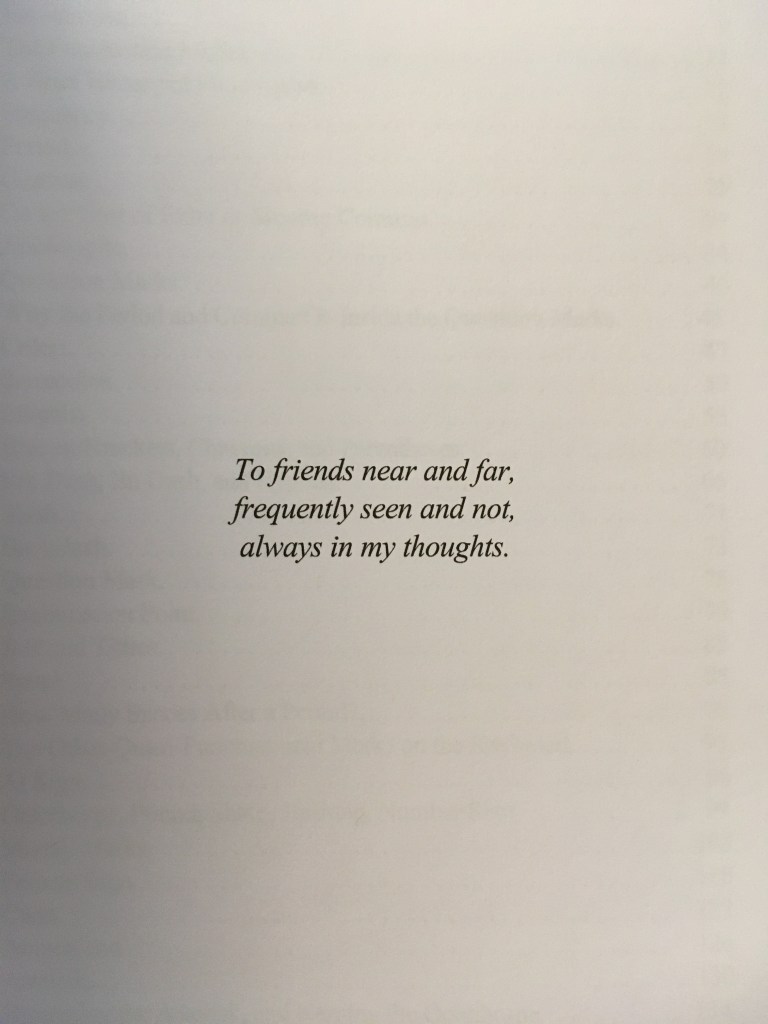
I had occasion today to scroll through my entire friends’ list on Facebook. That’s a lot of names. I was surprised how many times, just glancing at a name immediately brought to mind a face, or a memory of an interaction, or an entire relationship. On the other hand, I was also saddened as I realized how many of my Facebook friends are now deceased. It happens, but as final as their passings were, there’s an even greater feeling of finality in choosing to “unfriend” one of the deceased, because there’s no chance of a later request to reconnect ever being accepted.
All of those warm and maudlin thoughts combined to make me realize how prophetic the dedication of my forthcoming book is. Punctilious Punctuation will be officially published on September 15, but here’s a picture of the dedication page.
I’ve got my programming schedule for this year’s DragonCon. If you’re going to be part of the huge throng of people gathering in Atlanta the end of this month, these are the times/places you’ll be certain to run into me (I won’t have a dealers’ table, so everything else will be wandering about the convention):
I’ll be participating in the mass signing event known as The Gather on Friday August 29, from 8pm to midnight, in the Hyatt’s International Ballroom.
My panels include:
Saturday August 30, 5:30pm, in the Hyatt’s Embassy AB: “That Never Happened: Science Fiction as Alternate History” with D.J. Butler, Bill Fawcett, M.A. Rothman, Mark Stallings, and Ben Yalow.
Saturday August 30, 8:30pm, in the Hyatt’s Embassy EF: “Writing and Selling Short Stories” with Kevin A. Davis, Bethanne Kim, Violette L. Meier, Phillip Pournelle, and Sean H. Taylor.
Saturday August 30, 10:00pm, in the Hyatt’s International South: “Fantasy Dating Game: Will Our Characters Find a Match?” with Todd Fahnestock, Jen L. Grey, Sherrilyn Kenyon, Rachel Rener, Stacey Rourke, Daniel Schinhofen, Cisca Small, and Steve Wetherell.
Sunday August 31, 10:00pm in the Hyatt’s Embassy AB: “The Eye of Argon, Continued” with Keith R.A. DeCandido and Jean Marie Ward.
The Republican redistricting scheme currently causing so much consternation in and toward Texas gives me hope. Not, perhaps, in the way you might think. But in it, I see the seeds of potentially, maybe, if if if, a solution to the gerrymandering that has plagued this country for two centuries.
Allow me to explain.
I’ve been railing against gerrymandering for years. Gerrymandering is the drawing of boundaries on political districts in order to group blocks of voters together, either to increase the power of one group, or to decrease the power of another. Sometimes it is used to increase the chances that a member of a minority group can win an election. But far more often these days, it is used to cement a political party’s hold on a district, to make it “safe.” (For the problems safe districts cause, see my previous writings.)
In normal times, Congressional district boundaries are redrawn every ten years, after the decennial census data is received, so that the districts accurately represent where the people live and what those people want. These are not normal times.
Governor Abbott of Texas, kowtowing to President Trump’s request, is urging the Texas legislature to redraw the state’s Congressional map right now, half-way through a decennial period, in order to concentrate the Democratic minority voters into fewer districts, and thus give the Republicans, potentially, three to five more seats in the House of Representatives. Democratic members of the Texas legislature have left the state, in order to prevent the legislature from reaching a quorum, which would—at least, in theory— prevent action on the proposal. But they’ve tried such a quorum-break in the past; it has not been successful. I doubt it will be this time, either.
So we have to accept the reality that Texas is about to further marginalize their Democratic population and flip five of their seats in the House to the Republican party.
Governor Newsom of California has been making noises about attempting the same scheme in his state, which would flip several seats from the Republicans to the Democrats. There’ve been whispers elsewhere—such as Governor Hochul in New York—that other states might do something similar if Abbot and Trump get their way in Texas. The problem I foresee is an ongoing character flaw of the Democrats: the party insists that it must be holier than thou, purer than thou, that it will play be the rules even when their opponents have shown absolutely no compunction about violating those rules. While doing so may give them a moral victory, it will inevitably lead to an actual loss. To my mind, in these cases, the Democrats are those crying “life isn’t fair.” No, it isn’t. Everyone should follow the rules. Everyone should be a good, moral, decent human being. Everyone should be more interested in the good of us all than in our individual results.
But not everyone is.
We don’t need Governor Newsom and Governor Hochul warning “don’t do it or we might do something, too.” We need him and his fellow Democratic governors to act! Today! We need them to implement precisely the schemes Abbot and the Texans are planning. We need to gerrymander the country to a fare-thee-well, to legislate out of existence those last 40 competitive seats in the House.
Because then, and only then, will we all see just how egregious the gerrymandering has become. Only then will it be brought to the Supreme Court. And to my mind, regardless of the Court’s political slant, there is no way it can allow such outrageous diminution of the minorities to survive. In such a case, I think, the Supreme Court will only be able to rule that the gerrymandering violates the people’s rights to be fairly represented, and that political maps must be drawn in a fair, impartial manner.
(Yes, I know, I’m an idealist. It may not work out that way. But I don’t see any other way to fix the mess we’re in.)
And if, IF my dream comes true, may I humbly suggest new legislation regarding how districts are drawn? A fairly simple test, actually:
No Congressional district, when drawn on a Mercator projection map, shall be drawn in such a way that a straight line drawn on that map shall be able to cross into the district more than once. That is, except in cases where the state border itself violates this dictum.
I don’t expect any of this to happen. I expect the Democrats will continue to purge their own ranks, as they threw out Al Franken. I expect they’ll yell and whine and do nothing, while Texas rejiggers their Congressional map, and that the election of 2026 will result in a Trumpian increase in the House, and we’ll continue bitching and moaning about their self-serving actions for years to come.
But wouldn’t it be nice if I was wrong, and we could actually make things better?
A quick story on ABC’s noon news just now noted that Mikie Sherrill, who is the Democratic nominee for governor of New Jersey, has chosen Dale Caldwell as her running mate, and that if they win, he will be the first male lieutenant governor of New Jersey.
That caught my ear. While we have (or are much closer to) equality of the sexes, I know enough of our history to know it was not always the case, and that a claim that a political office holder will be the first man to hold the office is strange.
So I did a little research. The quote is accurate, but demands a slightly longer explanation, which is that in New Jersey, until recently, the governor was the only official elected state-wide. If the governor’s office became vacant, it would be filled by the president of the State Senate, or by the speaker of the General Assembly. The position of lieutenant governor was created in 2006, and first filled in the election of 2009. To date, the entire list of lieutenant governors of New Jersey is: Kim Guadagno (served January 19, 2010–January 16, 2018); Sheila Oliver (January 16, 2018–August 1, 2023 [she died in office]); and Tahesha Way (September 8, 2023–present).
Indeed, I can’t think of any other American political office to have been held exclusively by women at any point (excepting First Lady and Second Lady [until Doug Emhoff from 2021 to 2025]). Frances Perkins was the first woman to serve in a president’s cabinet, but she was the fourth Secretary of Labor. The 46th and current Treasurer of the United States, Brandon Beach, is the first man to hold that position in 76 years, since the 28th Treasurer, William Alexander Julian, who served June 1, 1933–May 29, 1949 (but all of his predecessors were men).



 Ian Randal Strock