I don’t know if anyone is really surprised that boxes of what should be public presidential records were secreted out of the White House to Donald Trump’s own property. He has a very long history of attempting to keep his actions secret. Instead of being surprised that he did so—again—we should be asking “What is he hiding?” What, for instance, is lurking in his tax returns that he has worked so hard to keep secret? Who does he owe money to? Who did he owe money to while he was president, and how much of those debts were reduced by means other than simple repayment? How much money did he receive from which foreign countries during his administration?
The ostensible purpose of the current investigations are to see how much he was the impetus for the attack on the Capitol building in January 2021, but I think we should also be asking just how much of an independent actor he was during his presidency, and how much he was indebted to—and acting on behalf of—others.
Fantastic Books is participating in this month’s “Scoundrels in Space” story bundle, in the form of Tom Purdom’s Romance on Four Worlds: A Casanova Quartet. If you’re unfamiliar with the concept of story bundles (as I was), it’s a group sale program: you pay $5 for the four main ebooks, or $20 (or more) for all 12. The money goes to the authors and a little to the sponsor, and you get some great reads for really cheap. The bundle is only available for a limited time (in this case, until February 24). But to grab your cheap reading, follow this link: https://storybundle.com/scifi
Fantastic Books published Romance on Four Worlds a few years back, and when it came out, Publishers Weekly called it “delightful” and “a pleasure from beginning to end.” So now you can get a copy cheaper than ever before, and another 11 wonderful books, too. Check it out!
The Democrats are doing it again: they’re so busy fighting amongst themselves that the Republicans and the Trumpians can just sit back and laugh, knowing they’re going to win because the Democrats are their own worst enemy. How many of them are yelling at Senators Manchin and Sinema to change the filibuster rule in the Senate, instead of yelling at the Republicans and the Trumpians to protect voters’ rights? They’re just wrong. The reason the original filibuster existed—and the current horrible incarnation of it is in place—is to prevent the tyranny of the majority over the minority. Yes, of course, the majority should decide. But if the slimmest of majorities can stomp all over the largest of minorities, that’s not what we want either. And overturning the filibuster now will only result in even unhappier Democrats in the future, because the pendulum continues to swing, and there will be a time when the Democrats are a minority.
Every time there’s a political debate, it’s the same story: the Republicans yell at the Democrats, the Trumpians yell at the Democrats and threaten the Republicans, and the Democrats yell at… other Democrats. Just the latest instance of the gang who couldn’t shoot straight, DC edition. If they ever focus on those who are actually in the wrong on the issue, they might be able to accomplish great things.
In a ongoing discussion of the Mensa Bulletin (the national publication of American Mensa), one topic that came up is members who don’t read it at all. One of those members commented “I realize part of it is my own fault. When I received the print edition, it would be on the kitchen table. I’d pick it up and read it over meals by myself. When I changed to the digital edition, I stopped reading the Bulletin.”
That, more than anything, is why I have spent years railing against the trend to all-digital publication. A physical magazine is there, in front of your eyes. You see it, even if you’re not going to read it. An electronic publication is so easy to ignore, to skip today because you’re busy, and then have it scroll down to the unnoticeable part of your unread in-box, that it won’t be many issues before you stop reading it altogether.
If the goal is to save money, to do everything as cheaply as possible, then by all means, we have to drop paper publication and shift to all-electronic.
But if the goal is to produce something that people notice, pay attention to, and read—and in the case of a membership organization, produce a regular reminder that readers are members of this organization, and may want to renew their membership regularly—then the printed magazine is a necessity.
I just finished giving my talk on Isaac Asimov for Eastern Oklahoma Mensa. Had a great time! I think nearly ten percent of the group’s membership was there (they said it was the best turn-out they’ve had in a long time). And they were a responsive crowd, despite the limitations of Zoom (I really, really miss doing my talks in person, where I can properly interact with people).
And they made this awesome ad for their Facebook group! Isn’t it neat?
Every time I do one of these talks, I get pumped up. The adrenaline rush comes after I’m done, but that was the joy with being in-person: after a talk, I could hang out with people, keep the evening going. Talking via Zoom, once it ends, the Zoom window shuts down, and I go right back to sitting in the house by myself <pout>. So now I’m amped up, and nothing to do with it. Oh well, I’ll try to save it up for when the world re-opens.
Reading articles like this (“Gravitational Waves Should Permanently Distort Space-Time”)makes me want to go back and study physics properly. But then again, I react similarly to other interesting articles in other fields of study. So instead, I just keep reading the interesting articles, and thinking “Wow, that’s interesting!”.
This particle article also makes me wonder: Given all of time up to this point, shouldn’t every point of space-time have experienced the passage of multiple gravitational waves, to point that all of space-time should be gravitational-wave distorted, and thus experiencing the gravitational memory effect? And since the universe is basically uniform and homogenous in any direction, wouldn’t that equally widespread memory be indistinguishable? Yep, another thing I want to study.
On several pages, I’m seeing that today is National Science Fiction Day, so chosen because it coincides with Isaac Asimov’s birthday. Well, I’m a science fiction writer and publisher, so that’s as good a reason as any to encourage you to go read some science fiction.
It also reminds me that, next Saturday, I’ll be the monthly speaker for Eastern Oklahoma Mensa, talking about “A Century of Asimov” and my time with him. I won’t actually be in Oklahoma (which is one of the 15 states I have not yet visited), but I’ll be using the formerly science fictional method of Zoom to join them electronically.
Nancy Heppner, Dolores Llodra, Pamela Weinstock, and me, at the GNYM holiday party 2021.
It was a weekend of people and art: kind of exciting, kind of tiring. And now I’m getting ready for a long science fiction convention selling books.
Friday was Greater New York Mensa’s holiday party. Kind of a small turn-out, but a nice time. Well, except for the fact that Pamela felt the need to enhance my eyebrows with some of the cotton otherwise decorating the intensely decorated Papillon Bistro and Bar on 54th Street. Eh, it wasn’t that bad.
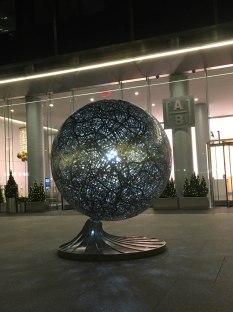
After the party, I walked to the subway with a new friend, past the Alliance-Bernstein Building, which has this cool globe in front. And here’s a close-up of it.
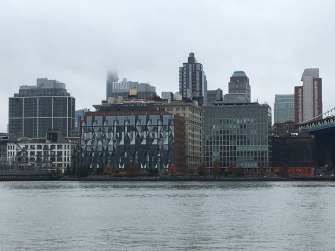
I was walking through the LES to meet up with Michele, Mary, and Erin for the Interactive Van Gogh exhibit on Pier 36. (Talking about it yesterday, I learned that there’s another, competing immersive Van Gogh exhibit in New York City; I didn’t see that one.) I walked around the building, took some pictures of the river and the bridges, and got to the entrance right on time. The exhibit was very impressive, though not exactly what I was expecting (obviously, I hadn’t read enough of it before we went). It was less like an art gallery, more like an all-around-you movie with a (slightly too loud) soundtrack. The exhibit takes Van Gogh’s paintings, projects them on the walls (and floors), animates pieces of them, duplicates and overlaps them, and sets it all to music. But it has a definite start and end point, as we discovered when the display ended with a credit scroll after half an hour… and then restarted. Two of the rooms are smaller, very dark, with interesting mirrored sculptures. The third, large room is much brighter (and in this room, the displays are also projected on the floor, making us part of it all. Michele commented on seeing the brush strokes, and as the images enlarged on the wall, it was very easy to see the individual strokes. I sat there a bit, trying to decide if we’d chosen the proper spot, or if, like the cosmological principle, every spot was the center point, the focal point of the show. Whichever it was, I got a good dose of art. I noticed a lot of people taking a lot of photos and videos while in the exhibit, but I decided to just absorb it, rather than try to record it, so if you want to see what it looks like, check out the link.
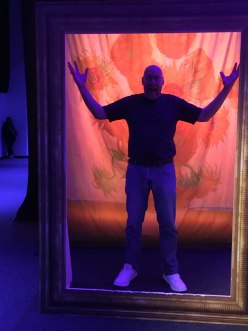
After the show, of course, there’s the gift shop and the pose-in-it frame (with poor lighting), so I did.
Then Chris joined us for a nice brunch, and then Erin left us, and the new quartet went up to 14th Street for the Banksy: Genius or Vandal? exhibit. He’s a very talented artist, and some of his pieces really grabbed me, but overall, I was less pleased with this one. It might have been the repeated theory that Banksy is opposed to capitalism, consumerism, etc., yet he sells limited edition prints of many of his works, and the exhibit charged a fairly hefty entry fee, and of course there’s the obligatory gift shop at the end… Well, it’s not really my taste. But for those who are fans, this is a good display of a lot of his work (in a much more traditional gallery format). And as with Van Gogh, I didn’t bother taking pictures in the exhibit.
And after that exhibit, we walked up town to Penn Station to get Michele to the train. Then we walked around Macys to see the windows, as the mist turned into a light rain, and Chris peeled off to catch his train. Then Mary and I walked up town, through the winter village in Bryant Park, through the mobs in Times Square, and out past the tree in Rockefeller Center, and to Saks, where we caught the lights-and-music show. Then we turned around, made better time walking south on Fifth Avenue (past the Library, with Patience and Fortitude wreathed for the season), and got Mary back to Penn Station minutes before her train left.
Then I walked back to Herald Square, caught my subway home, and got into the house five minutes before the light rain turned into a torrential downpour. A very nice two days with good friends (and one of these days, I’ll learn to take pictures of the people with me).
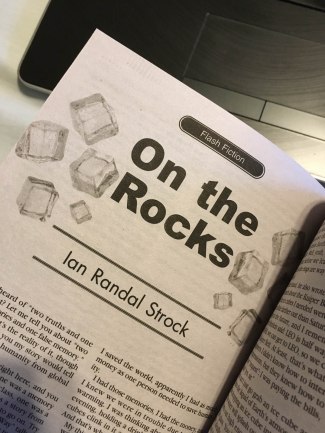
Today’s mail tells me I’m a fiction author again! Contributor’s copies of the January/February 2022 issue of Analog Science Fiction & Fact showed up, and my story, “On the Rocks,” is on page 140.
As I note in the bio attached to the story, this is my <gasp> 30th year of publishing fiction in Analog (my first, “Fermat’s Legacy,” was in the September 1992 issue).
So, woo! and hoo! (And now I have to write more fiction, since with this publication, I don’t have any stories in inventory anywhere.)
I’ve just learned of the death of Jessica Young, on November 23. I knew it was coming for a long time, but that doesn’t make it any easier to accept. Last February, she emailed to tell me she had inoperable pancreatic cancer (the same thing that killed my grandmother two decades ago), and that she’d just been through a year of chemotherapy and high intensity radiation treatment. So I spent the last year sending her chatty emails every month or so, just to let her know I was thinking of her, and because I really was thinking of her.
I first met her at the Mensa Annual Gathering in St. Louis in 1995, where she took me to the Gateway Arch. We ran into each other again a few years later, at the AG in Philadelphia in 2000, which cemented our friendship. After that, we saw each other intermittently, at Annual Gatherings. With the coming of smart phones, we communicated more often, sharing fireworks photos when we weren’t at Independence Day celebrations together. We saw each other only rarely, but every time, it was just picking up where we’d left off the last time, one long friendship.
Only once did we see each other outside of Mensa: In February 2016, her chorus sang at Carnegie Hall, and she was in New York for nearly a week. I got to see her most of the days she was in town, showing her around my home town, enjoying her concert, seeing a Broadway show, just hanging out, as good friends do.
She hadn’t responded to my most recent emails, and I knew the end was near. But a few days ago—at my sister’s house for Thanksgiving—I wondered that I hadn’t heard anything from her. After getting home tonight, I did a web search for “Jessica Young obituary,” and found it: she really is gone. https://www.kutisfuneralhomes.com/young-jessica-c/
Jessica Cerridwyn Young was a member of St. Louis Area Mensa. She is survived many family members and friends, all of whom, I’m sure, saw her far more often than I, and were far closer to her than I, and thus will miss her even more. But she was a very dear Mensa friend to me, and the excitement of next year’s AG will be tempered with the melancholy of knowing she won’t be there.

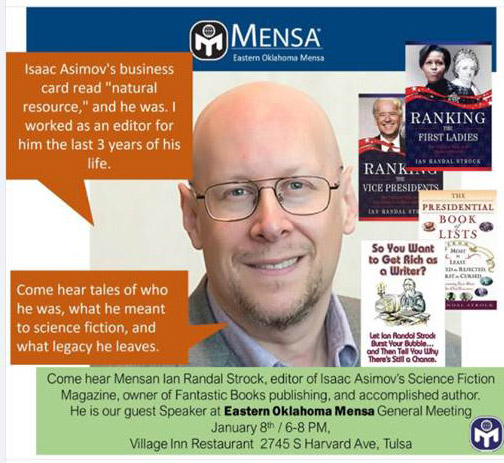 I just finished giving my talk on Isaac Asimov for Eastern Oklahoma Mensa. Had a great time! I think nearly ten percent of the group’s membership was there (they said it was the best turn-out they’ve had in a long time). And they were a responsive crowd, despite the limitations of Zoom (I really, really miss doing my talks in person, where I can properly interact with people).

 Friday was
  After the party, I walked to the subway with a new friend, past the Alliance-Bernstein Building, which has this cool globe in front. And here’s a close-up of it.
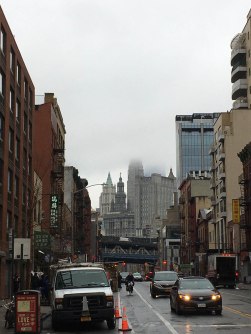 Got home late, and then got up early to ride the subway back into Manhattan. Got off at Canal Street and walked through the Lower East Side, seeing things I rarely see, such as this view of the Woolworth Building, and the Jewish Daily Forward Building (of which I didn’t take any pictures, but see this link:
  I was walking through the LES to meet up with Michele, Mary, and Erin for the
  After the show, of course, there’s the gift shop and the pose-in-it frame (with poor lighting), so I did.
 Then Chris joined us for a nice brunch, and then Erin left us, and the new quartet went up to 14th Street for the
 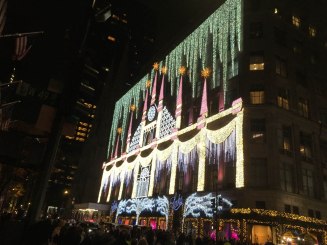 And after that exhibit, we walked up town to Penn Station to get Michele to the train. Then we walked around Macys to see the windows, as the mist turned into a light rain, and Chris peeled off to catch his train. Then Mary and I walked up town, through the winter village in Bryant Park, through the mobs in Times Square, and out past the tree in Rockefeller Center, and to Saks, where we caught the lights-and-music show. Then we turned around, made better time walking south on Fifth Avenue (past the Library, with Patience and Fortitude wreathed for the season), and got Mary back to Penn Station minutes before her train left.
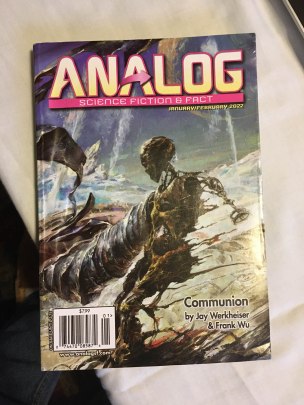 Today’s mail tells me I’m a fiction author again! Contributor’s copies of the January/February 2022 issue of
  As I note in the bio attached to the story, this is my <gasp> 30th year of publishing fiction in Analog (my first, “Fermat’s Legacy,” was in the September 1992 issue).
 I’ve just learned of the death of Jessica Young, on November 23. I knew it was coming for a long time, but that doesn’t make it any easier to accept. Last February, she emailed to tell me she had inoperable pancreatic cancer (the same thing that killed my grandmother two decades ago), and that she’d just been through a year of chemotherapy and high intensity radiation treatment. So I spent the last year sending her chatty emails every month or so, just to let her know I was thinking of her, and because I really was thinking of her.
 I first met her at the Mensa Annual Gathering in St. Louis in 1995, where she took me to the Gateway Arch. We ran into each other again a few years later, at the AG in Philadelphia in 2000, which cemented our friendship. After that, we saw each other intermittently, at Annual Gatherings. With the coming of smart phones, we communicated more often, sharing fireworks photos when we weren’t at Independence Day celebrations together. We saw each other only rarely, but every time, it was just picking up where we’d left off the last time, one long friendship.
 Only once did we see each other outside of Mensa: In February 2016, her chorus sang at Carnegie Hall, and she was in New York for nearly a week. I got to see her most of the days she was in town, showing her around my home town, enjoying her concert, seeing a Broadway show, just hanging out, as good friends do.
 Ian Randal Strock