Joe Biden is about to claim the Democratic nomination for President. He ran his primary campaign on the fact that he was Vice President during Barack Obama’s administration. That got me thinking about other Vice Presidents who ran for the Presidency. Well, my first thought was that Richard Nixon is the only person to serve as Vice President, retire from that office, and then later run for and win the Presidency (he was Dwight Eisenhower’s Vice President from 1953 to 1961, and then elected President in the election of 1968).
For this discussion, I’m ignoring the Vice Presidents who succeeded to the Presidency upon the death or resignation of their President: John Tyler following William Henry Harrison’s death in 1841, Millard Fillmore following Zachary Taylor’s death in 1863, Andrew Johnson following Abraham Lincoln’s assassination in 1865, Chester Arthur following James Garfield’s assassination in 1881, Theodore Roosevelt following William McKinley’s assassination in 1901, Calvin Coolidge following Warren Harding’s death in 1923, Harry Truman following Franklin Roosevelt’s death in 1945, Lyndon Johnson following John Kennedy’s assassination in 1963, and Gerald Ford following Richard Nixon’s resignation in 1974.
 In 1796, George Washington announced he was retiring from the presidency, not running for a third term. His vice president, John Adams, was the heir apparent, and won the election of 1796 to become the second president. At that time, whoever came in second in the electoral college balloting was declared the vice president, which is how Thomas Jefferson wound up as Adams’ vice president. In 1800, Jefferson beat Adams to be elected the third president, and we stopped electing vice presidents to the presidency for quite a while (we also changed the method of choosing the vice president, because Aaron Burr put up a fuss).
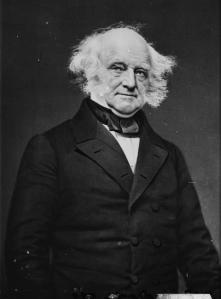 In 1832, Martin Van Buren was elected vice president for Andrew Jackson’s second term. Midway through that term, Jackson had some thoughts about resigning so Van Buren could become president immediately, but he didn’t. In the election of 1836, Vice President Van Buren was elected to succeed Jackson in the presidency. And that’s the last time we elected a current Vice President to be President until George H.W. Bush (who was serving his second term under Ronald Reagan) won the top job in 1988.
 John C. Breckinridge was the 14th Vice President, from 1857 to 1861 (serving under James Buchanan). Born in January 1821, he was the youngest vice president, taking office 47 days after his 36th birthday. In the election of 1860, Breckinridge was the presidential nominee of the Democratic party. He came in third in the popular vote in the severely divided country (he got about 18% of the vote), but second in the electoral college (which voted 180 for Abraham Lincoln, 72 for Breckinridge, 39 for John Bell, and 12 for Stephen Douglas). At the same time, his home state of Kentucky elected Brecknridge to the Senate. Breckinridge swore in his successor as vice president, Hannibal Hamlin, and then Hamlin turned around and swore in the new senators, including Breckinridge, on March 4, 1861. With the commencement of Civil War hostilities, Breckinridge—a southern sympathizer—returned home, and eventually joined the fighting on the Confederate side. The Senate declared him a traitor, and expelled him on December 4, 1861. In February 1865, Breckinridge was appointed the fifth, and last, Secretary of War of the Confederacy. The post was abolished in May 1865. After the war, Breckenridge went into exile in Europe and Canada, and returned to the US in 1869. He worked in insurance and as a lawyer, and died in 1875.

Adlai Stevenson (born in 1835) was the 23rd Vice President, serving during Grover Cleveland’s second (non-consecutive) term from 1893 to 1897. In 1896, he had very little support at the Democratic convention to succeed Cleveland. Instead, they nominated William Jennings Bryan for the first time (of three). In 1900, Stevenson was the nominee for vice president with Bryan. This made him the fourth vice president to run for that post with two different presidential candidates, after George Clinton (Thomas Jefferson’s second and James Madison’s first vice president), John C. Calhoun (John Quincy Adams’ only and Andrew Jackson’s first vice president), and Thomas A. Hendricks (the unsuccessful Democratic nominee for vice president in 1876, and Grover Cleveland’s vice president from March 1885 until his death in November of that year). The only other one to try for the vice presidency with two difference presidential candidates was Charles W. Fairbanks, who was Theodore Roosevelt’s vice president from 1905 to 1909, and then the unsuccessful Republican nominee in 1916 on Charles Evans Hughes’ ticket. Stevenson died in 1914. His son, Lewis G., was Illinois secretary of state (1914–1917). His grandson and namesake, Adlai Ewing Stevenson II, was the Democratic candidate for president in 1952 and 1956 (and governor of Illinois). His great-grandson, Adlai Ewing Stevenson III, was a senator from Illinois from 1970 to 1981.

In 1940, 52-year-old Henry A. Wallace was elected vice president to serve during Franklin Roosevelt’s third term as president (after Roosevelt and his first vice president, John Nance Garner, had a falling-out over Roosevelt’s decision to run for a third term, while Garner assumed it was his turn to be president). Wallace had been Roosevelt’s Secretary of Agriculture since 1933 (his father, Henry C. Wallace, had held the same post from 1921 to 1924). At the 1944 Democratic Convention, party leaders were uncomfortable with the thought of Wallace becoming president (since Roosevelt’s survival—even to them—seemed iffy at best), so they forced Roosevelt to drop him from the ticket, and chose Harry Truman instead. After the election, Wallace left office, and Roosevelt appointed him Secretary of Commerce. Roosevelt died three months into his fourth term, in April 1945, and Truman succeeded him. Truman fired Wallace in September 1946, in retaliation for Wallace’s speech urging conciliatory policies toward the Soviet Union. Wallace and his supporters then formed the Progressive Party, which nominated Wallace for the presidency in 1948 (the American Labor party also nominated him). Wallace got 2.4 percent of the popular vote, and then broke with the Progressive Party in 1950 over the Korean War. In 1952, he published a book called Where I Was Wrong, in which he declared the Soviet Union to be “utterly evil.” Wallace died in 1965.
 Hubert Humphrey was born in 1911 in South Dakota, but is remembered for his relationship with Minnesota. He represented Minnesota in the Senate from 1949 to 1964. In 1952, he vied for the Democratic presidential nomination, but lost out to Adlai Stevenson. In 1960, he tried again, and lost to John Kennedy. In 1956, Stevenson was the presidential nominee for the second time, but at the convention, he decided to create some excitement, and made a surprise announcement that the convention’s delegates would choose his running mate. This set off a one-day free-for-all scramble to win the nomination. The candidates included eventual nominee Senator Estes Kefauver, relative unknown freshman Massachusetts Senator John F. Kennedy (who came in a strong second), Tennessee Senator Albert Gore, Sr. (whose son and namesake would be Vice President under Bill Clinton), and Humphrey, who received 134 votes out of the 600-plus necessary to win the nomination. (That donnybrook was the last time any presidential or vice presidential nomination of either the Democratic or Republican parties, went past the first ballot.) After losing the 1960 nomination race, Humphrey thought he was unlikely to ever become President unless he served as Vice President first, as that, he felt, was the only path he could follow to raise the money and build the nationwide organization and visibility he would need to win the nomination. (Though, as we’ve seen, excepting succession upon death, the vice presidency is a far less certain path to the presidency than a seat in the Senate or a governorship.) So he angled for the vice presidency in 1964 with President Lyndon Johnson (who had no vice president because John Kennedy died in office, and the 25th Amendment hadn’t been adopted yet), was chosen, and won that election. Humphrey resigned from his Senate seat, and was replaced by Walter Mondale (who would serve as Vice President from 1977 to 1981). On March 31, 1968, a week before the Wisconsin primary, President Johnson surprised everyone when he announced he was not going to run for a second full term. Humphrey announced his candidacy on April 27, won the nomination, and went on to lose the election to Richard Nixon. In 1970, Senator Eugene McCarthy also made a surprise announcement, declining to seek re-election, and Humphrey, who hadn’t planned to return to politics, jumped into the race, won the nomination, and then was elected to the Senate. He again represented Minnesota in the Senate, from 1971 until his death in 1978 (his wife, Muriel, was appointed to his seat until a special election was held to replace him).
 Walter Mondale was born in Minnesota in 1928, and was appointed to the Senate when Humphrey resigned to become Vice President. Mondale kept the Senate seat until his own election as Vice President in 1976 on Jimmy Carter’s ticket. In 1980, Carter and Mondale lost to Ronald Reagan’s overwhelming election victory. In 1984, Mondale was the Democratic nominee for president (and the first major party nominee to choose a female running mate: New York Representative Geraldine Ferraro). Mondale lost to Reagan’s landslide re-election. Mondale then return to the practice of law. In 1993, President Bill Clinton appointed Mondale Ambassador to Japan (he served in that post until 1996). In 2002, Mondale stepped up to run for his old Senate seat as a last-minute replacement for Paul Wellstone, who had been killed in an airplane crash during the final two weeks of his re-election campaign. Mondale lost a close election to Saint Paul Mayor Norm Coleman. He is the oldest former Vice President, since George H.W. Bush’s death in 2018. The longest-lived Vice President was John Nance Garner, who died two weeks before his 99th birthday.
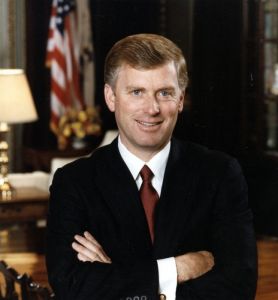 James Danforth “Dan” Quayle was born in 1947 in Indiana, represented Indiana in the House of Representatives from 1977 to 1981, and in the Senate from 1981 until he was elected Vice President on George H.W. Bush’s ticket in 1988. Following their one term in the White House, Quayle opted out of running for the Republican nomination for President in 1996, but challenged George W. Bush for the nomination in 2000. He came in a distant eighth in the Ames Straw Poll of August 1999, and withdrew from the race in September. Dan Quayle lives in Arizona, and his son, Benjamin, represented Arizona in the House of Representatives from 2011 to 2013.
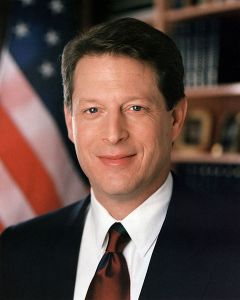 Al Gore is the only president or vice president to have been born in Washington, DC (in 1948). His father, Albert Gore, Sr., represented Tennessee in the House of Representatives (1939 to 1953) and the Senate (1953 to 1971). Al, Junior, represented Tennessee in the House of Representatives (1977 to 1985) and the Senate (1985 to 1993). In 1988, he ran for the presidential nomination, winning seven states and coming in third. In 1992, he was Bill Clinton’s running mate; at the ages of 45 and 44, they were the youngest presidential-vice presidential duo to be elected. In the election of 2000, Gore was the Democratic nominee for President, and won the popular vote by just over 500,000 votes (out of 105 million votes cast), but lost the Electoral College vote, 271-to-266 (with one abstention), to George W. Bush. Gore’s 266 electoral votes is the highest total for a losing candidate. Gore was the first person since Grover Cleveland in 1888 to win the popular vote but lose the Electoral College (Cleveland won in 1884 and 1892). The other two were Rutherford Hayes in 1876, and John Quincy Adams in 1824. Gore was also the the first major-party presidential candidate to lose his home state (Tennessee) since George McGovern lost South Dakota in 1972.
 And then there was Richard Milhous Nixon. Born in 1913 in California, the second of five brothers, he graduated from Whittier College and Duke University School of Law. He practiced law in California, and met his wife, Pat, in a community theatre group. In 1942, the Nixons moved to Washington, DC, and Richard got a job in the Office of Price Administration, which he did not enjoy. Later in the year, he enlisted in the Navy as a lieutenant junior grade. He served in logistics and administration during World War II, and was discharged as a lieutenant commander in March 1946. After the war, he returned to California, and was elected to the House of Representatives in the election of 1946. He was re-elected in 1948, and then elected to the Senate in 1950. At the age of 39, the Republican party nominated Nixon for Vice President on Dwight Eisenhower’s ticket, and they won re-election in 1956. In 1960, Nixon ran (with Eisenhower’s tepid support) for the presidency against Massachusetts Senator John Kennedy. Kennedy won by fewer than 112,000 votes (out of 68.8 million), and won the electoral vote 303-to-219 (with 15 for Robert Byrd). In 1962, Nixon ran for the governorship of California against incumbent Pat Brown, but lost by 5%. In an impromptu concession speech the morning after the election, Nixon blamed the media, saying, “You won’t have Nixon to kick around anymore because, gentlemen, this is my last press conference.” In 1964, he supported Barry Goldwater’s losing campaign against Lyndon Johnson, and in 1966, he campaigned for many Republicans running for Congress. In late 1967, he decided to run for President again, won the Republican nomination of 1968, and ran against sitting Vice President Hubert Humphrey. He won the popular vote by 500,000 votes (0.7% in a three-way race, with George Wallace a distant third), and the electoral college 301–191–46. His 1972 re-election was one of the largest electoral landslides in American politics (he beat George McGovern in the popular vote count, 47.2 million to 29.2 million, 60.7 to 37.5%; and in the Electoral College, 520-to-17). Nixon resigned the presidency in August 1974, and died in 1993.
 Which brings us to Joseph Robinette Biden, Junior. Born in Pennsylvania on November 20, 1942, he earned his law degree from Syracuse University in 1969, and started practicing in Delaware that same year. In 1970, he was elected to the New Castle County Council, and in 1972, before his 30th birthday, he was elected to the Senate. His birthday came before he took his seat, and he became the sixth youngest US Senator ever. On December 18, 1972, his wife and daughter were killed in a car crash (his two sons were injured), and he considered resigning from the Senate to care for his sons, but Senate Majority Leader Mike Mansfield convinced him not to. Biden served in the Senate from 1973 until 2009. He sought the Democratic nomination for president in both 1988 and 2008. In 2008, Barack Obama won the nomination, and chose Biden as his running mate. In 2015, following the death of his son, Biden opted to not seek the presidential nomination. But in 2019, he chose to run for the third time, and is now poised to run for the presidency.
If you found this article interesting, gratuities are very much appreciated.
 During the era of Covid-19, I haven’t announced many new book publications, because the bulk of Fantastic Books‘s publicity engine runs through in-person science fiction conventions (where we also make a significant percentage of our sales), so I’ve taken the company into semi-hibernation: still doing business, but cutting back to maintain the company’s health.
 Ian Randal Strock