MSNOW’s Morning Joe just wrapped up—as it frequently does—interviewing an actor. Today, it was Simu Liu talking about the science fictional ideas behind his new series, The Copenhagen Test. He did well, talking about the nature of privacy and hacking and trusting our own sense. But as he was talking, I wondered why they weren’t interviewing the writer who came up with the idea for the show. After all, their focus was on the concept underpinning it, so wouldn’t the best interview be the person who created that?
Intellectually, I know, they interview actors because viewers know the actors and don’t know the writers. But if they’re talking about the ideas, it occurred to me, they ought to be talking with the people whose ideas they are.
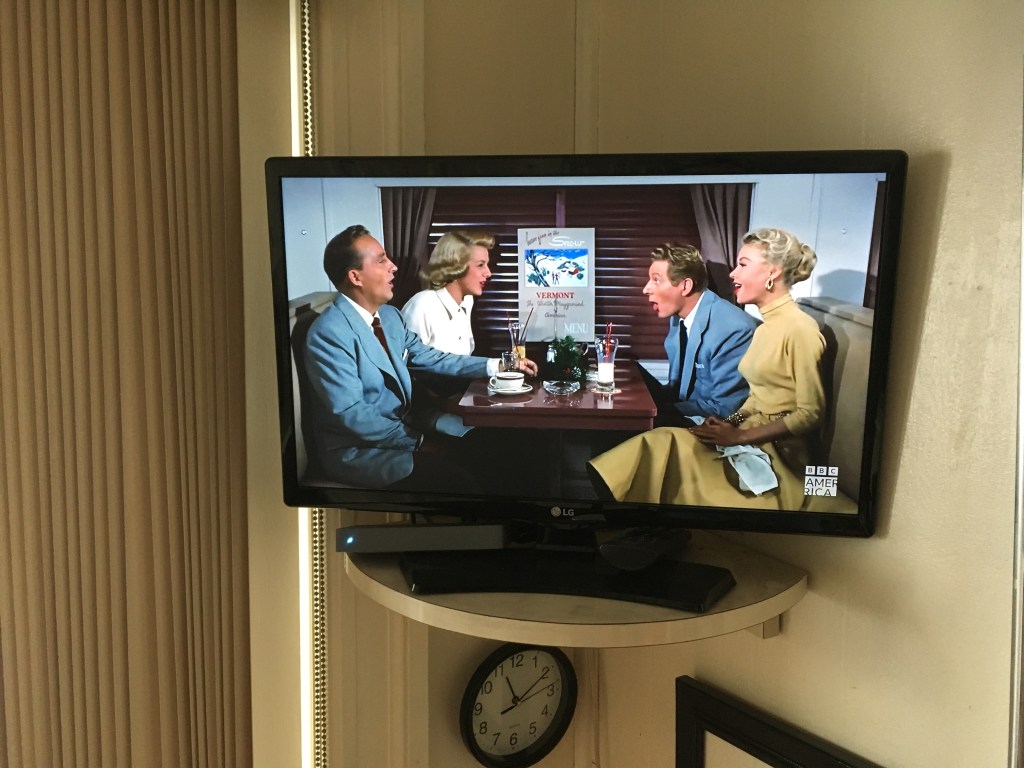
I’m home alone, all by myself. And White Christmas is on BBC America right now (one of my favorite musicals). I didn’t call it up from some on-demand service; I stumbled across it while flipping channels.
And watching a movie, “live,” as it were, has a very different feeling than on-demand would. I don’t quite understand it. There’s something in the knowledge that other people are watching the same thing at the same time, seeing and reacting to the same things.
I don’t know who they are, don’t know where they are, will never interact with them. And yet… yet I still find watching on television more appealing, more of a communal feeling, than on-demand or on DVD or VHS or whatever. Not communal like sitting in a movie theatre (which I think I’ve done once in the last six years), nor even with a few friends or family members in the living room. But still, there’s that hint of doing something as a group rather than all by my lonesome. Does that make any sense to you?
I just sent the following email to the US Mint (at inquires@usmint.treas.gov).
Please, PLEASE tell us the obverse design of the “Enduring Liberty Half Dollar” is NOT final, and that it will be improved. Specifically, the point on the Statue of Liberty’s crown that comes out from behind her nose makes her look like Pinnochio telling a lie. Please move the tine away from the nose.
I had an odd theatrical experience this past Tuesday. I went to a show, and while I’m still not sure if I liked it, I am still thinking about it, so in that respect, it was good.
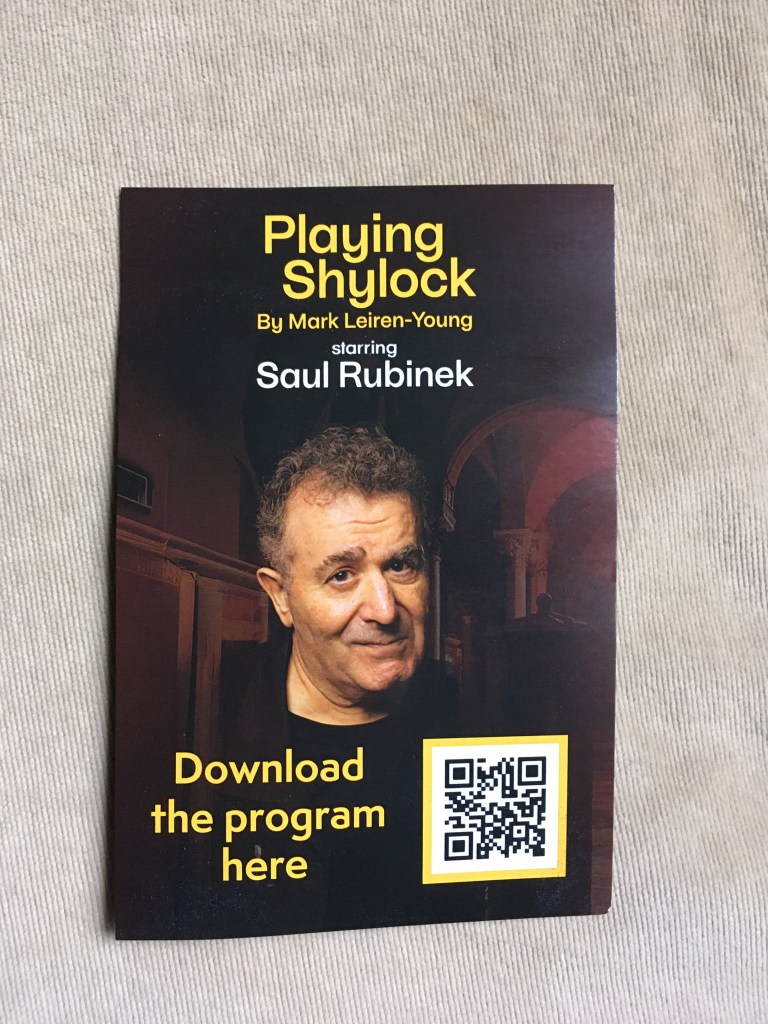
The show is Playing Shylock, starring Saul Rubinek (the original version was written by Mark Leiren-Young; this was apparently an updated, modified script). It was in the Polonsky Shakespeare Center, a little theatre in Brooklyn, and the show is closing tomorrow, so at this point, I can’t really urge you to see it yourself.
The conceit is that the audience is actually there to see a production of William Shakespeare’s The Merchant of Venice. [Aside: I’d never read the play before, though I knew bits of the story, so Monday night, I watched a film version from 2004.] A voice-over tells us the second act will be delayed due to technical difficulties, and eventually, Saul Rubinek comes on stage—in costume as Shylock—to tell the audience that they will not be performing the second half of the play, because the cast accidentally learned during this intermission that the theatre has cancelled the remainder of the run, making tonight’s performance the last.
What follows is a nearly two hour-long monologue/discussion of artistic freedom, antisemitism, and virtue signaling. But also, the concepts of freedom, security, and memory; the Jewish experience in surviving (or not) the Concentration Camps in Nazi Germany; and honoring our parents as we live the better lives they worked for us to have. Thrown in are digressions about the nature of representation, artistry and artistic credit, and the never-ending debate over who actually wrote the plays of William Shakespeare. As with all of the best questions, there were no hard-and-fast answers. It was all there to make us think.
Playing on nothing more than his own memories, the script, and the all-too-limited audience reactions, Rubinek is wonderfully emotive, and incredibly moving. And with such heavy concepts and weighty thoughts, there is just the right touch of levity to keep the show from being crushingly depressing… even though he and we know that the depression has a very strong foundation, and holding back the tide of the antisemitism, the repression, and the outright hatred may not be possible.
One of the unintended sources of discomfort, for me, was his interactions with the audience. I’ve been in theatres my whole life, sometimes on the stage, more often in the audience. And in all that time, I’ve learned that the audience’s role is to watch, but not to interact. (There is, of course, the allowed interaction during lectures, which are a different animal, perhaps because the “actor” is not playing some fictitious character, but is merely himself.) But in Playing Shylock, Rubinek is playing himself—or an alternate universe version of himself—in which he is still in costume from the interrupted performance of The Merchant of Venice, except that there was no actual interrupted performance of the play, so is he actually just Saul Rubinek, or is he a fictitious Saul Rubinek? At any rate, several times he asked the audience for commentary, for responses, and I truly didn’t know if I was supposed to supply the other side of that conversation, or if those were rhetorical questions, part of the script. I suppose that added discomfort may actually have been intended, to show that the comfortable world we hope we live in is not really so scripted and easy.
Yes, I guess I did like it. Not in the “that was a lot of fun; I want to do it again” way of liking something, but in the “that made me think” way. Yes, it was an evening well spent. Bravo, Saul Rubinek, and playwright Mark Leiren-Young.
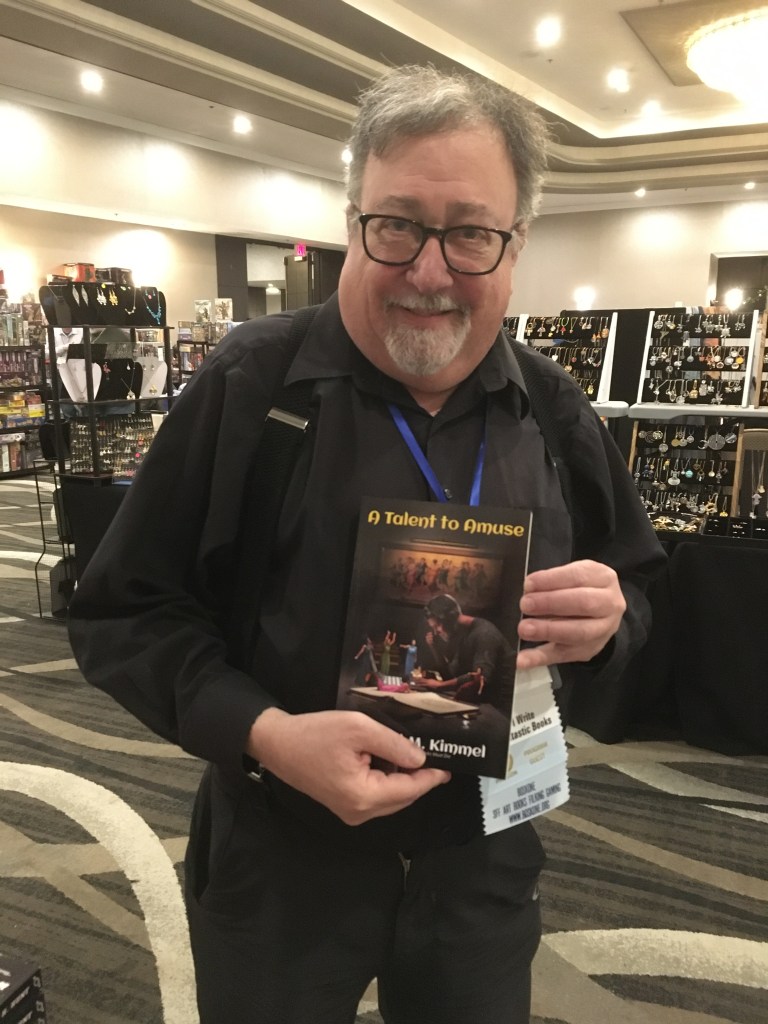
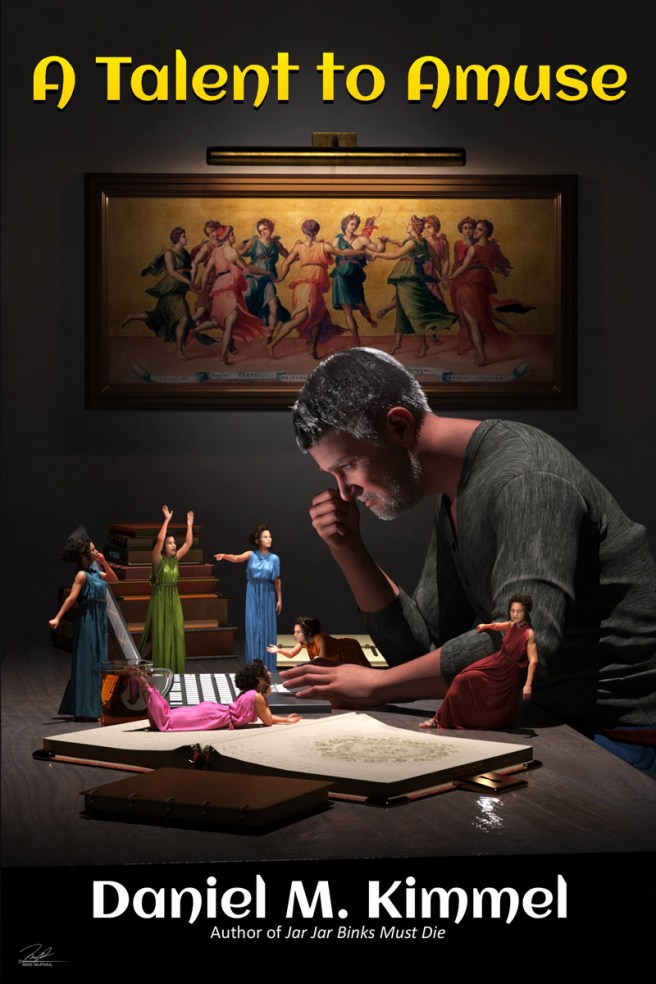
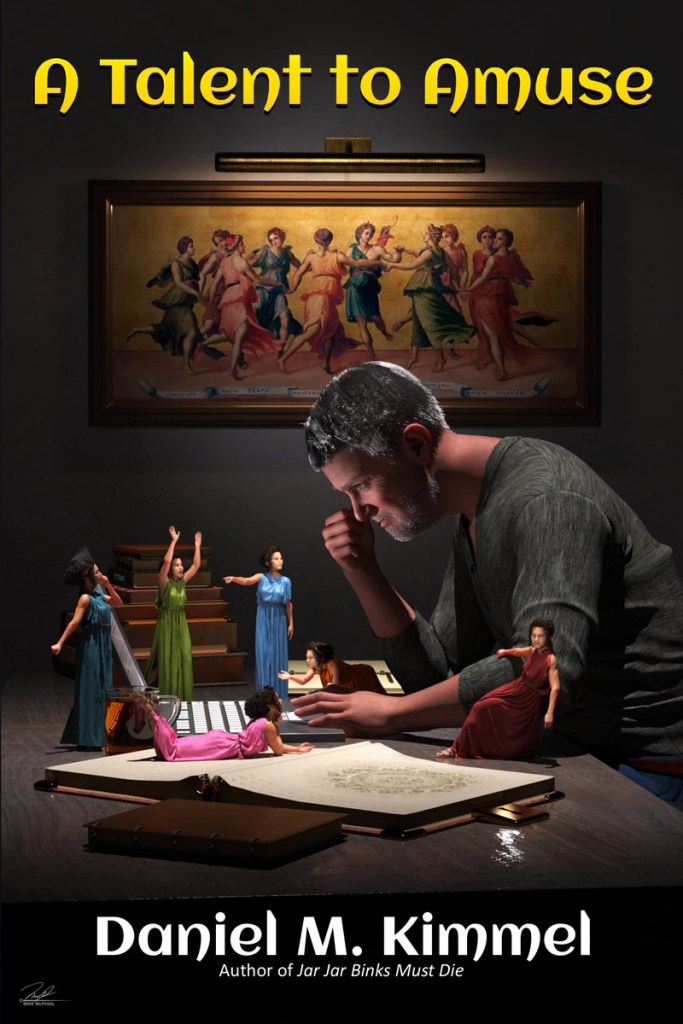
If you weren’t with us at Philcon this weekend, today is your first chance to get a copy of Daniel M. Kimmel’s fantastic new novel, A Talent to Amuse. It’s a funny, fantastical, romantic look at the concepts of creation and inspiration.
What happens when a struggling writer falls in love with an unemployed Muse? Only the Fates know…
Writers have spent centuries praising and cursing the Muses, as their artistic talents have waxed and waned. But it’s a rare writer indeed who can attract not only the attention of a Muse, but her love, too.
Meet Sherman Biberman, a fair-to-middlin’ writer who actually meets his Muse in the park. You thought there were only nine? Where have you been? Sherman and Komikós (the Muse of Humorous Genre Fiction) are parting ways, but Komikós knows another, out-of-work Muse, who just might be good for Sherman, and vice versa.
That begins Sherman’s relationship with Vinteokaséta, the erstwhile Muse of Blockbuster Video stores. She’s currently unemployed, and looking for some inspiration herself.
Hugo Award-finalist, Skylark Award winner, and Cable Center Book Award winner Daniel M. Kimmel showcases his wide range of writing talents in A Talent to Amuse, introducing us to Muses greater and lesser, offering tales in myriad genres, and topping it all with heaping dollops of the humor and pathos that has made him such a beloved writer.
The book is available hardcover, trade paperback, and electronic formats, in all the usual outlets.
I’m planning to go to a Mensa gathering this evening, just some people getting together in a restaurant/bar for conversation. The last time this particular gathering gathered, it was fascinating. I met several new people, including some from other countries, who knew and talked about things I didn’t know, so I learned. It was a good time.
But there was one woman present who I’d only known from online interactions. Unfortunately, in person, she was the same: always complaining, angry, and put upon. Nothing was right, and everything needed to be corrected to her standards. Thinking about tonight’s gathering, I’m anticipating the good, but I’m wondering what I might say if I find myself in proximity to this woman, to short-circuit her kvetching. I think I’ll ask her what brings her joy.
That, however, makes me think she might turn the question back on me: what brings me joy? So I’ve been thinking about that.
I try to find some joy in every day: whether it’s talking with my family, hearing a new song or joke (well, new jokes are rare these days), or learning and playing games with friends, but those are little things, small joys (mind you, that doesn’t make them any less important or less cherished). But there are bigger joys, too: being on stage (thinking of the talk I gave last weekend, about punctuation and my new book), selling a story or essay, or experiencing something genuinely new, like visiting a new place.
Most of those, however, rely on other people. But there are also the joys that don’t require other people’s efforts: writing, for me, is one of those joys, whether I’m at the keyboard or out walking and the right turn of phrase comes to me. Selling what I’ve written adds another level of joy, but even without the selling, I enjoy my time choosing precisely the correct word, and ordering those correct words. My wood carving is another one of those joys; one I get to experience too seldom, especially in the colder months, since there’s no place to do it in the house. And there are a few cherished movies I’ll rewatch when I need a lift, a pick-me-up, because they always make me smile (although movies, by their very nature, require other people to have done a great deal to get them to me). It’s a similar thing with reading an especially good passage or engrossing story, when not only am I enjoying what I’m reading, but I’m trying to figure out how the writer did it, to see if I can learn from it to improve my own writing.
Anyway, that’s a short answer to the question I may ask of others this evening, but I’ll ask you, too: what brings you joy?
It’s another science fiction convention weekend, this time with an over-stuffed Saturday! This weekend, I’ll be at the Doubletree in Cherry Hill, New Jersey, for Philcon.
As always, you can find me in the Dealers’ Room, open Friday, 4:00–7:00 pm; Saturday 10:00 am–6:00 pm; and Sunday 10:00 am–3:00 pm.
You can also find me on programming:
Saturday at 12:00N in Plaza 3: “Meet More Editors!” with Danielle Ackley-McPhail, Michael D. Pederson, Alex Shvartsman, and Ann Stolinsky
Saturday at 3:00PM in Plaza 4: “How Do I Get Publishers to Notice Me?” with Aaron Rosenberg, Neil Clarke, and Michael A. Ventrella
Saturday from 6:00 pm to 7:30 pm in the Con Suite: book launch party for Daniel M. Kimmel’s A Talent to Amuse, as well as Dragonwell Publishing’s new book by Bernie Mojzes.
Saturday at 8:00PM in the Grand Ballroom: I’ll be emceeing the Masquerade.
Sunday at 11:00AM in Plaza 3: “Assembling an Anthology” with Danielle Ackley-McPhail, Neil Clarke, Alex Shvartsman, and Michael A. Ventrella
If you read that schedule closely, you’ll notice I have to be in the dealers’ room and the con suite and the masquerade Saturday afternoon/evening, probably all three at the same time, so I don’t really know where I’ll be: setting up for the launch party in the con suite before 6:00; closing the table in the dealers’ room at 6:00; and preparing for the masquerade before 8:00. You, however, as an attendee, will be able to do all three with no overlap.
Dan’s book, A Talent to Amuse, is a wonderful romantasy. In it, a professional writer is looking for the inspiration to take his writing to the next level. He meets an out-of-work Muse, who is looking for some inspiration of her own. And together, they may find something even more.
This weekend, I’ll be attending Boston Mensa’s Pilgrimage regional gathering, in Andover, Massachusetts. Unlike science fiction conventions, I won’t have a dealer table, and I won’t be on a slew of panels. Instead, I’ll be giving a solo presentation, “Punctilious Punctuation,” on Saturday at 4:00pm Salon B/C A. I’ll have some books available for sale after.
Beyond that one scheduled appearance, I’ll be around, enjoying the RG just like everyone else.
Two weeks ago, I was in Chicago for their RG, which is a very good one. But Pilgrimage is nostalgic for me. The first RG I attended as a Mensan was the earlier incarnation of Pilgrimage, a few months after I graduated from college. That year, it was held in Boston’s Park Plaza Hotel, which later became the host for Arisia for a bunch of great years (which is a different kind of nostalgia), though it was also later the site of a wedding for two of my good friends. So Pilgrimage has always been special for me.
Dextrous (or dexterous) means skillful or adroit in the use of the hands or body. (Thus, “manual dexterity” is somewhat redundant.) I know, that definition includes “or body.” But shouldn’t there be a specific equivalent word for skillful use of the feet?
People who haven’t (or haven’t yet) attended one of these weekend-long conventions Mensa calls Gatherings ask me what happens at them. In addition to the formally scheduled events (turns out they’ve already updated the web site, including removing this year’s schedule, which included speakers, meals, tournaments, a costume contest, dance, fancy-dress event, and more)—which this weekend included my talk on “Punctilious Punctuation” to an almost full-house in one of the larger ballrooms—there is the unscheduled meeting new people, socializing with new and old friends, board gaming, and much more. Over one lingering breakfast this weekend, at a table of eight or ten people including several friends of long standing and several others I met this weekend, the conversation ranged from microdosing ketamine (that one was brought up by the PhD psychotherapist), to velcro underwear, to the etymology of the term “bye week” (as it relates to sports), the concept of vegan cookies versus yoga, to the term lavender marriage (which I’d never heard before), to, yes, the foot-centered complementary word for dextrous.
Anyway, that’s some of what I did this weekend. What did you do?




 Ian Randal Strock