Today’s Tough Trivia question: The EGOT is an entertainment awards grand-slam. To date, only 16 people have achieved an EGOT, winning at least one Emmy, Grammy, Oscar, and Tony Award in competitive categories (and only one has a double EGOT: at least two of each of the awards). How many of the EGOT winners can you name?
***

Yesterday’s question was: Scales: fish wear them for protection, humans step on them to fret about their diets. We love to measure, rank, and grade things. Your question for today: what do we measure with the following scales: Fujita, Mohs, Richter, Scoville. Bonus points if you know what measures on those scales are for the least intense, and for the most.
The answers are:
The Fujita scale (also called the Fujita-Pearson scale) rates tornado intensity. Introduced by Ted Fujita in 1971, it ranges from F0 (winds less than 73 miles per hour, inflicting light damage) to F5 (winds greater than 261 miles per hour, inflicting incredible damage).
The Mohs scale of mineral hardness measures just what it says it does, characterizing scratch resistance of various minerals through the ability of harder material to scratch softer material. Created by German geologist Friedrich Mohs in 1822, the scale ranges from 1 (talc) to 10 (diamond).
The Richter scale, also called the Richter magnitude scale, measures the strength of earthquakes. And though scientists now use other scales because of shortcomings in the Richter scale, it is still the most commonly known and popularly used. It’s a logarithmic scale, introduced by Charles Richter in 1935, ranging from 1.0–1.9 (microearthquakes, not or only rarely felt) up to 9.0 and greater (near total destruction).
The Scoville scale measures the pungency (spiciness, or heat) of chili peppers. Introduced by pharmacist Wilbur Scoville in 1912, it measures in Scoville Heat Units (SHU), ranging from non-pungent (0–700 SHU) to very highly pungent (above 80,000 SHU). Another way of looking at the scale ranges from bell peppers and pimentos (0–100 SHU) up to law-enforcement grade pepper spray (1,500,000 SHU and up).
***
Ian’s Tough Trivia is a daily feature of this blog (Monday’s category is History; Tuesday is Arts; Wednesday is Science; Thursday is Entertainment; and Friday is Grab Bag). Each day, I post a tough question, as well as the answer to the previous day’s question. Simply comment on this post with your answer. I’ll approve the comments after the next question is posted. Sure, you can probably find the answers by searching the web, but what’s the fun in that?
And if you’ve got a favorite trivia question—or even just a topic for which you’d like to see a question—let me know! Reader participation is warmly encouraged.
 I’ve just discovered this website, and now I have to share it with everybody. Pluviophiles of the world, unite!
 Fantastic Books is honored to be publishing On Samuel R. Delany’s Dhalgren, edited by Bill Wood, put together with a great deal of assistance from Delany himself.
 Yesterday’s question was: The entertainment industry gives a slew of awards. We have the Oscar and the Emmy for movies and television, the Tony for stage plays, the Grammy for music, the Hugo, Edgar, and Pulitzer for literature, and scores more. Do you know who (or what) those seven are named for? And which organizations, specifically, do the awarding? How about when they were first awarded?
 Emmy: The Emmy Award is presented by three related organizations: the Academy of Television Arts and Sciences, the National Academy of Television Arts and Sciences, and the International Academy of Television Arts and Sciences. They were first awarded in 1949. The name is a derivation of the word “immy,” itself a nickname for the image orthicon tube, which was a key piece of television cameras from the 1940s until the 1960s.
 Tony: More formally known as the Antoinette Perry Awards for Excellence in Broadway Theatre, they are presented by the American Theatre Wing and the Broadway League, and have been since 1947. The awards were founded by producer and director Brock Pemberton (1885–1950) and named for Mary Antoinette “Tony” Perry (1888–1946), who was an actress, director, and co-founder of the American Theatre Wing.
 Grammy: Originally called the Gramophone Award (named for the early record player which the award trophy depicts), they have been presented by the Recording Academy since 1959.
 Hugo: Originally and more formally known as the Science Fiction Achievement Awards (in the early 1990s, they dropped the longer title), they are awarded by vote of the members (attendees) of the World Science Fiction Convention. They were first handed out in 1953, and then every year since 1955. Their namesake, Hugo Gernsback (1884–1967), was born as Hugo Gernsbacher in Luxembourg City, Luxembourg. He emigrated to the United States in 1904, and founded the first science fiction magazine, Amazing Stories, in 1926.
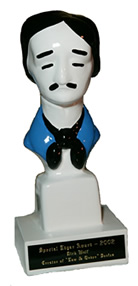 Edgar: More formally known as the Edgar Allan Poe Awards, they were named after the American writer (1809–1849), and have been awarded by the members of the Mystery Writers of America since 1946.
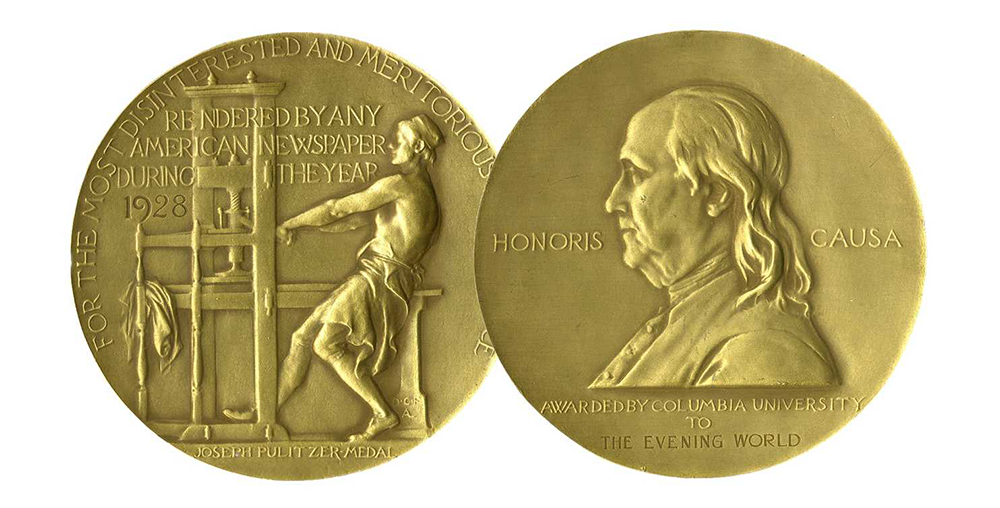 Pulitzer: The Pulitzer Prize was established in 1917 under the provisions of Joseph Pulitzer’s will. Pulitzer (1847–1911) was born in Hungary, and immigrated to the US in 1864. He is best remembered as the publisher of the St. Louis Post-Dispatch and the New York World. He also served two brief terms in the House of Representatives. The Pulitzer Prizes (for journalism, literature, and musical composition) are administered by Columbia University.