I’m at a horror convention this weekend, but President Trump has it beat all to hell.
With his attacks on the American electoral system, casting aspersions at every election he didn’t win, and making us doubt whether we’ll have a free and fair election, and now his launching a hot war in the middle East, he certainly looks like he wants to be the last President of the United States.
Sure, it might just be a quick jab at Iran that overwhelms them… but I doubt it. Those in power are not walking out the door, and they’ve launched counter-attacks at five other countries.
During the pandemic, I called Donald Trump a clear and present danger to the United States. I think that may have been too limited. His policies ignore science in favor of self-aggrandizement. His only interest in the future is how many buildings will bear his name, how many institutions will be marred by his footprint. This man who wants a new class of warship named for him, who thinks the “Department of Defense” sounds weak and wants to call it the “Department of War,” who campaigned for the Nobel Peace Prize (ironic, isn’t it?) is a threat to the entire globe.
If, like me, you watched President Trump’s State of the Union address tonight, then you know the state of the union is divided, and the president is doing his best to divide it even more. Never have I seen a president so antagonistic to half the Congress during this—or any—address.
It’s obvious that he doesn’t think of himself as the president of the entire country, but only of those who support him. Everything he says boils down to the same few thoughts: American citizens who do not support him are his enemies; he is the greatest and smartest anything ever; and he knows how everyone should live their lives.
He has no sense of dignity: He stood on that rostrum awarding medals to actual heroes, while joking that he wants to give himself the Medal of Honor.
He has no sense of unity: He spoke only to the Republican members of Congress, repeatedly saying of the Democratic members sitting in that chamber “they.” The only “we” in his mind is “me and those who support me.”
He has no sense of the awesome power that he could be commanding if he respected the office he holds: He is a jumped-up street thug, thinking the only power at his command is “might makes right.”
He has no sense of what the United States of America truly is or should be. But he certainly does love the sound of his own voice.
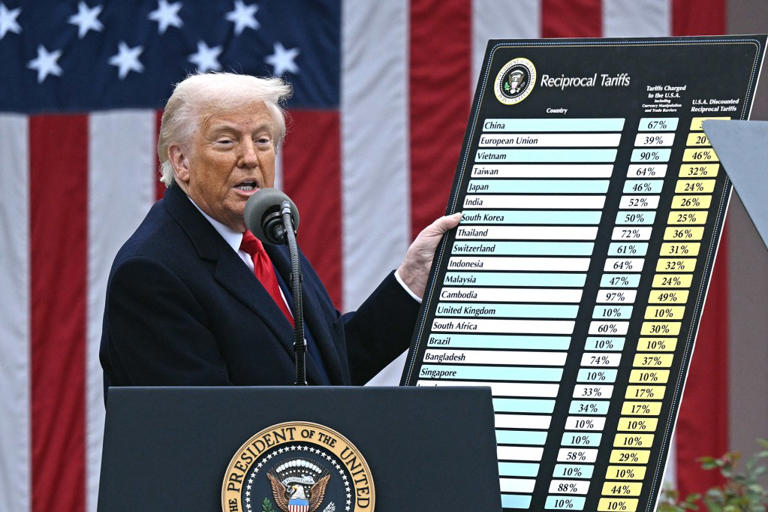
This morning on Face the Nation, US Trade Representative Jamieson Greer tried to convince us that when President Trump said on Friday that the Supreme Court has been “swayed by foreign influences,” he meant that foreign governments and foreign-owned companies hoped the Court would rule against the Trump IEEPA tariffs, and that the Court did so. That was the “influence” the president was decrying.
What a load of crap.
Indeed, the only part of today’s interview that was even more disingenuous was, before repeating that absurd twist on “foreign influence,” Greer said “I don’t speak for the president.” Think about that for a moment: Jamieson Greer is the United States Trade Representative, nominated by the president in November 2024 and confirmed by the Senate on February 27, 2025. The web site of the Office of the United States Trade Representative (https://ustr.gov/about-us/about-ustr) says “The head of USTR is the U.S. Trade Representative, a Cabinet member who serves as the president’s principal trade advisor, negotiator, and spokesperson on trade issues.” His job is to be the spokesperson for the president on trade issues, but he wasn’t speaking for the president when he tried to tell us the president only meant that the Supreme Court ruled on an issue that foreign powers favored, not that they were beholden to any foreign influences.
The message from the administration is fairly clear: “Don’t pay attention to what the president said yesterday. And there’s no reason to pay attention to what I—as his spokesperson—am telling you he meant. Just be outraged along with us that nobody can see the president is right about everything.” Oy.
Yesterday, we learned that the Supreme Court ruled against President Trump’s use of IEEPA [the International Emergency Economic Powers Act of 1977] to impose tariffs willy-nilly on other countries, in the case of Learning Resources, Inc. v. Trump. My first thought was: Is the Supreme Court recovering its spine? Is Chief Justice John Roberts finally hearing people saying that he’s ceded his power to be a Trump toady? Is this the beginning of a return to the rule of law?
I had high hopes that this was a sign that the members of the Court had decided to not merely be a vestigial organ of our government, to embrace the legacy that John Marshall, William Howard Taft, and generations of justices had fought so hard to maintain: that we do indeed have three co-equal branches of government. And that, despite the current Congressional leaders ceding their power to Donald Trump, our government might continue to function after the Trumpians’ departure.
I heard the decision and thought, “Yes! Finally. Some of the adults in the room are standing up and telling the president ‘I think Canada’s commercial was insulting’ is NOT an international economic emergency granting the president the power to impose an outlandish tariff in response.”
But then I listened to the president’s seething response from the Briefing Room, and remembered why he truly is such a danger: because he demands that the world do what he wants, right or wrong, for good or ill, because his only goal is his own self-aggrandizement and enrichment.
No sane person could look at the Court’s decision and say, “it clarifies the fact that I as president can impose whatever tariffs I want for whatever reason I want, I just have to check a different box on the form.” But he did. He (or more likely his lickspittles) found a passage in a dissent penned by one of the justices, and decided to focus their entire argument on that, rather than the clear majority opinion which said, “No. You may not do this.”
And he is dangerous. He spews bile, invective, and lies with every breath. He accused the Supreme Court of being beholden to “foreign influences,” with no proof and no evidence. He called the justices who ruled in favor of the law and against his illegal acts “embarrassments, fools, and lapdogs.”
When asked why he doesn’t simply work with Congress to come up with a legal tariff plan, he reminded us that he is nothing more than a petulant child, saying “Because I don’t have to. I have the right to do what I want.” And showing his own vaunting intellect, he said of the decision, “it’s like it was written by not-smart people.”
And perhaps worst of all, he said, repeatedly, that the ruling means “I can destroy a country, I can embargo their goods, I can do anything I want.” The only thing this ruling says is that “I can’t charge them money. But I can do anything I want to them.” No rational president has ever threatened to “destroy” another country out of hand, simply because he wants to. But for this president, it’s simply a negotiating tactic.
No call to arms here. Sadly, frighteningly, this is nothing new. While I applaud the Supreme Court for finally having to the courage to say “No, Mr. President, you are wrong, and the laws do not permit you to do this,” I doubt it will make much difference.
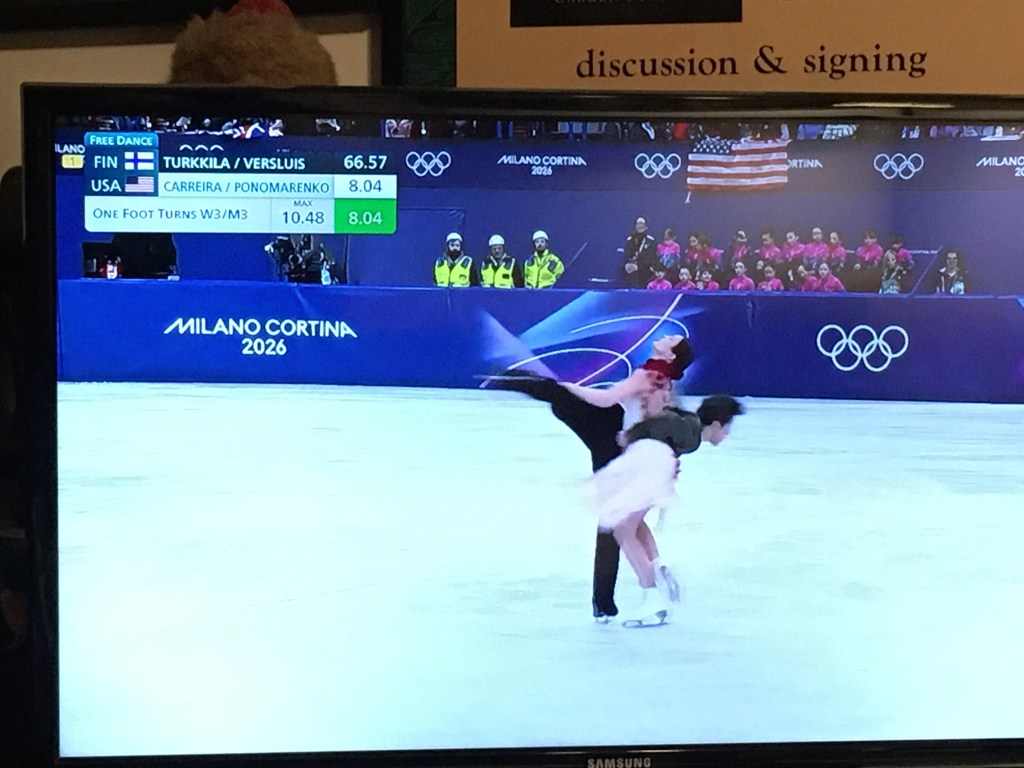
I’m watching and enjoying the Olympics, as always (at least, when I can find competition, rather than filler, being broadcast). But looking back on the Olympic competitions I remember from when I was younger, I think I’m seeing a change.
Sports which were (at least, to my memory) almost entirely judged artistic competitions, such as the various ice dancing events (or the gymnastics and equestrian events of summer), now seem to have more and more mathematically required elements in the scores. Indeed, NBC shows a box in the top left corner of “this element, if completed correctly, adds this many points,” and it’s measured down to hundredths. And that number updates in seeming real-time as the competitors are performing.
And sports which (again, I think I remember this correctly) were entirely numerical measurements not open to interpretation, such as ski jumping (which I thought was “how far down the slope did the competitor fly, and was the competitor able to land on the skis, or was it a wipe-out?”) now has a judged component: “Oops, he kind of wobbled a bit when he landed, and his feet were too close together” or something like that.
I’m still amazed that timed events like luge are measured down to thousandths of a second, and that the commentators think we can see any real difference between competitors when the final standings, after four 53-second runs, have six athletes separated by less than two seconds.
But are we seeing a blending of judged events and those measuring absolute values? How long before there’s an artistic component figured into curling or ice hockey?
Many of my friends are doing it, so I guess it’s time: next weekend, I’ll be at Boskone in Boston, Massachusetts, and here is my schedule.
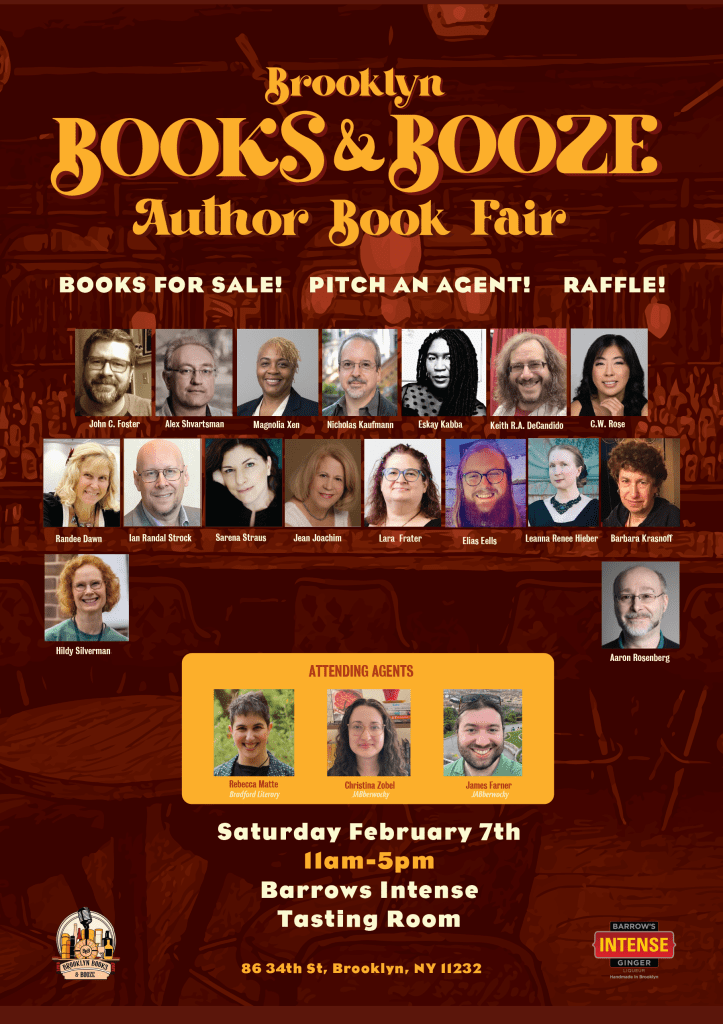
But, before that, I’ll be at the Brooklyn Books & Booze Book Fair at Barrows Intense Tasting Room, 86 34th Street, in Brooklyn, New York. That’s Industry City, for those unsure of the address. I’ll be there with a bunch of other authors from 11am to 5pm. Come join us!
Then, next weekend is Boskone. As always, I’ll be in the dealers’ room at the Fantastic Books table Friday 4:00pm – 8:00pm, Saturday 10:00am – 6:00pm, and Sunday 10:00am – 3:00pm.
I’ll also be on panels and such.
Friday at 5:30pm in Harbor III: “Secret Wars, Futuristic Espionage, and Lost Technologies” with Laurence Raphael Brothers, Kacey Ezell, Alexander Jablokov, and Walter Jon Williams.
Friday at 8:30pm in Harbor I: “Boskone 63 Awards Ceremony.” As last year’s Skylark Award winner (it’s still hard to believe that they thought I was worthy of the award), I’ll be participating in this year’s ceremony.
Saturday at 1:00pm in Marina III: “Working with an Editor” with Ginjer Buchanan, Neil Clarke, David B. Coe/D.B. Jackson, and Matthew Kressel.
Saturday at 2:30pm in Harbor III: “Forks in Time” with Steven Popkes, Stefan Rudnicki, Susan Shwartz, and Sarah Smith.
Hope to see many of you in both Brooklyn and Boston!
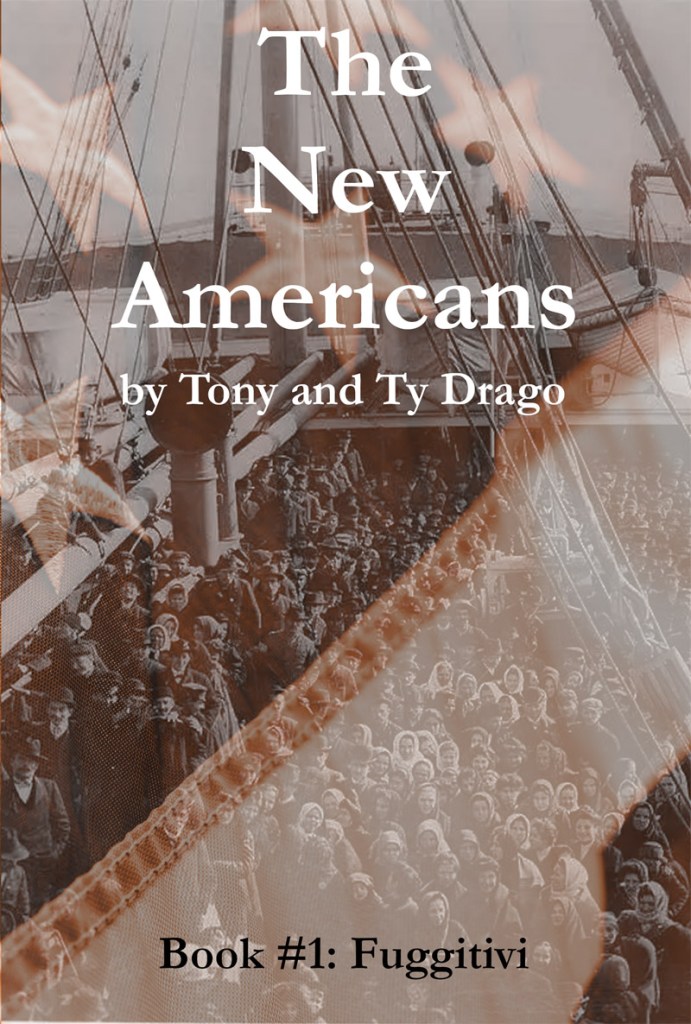
The New Americans: A Saga of Immigration and Family
After being forced to kill in order to protect their widowed mother, three brothers escape Mafia-controlled Sicily to the New World.
Life for immigrants in America during the second decade of the 1900s is difficult and often harrowing, but that’s the reality into which Peter, John, and Angelu Donatello are thrust when their ship docks in Philadelphia. As Peter tries to make his way in this new land through honest hard work, John’s talents—many learned fighting in the Great War—lead him to the seamier, but potentially more profitable, underworld. And all the while, Angelu, the youngest brother and a true innocent, struggles to just find a place for himself in a world he can never truly understand.
Prohibition may make criminals of honest men, but it also allows poor immigrants to mingle with the upper classes; the Donatellos among them. Yet, despite war and crime, marriage and loneliness, honor and betrayal, the brothers, each in their own way, cling to their creed of Supra tuttu la famigghia: Family is all.
Eventually, everything will lead them back to Sicily, to a confrontation with the forces that have shaped their lives, and to a heart-wrenching reconciliation.
Reminiscent of John Jakes’ Bicentennial series, The New Americans by Tony and Ty Drago is a wonderfully moving saga. The genesis of the story is itself a tale: in his final weeks, Tony Drago tape-recorded what his son Ty thought were simple reminiscences. It was only in the years following Tony’s death, after Ty became an established novelist, that he listened to the tapes and realized his father had left him, not a family history, but rather an emotional novel of immigration, rebirth, and growth. Milherst Publishing is honored to bring this story to the world.
The New Americans, by Tony & Ty Drago, will be released in six monthly installments, as both trade paperbacks and ebooks.
Book #1 begins in Sicily in 1915. When his middle brother kills the son of the local Mafia don while defending their mother, Petru Donatello and his younger brothers, Juvanni and Angelu, are forced to flee their homeland. This takes them on a harrowing voyage in the bilges of a transatlantic ship teeming with Sicilian and Italian immigrants just like them, a multitude hoping for a better life in America. Along the way, they make both friends and enemies as the Donatello brothers struggle to prepare themselves for their new life in a world beyond their understanding.
Milherst is a division of Gray Rabbit Publications/Fantastic Books. All Milherst Books are distributed via Ingram. Review copies are available upon request.
Should I just give up, or should I continue to cringe when I hear people using the word “fulsome” when they mean “full” or “large”? Because it grates on my ears. And yes, before I looked up this source, I hadn’t realized that the modern usage of just meaning “full” but with more syllables is actually the original meaning from the 1200s.
Dictionary.com offers the following on the word fulsome:
adjective
offensive to good taste, especially as being excessive; overdone or gross. Example: fulsome praise that embarrassed her deeply; fulsome décor.
disgusting; sickening; repulsive. Example: a table heaped with fulsome mounds of greasy foods.
excessively or insincerely lavish. Example: fulsome admiration.
encompassing all aspects; comprehensive. Example: a fulsome survey of the political situation in Central America.
abundant or copious.
adjective
excessive or insincere, esp in an offensive or distasteful way Example: fulsome compliments
[not standard] extremely complimentary
[informal] full, rich or abundant Examples: a fulsome figure a fulsome flavour fulsome detail
[archaic] disgusting; loathsome
Note: In the 13th century when it was first used, fulsome meant simply “abundant or copious.” It later developed additional senses of “offensive, gross” and “disgusting, sickening,” probably by association with foul, and still later a sense of excessiveness: a fulsome disease; a fulsome meal, replete with too much of everything. For some centuries fulsome was used exclusively, or nearly so, with these unfavorable meanings. Today, both fulsome and fulsomely are also used in senses closer to the original one: The sparse language of the new Prayer Book contrasts with the fulsome language of Cranmer’s Book of Common Prayer. Later they discussed the topic more fulsomely. These uses are often criticized on the grounds that fulsome must always retain its connotations of “excessive” or “offensive.” The common phrase fulsome praise is thus sometimes ambiguous in modern use.
The US military removed Nicolas Maduro from Venezuela.
The Abraham Lincoln carrier group is nearing Iran to support the protesters demanding regime change in that country.
I think it’s time we started considering domestic regime change. Donald Trump: you can save us all a lot of pain if you resign with dignity and grace.
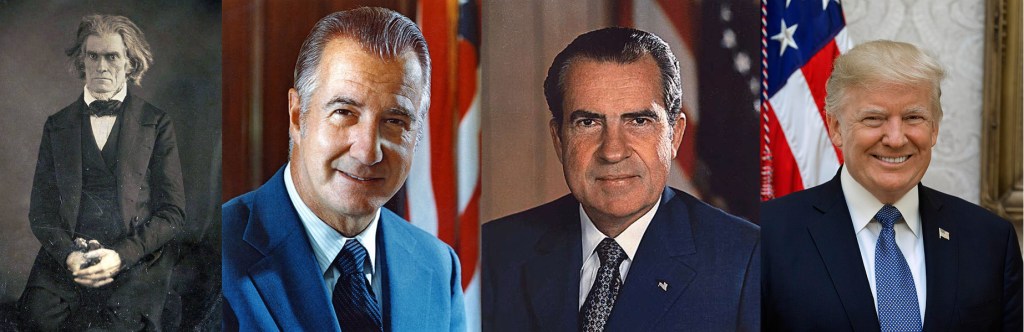
And note, the founders considered this an acceptable possibility. Article 2, Clause 6, begins: “In Case of the Removal of the President from Office, or of his Death, Resignation, or Inability to discharge the Powers and Duties of the said Office…” Resignation is acceptable. Richard Nixon did so for the good of the country, as did Vice Presidents John Calhoun and Spiro Agnew.
I frequently attend science fiction conventions and other conventions, but this is going to be a first for me. I’ll be one of the featured authors at the Brooklyn Books & Booze Author Book Fair. I’ve been in the house since the weekend, avoiding the cold, so this will be a wonderful reason to get out, to be with people, to revel in books (and meet their authors, and buy some books), and bask in the warmth of it all. The event will be Saturday, February 7, at Barrows Intense Tasting Room, 86 34th Street (Industry City) in Brooklyn, New York. We’ll be open for browsing and buying and boozing from 11 am to 5 pm. Hope to see many of you there!
 Ian Randal Strock